
This holds across Amazon Web Services (AWS), Microsoft Azure, and Google Cloud, and across industries from manufacturing to telecom.
3M moved a large number of SAP servers to AWS over a period of about a year and completed the migration ahead of schedule while improving financial outcomes. Sony Interactive Entertainment cut operational costs 60% and shipped deployments five times faster after standardizing on Amazon EKS. AUDI reduced compute spending substantially by using Karpenter and Graviton instances. These aren’t outliers. They’re the pattern.
What decision-makers actually find when they dig into cloud adoption case studies:
- Compute or operational cost reductions often range between moderate to substantial for well-scoped workloads
- Deployment velocity gains of 3x to 7x after containerization or platform unification
- ERP-scale migrations completing in 12 to 18 months when planned with rightsizing baked in
- Measurable reliability gains from managed Kubernetes and autoscaling adoption
- Documented sustainability wins, including hardware decommissioning that cuts carbon output
Key Takeaways
| Point | Details |
|---|---|
| Cost savings cluster predictably | Compute-focused migrations report 40–63% cost cuts once autoscaling and rightsizing are applied. |
| ERP migrations run 12–18 months | Large SAP-scale moves such as 3M’s took over a year even when completed ahead of schedule. |
| Containerization drives velocity | Sony’s EKS unification delivered 5x faster deployments; refactoring beats lift-and-shift for speed. |
| Validate vendor metrics before forecasting | Check the measurement window and cost categories before applying someone else’s percentage to your budget. |
| Pattern-based migration reduces risk | Service-by-service moves, as used by Netflix and Pinterest, avoid big-bang cutover failures. |
| IT-Magic supports the execution layer | As an AWS Advanced Tier partner, IT-Magic runs the rightsizing, Kubernetes, and compliance work behind these outcomes. |
Primary Sources for Further Reading
Vendor case studies carry the strongest evidence for specific, quantified outcomes; independent analyses are better for understanding migration patterns and risk trade-offs.
- 3M’s SAP migration to AWS: best for ERP-scale timeline and savings evidence.
- Sony’s EKS platform unification: best for containerization and deployment velocity data.
- AUDI’s Karpenter and Graviton case study: best for compute cost optimization technique.
- Vodafone’s SAP migration to Google Cloud: best for sustainability and ESG-linked outcomes.
- Independent migration analysis covering Netflix, Pinterest, and Symantec: best for pattern-based migration strategy.
- Academic TCO research on cloud computing: best for understanding cost-scope comparability.
| Source | Best used for |
|---|---|
| AWS case studies (3M, Sony, AUDI) | Quantified before/after outcomes |
| Google Cloud (Vodafone) | Sustainability and developer productivity metrics |
| Increment (Netflix, Pinterest, Symantec) | Independent migration pattern analysis |
| Academic TCO research | Cost-scope and comparability standards |
Case Studies on Cloud Computing: Five Representative Examples
Running this on your own AWS setup? IT-Magic is an AWS Advanced Tier Partner — we audit, fix, or fully manage it for you.
Get a free consultationEvery decision-maker evaluating a cloud program should look at a handful of well-documented moves before building their own business case. These five span ERP migration, platform engineering, cost optimization, sustainability, and independent (non-vendor) analysis. Together they cover the technical approaches you’ll actually be choosing between.
3M: enterprise SAP migration to AWS
3M’s IT team faced a familiar problem: an aging, monolithic SAP footprint spread across roughly 1,200 servers, expensive to run and slow to scale. The approach was a large-scale lift-and-shift combined with rightsizing, migrating critical ERP workloads to AWS rather than refactoring the application layer first. The migration finished in 15 months, three months ahead of schedule, and delivered multi-million-dollar savings through server consolidation and improved resiliency. This is the reference case for anyone planning an ERP-scale move: it proves lift-and-shift can work at serious scale when rightsizing is part of the plan from day one, not an afterthought.
Sony Interactive Entertainment: platform unification on EKS
Sony’s engineering teams were running fragmented developer workflows across separate infrastructure stacks, which slowed releases and duplicated operational overhead. The fix was consolidating onto a managed Kubernetes platform. After unifying on Amazon EKS, Sony reported a 60% reduction in operational costs and a 5x increase in deployment velocity. The technical approach here is refactor and containerize, not lift-and-shift, and the timeline reflects platform engineering work rather than a single migration event. This case matters most to organizations juggling multiple product teams that each reinvented their own deployment pipeline.
AUDI: compute-cost optimization at scale
AUDI’s car-configurator backend needed to handle unpredictable traffic spikes without over-provisioning for peak load year-round. The team adopted a containerized architecture and layered in Karpenter for autoscaling alongside Graviton-based instances, which cut compute costs by roughly 63% and improved startup times. This case is the clearest illustration of what a mature autoscaling and instance-selection strategy buys you after the initial migration is already done. It’s a cost-optimization story, not a migration story.

Vodafone: telecom SAP migration with sustainability outcomes
Vodafone migrated one of Europe’s largest SAP ERP environments to Google Cloud, an undertaking with the operational risk profile of any large telecom’s core business systems. The migration improved response times by about 12%, sped up spinning up complex SAP development environments by roughly 7x, and produced a reported annual saving of around 700 tons of CO2 from decommissioned hardware. Vodafone’s case is worth studying specifically for the ESG angle: it shows cloud migration doing double duty as both a performance project and a sustainability initiative, something most cost-focused case studies leave out entirely.

Independent analysis: Netflix, Pinterest, and Symantec
Not every useful case study comes from a vendor’s own case-study page. Independent write-ups covering Netflix, Pinterest, and Symantec’s cloud migrations highlight a shared pattern: incremental, service-by-service migration rather than a single cutover. Netflix’s move to extreme scalability and Pinterest’s and Symantec’s separate paths both prioritized proving a migration pattern on a low-risk service before scaling it across hundreds of services. This is the pattern-based approach worth borrowing regardless of which cloud provider you use.
What These Cloud Adoption Case Studies Prove Collectively
Line up all five cases and a few honest ranges emerge, along with a few caveats worth taking seriously before you build a business case around someone else’s numbers.
Cost reduction clusters between 40% and 63% for compute-heavy or infrastructure-focused workloads once teams get past initial migration into optimization (AUDI’s substantial savings, Sony’s substantial savings). ERP-scale migrations like 3M’s tend to report savings in absolute multi-million-dollar terms rather than clean percentages, because the cost base includes hardware retirement, licensing, and staff time that don’t reduce to one tidy figure.
Deployment velocity gains run 3x to 7x, with Sony’s and Vodafone’s development-environment speedups are tied to specific technical changes, container platform unification in one case, faster environment provisioning in the other. These numbers describe a narrow, well-defined metric, not overall team productivity.
Timelines split cleanly by scope. ERP-scale migrations run 12 to 18 months even when they go well, as 3M’s 15-month timeline shows. Platform-level refactoring projects like Sony’s don’t have a single finish line; they’re closer to ongoing operational maturity work measured in quarters, not a single completion date.
Here’s where to apply real caution: vendor-published percentages almost never specify whether they measure against a pre-migration baseline that includes idle capacity, or against a right-sized on-premises comparison that nobody would have actually run. Academic total cost of ownership research makes the same point: comparability collapses fast once you dig into which cost categories each study actually includes.
Pro Tip: *Ask any vendor case study for the measurement window and the specific cost categories included before you cite their percentage in your own business case.
Migration Strategies, Timelines, and the Tools Behind the Results
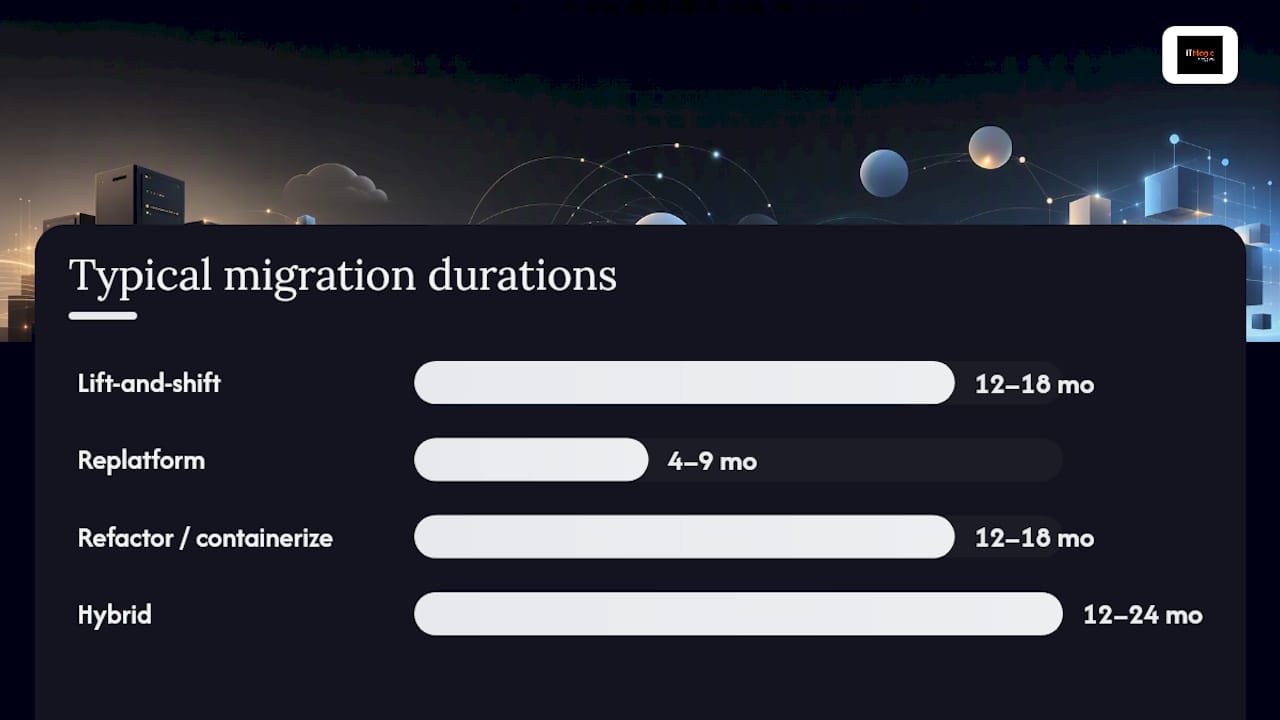
Every case study above maps to one of four migration patterns, and the pattern you choose drives your timeline, your risk exposure, and which tools you’ll need on your team.
Lift-and-shift moves workloads with minimal code changes, the approach 3M used for its SAP environment. It’s the fastest way to exit a data center and the lowest-risk option for large, stable ERP systems, but it leaves cost and performance gains on the table until a rightsizing pass happens afterward.
Replatform makes targeted changes, often swapping self-managed databases for managed services, without a full application rewrite. It splits the difference between speed and long-term efficiency.
Refactor to containers or microservices is what Sony and AUDI did. It takes longer up front and demands real platform engineering skill, but it’s where the biggest velocity and cost gains show up, because autoscaling and standardized deployment pipelines only pay off once the application is decoupled enough to take advantage of them.
Hybrid approaches keep some workloads on-premises, usually for data residency, compliance, or legacy coupling reasons, while migrating everything else. This is common in regulated industries and typically extends timelines rather than shortening them.
| Migration pattern | Common tools | Typical duration | Primary outcome range |
|---|---|---|---|
| Lift-and-shift (ERP-scale) | Rightsizing tools, automated server migration, IaC for provisioning | 12–18 months | Multi-million-dollar absolute savings, improved resiliency |
| Replatform | Managed database services, CI/CD pipelines | 4–9 months | Moderate cost reduction, reduced operational overhead |
| Refactor / containerize | Kubernetes (EKS/GKE), Karpenter, Terraform, container registries | 12–18 months (ongoing) | 40–63% compute cost reduction, 3x–7x velocity gains |
| Hybrid | Secrets management, VPN/Direct Connect, IaC | 12–24 months | Compliance continuity, gradual cost improvement |
Behind every one of these patterns sits a common toolchain: infrastructure as code (commonly Terraform) for repeatable provisioning, CI/CD pipelines for deployment automation, container registries for image management, and secrets management to keep credentials out of application code. Autoscaling solutions, whether Karpenter on AWS or an equivalent elsewhere, are what actually convert a container migration into a cost story.
Common Challenges Cloud Migrations Run Into
Every one of the case studies above got where it did by working through a fairly predictable set of obstacles. Recognizing them ahead of time is cheaper than discovering them mid-project.
- Data transfer and bandwidth constraints: large ERP datasets can take weeks to move. Successful teams schedule transfers in phases and use dedicated network links rather than betting on standard internet bandwidth.
- Legacy application coupling: tightly coupled systems resist clean migration. Pattern-based, service-by-service migration, the approach Netflix and Pinterest used, avoids the all-or-nothing risk of a single cutover.
- Insufficient test coverage: migrations expose gaps in automated testing that nobody noticed while everything ran on stable, unchanging on-premises hardware.
- Security and compliance gaps: regulated workloads need compliance mapping done before migration starts, not audited afterward.
- Overprovisioning and cost leakage: teams that lift-and-shift without a rightsizing pass often see costs rise initially, not fall.
- Organizational resistance: platform unification projects like Sony’s require buy-in from teams that already built their own tooling and don’t want to give it up.
Three red flags should trigger a pause rather than a push-through: a migration with no rollback plan for a critical system, a cost estimate built entirely on vendor percentages with no internal baseline, and a compliance requirement discovered after the architecture is already locked in.
How to Apply These Lessons to Your Own Cloud Program
Before adopting any pattern from the cases above, run through a short diagnostic: What’s the actual business driver, cost, agility, compliance, or all three? What’s the data gravity of your critical systems, meaning how expensive is it to move the data itself versus the application logic? What compliance constraints (PCI DSS, SOC2, HIPAA) shape your architecture choices before you even pick a cloud provider?
A simple decision framework, ranked by what should drive your migration pattern choice:
- Application criticality: mission-critical systems with strict uptime requirements favor phased, hybrid, or pattern-based approaches over a single cutover weekend.
- Data coupling: tightly coupled legacy systems often need replatforming before a full refactor makes sense; trying to containerize a monolith on day one usually backfires.
- Desired timeline: if leadership wants results in a quarter, lift-and-shift with rightsizing beats a full refactor every time; refactoring is a multi-quarter investment that pays off later, not immediately.
- Internal platform maturity: teams without existing Kubernetes experience should weigh a managed service partner against building in-house platform engineering capability from scratch.
Immediate next steps for a decision-maker evaluating a cloud program:
- Scope a pilot on one non-critical but representative workload, not your riskiest system.
- Set metric targets before the pilot starts: cost per workload, deployment frequency, incident rate.
- Align stakeholders on what success looks like at 90 days, not just at project completion.
- Decide early whether you’re building an internal platform team or partnering with a managed service, since retrofitting that decision later is expensive.
How These Case Studies Were Selected and Validated
Every case referenced here comes from a published vendor case study with quantified before-and-after metrics, an independent technical analysis, or academic total cost of ownership research. Vendor-published metrics generally describe operational cost, a narrower figure than full TCO, which includes staff time, licensing, and decommissioning costs. When comparing case studies, check whether a percentage refers to compute spend alone or total infrastructure cost. Verify vendor claims by looking for a stated measurement window, a defined pre-migration baseline, and an explicit list of what cost categories were included.
IT-Magic’s Experience With Cloud Migration and Cost Optimization
IT-Magic has built on AWS since 2010 and is an AWS Advanced Tier Services Partner, delivering more than 700 projects for over 300 clients, with a practice built entirely around AWS infrastructure, DevOps, and Kubernetes rather than software development. That focus matters here: the team spends its time on the exact technical layer where the case studies above generated their results, container orchestration, autoscaling, cost rightsizing, and compliance architecture.
One representative engagement: IT-Magic worked with INTERTOP on an AWS cost reduction project built around scalable infrastructure, applying the same rightsizing and architecture review principles that show up in the AUDI and Sony cases above.
Cost optimization on AWS rarely comes from a single fix. It comes from combining rightsizing, autoscaling policy, and architecture review, the same combination behind every double-digit compute savings case study worth citing.
IT-Magic’s certified team supports compliance frameworks including PCI DSS, SOC2, and HIPAA, relevant for any fintech or healthcare organization reading these case studies and wondering whether the same cost and velocity gains are achievable under regulatory constraints.
What a CTO Should Prioritize Next
The gap between these case studies and most internal cloud strategies isn’t ambition, it’s sequencing. Pilot your riskiest architectural assumption first, not your easiest workload. Lock down two or three metrics before you start, cost per workload and deployment frequency are usually the right pair, and resist the urge to add more once the project is underway.
Pro Tip: Treat every vendor percentage as a hypothesis about your own environment, not a forecast. Run a scoped pilot that measures your actual workload before committing budget to a full migration based on someone else’s case study.
Turning These Lessons Into a Cloud Program With IT-Magic
The case studies above share one thing besides good numbers: none of those results happened without dedicated infrastructure expertise driving the rightsizing, the autoscaling policy, and the compliance architecture behind them. IT-Magic runs that exact work for startups, fintech, and enterprise clients as an AWS Advanced Tier partner, without the overhead of a full-service agency trying to also build your application.
Where IT-Magic fits into a migration program you’re planning:
- Pilot design and scoping for a representative, low-risk workload
- Migration execution using rightsizing and automation from day one, not as a follow-up phase
- Cost baseline analysis and ongoing rightsizing, the same discipline behind the AUDI and Sony outcomes above
- 24/7 AWS infrastructure support and Kubernetes operations once the migration is live
If your roadmap includes container orchestration, IT-Magic’s Kubernetes support services cover exactly the EKS and platform engineering work behind Sony’s 5x deployment velocity gain. Get in touch to scope a pilot against your own workload before committing to a full migration timeline.
Sources
- Vodafone case study | Google Cloud
- Case studies in cloud migration: Netflix, Pinterest, and Symantec – Increment
FAQ
What Metrics Do Cloud Case Studies Typically Report?
Is Lift-and-Shift or Refactoring Better for Cost Savings?
Lift-and-shift delivers faster migration with moderate savings once rightsized, while refactoring to containers, as AUDI and Sony did, typically produces larger long-term cost and velocity gains at the cost of a longer initial timeline.
How Long Does an Enterprise Cloud Migration Usually Take?
Enterprise ERP-scale migrations, like 3M’s SAP move to AWS, typically take 12 to 18 months; application-level replatforming projects run 4 to 9 months.
How Should I Verify a Vendor’s Published Cost-Savings Percentage?
Check the measurement window, the pre-migration baseline, and which cost categories are included; a percentage against unoptimized on-premises hardware isn’t comparable to one against an already-efficient baseline.
Can Cloud Migration Also Deliver Sustainability Benefits?
Yes. Vodafone’s migration to Google Cloud reported roughly 700 tons of annual CO2 savings from decommissioned hardware alongside performance gains, showing migration can serve both cost and ESG goals.
Does IT-Magic Help With Cloud Migration and Kubernetes Adoption?
Yes. IT-Magic is an AWS Advanced Tier Services Partner supporting migration, Kubernetes implementation, cost optimization, and compliance work including PCI DSS, SOC2, and HIPAA for startups, fintech, and enterprise clients.
Alexander founded IT-Magic, an AWS Advanced Tier Services Partner delivering DevOps, cloud architecture, and managed services since 2010. He holds:
- AWS Certified Solutions Architect – Professional
- AWS Certified DevOps Engineer – Professional
- AWS Certified Security – Specialty
- AWS Certified Advanced Networking – Specialty
Talk to a certified AWS team trusted by INTERTOP, Foxtrot, Pandora, and J.Hilburn.
Get a free consultation