

A cloud adoption framework is a structured, experience-based roadmap that connects business goals to technical execution and covers people, processes, and infrastructure. If you are a CIO, cloud program manager, or head of engineering deciding where to start, the answer is straightforward: define measurable business outcomes first, then assemble an accountable strategy team before touching a single server.
The core elements of any CAF, regardless of vendor, follow a consistent arc:
- Strategy: Document why you are moving to the cloud and what success looks like in measurable terms.
- Plan: Inventory your estate, identify workloads, and sequence migration waves.
- Ready: Build the landing zone, identity model, and governance baseline.
- Adopt/Migrate: Execute migration waves using the right pattern per workload.
- Govern/Manage: Enforce policy, track cost, and operate at scale.
Your first deliverable is a one-page strategy brief, owned by a named executive sponsor, stating three to five business outcomes with target metrics. Everything else follows from that document.
Pro Tip: Assign a single named owner to the strategy brief before your first planning meeting. Frameworks without a named sponsor stall at the planning phase more often than at any technical hurdle.
Key Takeaways
A cloud adoption framework succeeds when strategy, governance, and people are treated as technical deliverables with named owners and measurable acceptance criteria, not as soft prerequisites to the real work.
| Point | Details |
|---|---|
| Start with a strategy brief | A signed, one-page document with 3–5 measurable outcomes is the first and most critical deliverable. |
| Build the landing zone in IaC | Every landing zone component written as Terraform or CDK code prevents drift and enables repeatable account provisioning. |
| Align training to migration waves | Certifications timed 2–4 weeks before a team’s wave are retained and applied; front-loaded training is largely wasted. |
| Use the 6R model to sequence workloads | Classifying workloads by rehost, replatform, refactor, repurchase, retire, or retain prevents over-engineering and keeps velocity high. |
| IT-Magic as your AWS adoption partner | IT-Magic (AWS Advanced Tier Services Partner, 700+ projects) delivers assessment, landing zone, migration, and FinOps as a single engagement. |
What is a cloud adoption framework, and how does it differ from a Well-Architected approach?
Running this on your own AWS setup? IT-Magic is an AWS Advanced Tier Partner — we audit, fix, or fully manage it for you.
Get a free consultationA cloud adoption framework addresses the full organizational journey: why to move, who leads it, how to sequence workloads, and how to govern the result. It spans people, process, and technology at the program level. A Well-Architected Framework (WAF), by contrast, focuses on how to design and operate a specific workload once it is already in the cloud. Think of a CAF as the city planning document and a WAF as the building code for each structure.
The scope difference matters in practice. CAF-level decisions include which business units migrate first, how to fund the program, and what governance model applies across all accounts. WAF-level decisions include whether a specific service uses multi-AZ deployment or how a Lambda function handles retries. Both are necessary. Neither replaces the other.
Three concrete benefits organizations consistently realize when they follow a structured CAF:
- Reduced rework. Governance guardrails defined early prevent the account sprawl and security debt that plague ad-hoc migrations.
- Faster time to value. A sequenced migration plan with clear wave priorities cuts the time from “we decided to move” to “first workload in production” by weeks.
- Stakeholder alignment. A written strategy document forces finance, security, and operations into the same conversation before technical work begins, not after the first incident.
Gartner recommends a concise, living cloud strategy document, typically 10–20 pages, that states what the organization will do in the cloud and why, aligned with existing corporate plans. That document is the CAF’s first artifact, not its last.
A cloud adoption framework is not a project plan. It is a governance and decision-making system that keeps strategy, people, and technology aligned as priorities shift and the program scales.
What are the core phases of a cloud adoption program?
Every major vendor CAF and independent framework converges on five phases. The names vary slightly; the logic does not.
Microsoft’s CAF Strategy methodology organizes strategy work into four iterative steps: define motivations and objectives, define the strategy team, prepare the organization, and inform the strategy. It explicitly recommends treating strategy as recurring, not a one-time gate. That iteration principle applies across all five phases below.
-
Strategy. Define business motivations, expected outcomes, and the executive sponsor. Success criterion: a signed, one-page strategy brief with three to five measurable outcomes. Owner: CIO or equivalent. Typical duration: a few weeks.
-
Plan. Inventory the application estate, rationalize workloads (retire, retain, migrate, modernize), and sequence migration waves. Success criterion: a prioritized workload backlog with wave assignments. Owner: Cloud program manager + application owners. Typical duration: several weeks.
-
Ready. Build the landing zone, establish identity and access management, configure networking, and set the security baseline. Success criterion: a validated landing zone with at least one workload deployed in a non-production environment. Owner: Platform engineering team. Typical duration: several weeks (can overlap with Plan).
-
Adopt/Migrate. Execute migration waves. Each wave follows a pattern: assess, replicate, validate, cutover. Success criterion: workloads in production meeting agreed SLAs with no critical security findings. Owner: Migration team leads per wave. Typical duration: a few weeks per wave, depending on workload complexity.
-
Govern/Manage. Enforce policy-as-code, track cost against budget, monitor availability, and run the Cloud Center of Excellence (CCoE). Success criterion: all production workloads covered by governance policies, cost variance under 10% of forecast. Owner: CCoE, FinOps lead, security team. Ongoing.
| Phase | Key Deliverable | Primary Owner | Typical Duration |
|---|---|---|---|
| Strategy | Strategy brief (outcomes + sponsor) | CIO / Executive sponsor | 2–4 weeks |
| Plan | Prioritized workload backlog | Cloud program manager | 4–8 weeks |
| Ready | Validated landing zone | Platform engineering | 4–8 weeks |
| Adopt/Migrate | Production workloads per wave | Migration team leads | 2–6 weeks per wave |
| Govern/Manage | Governance policy set + cost dashboard | CCoE / FinOps lead | Ongoing |
Run a pilot wave of two to three low-risk workloads before committing to full-scale migration. The pilot exposes tooling gaps, team skill gaps, and process friction at a cost you can absorb.
How do the core CAF pillars map to your organization?
The AWS Cloud Adoption Framework groups organizational capabilities into six perspectives: Business, People, Governance, Platform, Security, and Operations. These perspectives are designed to surface capability gaps and prioritize readiness activities. Oracle and Microsoft use slightly different labels but cover the same ground.
MITRE’s Enterprise Cloud Adoption Framework (ECAF) adds a useful lens: the POETS model (Political, Organizational, Economic, Technical, Security), which forces large programs to check dimensions that purely technical frameworks miss, particularly organizational politics and economic constraints.
| Pillar | Primary Goal | Typical Owner | Example Controls / Policies |
|---|---|---|---|
| Business | Align cloud investment to measurable outcomes | CIO, CFO, business unit leads | ROI targets, cost-benefit model, business case sign-off |
| People | Build cloud skills and change readiness | HR, cloud program lead | Training plan, role definitions, CCoE charter |
| Governance | Enforce policy, manage risk, control spend | CCoE, compliance, legal | Tag policies, budget alerts, account vending machine |
| Platform | Design and operate the technical foundation | Platform engineering | Landing zone blueprint, IaC standards, service catalog |
| Security | Protect data and workloads | CISO, security engineering | IAM least-privilege, encryption at rest/transit, SIEM integration |
| Operations | Run cloud workloads reliably | SRE / DevOps teams | Runbooks, incident response playbook, SLA monitoring |

Governance and Security deserve special attention early. Tag policies applied from day one prevent the cost-attribution chaos that hits programs at month six. Encryption standards and IAM boundaries set at landing-zone time are far cheaper to enforce than to retrofit.
Pro Tip: Map each pillar to a named person before the Ready phase begins. A pillar without an owner is a gap that will surface as an incident.
What do you need to build first: landing zone and technical foundations
A landing zone is the pre-configured, governed environment into which workloads land. It is not optional and not something to build “later.” Every major vendor CAF, including Oracle’s framework, treats the landing zone, organizational change management, and stepwise modernization as central parts of adoption from the start.
The five components every landing zone must address:
- Identity and access management: A single identity provider (Azure AD / AWS IAM Identity Center / OCI IAM) federated to your corporate directory. No local IAM users for human access.
- Networking: Hub-and-spoke or transit gateway topology with defined CIDR ranges, private connectivity to on-premises (VPN or Direct Connect / ExpressRoute / FastConnect), and DNS resolution strategy.
- Account / subscription structure: Separate accounts or subscriptions per environment (dev, staging, production) and per business unit, managed through an organizational unit hierarchy.
- Security baseline: CloudTrail / Activity Log enabled on all accounts, GuardDuty or equivalent threat detection active, and a centralized security account with read access to all child accounts.
- Logging and monitoring: Centralized log aggregation (CloudWatch Logs / Azure Monitor / OCI Logging), retention policy defined, and alerting on critical security events from day one.
First 4–8 weeks: minimum viable landing zone checklist
- [ ] Identity provider federated; MFA enforced for all human access
- [ ] Account vending machine or enrollment policy configured
- [ ] Hub VPC / VNet deployed with defined CIDR ranges
- [ ] Private connectivity to on-premises validated (VPN or dedicated link)
- [ ] CloudTrail / Activity Log enabled on all accounts, logs centralized
- [ ] Threat detection service active (GuardDuty / Defender for Cloud / OCI Security Zones)
- [ ] Budget alerts configured per account
- [ ] Tag policy enforced (minimum: environment, owner, cost-center)
- [ ] At least one non-production workload deployed and validated
Pro Tip: Write every landing zone component as Infrastructure-as-Code from the first day. A Terraform or AWS CDK module that provisions a new account in minutes pays for itself the moment you need to onboard a second business unit. Manual landing zones become technical debt within 90 days.
How do you structure people and a Cloud Center of Excellence?
The CCoE is the organizational mechanism that keeps cloud adoption from reverting to a series of one-off projects. It is a small, cross-functional team with authority to set standards, not just recommend them.
Typical CCoE structure:
| Role | Responsibility | Time Commitment |
|---|---|---|
| Executive sponsor | Removes blockers, owns budget | Part-time (4–6 hrs/week) |
| Cloud program lead | Coordinates waves, tracks KPIs | Full-time |
| Platform engineers (2–3) | Builds and maintains landing zone, IaC | Full-time |
| Security representative | Owns security baseline and compliance | Part-time (50%) |
| FinOps representative | Tracks cost, runs optimization reviews | Part-time (50%) |
| Application liaisons (per BU) | Represent workload teams in planning | Part-time (20–30%) |
Training should be sequenced against migration waves, not front-loaded. Certifications completed six months before a team’s wave begins are largely forgotten by the time they matter. A practical sequence: foundational cloud practitioner certification for all team members in wave 1, then role-specific certifications (Solutions Architect, Security Specialty, DevOps Engineer) for the engineers who will own those workloads, timed two to four weeks before their wave starts.
A minimal CCoE charter covers four things: mission (what the CCoE exists to do), responsibilities (what it owns versus advises on), decision rights (what it can mandate versus recommend), and KPIs (how it measures its own effectiveness). KPIs worth tracking from the start include: number of accounts provisioned via the vending machine, percentage of workloads covered by governance policy, and monthly cost variance against forecast.
Microsoft’s iterative strategy guidance reinforces the same point: treat the CCoE’s charter as a living document, revisited each quarter as the program matures.
Pro Tip: Give the CCoE a veto on non-standard account provisioning requests. Without enforcement authority, it becomes an advisory body that application teams route around.
Which migration approach fits your workloads?
Migration patterns are not interchangeable. Choosing the wrong one for a workload adds weeks of rework. The six standard patterns, often called the “6 Rs,” map to workload characteristics:
- Rehost (lift-and-shift): Move the workload as-is to cloud VMs. Fastest, lowest risk, lowest cloud-native benefit. Best for: legacy apps with no near-term modernization plan, or workloads that need to move quickly to exit a data center.
- Replatform (lift-and-optimize): Move with minor changes to use managed services (e.g., migrate a self-managed MySQL to Amazon RDS). Moderate effort, meaningful operational savings. Best for: databases and middleware where managed services reduce ops burden without a full rewrite.
- Refactor/Re-architect: Redesign the application to use cloud-native patterns (containers, serverless, microservices). Highest effort, highest long-term value. Best for: applications with active development teams and clear scalability or agility requirements.
- Repurchase: Replace with a SaaS product. Best for: commodity workloads (CRM, HR systems) where the build/maintain cost exceeds the SaaS subscription.
- Retire: Decommission the workload. Best for: applications with no active users or redundant functionality covered by another system.
- Retain: Keep on-premises for now. Best for: workloads with regulatory constraints, hardware dependencies, or migration complexity that exceeds near-term benefit.
| Workload Type | Recommended Pattern | Common Tools |
|---|---|---|
| Legacy monolith, no active dev | Rehost | AWS Application Migration Service, Azure Migrate |
| Self-managed database | Replatform | AWS DMS, Azure Database Migration Service |
| Actively developed app, scalability need | Refactor | AWS EKS, ECS, Lambda; Terraform |
| Commodity business app (CRM, ERP) | Repurchase | Evaluate SaaS vendors |
| Unused or redundant system | Retire | Decommission checklist |
| Regulated or hardware-dependent | Retain | Hybrid connectivity (VPN / Direct Connect) |
For a pilot, pick two rehost candidates and one replatform candidate. Define success criteria before you start: target RTO/RPO, acceptable performance delta versus on-premises, and a cutover window. Measure against those criteria, not against a vague sense of “it works.”
What does cloud adoption cost, and how do you measure success?
Cost is the most common source of executive disappointment in cloud programs, usually because the model was built on compute alone and ignored people, tooling, networking, and licensing.
Primary cost factors to model:
- People: Internal team time (often underestimated at 30–40% of total program cost) plus any external consulting or managed services fees.
- Migration tooling: Discovery tools, data transfer services, and testing environments.
- Cloud run costs: Compute, storage, networking egress, and managed services. Model both the migration period (often higher due to parallel running) and the steady-state run rate.
- Networking: Private connectivity (Direct Connect / ExpressRoute / FastConnect) has setup fees and monthly port charges that vary by bandwidth and region.
- Licensing: Windows Server, SQL Server, and third-party software licenses may require new cloud-specific agreements or benefit from programs like AWS License Manager or Azure Hybrid Benefit.
Typical timeline by program size:
| Program Size | Workload Count | Estimated Duration |
|---|---|---|
| SMB | 10–30 workloads | 3–6 months |
| Mid-market | 30–100 workloads | 6–12 months |
| Enterprise | 100+ workloads | 12–24+ months |
AWS Cloud Value Benchmarking, cited in AWS CAF materials, reports measurable operational improvements from migration, including reduced cost per user, higher VM-to-admin ratios, and decreased downtime. These are vendor-reported benchmarks, not guarantees, but they give program teams a reasonable target range for KPI setting.
| KPI | What It Measures | Target Direction |
|---|---|---|
| Cost per workload (monthly) | Run-rate efficiency | Decrease vs. on-premises baseline |
| Time to production per workload | Migration velocity | Decrease wave over wave |
| Availability (uptime %) | Reliability | Meet or exceed on-premises SLA |
| Security findings (critical/high) | Security posture | Zero critical open >30 days |
| Cost variance vs. forecast | FinOps discipline | Within 10% monthly |
| Deployment frequency | Engineering agility | Increase quarter over quarter |
AWS vs. Azure vs. Oracle: which CAF fits your program?
All three major vendor CAFs share a common structure: pillars or perspectives, landing zone guidance, governance controls, and iterative adoption. The differences are in emphasis, tooling depth, and the audience each framework assumes.
| Dimension | AWS CAF | Azure CAF (Microsoft) | Oracle CAF (OCI) |
|---|---|---|---|
| Primary focus | Capability gap analysis and cloud readiness | End-to-end adoption methodology with strategy iteration | Pillar-based modernization and OCI-specific landing zones |
| Core pillars / perspectives | 6 perspectives: Business, People, Governance, Platform, Security, Operations | 8 methodology areas: Strategy, Plan, Ready, Adopt, Govern, Manage, Secure, Organize | 6 pillars: Business, People, Security, Process Design, Technology, Management and Operations |
| Typical deliverables | Capability gap report, cloud readiness assessment, migration backlog | Strategy doc, landing zone (Azure Landing Zones), CCoE charter, governance policy | Landing zone blueprint, organizational change plan, modernization roadmap |
| Recommended starting audience | Organizations with existing AWS workloads or AWS-first strategy | Enterprise and mid-market, especially Microsoft-heavy environments | Oracle workload owners, regulated industries with OCI preference |
| Prescriptiveness | High: detailed perspective-level guidance, AWS-specific tooling | Very high: prescriptive templates, Bicep/Terraform modules, policy-as-code | Moderate: pillar guidance with OCI-specific implementation notes |
| Maturity and next steps | Start with the CAF readiness assessment; use AWS Migration Hub for tracking | Start with the Strategy phase doc; use Azure Landing Zones accelerator | Start with the OCI landing zone blueprint; engage Oracle Cloud Lift for initial setup |
For migration-heavy programs with a mixed estate, the AWS CAF’s capability gap model gives the clearest prioritization signal. For organizations already deep in Microsoft 365 and Azure AD, the Azure CAF’s prescriptive templates and policy-as-code modules reduce landing zone build time. Oracle’s CAF is the natural starting point when the workload portfolio includes Oracle Database, E-Business Suite, or other Oracle applications where OCI licensing benefits apply.
Official documentation:
- AWS Cloud Adoption Framework
- Microsoft Azure Cloud Adoption Framework
- Oracle Cloud Infrastructure Cloud Adoption Framework
How do you adapt a CAF for Ukraine’s regulatory and business environment?
Ukraine’s cloud adoption context has specific characteristics that generic CAF guidance does not address. Program leads operating in or with Ukraine should account for the following.
Regulatory and compliance considerations:
- Data residency: Ukraine does not currently mandate that all data remain within Ukrainian borders for most sectors, but financial services (regulated by the National Bank of Ukraine) and state information systems have specific localization and security requirements. Verify current NBU guidance and the Law on Personal Data Protection before finalizing your data residency architecture.
- Sector-specific rules: Healthcare data, payment card data (PCI DSS), and state secrets each carry distinct storage and processing requirements. Map workloads to their regulatory category before assigning them to a migration wave.
- Wartime infrastructure risk: Since 2022, organizations operating in Ukraine have additional continuity requirements. Multi-region architectures with at least one region outside Ukraine are a practical necessity for critical workloads, not just a best practice.
Local partner and sourcing notes:
- AWS, Microsoft Azure, and Oracle Cloud are all available in Ukraine through authorized resellers and direct agreements. Procurement through a local AWS Partner Network member simplifies invoicing in UAH and provides local support coverage.
- Evaluate partners on AWS Partner Network tier (Advanced or Premier), the number of certified engineers on staff, and verifiable project references in your sector.
Talent and upskilling:
- Ukraine has a strong engineering talent pool with high AWS and Azure certification density relative to the region. Local bootcamps, AWS Training and Certification programs available in Ukrainian, and partnerships with universities in Kyiv, Lviv, and Kharkiv provide structured upskilling paths.
- Sequence training against your migration waves: foundational certifications first, then role-specific tracks (DevOps, Security, Data) timed to the wave where those skills are needed.
Pro Tip: For Ukrainian organizations, run your POETS check (Political, Organizational, Economic, Technical, Security) with wartime continuity as an explicit Political and Security dimension. Multi-region active-active or active-passive architectures are not gold-plating in this context; they are baseline risk management.
Practical implementation checklist and a 12-week starter roadmap
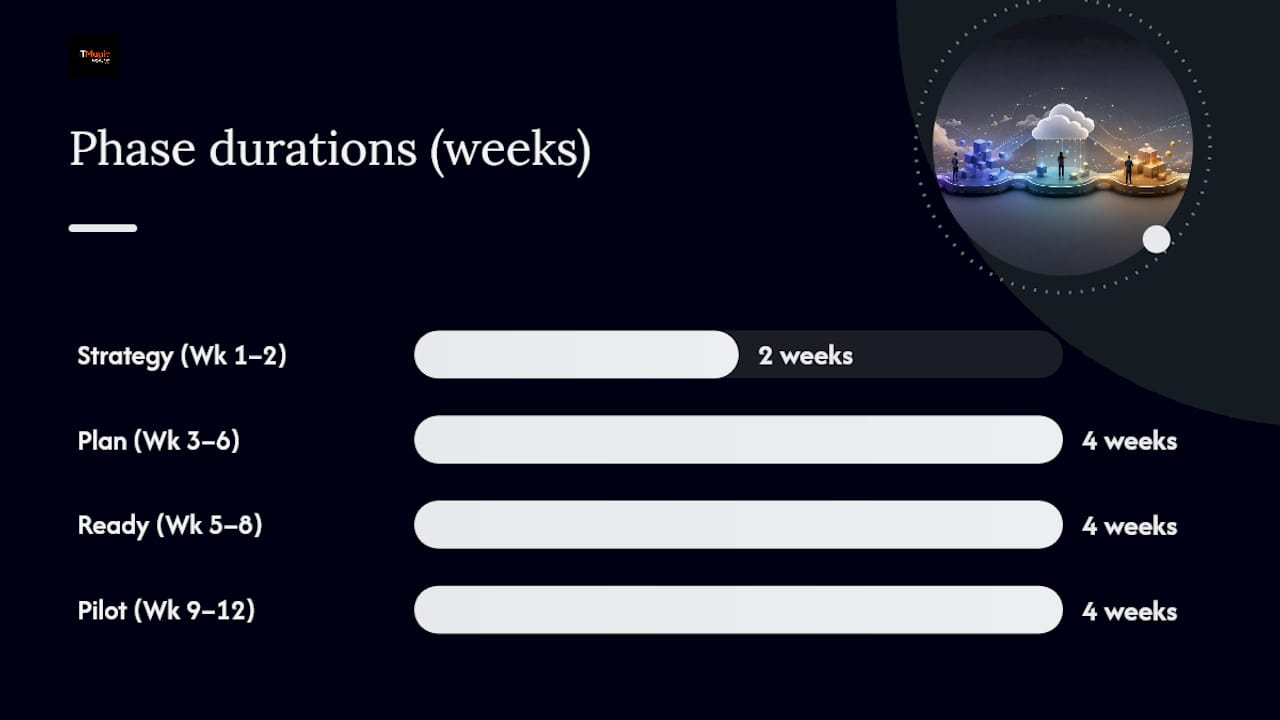
This roadmap covers the first 12 weeks: enough to complete Strategy, Plan, and Ready phases and launch a pilot migration wave. Adapt owners and timelines to your organization’s size.
Phase-grouped checklist with owners and acceptance criteria:
Strategy (Weeks 1–2)
- [ ] Executive sponsor named and briefed — Owner: CIO — Acceptance: signed strategy brief
- [ ] Strategy brief drafted: 3–5 outcomes with metrics — Owner: Cloud program lead
- [ ] Stakeholder map completed (finance, security, legal, BU leads) — Owner: Cloud program lead
Plan (Weeks 3–6)
- [ ] Application inventory completed (all workloads cataloged) — Owner: Application owners + cloud program lead
- [ ] Workload rationalization complete (6R classification per workload) — Owner: Cloud architect
- [ ] Wave 1 workloads selected (2–3 rehost + 1 replatform candidates) — Owner: Cloud program lead
- [ ] Total cost of ownership model built — Owner: FinOps lead + finance
Ready (Weeks 5–8, overlapping with Plan)
- [ ] Landing zone deployed (identity, networking, accounts, security baseline, logging) — Owner: Platform engineering
- [ ] IaC repository initialized with landing zone modules — Owner: Platform engineering
- [ ] CCoE charter drafted and signed — Owner: Executive sponsor + cloud program lead
- [ ] Governance policies applied (tags, budgets, threat detection) — Owner: Security + FinOps
Adopt/Migrate — Pilot (Weeks 9–12)
- [ ] Wave 1 workloads assessed and replicated to staging — Owner: Migration team
- [ ] Validation testing complete (performance, security, connectivity) — Owner: QA + security
- [ ] Cutover executed and monitored for 72 hours — Owner: Migration team + SRE
- [ ] Pilot retrospective completed; lessons applied to Wave 2 plan — Owner: Cloud program lead
| Week | Milestone | Owner | Checkpoint |
|---|---|---|---|
| 1–2 | Strategy brief signed | CIO, cloud program lead | Executive sign-off |
| 3–4 | Application inventory complete | Application owners | Workload count confirmed |
| 5–6 | 6R classification done; Wave 1 selected | Cloud architect | Wave 1 backlog approved |
| 5–8 | Landing zone deployed and validated | Platform engineering | Non-prod workload live |
| 7–8 | CCoE charter signed; governance policies active | Executive sponsor | Policies enforced in all accounts |
| 9–10 | Wave 1 workloads replicated to staging | Migration team | Staging validation passed |
| 11–12 | Wave 1 cutover complete; pilot retrospective done | Cloud program lead | Production SLAs met; Wave 2 plan updated |
For a detailed step-by-step migration walkthrough, IT-Magic’s on-premise to AWS migration guide covers the technical sequence in depth.
What are the most common cloud adoption pitfalls?
Most adoption failures are predictable. The patterns repeat across programs regardless of industry or vendor.
- No named executive sponsor. Programs without C-suite ownership stall when cross-departmental conflicts arise. Signal: decisions escalate to committee and sit unresolved for weeks.
- Strategy skipped or treated as a one-time gate. Teams jump to landing zone build without a written strategy. Six months later, the program has no agreed success criteria. Signal: no one can name the three business outcomes the program is delivering.
- Landing zone built manually. Manual configurations drift. Drift causes security findings. Security findings cause audit failures. Signal: engineers making console changes without a corresponding IaC commit.
- All workloads classified as “refactor.” Refactoring everything is expensive and slow. Most estates have 60–70% of workloads that are better served by rehost or replatform. Signal: migration velocity is near zero after three months.
- Cost model built on compute only. Egress fees, support tiers, licensing, and tooling costs routinely add 30–50% to compute-only estimates. Signal: first monthly bill exceeds forecast by more than 20%.
- CCoE has no enforcement authority. An advisory-only CCoE gets bypassed. Application teams provision accounts outside the vending machine. Signal: accounts exist that the CCoE did not provision.
- Training front-loaded, not wave-aligned. Certifications completed months before a team’s migration wave are not retained. Signal: engineers ask basic questions about services they were “trained on” six months ago.
- Security treated as a final gate. Security reviews at the end of a wave find architectural issues that require rework. Signal: security sign-off is a recurring blocker at cutover.
- No pilot before full-scale commitment. Programs that skip the pilot discover tooling gaps and process friction at scale, where the cost of fixing them is much higher. Signal: Wave 2 is delayed because Wave 1 exposed problems no one anticipated.
- Hybrid connectivity underestimated. Private connectivity (Direct Connect / ExpressRoute) has lead times of 4–12 weeks depending on provider and region. Signal: migration waves blocked waiting for network connectivity that was ordered too late.
The MITRE ECAF’s POETS model is a useful pre-program checklist: if your program has not explicitly addressed Political (stakeholder alignment), Organizational (change management), Economic (full cost model), Technical (architecture decisions), and Security (baseline controls) dimensions, you have a blind spot that will surface as a problem.
What should you do in the first 30, 60, and 90 days?
The first 90 days determine whether a cloud adoption program builds momentum or stalls. The actions below are sequenced by dependency, not by preference.
Days 1–30: Foundation
- Name the executive sponsor and cloud program lead. No other work is meaningful without these two roles filled.
- Draft and sign the strategy brief (3–5 outcomes, named metrics, timeline expectation).
- Complete a cloud readiness assessment: inventory your application estate, identify the top 10 workloads by migration priority, and flag any regulatory constraints.
- Engage your cloud partner (or internal platform team) to scope the landing zone build.
Days 31–60: Structure
- Complete the full application inventory and 6R classification.
- Deploy the minimum viable landing zone (identity, networking, accounts, security baseline, logging).
- Stand up the CCoE: draft the charter, assign roles, schedule the first governance review.
- Build the total cost of ownership model with finance.
Days 61–90: Execution
- Execute the pilot migration wave (2–3 rehost workloads, 1 replatform).
- Run the pilot retrospective and update the Wave 2 plan with lessons learned.
- Present pilot results to the executive sponsor: cost actuals vs. model, SLA performance, security findings.
- Approve Wave 2 scope and timeline.
Engage an external partner when: your internal team lacks the certifications or bandwidth to build the landing zone in the required timeframe; your program has compliance requirements (PCI DSS, SOC2, HIPAA) that need specialist input; or your pilot retrospective reveals tooling or architecture gaps that would delay Wave 2 by more than two weeks. IT-Magic’s team of certified AWS engineers has run this sequence across 700+ projects and can compress the landing zone build to the first four weeks while your internal teams focus on workload preparation.
Why the framework matters less than the discipline behind it
Every vendor CAF is well-documented. AWS, Azure, and Oracle all publish detailed guidance, templates, and tooling. The frameworks are not the problem. What consistently separates programs that deliver from programs that drift is something no framework document can mandate: the discipline to treat strategy as a living document, governance as a technical control rather than a meeting, and the CCoE as a team with real authority rather than a committee that produces slide decks.
The programs that stall share a recognizable pattern. They spend the first two months in planning workshops, produce a detailed migration plan, and then discover at the landing zone stage that no one agreed on the identity model or the account structure. The technical work has to pause while organizational decisions get made. That pause is not a technical failure. It is a governance failure that a well-run CAF process would have caught in week two.
The other pattern worth naming: organizations that treat cloud adoption as a cost-reduction exercise alone tend to underinvest in the people and governance pillars. They get the compute savings and then spend the next 18 months managing security incidents, cost overruns, and application teams that have gone rogue with their own accounts. Cloud adoption is a business transformation. The compute is the easy part.
For Ukrainian organizations specifically, the wartime operating environment adds a dimension that most CAF documentation does not address. Multi-region continuity is not an advanced architecture pattern here; it is a baseline requirement. Programs that design for single-region operation in Ukraine are not following cloud adoption best practices; they are creating a continuity risk that will surface at the worst possible time.
IT-Magic accelerates your cloud adoption program
For organizations that need to move faster than their internal bandwidth allows, IT-Magic offers a direct path from strategy to production. As an AWS Advanced Tier Services Partner with 700+ projects delivered for 300+ clients since 2010, IT-Magic’s certified engineers cover the full adoption sequence: cloud readiness assessment, landing zone build, migration wave execution, and ongoing FinOps and governance.
The practical difference: IT-Magic does not hand you a framework document and leave. The team builds the landing zone in Terraform, runs the pilot wave alongside your engineers, and sets up the cost monitoring and governance controls that keep the program on track after go-live. For fintech, retail, and enterprise clients in Ukraine and across the region, that combination of AWS expertise and local market knowledge cuts the time from decision to first production workload significantly.
If your program is at the assessment stage or you are preparing Wave 1, contact IT-Magic for a cloud readiness assessment and get a scoped engagement plan within one week.
Sources
These references cover the official CAF documentation and strategy guidance referenced throughout this article. Read the vendor CAF overview first for your chosen platform, then the Gartner strategy guidance for the executive-facing strategy document.
- Microsoft’s Cloud Adoption Framework – Cloud Adoption Framework | Microsoft Learn
- Transform IT Value with a Cloud Strategy Roadmap | Gartner
- AWS Cloud Adoption Framework (AWS CAF)
- Enterprise Cloud Adoption Framework (ECAF)
- Oracle Cloud Infrastructure Cloud Adoption Framework
FAQ
What is a cloud adoption framework?
A cloud adoption framework is a structured roadmap that connects business goals to technical execution across people, process, and infrastructure. It guides an organization through strategy, planning, landing zone build, migration, and ongoing governance.
What is the difference between a CAF and a Well-Architected Framework?
A CAF operates at the program level, covering how an organization adopts cloud across its entire estate. A Well-Architected Framework focuses on how to design and operate a specific workload once it is already in the cloud. Both are necessary; neither replaces the other.
What are the four stages of cloud adoption?
Most frameworks describe five stages rather than four: Strategy, Plan, Ready, Adopt/Migrate, and Govern/Manage. Some vendors compress these into four by merging Govern and Manage, but the underlying activities are consistent across all major CAFs.
What is the AWS Cloud Adoption Framework?
The AWS CAF groups organizational capabilities into six perspectives: Business, People, Governance, Platform, Security, and Operations. It is designed to identify capability gaps and prioritize cloud readiness activities before and during migration.
How long does a cloud adoption program typically take?
Timeline depends on program size. SMB programs with 10–30 workloads typically complete in 3–6 months; mid-market programs (30–100 workloads) run 6–12 months; enterprise programs with 100+ workloads often take 12–24 months or more, running in parallel waves.
Alexander founded IT-Magic, an AWS Advanced Tier Services Partner delivering DevOps, cloud architecture, and managed services since 2010. He holds:
- AWS Certified Solutions Architect – Professional
- AWS Certified DevOps Engineer – Professional
- AWS Certified Security – Specialty
- AWS Certified Advanced Networking – Specialty
Talk to a certified AWS team trusted by INTERTOP, Foxtrot, Pandora, and J.Hilburn.
Get a free consultation