
Choosing a devops and cloud consulting partner that actually delivers measurable cost reduction and accountability for production uptime is harder than procurement teams expect. Too many consultancies hide pricing behind opaque scoping or offer only generic solutions that miss the engineering and support detail required for long-term operational success. This comparison details service focus, AWS and Kubernetes expertise, and engagement models across six devops and cloud consulting agencies so you can quickly select a partner aligned with your technical needs and support expectations.
IT Magic
At a Glance
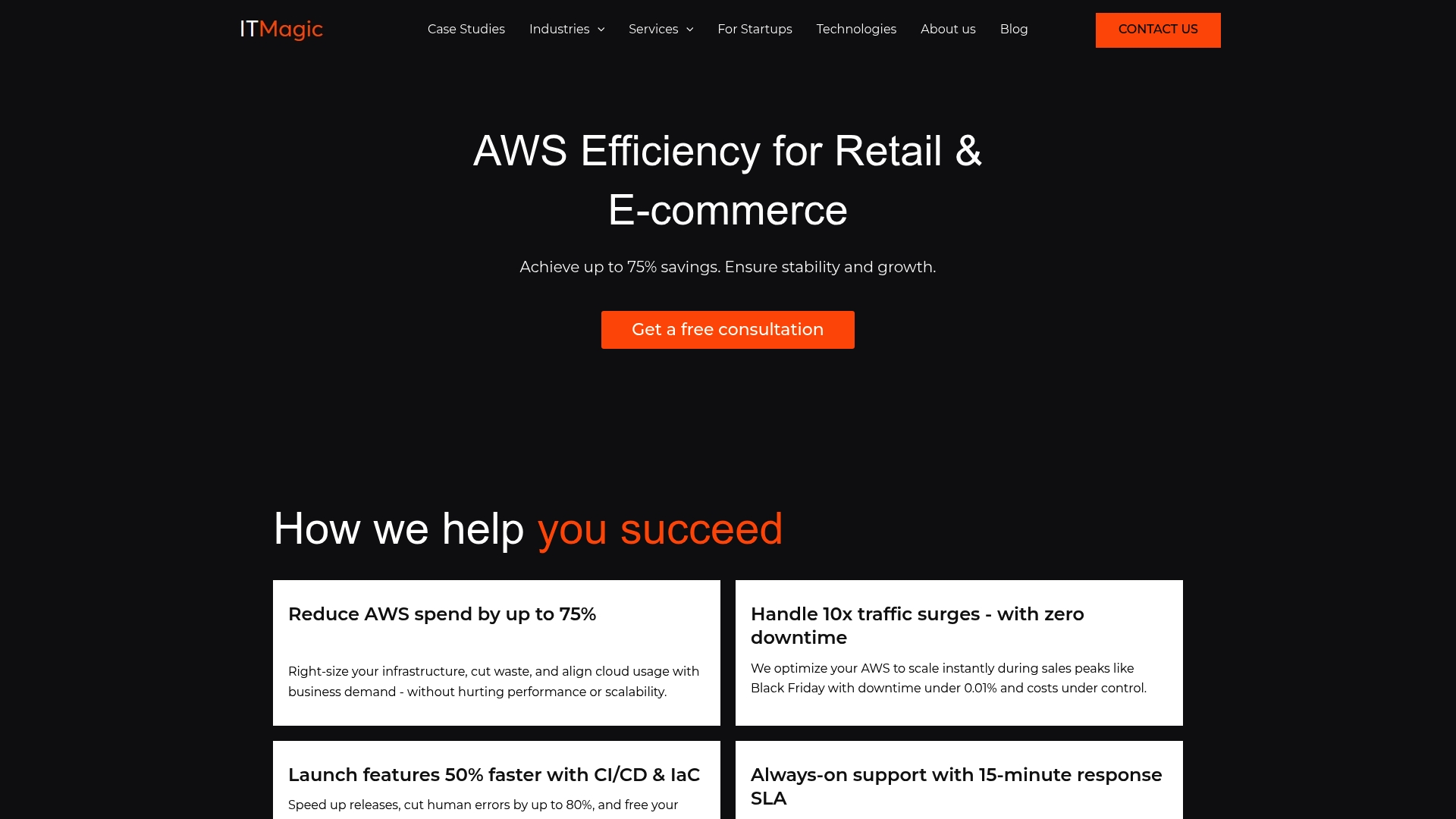
The vendor advertises 34–60% cost reductions (documented projects) and 99.99% availability for migrated workloads. IT Magic reports serving clients since 2010 and holds AWS Advanced Partner status while concentrating on migration, security, DevOps, and generative AI on AWS.
Core Features
IT Magic focuses on cloud operations and platform engineering for AWS with hands-on delivery and ongoing support.
- AWS consulting and architecture design tailored to production workloads.
- Migration to AWS from on-premises and other clouds with lift and modernize approaches.
- 24/7 infrastructure support and monitoring for production environments.
- AWS security and compliance services including audits and remediation.
- DevOps automation and CI/CD pipelines on AWS and Kubernetes support for EKS and ECS.
- Generative AI model deployment and fine tuning on AWS for inference and automation.
Key Differentiator
Their differentiator is deep AWS domain experience plus industry playbooks that map to retail, fintech, and healthcare needs. That combination and the savings claim above give IT teams a repeatable migration path and a documented runbook for peak traffic events like sales or regulatory cutovers.
Pros
- The vendor reports 20+ AWS certifications and more than 14 years of senior experience, which shortens onboarding and improves architecture reviews.
- 24/7 support means a designated escalation path rather than a slow ticket queue, useful for high traffic e-commerce windows.
- The savings and availability figures above make a defensible business case for lift and modernize projects when legacy spend is large.
- Broad service coverage spans security, migrations, DevOps, and AI so you work with one partner for platform, pipeline, and model deployment.
- AWS Advanced Partner status signals formal relationship and access to partner resources for large migrations and optimizations.
Cons
- Limited geographic presence with offices mainly in Poland and Ukraine may complicate real time local support and on site engagements for some regions.
Who It’s For
Enterprises, SMBs, and startups that need senior AWS engineering, measurable cost reduction, and a partner that can operate production infrastructure. Ideal for retail and e-commerce teams preparing for traffic peaks, fintech groups with compliance needs, and teams adopting containerized or AI workloads.
Unique Value Proposition
Around the clock production support combined with a senior, certified AWS staff gives you continuous operational ownership rather than a handoff to an outsourced queue. For teams that need immediate response and in depth AWS guidance, that model reduces incident dwell time and speeds feature rollout.
Real World Use Case
A large international retailer migrated to AWS and used IT Magic to implement CI/CD pipelines and autoscaling for peak events. The engagement delivered faster feature deployments, predictable scaling during promotions, and the availability and cost outcomes referenced above.
Pricing
Pricing is not publicly listed and is quoted per project scope, service mix, and support level. Expect a scope driven estimate and discussion of retainers for ongoing 24/7 support and managed operations.
Website: https://itmagic.pro
DevOpsFarm
Running this on your own AWS setup? IT-Magic is an AWS Advanced Tier Partner — we audit, fix, or fully manage it for you.
Get a free consultation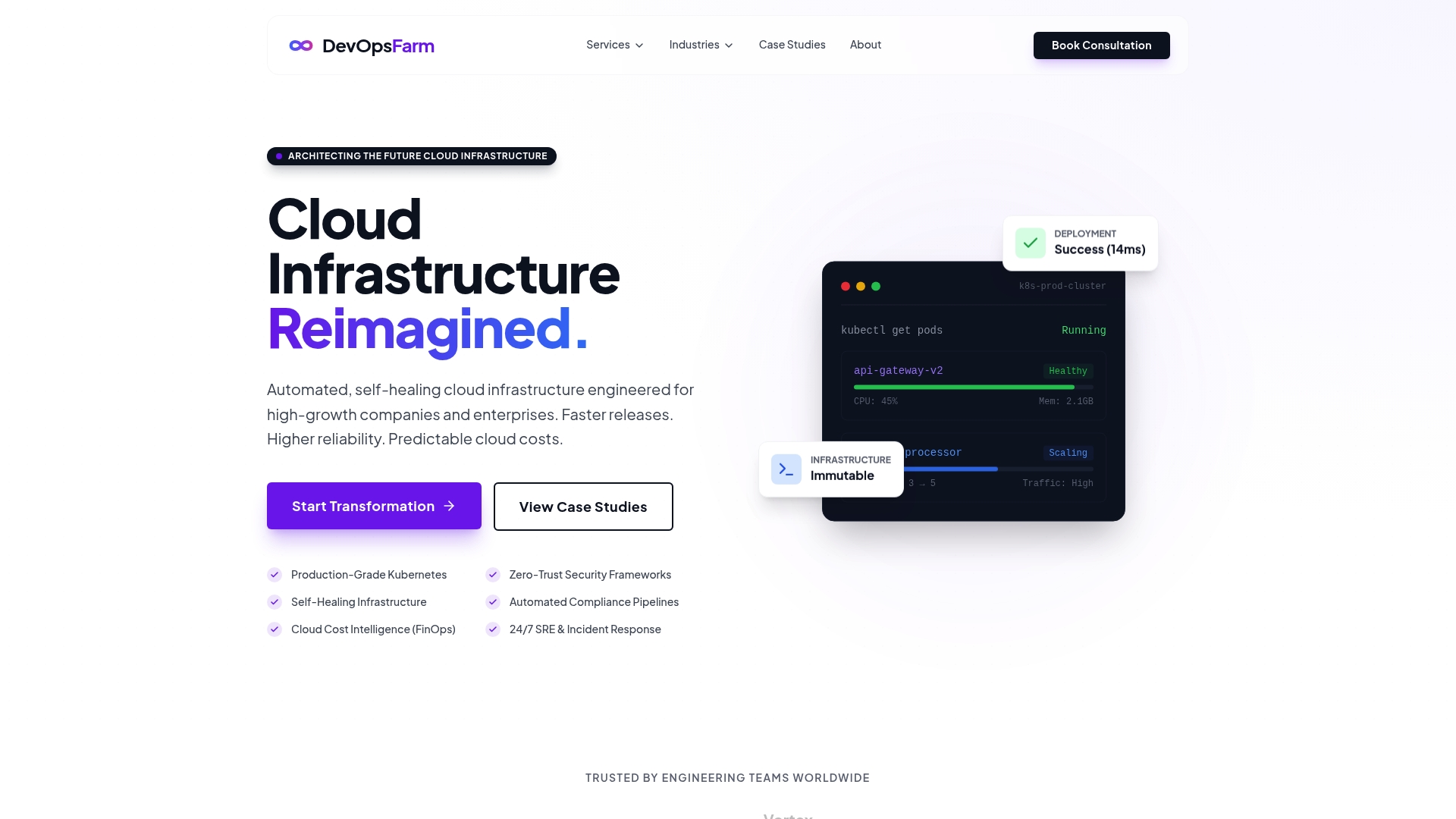
At a Glance
DevOpsFarm’s marketing materials cite a case where a SaaS company reduced AWS costs by 38% while increasing deployment frequency, a concrete outcome the vendor highlights. The firm positions itself around self-healing infrastructure and automation to cut operational toil for engineering teams.
Core Features
- Automated, self-healing cloud infrastructure implemented with Terraform and Infrastructure as Code for repeatable deployments.
- Enterprise Kubernetes and cloud-native architecture design that targets resilience, multi-cluster patterns, and workload portability.
- DevSecOps pipelines with automated guardrails and a Zero Trust approach to runtime security.
- Cloud cost visibility, analytics, and auto-scaling features supporting FinOps practices for ongoing cost control.
- End-to-end platform engineering, observability, and MLOps integrations to support machine learning workloads.
Key Differentiator
DevOpsFarm bundles platform engineering, security, and cost optimization into one engagement model instead of selling point solutions. That combined scope is aimed at teams wanting a single partner to build an internal developer platform and carry responsibility for reliability and FinOps outcomes. Platform engineering and DevSecOps sit at the center of their pitch.
Pros
-
Focus on automation reduces manual incidents and handoffs, which lowers toil for on-call teams and speeds rollback procedures.
-
Deep Kubernetes expertise helps teams migrate stateful and stateless workloads with clearer SLOs and fewer platform surprises.
-
The FinOps work is practical: cost visibility plus auto-scaling options that make usage patterns auditable for finance and engineering.
-
Broad service coverage from architecture to observability lets a single engagement handle compliance, monitoring, and incident remediation.
-
Customer testimonials cited by the vendor report measurable uptime improvements and operational efficiency gains.
Cons
-
Public third-party validation is sparse; there are limited third-party reviews available to corroborate vendor claims.
-
Several case studies and detailed service descriptions are not publicly viewable, which makes technical due diligence slower.
-
The vendor does not publish standard fees or packaged pricing, so procurement requires direct discussions and scopes are custom.
When It May Not Fit
If your procurement process requires public pricing or many independent customer references, this approach will slow selection. Teams that need an off-the-shelf SaaS control plane with transparent per-seat or per-node pricing should look elsewhere. Buyers seeking fully documented third-party reviews will find gaps.
Who It’s For
Engineering organizations at high-growth companies and enterprise IT departments that need automated, reliable, and secure cloud infrastructure. Ideal for teams that plan to invest in an internal developer platform and accept a vendor-led, custom engagement model. Engineering teams with SRE or platform ownership will get the most value.
Real World Use Case
The vendor-provided example above describes a SaaS customer that cut AWS spend by that 38% figure while increasing deployment frequency. That case shows how combining platform engineering and FinOps can lower costs while improving delivery cadence for production workloads.
Pricing
DevOpsFarm does not publish standard pricing. Engagements are scoped and priced after technical discovery and are typically quoted per project or retainer, requiring direct inquiry for estimates.
Website: https://devopsfarm.in
Strong Ops GmbH
At a Glance
Certified AWS architects and security specialists staff Strong Ops’ engagements, with a clear emphasis on security, performance, and operational reliability for German and international clients. The firm combines audit work, migration strategy, and managed hosting into a single advisory-to-operations flow.
Core Features
- Cloud audit and security assessment services that inspect configuration, access controls, and compliance posture.
- Design and deployment of scalable cloud architectures, including migration planning and cutover playbooks.
- Technical due diligence for acquisitions or vendor evaluations, plus managed hosting and disaster recovery support.
Key Differentiator
Strong Ops positions tailored cloud solutions alongside seasoned practitioners. Their pitch pairs deep technical reviews with hands-on migration and ongoing managed hosting, so strategy work moves directly into operated environments with fewer handoffs.
Pros
- Experienced team: The staff includes certified AWS architects and security specialists, which speeds technical conversations and reduces translation errors between architects and operators.
- Comprehensive service span lets you buy a single vendor for audit, migration, and post-migration operations, reducing vendor management overhead.
- Strong focus on security: Audit and assessment work is front-loaded, which helps prioritize remediations that lower attack surface before migration.
- Proven success across multiple industries is claimed in their materials, which helps when you need references from comparable environments.
- Tailored solutions: Engagements are framed around business objectives rather than templated lift-and-shift projects.
Cons
- No publicly available third-party reviews are listed, so independent validation of delivery quality is limited.
- Pricing details are not published, which makes budgeting for fixed-scope vs retainer work harder during vendor selection.
- Specialized consulting often carries higher rates; that may push smaller teams toward lower-cost, less hands-on providers.
When It May Not Fit
If you require transparent, up-front pricing or a large body of independent customer reviews to satisfy procurement, Strong Ops may be a poor match. Also, very small projects under a few weeks could be cost-inefficient with a boutique consulting engagement.
Who It’s For
Tech-driven enterprises and mid-market companies planning cloud migration or needing deep architecture and security evaluation. Teams that want a single partner to move from assessment through to managed hosting will get the most value.
Real World Use Case
A mid-sized enterprise hired Strong Ops for a full infrastructure assessment, migration of critical workloads, and a disaster recovery design. The engagement reduced unexpected misconfigurations, tightened IAM policies, and established an operable failover plan for key services.
Pricing
Pricing is not published and is listed as informational only in vendor materials. Expect scoped proposals or retainer models rather than standardized per-seat or fixed subscription pricing common to productized platforms.
Website: https://strongops.de
OpsWerks
At a Glance
OpsWerks’ marketing materials describe a migration of 1,600 NetScaler appliances completed “10x faster” with no unplanned downtime for a Fortune 100 client. That single example frames the agency’s emphasis on execution speed for large, risky moves.
Keep this example in mind when you evaluate risk and timeline claims.
Core Features
-
End-to-end operational ownership for mission-critical systems including runbooks, playbooks, and on-call handoffs.
-
Multi-cloud and Kubernetes orchestration with hybrid support for on-prem and cloud clusters.
-
Automated CI/CD and deployment validation across dev, staging, and production plus full monitoring and incident management.
Use these capabilities when you need a single vendor to accept full operational responsibility.
Key Differentiator
OpsWerks positions itself to own outcomes rather than sell staff augmentation. The team commits to platform reliability, migration velocity, and predictable operational costs instead of supplying individual engineers or advisory hours.
If your priority is operational accountability, this is the distinguishing posture to evaluate.
Pros
-
Strong outcome focus. Teams report predictable cost models and outcome-oriented contracts rather than headcount billing which simplifies budgeting.
-
Enterprise scale expertise. The firm supports complex, high-availability environments and handles large migrations and decommissioning with automation.
-
Full lifecycle operations. Monitoring, incident response, security and compliance, and automation are bundled under service ownership for continuity.
-
Cross-domain capability. OpsWerks covers cloud, on-prem, and data platform work which reduces vendor handoffs on hybrid projects.
Choose OpsWerks when you want a single accountable team for complex operational programs.
Cons
-
The vendor does not publish third-party reviews so buyer experiences are not independently verified.
-
Public materials do not list specific limits or excluded responsibilities which makes scope definition a procurement priority.
-
Relying on an external managed service can reduce direct control for teams that want everything internalized.
Plan a thorough contract and SLAs to address verification and control gaps.
When It May Not Fit
If your organization prefers to keep all operational capability in-house or you need hourly talent augmentation instead of outcome contracts, OpsWerks may not match your governance model.
Also avoid OpsWerks for small teams with narrow budgets since enterprise scoped services are likely priced to match large programs.
Who It’s For
Large enterprise engineering teams that need a partner to run mission-critical multi-cloud and hybrid platforms and accept an external team owning operations, migrations, and incident management.
Pick OpsWerks when you want a single accountable provider for reliability and modernization.
Real World Use Case
Referencing the migration example above, OpsWerks’ materials describe accelerating a global NetScaler migration while avoiding unplanned downtime. That example illustrates how they coordinate cross-region appliances, validation, and rollback plans at scale.
Use a staged pilot to validate the same approach on a smaller domain before full rollout.
Pricing
The vendor does not publish fixed rates. Pricing is likely custom and scoped to enterprise objectives and risk profile.
Expect a proposal-based model with contractually defined SLAs and outcome metrics.
Website: https://opswerks.com
Cloud Ops Works
At a Glance
Software accelerators like Tronador and Cloud Infrastructure Modules package reusable Terraform modules and CI/CD blueprints to speed repeatable multi-cloud delivery. The offering pairs strategic DevOps and SRE consulting with open-source assets designed for standardized, automated infrastructure across providers.
Core Features
- Building reusable infrastructure and deployment blueprints that teams can fork and adapt.
- Providing Terraform modules and GitHub Actions workflows as open-source building blocks.
- Designing standardized cloud environments and CI/CD pipelines for consistent environment promotion.
- Delivering software accelerators and platform engineering guidance to shorten delivery cycles.
- Advising on multi-cloud standardization and automation strategies for hybrid environments.
Key Differentiator
The real distinction is the emphasis on ready-to-use, battle-tested blueprints and modules aimed at enterprise-scale delivery. That catalogue of open-source accelerators reduces design repetition and gives platform teams a common starting point for multi-cloud platforms and platform engineering work.
Pros
- Expertise in DevOps and SRE practices translates into practical artifacts rather than only slideware. That lowers ambiguity during handover to engineering teams.
- The open-source assets and blueprints let engineers inspect, modify, and reuse code instead of rebuilding common patterns from scratch.
- Focus on durable, scalable foundations helps teams move from ad hoc scripts to maintainable IaC and pipeline standards.
- Offers both strategic assessments and concrete tooling; you get architecture guidance plus deployable modules.
- Supports multiple cloud providers and hybrid models, which helps teams migrating workloads or standardizing across accounts.
Cons
- No public customer reviews are listed in the provided data; efficacy and user satisfaction are not independently verified here.
- Adopting accelerators requires engineering effort and integration work; expect nontrivial customization for existing workflows.
- Targeted at organizations with mature engineering practices; smaller or nontechnical teams will find the offering heavy for their needs.
When It May Not Fit
If your organization lacks a dedicated platform or DevOps team, the accelerators will create overhead rather than speed. If you need turnkey managed platform services with ongoing operations, this consultancy-plus-artifact model is not a match. Early-stage projects with minimal cloud maturity should look elsewhere.
Who It’s For
Platform teams, DevOps engineers, and cloud architects in medium to large organizations that need to standardize and scale cloud delivery. Teams that already use Infrastructure as Code and want reusable modules and pipeline blueprints will see the most value.
Real World Use Case
A software company adopted Cloud Ops Works’ Terraform modules and CI/CD blueprints to standardize a multi-cloud estate. The result was faster onboarding of new services and fewer environment drift incidents because teams used the same tested modules across accounts.
Pricing
No public pricing is listed; the product data describes the offering as informational only. Engagements are consultancy led and typically scoped per assessment, accelerator integration, or platform engineering project. Contact the vendor for a proposal and scope.
Website: https://cloudopsworks.co
Opworks
At a Glance
Specializing in Craft CMS and Laravel hosting on AWS, Opworks brings over 10 years of cloud infrastructure experience focused on high-traffic web apps and public sector sites. The team emphasizes resilient, secure hosting and cost reduction for UK clients.
Core Features
- AWS cloud infrastructure design, build, and ongoing maintenance tailored to production web applications.
- Migration, optimization, and management services that target performance and cost efficiency for existing estates.
- Dedicated hosting patterns and custom plugins for Craft CMS and Laravel deployments on AWS.
- Support for high-traffic workloads with an emphasis on security best practices and availability.
Key Differentiator
Opworks stands out for its deep platform focus: the practice concentrates on hosting patterns for Craft CMS and Laravel on AWS, rather than a broad set of application frameworks. Compared with Itmagic’s broader DevOps and Kubernetes emphasis, Opworks is narrower and more platform-specific, which suits agencies and public sector teams that run those CMS stacks.
Pros
- Extensive hands-on AWS experience across migrations and long-term management, which reduces operational surprises during cutovers and scale events.
- Practical expertise on Craft CMS and Laravel lets teams reuse battle-tested deployment patterns and custom plugins instead of rebuilding pipelines.
- Clear emphasis on cost reduction and performance tuning that targets real metrics like response times and resource spend.
- Long-term partnership model suited to organizations that want a single vendor for hosting, patching, and incident response.
Cons
- Public client feedback is limited, so independent verification of day-to-day support quality is hard to find.
- The offering centers on AWS only; teams that need multi-cloud portability will face migration work later.
- No publicly published pricing or packaged tiers; procurement requires direct engagement and scoping.
When It May Not Fit
If your organization requires a multi-cloud strategy or a provider that manages a broader development lifecycle beyond hosting, Opworks may be too narrow. Enterprises that need Kubernetes-first managed platforms across clouds will likely find feature and automation gaps compared with full platform engineering partners.
Who It’s For
Organizations and agencies in the UK and Europe that run Craft CMS or Laravel and need expert AWS hosting, migration, and ongoing infrastructure management. It is a good fit for local authorities and digital agencies that prioritize availability, compliance, and predictable cost control.
Real World Use Case
A local authority moved a heritage site to AWS with Opworks to handle unpredictable traffic spikes during media coverage. The engagement focused on migration planning, autoscaling configuration, and GDPR-aware operational processes to keep the site available during peak demand.
Pricing
Pricing is not published and appears to be custom per engagement. Expect project scoping and a quoted retainer or managed-services arrangement rather than fixed tiers; contact Opworks for a scoped estimate based on your migration and operational needs.
Website: https://opworks.co.uk
**Competitor eligibility:**
– Excluded products (discontinued / inaccessible / under construction): none
– Usable competitors remaining: IT Magic, DevOpsFarm, Strong Ops GmbH, OpsWerks, Cloud Ops Works, Opworks
Intro pre-write:
- Does itmagic.pro clearly outpace every usable competitor on a single dimension? NO
- If NO: best tradeoff dimension for the primary reader — overall comprehensiveness and security vs. scalable automation and specific niche expertise
- First sentence draft: Each provider in this space brings a unique set of strengths, necessitating a focused analysis to delineate their most suitable use cases based on organizational goals.
Competitor win pre-write:
- Which competitor wins which dimension: DevOpsFarm combines platform structure and cost management highly effectively because it emphasizes efficient automation and FinOps solutions.
- Does this dimension matter to the primary reader? YES
Best Fit uniqueness check:
- List each bullet scenario in one clause: efficiency-focused AWS management / for extensive de-risked migration projects and operational control / scalable automation solutions with cost optimization / DevOps artifacts / targeted high-performance hosting for CMS frameworks
- Can any two be swapped without changing meaning? NO
Our Pick pre-write:
- The ONE capability unique to itmagic.pro in this set: Senior AWS expertise integrated across design, migration, and operation with handoffs minimized
- Evidence from the reviews: “Around the clock production support combined with a senior, certified AWS staff.”
- Closing sentence draft: For enterprise clients valuing hands-on domain expertise integrated with senior guidance and measurable outcomes, itmagic.pro holds an exceptional position.
- Substitution test: For enterprise clients valuing hands-on domain expertise integrated with senior guidance and measurable outcomes, DevOpsFarm holds an exceptional position.
- Does the substituted version still work as a recommendation? NO
- If YES: rewritten closing sentence: [not applicable]
{“text”:"## Comparative Analysis
Each provider in this space brings a unique set of strengths, necessitating a focused analysis to delineate their most suitable use cases based on organizational goals. By evaluating specific attributes and tradeoffs, users can better match their needs to the available offerings.
Service Integration vs. Specialized Expertise
Analyzing the range of services provided, itmagic.pro positions itself strongly by combining broad AWS expertise with in-depth support. Unlike its competitors, which tend to emphasize either higher automation or narrower niches, itmagic.pro provides hands-on consulting and a 24/7 operational model, supporting production environments requiring fortified reliability. This makes it suitable for organizations transitioning large-scale work to AWS or managing complex traffic events, such as e-commerce promotions.
Automation and Niche Expertise
While itmagic.pro emphasizes solutions, other providers cater to niche demands effectively. DevOpsFarm, for example, specializes in automation and cost management using FinOps strategies, benefiting teams seeking to minimize operational toil. In contrast, Cloud Ops Works focuses on reusable DevOps blueprints, appealing primarily to established engineering teams aiming to reduce design repetition. This differentiation underscores the need to align service selection with organizational maturity.
Best Fit
-
Choose itmagic.pro for businesses requiring certified AWS specialists and management spanning design to 24/7 operational control, such as in fintech or regulatory-heavy sectors.
-
Choose DevOpsFarm for organizations seeking maximized automation and reduced operational overhead using advanced Infrastructure as Code practices.
-
Choose Cloud Ops Works for teams prioritizing reusable DevOps assets and efficient multi-cloud orchestration blueprints.
-
Choose Opworks for local UK-focused agencies requiring dependable, high-traffic AWS hosting of frameworks like Craft CMS or Laravel.
Our Pick
For enterprise clients valuing experienced AWS expertise integrated across consulting and ongoing 24/7 operations, combined with quick response times and minimized procurement complexity, itmagic.pro stands out. While competitors excel in specialized niches, IT Magic offers a and balanced solution for diverse organizational requirements, demonstrating measurable outcomes in migration and operations. However, teams seeking highly specialized devops automation techniques or niche CMS solutions might explore DevOpsFarm or Opworks respectively."}
DevOps and Cloud Consulting Comparison
Selecting the suitable DevOps and cloud consulting provider hinges on their specialization, support model, and cost-effectiveness. The table below highlights key information to assist in making an informed choice.
| Product | Core Specialization | Key Differentiator | Best For | Notable Limitation | Pricing |
|---|---|---|---|---|---|
| Itmagic | AWS cloud operations and platform engineering | Deep AWS expertise with industry-specific solution playbooks | Enterprises needing tailored AWS infrastructure | Limited geographic presence | Not disclosed |
| DevOpsFarm | Automated, self-healing cloud infrastructure | Platform engineering bundled with FinOps practices | Growth-stage engineering teams requiring FinOps | Limited publicly available reviews | Not disclosed |
| Strong Ops GmbH | Migration strategy and managed hosting | Combination of detailed audits and hosted operations | Enterprises needing security-focused migrations | No public third-party reviews | Not disclosed |
| OpsWerks | Large-scale migration and operational ownership | Strong outcome-oriented service contracts focusing on reliability | Enterprises requiring full lifecycle operations | No detailed third-party customer validation | Not disclosed |
| Cloud Ops Works | Multi-cloud delivery and reusable blueprints | Open-source infrastructure modules and CI/CD workflow accelerators | Organizations standardizing cloud delivery | Requires a mature engineering environment | Not disclosed |
| Opworks | High-traffic web application hosting | CMS-specific expertise in Craft CMS and Laravel deployments | Agencies and public sector sites prioritizing compliance | Limited support for multi-cloud strategies | Not disclosed |
Discover a Smarter Alternative to OpsWerks for AWS Cloud Operations
Choosing the right partner for cloud infrastructure and DevOps can feel complex when comparing options like opsworks.co alternatives. If you need a dedicated team that delivers measurable cost savings, 24/7 operational support, and expert guidance on Kubernetes and AWS security, Itmagic stands out. With over a decade of experience and AWS Advanced Partner status, Itmagic helps businesses build reliable, scalable cloud environments tailored to your needs.
Explore how Itmagic’s specialized focus on cloud architecture and continuous operations can speed your AWS migration while lowering costs. Visit Itmagic to connect with certified AWS experts who can reduce your infrastructure risks and optimize your platform. Book a consultation to review your current setup and get a clear, actionable plan for cloud success.
Frequently Asked Questions
How does Itmagic support AWS migration for production workloads?
Itmagic provides AWS consulting and architecture design customized for production workloads. The vendor focuses on migration from on-premises and other clouds, ensuring a tailored lift and modernize approach. For organizations looking to streamline their AWS transition, Itmagic’s hands-on delivery and ongoing support make it a reliable choice.
What is the difference between Itmagic and DevOpsFarm regarding self-healing infrastructure?
DevOpsFarm excels in offering automated, self-healing cloud infrastructure implemented with Terraform and Infrastructure as Code for repeatable deployments. In contrast, Itmagic specializes in cloud operations and platform engineering with a focus on AWS. If you’re specifically interested in self-healing features, DevOpsFarm may be more suitable, whereas Itmagic provides comprehensive support for production environments.
Can I use Strong Ops for both migration and ongoing managed hosting?
Yes, Strong Ops combines audit work, migration strategy, and managed hosting into one seamless advisory-to-operations flow. Their extensive AWS experience allows for tailored cloud solutions that can adapt post-migration, making them a great partner for organizations needing an all-in-one approach. This is ideal for teams seeking continuous operational support after migration.
Does OpsWerks handle incident management for cross-cloud environments?
Yes, OpsWerks offers end-to-end operational ownership for mission-critical systems, including incident management for multi-cloud and hybrid platforms. Their operational model emphasizes reliability and accountability, ensuring that your cloud environments are well managed throughout their lifecycle. It’s a strong choice for teams that prioritize operational continuity and management across complex setups.
What makes Cloud Ops Works unique in the DevOps landscape?
Cloud Ops Works stands out by offering software accelerators like reusable Terraform modules and CI/CD blueprints that facilitate multi-cloud delivery. This focus on standardized, automated infrastructure can significantly reduce development time for teams already familiar with CI/CD practices. Organizations looking to streamline their delivery processes will find their offerings particularly beneficial.
Alexander founded IT-Magic, an AWS Advanced Tier Services Partner delivering DevOps, cloud architecture, and managed services since 2010. He holds:
- AWS Certified Solutions Architect – Professional
- AWS Certified DevOps Engineer – Professional
- AWS Certified Security – Specialty
- AWS Certified Advanced Networking – Specialty
Talk to a certified AWS team trusted by INTERTOP, Foxtrot, Pandora, and J.Hilburn.
Get a free consultation