
TL;DR:
- Most organizations mistakenly believe that cloud providers handle all security responsibilities, which is costly and false. Effective cloud risk management requires continuous assessment, unified visibility, and proactive governance across all service models to prevent breaches and compliance failures. Leaders must embed risk oversight into governance frameworks, prioritizing real-time monitoring and organizational accountability to mitigate evolving cloud threats.
Most business leaders assume that moving to the cloud transfers security responsibility to the provider. That assumption is expensive. What is cloud risk management, and why does it matter more than ever? It’s the structured discipline of identifying, assessing, and reducing threats across your entire cloud estate before they become breaches, outages, or compliance failures. The Shared Responsibility Model makes this clear: providers secure the infrastructure, but your organization owns everything else. This guide covers the frameworks, tools, and governance decisions that make cloud risk programs work in practice.
Table of Contents
- Key Takeaways
- What cloud risk management actually means
- Common cloud risk categories and their business impact
- Best practices and tools for cloud risk management
- Governance, roles, and standards shaping cloud risk in 2026
- How to implement a cloud risk management program
- My take on where cloud risk programs actually fail
- How Itmagic helps you manage cloud risk in practice
- FAQ
Key Takeaways
Running this on your own AWS setup? IT-Magic is an AWS Advanced Tier Partner — we audit, fix, or fully manage it for you.
Get a free consultation| Point | Details |
|---|---|
| Providers don’t cover everything | Cloud vendors secure infrastructure, but data controls and access management are entirely your responsibility. |
| Static assessments fail | Real-time telemetry and continuous monitoring are required to catch risks that annual reviews miss. |
| Governance is a leadership issue | Board-level visibility and documentation of cloud risk programs are now mandated by frameworks like DORA. |
| Fragmented tools create blind spots | Separate tools for configuration and identity access produce incomplete risk pictures across cloud estates. |
| Zero Trust is the operating standard | Continuous identity verification and least-privilege access reduce exposure across IaaS, PaaS, and SaaS. |
What cloud risk management actually means
Cloud risk management is a structured, ongoing process covering identification, assessment, prioritization, and mitigation of security, compliance, and vendor risks across dynamic cloud environments. That definition sounds clean, but the reality is more complex. Organizations today run workloads across multiple cloud service models simultaneously, and each one shapes the risk profile differently.
Here is how the scope breaks down across service models:
- IaaS (Infrastructure as a Service): You manage operating systems, runtime, and application security. Misconfigured storage buckets and exposed virtual machines are the most common failure points.
- PaaS (Platform as a Service): The provider manages the runtime and middleware, but you own application logic and data. Insecure APIs and inadequate input validation are the dominant risks here.
- SaaS (Software as a Service): You control almost nothing on the infrastructure side, but you are fully responsible for user permissions, data classification, and integration security.
The CSA Cloud Controls Matrix provides a widely adopted framework that maps security controls across all three models, covering over 200 control objectives. Risk management in cloud computing, done correctly, is not a point-in-time exercise. It requires continuous oversight and a data-driven approach that cuts across organizational silos. For teams managing cloud compliance obligations alongside security posture, this integrated scope is the only approach that holds up.
Common cloud risk categories and their business impact
Understanding cloud risk means understanding where exposure actually lives. The categories below represent the most consequential threat areas for organizations in 2026.
- Data breaches from misconfiguration: Misconfigured S3 buckets and overly permissive IAM roles are responsible for a significant share of cloud breaches. These are not sophisticated attacks. They are administrative errors that sit undetected for months.
- Insecure APIs: APIs are the connective tissue of modern cloud architectures. An unpatched or poorly authenticated API endpoint can expose entire data pipelines to unauthorized access.
- Compliance and regulatory gaps: Meeting standards like PCI-DSS, GDPR, and HIPAA in cloud environments requires continuous verification, not just annual audits. A single misconfigured data retention policy can trigger a regulatory finding.
- Vendor and third-party dependencies: Vendor risk management requires continuous technical evaluation beyond once-a-year questionnaires. A vendor’s security posture can deteriorate between reviews, and your organization carries the exposure.
- Operational risks from service outages: Single-provider dependency without failover architecture is a business continuity risk. This is especially relevant for organizations with revenue-critical SaaS platforms.
- Insider threats: Privileged access misuse, whether intentional or accidental, remains one of the hardest risks to detect using traditional perimeter-based tools.
The business impact of these risks is not abstract. A compliance failure in a fintech environment can mean regulatory fines, lost licenses, and reputational damage that outlasts the incident itself. Defense-in-depth security controls covering preventive, detective, and corrective layers remain the baseline for managing these risk categories effectively.
Pro Tip: Map each cloud risk category to a specific business outcome, such as revenue loss, regulatory penalty, or reputational damage. Risk owners make faster, better decisions when the exposure is expressed in business terms, not just technical severity scores.

Best practices and tools for cloud risk management
Effective cloud security management is not about deploying more tools. It is about deploying the right tools with an integrated view of your posture. Here are the core practices that consistently reduce exposure:
-
Deploy a Cloud Security Posture Management (CSPM) platform. CSPM platforms automatically check configurations against more than 40 industry standards and use real-time threat signals to prioritize risk by actual exposure, not theoretical severity. This replaces manual configuration reviews that go stale within days of completion.
-
Converge posture and identity visibility. Separating configuration and access risk tools leads to incomplete risk visibility. A misconfigured storage resource combined with overly broad user permissions is a high-severity risk that neither tool alone would flag. Unified SASE and IAM integration solves this.
-
Replace static assessments with continuous runtime telemetry. Static annual assessments cannot capture real-time cloud risk exposure. Runtime telemetry that maps exploitability and asset value gives risk teams a live picture of what is actually at risk right now.
-
Automate compliance checking. Aligning your cloud posture against NIST, ISO 27001, and PCI-DSS manually is not scalable. Automated compliance tools generate audit-ready reports continuously, reducing the effort of periodic audits by a significant margin.
-
Adopt Zero Trust Architecture. Verify every identity, every access request, and every connection continuously. Zero Trust reduces the blast radius of credential compromise and insider threats by removing implicit trust from your network architecture.
-
Prioritize by severity and real exposure, not alert volume. Integrated risk dashboards that unify posture and access risks accelerate exposure reduction and prevent teams from drowning in low-priority alerts.
For deeper context on applying these practices in AWS environments, Itmagic’s coverage of AWS security strategies outlines how these tools layer in practice.
Pro Tip: Before purchasing a new security tool, audit your current tool coverage for gaps in identity and configuration visibility. Most organizations have more tools than they need and fewer integrations than they should.
Governance, roles, and standards shaping cloud risk in 2026
Cloud risk management is no longer purely a technical function. The governance dimension has expanded significantly, and business leaders are now accountable in ways that were not formalized two years ago.
Several major shifts define the current environment:
- Board-level documentation requirements: New standards, including DORA and the IIA’s 2025 standards, require organizations to maintain board-visible cloud risk programs with proactive management documentation. This is no longer optional for regulated industries.
- CFOs and business leaders as risk orchestrators: Executive oversight must actively manage data access and governance. Assuming that platform security handles enterprise risk is a documented failure mode, particularly in cloud ERP environments.
- Rising demand for GRC professionals: ISACA’s CRISC certification has seen growing global demand as organizations recognize they need dedicated professionals to manage the intersection of governance, risk, and compliance in cloud environments.
- Legacy frameworks are insufficient: Legacy governance frameworks are failing to secure decentralized, interconnected cloud environments. Finance and operations leaders must partner with security teams to embed continuous monitoring into business workflows.
“Effective risk management balances risk quantification with innovation, enabling risk-informed decisions over risk avoidance.” This distinction matters for executives: the goal is not to eliminate cloud risk but to understand it well enough to make confident strategic choices.
Cloud compliance management that is embedded into daily workflows, rather than bolted on at audit time, is what separates organizations that pass reviews from those that genuinely reduce their exposure.
How to implement a cloud risk management program
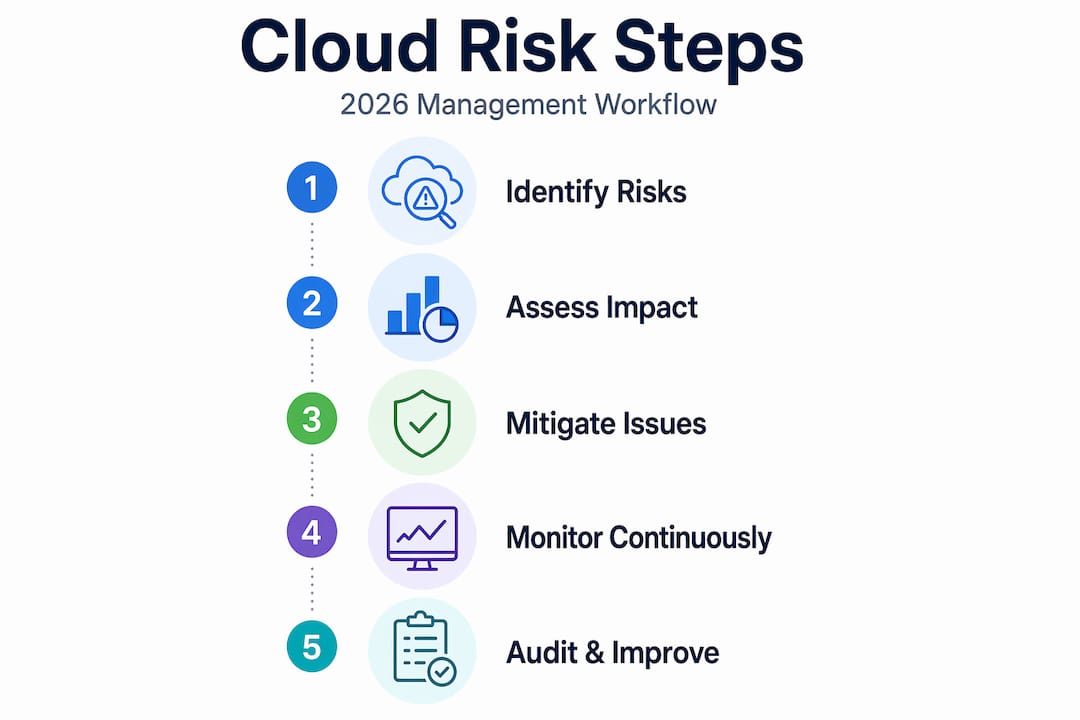
Operationalizing cloud risk strategies requires a clear sequence. Here is a practical framework for getting a program off the ground and keeping it current:
-
Build a complete cloud asset inventory. You cannot manage risk across assets you do not know exist. Catalog every IaaS instance, PaaS service, and SaaS application your organization uses, including shadow IT where possible.
-
Establish continuous monitoring across all environments. Deploy monitoring tools that provide real-time visibility into cloud infrastructure performance and configuration state. A single pane of glass across environments is the goal.
-
Prioritize risks by contextual impact. A vulnerability in a development environment carries different weight than the same vulnerability in a production payment system. Context, asset value, and exploitability should drive prioritization, not raw severity scores alone.
-
Assign clear accountability. Risk without an owner is risk that goes unmanaged. Every significant risk finding should have a named owner, a remediation timeline, and a financial exposure estimate.
-
Implement Zero Trust access controls. Tighten permissions to least privilege across all cloud roles and service accounts. Audit access grants quarterly at minimum.
-
Embed compliance controls into CI/CD pipelines. Automated compliance checks at the deployment stage catch misconfigurations before they reach production, reducing the cost of remediation significantly.
The table below shows how two approaches to cloud risk assessment compare in practice:
| Approach | Assessment frequency | Risk visibility | Compliance readiness |
|---|---|---|---|
| Static annual review | Once per year | Snapshot only | Periodic, often outdated |
| Continuous runtime monitoring | Real-time | Live exploitability mapping | Audit-ready at all times |
Pro Tip: Treat your cloud asset inventory as a living document updated by automation, not a spreadsheet someone refreshes quarterly. Tools like AWS Config and third-party CSPM platforms can maintain this automatically.
My take on where cloud risk programs actually fail
I’ve spent years working with organizations across fintech, retail, and enterprise, and the most common failure I see is not technical. It’s organizational. Teams invest in CSPM tools, document their risk register, and then operate in silos where security, DevOps, and finance never share a unified view of exposure.
The uncomfortable reality is that fragmented tool stacks create blind spots. A cloud configuration tool that does not talk to your identity management platform will always miss compound risks, the kind where a permissive role combined with an exposed API creates a breach path no single tool would catch.
What I’ve found actually works is treating cloud risk management as a governance discipline first and a technical problem second. When CFOs and business leaders take ownership of the risk program, tooling decisions improve. Budget gets allocated to integration rather than additional point solutions. And teams stop measuring success by alert volume and start measuring it by reduction in actual exposure.
The shift toward risk-informed decision-making, rather than risk avoidance, is where mature organizations land. The cloud is not going to get simpler. The organizations that win are the ones that build governance-led, continuously updated risk programs rather than chasing compliance checkboxes once a year.
— Oleksandr
How Itmagic helps you manage cloud risk in practice
Managing cloud risk at scale requires infrastructure expertise, not just policy documents. Itmagic has delivered 700+ cloud projects since 2010, working with fintech, retail, and enterprise clients who need their AWS environments to be secure, compliant, and cost-efficient simultaneously. For organizations running containerized workloads, Itmagic’s Kubernetes support services cover security hardening, access controls, and runtime monitoring across EKS and ECS environments. For teams looking to prove that risk-aware infrastructure also reduces cost, the INTERTOP case study shows what scalable, risk-informed AWS architecture delivers in practice. If cloud risk management is on your agenda for 2026, Itmagic’s team of certified AWS experts is the practical next step.
FAQ
What is cloud risk management?
Cloud risk management is the structured process of identifying, assessing, prioritizing, and mitigating security, compliance, and operational risks across cloud environments including IaaS, PaaS, and SaaS. It covers everything from misconfiguration and access control failures to vendor dependencies and regulatory compliance gaps.
Who is responsible for security in the cloud?
Responsibility is shared. Cloud providers secure the underlying infrastructure, while customers are fully responsible for data protection, access management, and application security under the Shared Responsibility Model.
What are the most common cloud risk categories?
The most common categories include data breaches from misconfiguration, insecure APIs, regulatory compliance gaps, vendor dependencies, service outages, and insider threats. Each category carries distinct business consequences ranging from financial penalties to operational disruption.
How often should cloud risk assessments be conducted?
Continuous monitoring is the standard in 2026. Static annual assessments cannot capture the real-time changes in cloud environments that create new exposure. Runtime telemetry and CSPM platforms provide ongoing assessment automatically.
What governance frameworks apply to cloud risk management in 2026?
Key frameworks include the CSA Cloud Controls Matrix, NIST Cybersecurity Framework, ISO 27001, PCI-DSS, GDPR, HIPAA, and the Digital Operational Resilience Act (DORA) for regulated industries. The IIA’s 2025 standards also require documented, board-visible risk programs.
Recommended
- AWS cloud security: 7 essential strategies for 2026
- What is cloud compliance: A guide for IT decision-makers
- Network Security Strategies for Cloud Environments in 2026
- Why security is non-negotiable in cloud migration
Alexander founded IT-Magic, an AWS Advanced Tier Services Partner delivering DevOps, cloud architecture, and managed services since 2010. He holds:
- AWS Certified Solutions Architect – Professional
- AWS Certified DevOps Engineer – Professional
- AWS Certified Security – Specialty
- AWS Certified Advanced Networking – Specialty
Talk to a certified AWS team trusted by INTERTOP, Foxtrot, Pandora, and J.Hilburn.
Get a free consultation