

TL;DR:
- Cloud migration requires security to be integrated from the start to prevent costly breaches and compliance issues.
- Organizations must understand shared responsibility models and proactively address misconfigurations, data controls, and identity management.
- Continuous monitoring, automation, and structured risk assessment are essential for maintaining security and audit readiness post-migration.
Moving workloads to the cloud is not a security upgrade by default. Many IT and compliance teams are surprised to discover that their cloud provider’s built-in protections don’t cover configurations, access policies, or the regulatory controls their industry demands. Nearly 30% of organizations face significant security incidents during migration, and in financial services, the average breach costs $5.9M. This guide explains where the real security gaps live, what your team is responsible for, and exactly how to close those gaps before, during, and after migration.
Table of Contents
- Why security must lead your cloud migration strategy
- Key security risks and regulatory obligations
- Security frameworks and best practices for cloud migration
- How to ensure ongoing governance, monitoring, and compliance
- Why most cloud migrations fall short on security and how to change that
- Put your migration security strategy into action
- Frequently asked questions
Key Takeaways
Running this on your own AWS setup? IT-Magic is an AWS Advanced Tier Partner — we audit, fix, or fully manage it for you.
Get a free consultation| Point | Details |
|---|---|
| Security is shared responsibility | Cloud migration means your team—not just your provider—must address configuration, access, and compliance risks. |
| Frameworks reduce risk | Adopting structured frameworks like NIST or PCI DSS streamlines compliance and reduces vulnerabilities. |
| Continuous monitoring is vital | Active monitoring and automated controls enable quick incident detection and sustained audit readiness. |
| Integrate security early | Embedding security and compliance into migration planning avoids costly setbacks and strengthens outcomes. |
Why security must lead your cloud migration strategy
The moment an organization decides to migrate, security should move from a backlog item to a first-order priority. Most teams start by mapping workloads and estimating costs. Security reviews come later, often after key architectural decisions are already locked in. That sequencing is exactly backward, and it creates risks that are expensive to untangle.
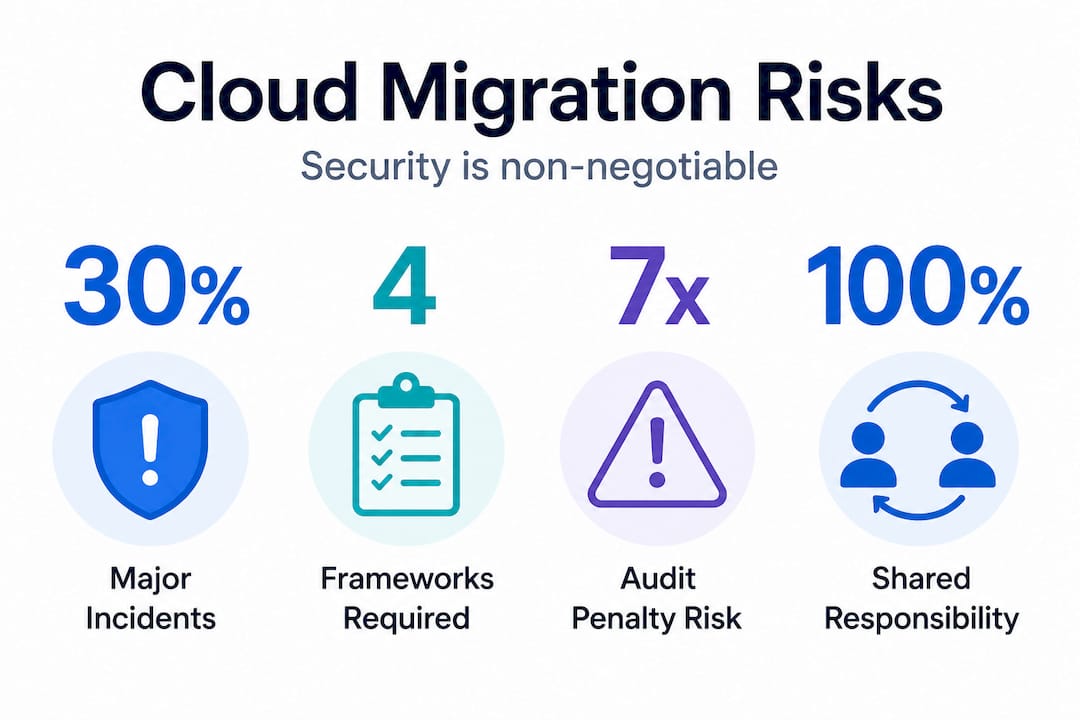
The numbers make this clear. Organizations experience major security incidents in roughly 30% of cloud migrations, and the average breach in the financial sector costs $5.9M. These are not edge cases. They are predictable outcomes when security is treated as a phase-two concern.
The good news is that the reverse is also true. One financial services provider migrated workloads to Azure with DORA compliance as a hard requirement from day one. The result was a 22% operational cost reduction and 99.99% availability post-migration. Those are not coincidental outcomes. Security-driven design forced better architecture decisions, which led directly to operational efficiency and resilience. Our own cloud migration case studies show a similar pattern: clients who invest in security planning early consistently achieve faster go-lives and fewer post-migration incidents.
Here is what security-first migration actually delivers when executed well:
- Reduced breach risk during the most vulnerable window of your infrastructure lifecycle
- Compliance readiness from go-live rather than after an audit finding
- Lower total remediation cost by fixing misconfigurations before they reach production
- Operational resilience through better access controls and network segmentation
- Faster regulatory approval because evidence is built in, not assembled after the fact
“Security in cloud migration is not a gate you pass through. It is the architecture you build from the ground up. Organizations that treat it as a final checkpoint pay for that mistake in breach costs and compliance penalties.”
The key shift for IT decision-makers is recognizing that migration is not a lift-and-shift of existing security posture. It is an opportunity to modernize your entire risk profile, but only if security owns a seat at the table from the project kickoff.
Key security risks and regulatory obligations
Cloud environments introduce attack surfaces that on-premises setups do not have in the same form. Identity and access sprawl, misconfigured storage buckets, and unencrypted data in transit are among the fastest routes to a breach. Understanding these risks specifically is what allows you to map them to compliance controls before a single server is moved.
The most common security failures during migration fall into predictable categories:
- Misconfigured cloud assets such as open S3 buckets or overly permissive IAM roles
- Incomplete data transfer controls that leave sensitive records in unprotected intermediate states
- Weak identity controls including shared credentials, missing multi-factor authentication, and orphaned service accounts
- Missing encryption for data at rest and in transit during the cutover window
- Inadequate logging that leaves you blind to anomalous activity during migration execution
For compliance-focused organizations, regulatory requirements add another layer of structured obligation. U.S. cloud migration compliance involves four primary frameworks: HIPAA (which requires six-year log retention and signed Business Associate Agreements, or BAAs, with cloud providers), PCI DSS v4.0 (which specifies 12 security requirements covering everything from network controls to regular testing), NIST SP 800-53 (which defines 20 control families applicable to federal and regulated commercial environments), and FedRAMP (which is mandatory for any cloud service processing U.S. federal data).

Data residency and encryption key management are critical in all four frameworks. Knowing where your data physically lives and who controls the encryption keys is not optional. It is the foundation of demonstrable compliance. Read more about the specifics in our PCI compliance for cloud migration breakdown.
| Framework | Primary applicability | Key requirement | Log retention |
|---|---|---|---|
| HIPAA | Healthcare and business associates | BAA with cloud provider | 6 years |
| PCI DSS v4.0 | Payment card data environments | 12 security requirement domains | 1 year minimum |
| NIST SP 800-53 | Federal and regulated enterprise | 20 control families | Varies by system |
| FedRAMP | U.S. federal cloud services | Authorized cloud service provider | 90 days active |
Pro Tip: Run a compliance gap analysis before you migrate a single workload. Map your current configuration against each required control, and flag every gap as a migration dependency. This prevents the common scenario where a team discovers mid-migration that their encryption approach doesn’t satisfy PCI DSS v4.0 requirements.
Regulatory obligations are not static. PCI DSS v4.0, which took full effect in 2024, introduced new requirements around multi-factor authentication and customized implementation options. Teams migrating in 2026 need to work against the current version, not the 2018 guidance their policy documents may still reference.
Security frameworks and best practices for cloud migration
Knowing the risks is not enough. You need an operational approach that makes security decisions systematic rather than reactive. The most effective migrations we work on use structured risk assessment from the first planning session.
The Likelihood x Impact matrix scores each identified risk from 1 to 25 by multiplying the probability of occurrence by the business impact if it materializes. This approach forces prioritization. A risk with a score of 20 gets addressed in the architecture. A score of 4 goes on a watch list. Without this structure, teams tend to spend equal energy on high and low risks, which exhausts bandwidth before the critical controls are in place.
Beyond risk scoring, the operational mechanics that matter most include:
- Asset mapping before any workload moves, documenting every data store, application dependency, and third-party integration
- Configuration consistency checks to ensure cloud resource settings match your baseline security policy, not just default provider settings
- Infrastructure-as-code (IaC) with security scanning so that every resource deployment is codified, version-controlled, and reviewed for security issues before provisioning
- CSPM (Cloud Security Posture Management) tools for continuous monitoring that flags drift from your security baseline in real time
- CASB (Cloud Access Security Broker) deployment for visibility and control over SaaS, IaaS, and PaaS usage across the environment
| Practice | Tool category | When to implement | Primary benefit |
|---|---|---|---|
| Asset mapping | CMDB / discovery tools | Pre-migration planning | Eliminates unknown attack surface |
| IaC security scanning | SAST for IaC (e.g., Checkov) | Before first deployment | Prevents misconfigurations at source |
| CSPM continuous monitoring | Cloud-native or third-party | At go-live and ongoing | Active drift and threat detection |
| CASB deployment | Network security | During migration execution | SaaS/PaaS access visibility |
| Identity access reviews | IAM tooling | Post-migration and quarterly | Removes excess privilege |
The AWS Secure Migrations Framework aligns security controls directly with business strategy rather than treating them as an overlay. It recommends DevSecOps as the operating model, which means security testing, code review, and compliance checks are built into the CI/CD pipeline rather than performed as separate audits. This matters because manual security reviews cannot keep pace with the velocity of a cloud migration project. Automation can.
Read how our team approaches DevOps for secure migration and cloud-native DevOps security to see this in practice.
Pro Tip: Integrate security scanning into your CI/CD pipelines from the first deployment, not after you’ve established your baseline. Every day those pipelines run without security checks is a day misconfigured resources could accumulate in your environment unchecked.
The most important cultural shift DevSecOps requires is that developers and infrastructure engineers stop treating security tooling as a blocker. When scanning tools surface findings early in the pipeline, the fix is a two-minute code change, not a two-week remediation project.
How to ensure ongoing governance, monitoring, and compliance
Getting to go-live is not the finish line. The production cloud environment is where most compliance violations actually occur, not during migration. Governance and monitoring need to be operational from day one in production and sustained indefinitely.
The NIST Risk Management Framework (RMF) provides a seven-step cycle that compliance officers can use as a structured governance backbone: Prepare, Categorize, Select, Implement, Assess, Authorize, and Monitor. Each step has defined outputs and accountability. Mapping your migration project to this cycle ensures that security controls are formally assessed and authorized before workloads process production data.
Ongoing compliance requires specific operational controls:
- Centralized audit logging with retention periods that satisfy your applicable frameworks, ranging from 90 days for FedRAMP active logs to six years for HIPAA records
- Automated response playbooks for common threat scenarios, such as unauthorized API calls or unusual data egress patterns
- Quarterly access reviews to verify that service accounts, federated identities, and privileged roles reflect current business need
- Business Associate Agreements confirmed and documented with every cloud service touching HIPAA-covered data
- Regular penetration testing and vulnerability scanning as required by PCI DSS v4.0
“Audit readiness is not something you achieve once. It is a state you maintain through continuous monitoring, documented controls, and regular validation. Organizations that treat it as a point-in-time exercise consistently fail audits on the first review.”
DevOps-driven monitoring connects operational visibility with the compliance audit trail your team needs during a regulatory review. When your monitoring is codified and automated, you can generate evidence of control effectiveness on demand rather than scrambling when an auditor arrives.
Pro Tip: For FedRAMP and other high-stakes environments, use an independent Third-Party Assessment Organization (3PAO) to validate your control implementation before authorization. Self-assessment alone will not satisfy agency Authorizing Officials and often misses the control gaps that matter most.
The access review process deserves special attention. Over time, cloud environments accumulate permissions that were granted for a specific project or migration task and never revoked. A quarterly access review, with clear ownership and an automated report as input, prevents privilege creep from becoming a material security risk.
Why most cloud migrations fall short on security and how to change that
After working on hundreds of cloud projects since 2010, a pattern emerges that is worth naming directly: most organizations delegate security upward to the vendor and downward to the security team, leaving the gap in between entirely unaddressed.
Cloud providers are not your security team. AWS, Azure, and Google Cloud secure the physical infrastructure and the underlying platform. Everything above that, including your configurations, your IAM policies, your encryption key rotation schedule, and your compliance posture, belongs to you. This is the shared responsibility model, and it is consistently misunderstood, not because it is complicated, but because it is easy to assume someone else is handling the parts you can’t see.
The second failure pattern is treating security as a checklist rather than a capability. A checklist gets completed once and filed. A capability gets tested, updated, and improved continuously. Organizations that pass their first post-migration audit but fail the second one almost always made this mistake.
The third failure, and the one that is hardest to fix, is investing in perimeter tools without building internal visibility. Firewalls and WAFs are necessary. But if your team cannot answer basic questions about which resources are exposed, who has access to them, and what changed in the last 24 hours, then the perimeter tools are protecting a box you can’t see inside.
The organizations that get this right do a few things differently. They assign security ownership to specific people across engineering, compliance, and operations, not just to the CISO. They build automation before they need it, so that policy enforcement is not dependent on someone remembering to run a script. And they make risk-based decisions with cross-functional buy-in, so that every team understands what they’re trading off when they accept a risk or deprioritize a control.
See how this approach plays out in our real-world migration success stories.
Put your migration security strategy into action
Cloud migration done right requires more than good intentions. It requires deep technical execution, compliance knowledge, and the operational discipline to maintain security controls after go-live.
At IT-Magic, we have been delivering secure cloud migrations for compliance-focused enterprises since 2010, with 700+ projects completed for clients in fintech, healthcare-adjacent, and enterprise environments. Our certified AWS experts handle the architecture, automation, and ongoing operations so your team can focus on business outcomes. Explore our migration-enabling technologies and see the results in our cloud migration case study. If Kubernetes is part of your target architecture, our Kubernetes support team can help you operationalize it securely from the start.
Frequently asked questions
What are the most common security risks during cloud migration?
The leading risks include misconfigured cloud assets, incomplete data transfer controls, weak identity management, and gaps in compliance coverage. Nearly 30% of migrations result in significant security incidents when these are not addressed proactively.
Which compliance frameworks should guide a U.S. cloud migration?
U.S. organizations should align to NIST SP 800-53, FedRAMP, PCI DSS v4.0, and HIPAA based on their industry and data types, as these frameworks define the specific technical and administrative controls required.
How do you ensure audit-readiness after migrating to the cloud?
Maintain centralized logging with retention periods matching your applicable framework, from 90 days to 7 years depending on the regulation, and schedule quarterly access reviews to demonstrate ongoing control effectiveness.
Why can’t we rely solely on our cloud provider for security?
Cloud providers secure the physical infrastructure and platform layer, but your configurations, access policies, and regulatory compliance posture are your responsibility under the shared responsibility model.
What is the role of DevSecOps in cloud migration security?
DevSecOps integrates security checks and policy enforcement into the CI/CD pipeline, meaning security for SaaS, IaaS, and PaaS is validated automatically at every deployment rather than reviewed manually after the fact.
Recommended
- AWS cloud security: 7 essential strategies for 2026
- AWS Cloud Security: Best Practices, Tools & Complete Guide | IT-Magic
- What Is Cloud Migration? Key Types, Benefits & Process Explained | IT-Magic
- Cloud Migration Strategies: Everything You Need to Know | IT-Magic
Alexander founded IT-Magic, an AWS Advanced Tier Services Partner delivering DevOps, cloud architecture, and managed services since 2010. He holds:
- AWS Certified Solutions Architect – Professional
- AWS Certified DevOps Engineer – Professional
- AWS Certified Security – Specialty
- AWS Certified Advanced Networking – Specialty
Talk to a certified AWS team trusted by INTERTOP, Foxtrot, Pandora, and J.Hilburn.
Get a free consultation