

TL;DR:
- Manual infrastructure management often leads to technical debt until failures occur in production. Infrastructure as code automates resource provisioning by defining IT components in machine-readable files, enabling reproducibility and testing. Embracing IaC as a cultural shift improves reliability, security, and scaling for both startups and large enterprises.
Manual infrastructure management is a liability most organizations don’t recognize until something breaks in production. What is infrastructure as code? It’s the practice of replacing manual console clicks and one-off scripts with machine-readable configuration files that provision, update, and manage your cloud resources automatically. If your team is still spinning up servers by hand, configuring networks through a UI, or relying on a single engineer’s memory to recreate an environment, you’re carrying technical debt that compounds with every new deployment. This guide covers IaC concepts, core approaches, leading tools, real benefits, and how to start implementing it.
Key Takeaways
| Point | Details |
|---|---|
| IaC automates infrastructure | Infrastructure as code lets you manage IT infrastructure through machine-readable code, replacing manual setup processes. |
| Declarative vs imperative | Declarative IaC defines the desired state, while imperative IaC specifies explicit steps to achieve it, with declarative being more common today. |
| Tools like Terraform matter | Terraform and CloudFormation are popular IaC tools that use configuration files and state management to provision cloud resources reliably. |
| Version control and auditability | IaC configurations can be version-controlled and audited, improving collaboration and reducing errors in infrastructure changes. |
| Adoption requires best practices | Effective IaC implementation depends on managing state properly, integrating with CI/CD, and avoiding manual changes outside code. |
What is infrastructure as code? A clear definition
Running this on your own AWS setup? IT-Magic is an AWS Advanced Tier Partner — we audit, fix, or fully manage it for you.
Get a free consultationInfrastructure as code (IaC) means your servers, networks, storage, databases, and platform components are defined in code rather than configured manually. Instead of logging into a console and clicking through settings, your team writes configuration files that describe exactly what the infrastructure should look like. A tool then reads those files and provisions the resources accordingly.
Infrastructure as code is the practice of defining and managing infrastructure using machine-readable configuration files, rather than manual console clicks or ad-hoc scripts, so that IaC tools provision, update, and manage resources to match the desired state defined in code.
Think of it this way: just as application developers write code to define how software behaves, infrastructure teams write code to define how infrastructure is built. That analogy matters more than it sounds because it means infrastructure can now be reviewed, tested, versioned, and automated the same way your application is.
Resources typically managed through IaC include:
- Compute resources: Virtual machines, containers, serverless functions
- Networking components: VPCs, subnets, security groups, load balancers
- Storage: S3 buckets, EBS volumes, database instances
- Platform services: IAM roles and policies, DNS records, monitoring configurations
- Orchestration layers: Kubernetes clusters, ECS task definitions
Understanding cloud infrastructure at this level is the starting point for deciding what to automate and how. The key outcome is reproducibility. When infrastructure is code, you can recreate an identical environment from scratch in minutes, whether for a new region, a staging environment, or disaster recovery.
Understanding declarative vs imperative IaC approaches
Having defined IaC, let’s explore the core approaches teams use to write infrastructure code. The distinction here is not just academic. It has direct implications for reliability, maintainability, and the risk of human error at scale.
IaC typically uses declarative and imperative paradigms: declarative IaC lets teams describe the desired end state while the tool determines how to reach it, while imperative approaches describe specific steps and sequences to configure infrastructure.
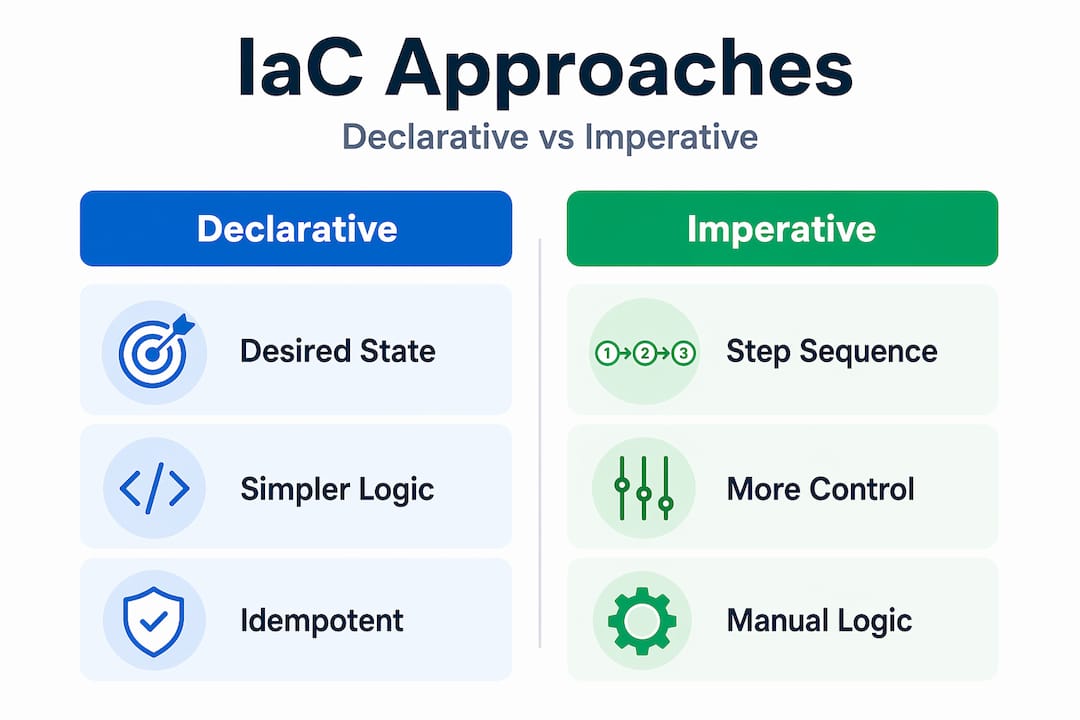
| Attribute | Declarative | Imperative |
|---|---|---|
| You define | What should exist | How to create it |
| Example tools | Terraform, CloudFormation, Pulumi | Ansible (procedural mode), shell scripts |
| Idempotent by default | Yes | Not always |
| Risk of drift | Lower | Higher |
| Best for | Cloud resource provisioning | Configuration management, task automation |
Idempotence is worth pausing on. It means you can run the same configuration repeatedly and get the same result every time. With declarative IaC, if a resource already exists and matches the desired state, the tool skips it. With imperative scripts, running the same script twice might create duplicate resources or throw errors.
Declarative IaC is generally preferred for cloud provisioning because it removes the burden of sequencing logic from the engineer. You don’t need to worry about whether the VPC must be created before the subnet or whether the security group must exist before the EC2 instance. The tool handles dependency resolution.
This directly supports better CI/CD practices, where infrastructure changes need to be applied predictably across multiple environments without manual intervention.
Pro Tip: Even if your team uses a declarative tool like Terraform, resist the urge to use provisioners (inline scripts inside Terraform) for configuration tasks. That mixes paradigms and introduces imperative logic where declarative tools expect clean state.
IaC tools in action: Terraform and AWS CloudFormation examples
To see IaC in practice, let’s examine two major tools powering cloud infrastructure automation. Both are widely adopted, though they serve slightly different use cases and organizational contexts.
Terraform uses HashiCorp Configuration Language (HCL), a human-readable declarative syntax, to define resources across cloud providers. You describe a resource (say, an S3 bucket or an RDS instance), run "terraform planto preview changes, andterraform apply` to provision them. Terraform state management is central to how it works: state files store bindings between your configuration and real-world resources, which drives accurate provisioning and updates. Without proper state management, Terraform loses track of what it created and risks creating duplicates or failing to destroy resources cleanly.

AWS CloudFormation takes a different approach. CloudFormation models and provisions AWS resources by treating infrastructure as code: you write a JSON or YAML template describing desired AWS resources, and CloudFormation provisions and configures them as a “stack.” Stacks can be created, updated, and deleted as a unit, which makes it easier to manage dependencies between related resources.
| Feature | Terraform | AWS CloudFormation |
|---|---|---|
| Configuration language | HCL (also JSON) | JSON or YAML |
| Cloud scope | Multi-cloud | AWS only |
| State storage | Remote backends (S3, Terraform Cloud) | Managed by AWS |
| Drift detection | Manual or automated via Atlantis | Built-in |
| Best for | Multi-cloud or hybrid environments | AWS-native teams |
Both tools automate the full lifecycle of cloud infrastructure, from initial creation to ongoing updates to final teardown. The choice between them often comes down to whether you’re all-in on AWS or managing infrastructure across multiple providers.
Pro Tip: If you’re starting with Terraform in AWS, store state in an S3 bucket with DynamoDB locking from day one. Migrating state storage later is painful and introduces operational risk during the transition.
Benefits and challenges of infrastructure as code for startups and enterprises
Now that we’ve seen tools in action, let’s explore the concrete benefits and real-world challenges of adopting IaC. For IT decision-makers, this is where the business case gets built or collapses.
The benefits are substantial:
- Version control and audit trails: Every infrastructure change is committed to Git, reviewed, and traceable. You know who changed what, when, and why.
- Reduced configuration drift: IaC configurations are version-controlled, enabling automated testing and CI/CD deployment, which reduces drift and ensures consistent environments across dev, staging, and production.
- Faster environment provisioning: A new environment that used to take days of manual setup can be created in minutes by running a pipeline.
- Security and compliance by default: Security group rules, IAM policies, and encryption settings are defined in code and applied consistently, rather than configured differently by each engineer.
- Cost visibility: When infrastructure is code, it’s easier to identify unused or over-provisioned resources before they accumulate cost.
The desired state model in IaC is what makes these benefits sustainable. Instead of chasing discrepancies between environments, the code is the truth.
The challenges are real too. Misunderstandings of Terraform state can cause destructive updates if resources are managed outside IaC and not reconciled. If someone creates a resource manually in the AWS console and that resource conflicts with what Terraform expects, the next apply can delete or overwrite it. This is one of the most common sources of outages in teams transitioning to IaC.
“The biggest risk in IaC adoption isn’t choosing the wrong tool. It’s allowing engineers to make infrastructure changes outside the IaC workflow. The moment someone bypasses the code, the state diverges and your automation becomes unreliable.”
Scaling IaC also requires discipline. Managing hundreds of modules across multiple teams and environments introduces complexity around module versioning, access control, and infrastructure monitoring to catch drift before it causes incidents.
Pro Tip: Enforce a policy that no infrastructure changes are made outside IaC. Use AWS Service Control Policies (SCPs) or Terraform’s prevent_destroy lifecycle rule to add guardrails that back up this cultural rule with technical enforcement.
Implementing infrastructure as code: Practical steps for IT decision-makers
After understanding benefits and challenges, let’s discuss practical steps to successfully implement IaC in your organization.
-
Inventory your current infrastructure: Before writing a single line of code, document what you have. Servers, networks, databases, security configurations. You can’t automate what you haven’t defined.
-
Choose tools that fit your environment: For AWS-native teams, CloudFormation or the AWS CDK are natural fits. For multi-cloud or teams wanting a broader ecosystem, Terraform is the industry standard. Defining infrastructure declaratively lets teams review and test changes like application code, enabling consistent rollouts across environments.
-
Start with a low-risk environment: Don’t begin by converting your production infrastructure. Start with a dev or staging environment where mistakes are recoverable and your team can build confidence.
-
Integrate with version control and CI/CD: Every infrastructure change should go through a pull request, get reviewed, and be applied by a pipeline rather than by hand. This is where CI/CD and IaC genuinely reinforce each other.
-
Establish a state management policy: Decide from the start where state lives, who can access it, and how state locking is enforced. Remote state with access controls is non-negotiable for teams beyond two engineers.
-
Monitor for drift continuously: Set up automated drift detection so you know immediately when real-world infrastructure diverges from your code. Drift left undetected becomes a security and reliability risk.
For decision-makers evaluating where to begin, IT consulting on IaC readiness can shortcut months of trial-and-error. A structured cloud infrastructure assessment helps identify which components to automate first and which tools to standardize on.
Pro Tip: Build an IaC checklist for every new project: repository structure, state backend configuration, module naming conventions, tagging policies, and CI/CD pipeline integration. This becomes your team’s infrastructure as code guide for onboarding and audits.
Why treating infrastructure as code is a game changer for cloud operations
Here’s a perspective most IaC articles miss. The tools are not the transformation. Terraform and CloudFormation are just software. The real shift is cultural: moving infrastructure from tribal knowledge locked inside a few engineers’ heads into auditable, repeatable code that any qualified team member can understand and modify.
Microsoft’s DevOps guidance emphasizes that IaC deployments are repeatable and designed to avoid runtime configuration drift, proving why treating code as the single source of truth matters operationally. We’ve seen this validated across 700+ projects at IT-Magic. The teams that struggle most with IaC adoption are not those who chose the wrong tool. They’re the ones where senior engineers still make ad-hoc changes in the console, treating IaC as optional rather than mandatory.
There’s also a security dimension that’s often underplayed. When infrastructure configuration lives in code, it goes through code review. Security teams can audit IAM policies, network configurations, and encryption settings before they’re applied. That’s a fundamentally different security posture than discovering a misconfigured security group after a breach.
The importance of infrastructure as code becomes clearest at scale. A startup with five engineers can survive on manual processes. An enterprise with 50 engineers across three cloud regions cannot. IaC is what makes DevOps at scale operationally viable rather than theoretically appealing.
The teams that get the most from IaC treat it as an engineering discipline with the same rigor they apply to application development: code standards, peer review, automated testing, and continuous monitoring. That’s not a technology decision. It’s a cultural one.
Enhance your cloud and DevOps strategy with IT-Magic’s expertise
Taking full advantage of IaC’s benefits requires more than picking the right tool. It requires the right architecture, the right processes, and experienced engineers who’ve solved these problems before.
At IT-Magic, we help startups and enterprises design and implement IaC-driven cloud environments on AWS that are secure, cost-efficient, and built to scale. Our AWS Well-Architected review identifies gaps in your current infrastructure and gives you a concrete action plan. We also provide Kubernetes support for teams managing containerized workloads at scale. If you want to see what results look like, our Intertop case study shows how we delivered measurable infrastructure improvements and cost savings using IaC practices on AWS.
Frequently asked questions
What exactly is infrastructure as code?
Infrastructure as code is the practice of managing and provisioning IT infrastructure using machine-readable configuration files rather than manual setup, enabling automation, repeatability, and consistent environments across your cloud operations.
What are the differences between declarative and imperative IaC?
Declarative IaC describes the desired end state and lets tools determine how to reach it, while imperative IaC specifies explicit commands or steps to configure infrastructure, which requires more sequencing logic from the engineer.
Why is managing state important in IaC tools like Terraform?
State management lets IaC tools track real-world resources and their mappings to configuration code; improper handling causes configuration drift or accidental destructive changes when resources are modified outside the IaC workflow.
How does IaC improve collaboration between developers and operations teams?
IaC treats infrastructure like application code, which means it can be version-controlled, reviewed in pull requests, and tested automatically. IaC configurations are shareable and reviewable, applying the same engineering practices to infrastructure that developers already use for applications.
Can IaC help reduce cloud infrastructure costs?
Yes. By automating provisioning and enforcing consistent configurations, IaC prevents the over-provisioning and manual errors that quietly inflate cloud bills. Consistent IaC rollouts reduce configuration drift, which is one of the most common sources of unnecessary cloud spending.
Alexander founded IT-Magic, an AWS Advanced Tier Services Partner delivering DevOps, cloud architecture, and managed services since 2010. He holds:
- AWS Certified Solutions Architect – Professional
- AWS Certified DevOps Engineer – Professional
- AWS Certified Security – Specialty
- AWS Certified Advanced Networking – Specialty
Talk to a certified AWS team trusted by INTERTOP, Foxtrot, Pandora, and J.Hilburn.
Get a free consultation