


TL;DR:
- Ecommerce cloud infrastructure combines scalable services to ensure high performance and reliability for online retail. Proper design of components like compute, databases, caching, and security supports scalability and consistent user experience worldwide. Focus on architecture and integration, with Infrastructure-as-Code and event-driven models, is crucial for operational stability in retail environments.
Ecommerce cloud infrastructure is the combination of cloud-based services and technologies that power scalable, high-performance online retail platforms. The industry standard for serious operations targets 99.99% uptime SLAs, PCI DSS compliance, and NVMe SSD storage as baseline quality benchmarks. Choosing the right cloud hosting for ecommerce is not a one-time decision. It shapes how your store handles traffic spikes, protects payment data, and delivers product pages to customers in Tokyo as fast as customers in Texas. This guide breaks down the components, trade-offs, and design decisions that determine whether your infrastructure holds up or falls apart.
What are the core components of ecommerce cloud infrastructure?
Ecommerce cloud infrastructure is built from several distinct technology layers. Each layer handles a specific job, and a failure in any one of them affects the entire customer experience.
Compute
The compute layer runs your application code. Container-based services like AWS ECS Fargate let you run microservices without managing the underlying servers. Each service, whether it handles product search, cart logic, or checkout, runs independently. That separation means a spike in search traffic does not slow down your checkout process.

Databases and caching
Transactional databases like Aurora PostgreSQL handle order records, user accounts, and inventory counts. They are built for consistency, meaning every write is durable and every read reflects the latest state. Caching layers like ElastiCache Redis sit in front of the database and serve frequently requested data, such as session tokens and product catalog pages, from memory. That reduces database load and cuts response times from milliseconds to microseconds.
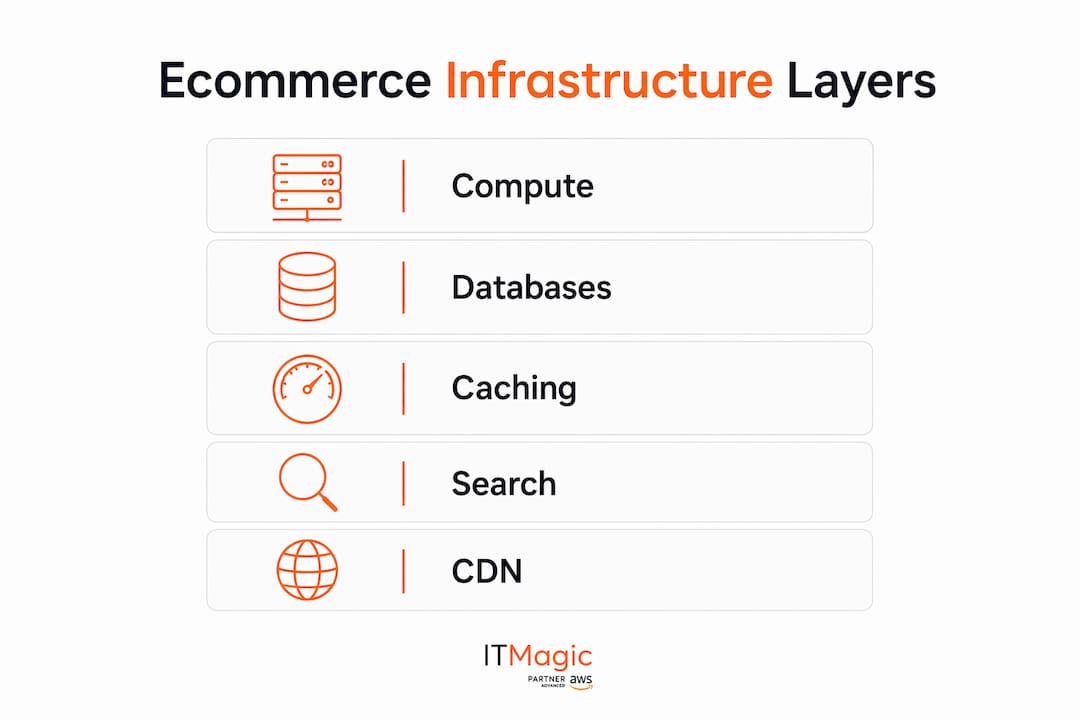
Search and queuing
Product discovery depends on a dedicated search service. OpenSearch indexes your catalog and returns ranked results based on relevance, filters, and user behavior. Without a dedicated search layer, your database handles every search query directly, which degrades performance at scale. SQS queues decouple order placement from order processing. When a customer clicks “buy,” the order goes into a queue rather than directly triggering every downstream system at once. That design prevents a processing bottleneck from blocking the checkout experience.
Content delivery and Infrastructure-as-Code
CloudFront and similar CDN services cache static assets, including images, JavaScript, and CSS, at edge locations worldwide. A customer in Berlin loads your product images from a Frankfurt edge node, not from your origin server in Virginia. The round-trip time drops from hundreds of milliseconds to single digits. Infrastructure-as-Code tools like Terraform define your entire stack, from ECS task definitions to Aurora DB clusters to CloudFront distributions, as version-controlled code. That eliminates configuration drift and lets you spin up identical environments in minutes.
- Compute: ECS Fargate or EKS for containerized microservices
- Database: Aurora PostgreSQL for transactional consistency
- Cache: ElastiCache Redis for session and catalog data
- Search: OpenSearch for product discovery and filtering
- Queue: SQS for decoupled order workflows
- CDN: CloudFront for global static asset delivery
- IaC: Terraform for repeatable, auditable provisioning
Pro Tip: Version your Terraform state files in S3 with DynamoDB locking. That prevents two engineers from applying conflicting changes simultaneously, which is the most common cause of configuration drift in fast-moving ecommerce teams.
How does ecommerce cloud infrastructure support scalability and performance?
Running this on your own AWS setup? IT-Magic is an AWS Advanced Tier Partner — we audit, fix, or fully manage it for you.
Get a free consultationScalability is not a feature you add later. It is a design property you build in from the start. The mechanisms that make cloud hosting for ecommerce genuinely elastic are auto-scaling, CDN distribution, and event-driven architecture working together.
Auto-scaling monitors CPU utilization, request queue depth, or custom metrics and adds or removes compute capacity automatically. During a flash sale, your ECS service scales from 4 tasks to 40 in under two minutes. When traffic drops, it scales back down and stops billing you for idle capacity. That elasticity is what separates cloud-based retail solutions from fixed-capacity hosting.
Enterprise-scale ecommerce infrastructure handles over 600 million SKUs, 250 million API calls, and 1 billion inventory updates daily. That volume is only possible with fully distributed, asynchronous architecture where no single service becomes a bottleneck.
The four mechanisms that make this scale achievable are:
- Horizontal auto-scaling adds compute instances based on real-time load metrics, not scheduled guesses.
- CDN edge caching serves static and semi-static content from locations close to the customer, reducing origin server load by a large margin.
- Asynchronous event-driven processing uses SQS and SNS to decouple services, so a spike in order volume does not cascade into checkout failures.
- Multi-region deployment distributes your application across AWS regions, reducing latency for international customers and providing geographic redundancy.
CDNs and multi-region deployments reduce global latency and enable cross-border sales without duplicating your entire infrastructure stack. A single well-architected deployment can serve customers across continents with consistent performance.
Pro Tip: Set your auto-scaling policies to trigger at 60% CPU utilization, not 80%. Scaling at 80% means you are already degraded by the time new capacity comes online. The extra buffer costs almost nothing during normal traffic.
What integration challenges do ecommerce businesses face in cloud infrastructure?
Platform selection is often treated as the finish line. The real complexity starts after go-live, when your ecommerce platform needs to exchange data with your PIM, OMS, ERP, payment gateway, and fulfillment systems in real time.
Real operational complexity in ecommerce arises from integration, data flow, and compliance handling across distributed systems. A product update in your PIM must propagate to your storefront, your search index, and your fulfillment system within seconds. An order placed on your storefront must trigger inventory reservation, payment capture, and warehouse notification simultaneously. When those connections are fragile, customers see stale prices, failed checkouts, and delayed shipments.
The traditional approach uses point-to-point integrations, where each system connects directly to every other system it needs. That model breaks quickly. Adding a new system means building connections to every existing system. Debugging a data mismatch requires tracing through a web of direct API calls with no central visibility.
- Point-to-point integrations create exponential complexity as system count grows
- Legacy iPaaS platforms add middleware overhead without solving the underlying coupling problem
- Unified API layers expose a single endpoint per data domain, masking backend complexity
- Event-driven orchestration uses a cloud-native message bus to trigger serverless workflows when data changes
Unified APIs reduce maintenance overhead and enable integration launches in days rather than months. Instead of building a custom connector between your OMS and your 3PL, you publish an order event to a message bus and let each downstream system subscribe to what it needs. Adding a new fulfillment partner means adding a new subscriber, not rewriting existing connections.
Event-driven orchestration with serverless workflows enables real-time data synchronization between your ecommerce platform and backend systems without maintaining persistent connections. That reduces infrastructure cost and eliminates the single points of failure that plague synchronous integration architectures.
Understanding how ecommerce data integration affects retail growth helps clarify why the architecture of your integration layer matters as much as the platform itself.
Pro Tip: Build your integration layer around events, not API polling. Polling creates unnecessary load and introduces latency. An event published when an order is placed reaches every subscriber in under a second, with no wasted requests.
How can ecommerce businesses design infrastructure for security and compliance?
Security in ecommerce cloud environments is not a checklist you complete before launch. It is an ongoing operational practice built into every layer of your infrastructure.
PCI DSS compliance governs how you handle cardholder data. At the infrastructure level, that means network segmentation, encryption in transit and at rest, access logging, and regular vulnerability scanning. Failing a PCI audit does not just create legal exposure. It can result in losing your ability to process card payments entirely.
Adaptive cloud hosting applies WAFs, rate limiting, and observability automatically at the infrastructure layer, improving security without requiring a platform overhaul. A Web Application Firewall inspects every HTTP request before it reaches your application. It blocks SQL injection attempts, cross-site scripting payloads, and malformed requests that exploit application vulnerabilities. Rate limiting prevents credential stuffing attacks by capping the number of login attempts per IP address per minute.
The key security controls for ecommerce cloud environments are:
- WAF rules block application-layer attacks before they reach your code
- Rate limiting stops brute-force and credential-stuffing attacks at the edge
- Bot IP shields identify and block known malicious IP ranges automatically
- PCI DSS network segmentation isolates cardholder data environments from general application traffic
- Observability tooling provides real-time alerting on anomalous traffic patterns and error rates
Observability means more than logging. It means correlating metrics, traces, and logs across every service so you can identify the exact moment and location where an incident began. A spike in 5xx errors from your checkout service, combined with a drop in database connection pool availability, tells a specific story. Without that correlation, you are guessing.
Pro Tip: Implement AWS GuardDuty and Security Hub from day one, not as an afterthought. They provide continuous threat detection across your AWS account with almost no configuration overhead, and they surface findings that manual log review would miss entirely.
Key takeaways
Ecommerce cloud infrastructure requires deliberate design across compute, integration, security, and scalability layers to support reliable, high-performance online retail operations.
| Point | Details |
|---|---|
| Layer-by-layer architecture | Build compute, database, cache, search, and CDN as separate layers to isolate failures and scale independently. |
| IaC prevents configuration drift | Use Terraform to define your full stack as code, enabling fast provisioning and consistent environments. |
| Integration design is critical | Design your integration layer around events and unified APIs before go-live, not after problems appear. |
| Security must be built in | Apply WAF, rate limiting, PCI DSS segmentation, and observability from the start, not as post-launch additions. |
| Auto-scaling needs early triggers | Set scaling thresholds at 60% utilization to maintain performance headroom during traffic spikes. |
Why platform choice is the wrong place to start
After working on AWS infrastructure for ecommerce businesses across fintech, retail, and marketplace verticals, the pattern I see most often is this: teams spend months evaluating platforms and almost no time designing the integration and data flow architecture that will actually determine whether the system works in production.
The platform is a solved problem. Every major cloud-native ecommerce platform can handle the traffic. What breaks systems is the gap between the platform and the rest of the business. The OMS that was not designed to receive events. The PIM that exports a CSV file once a night. The payment gateway that requires a synchronous API call in the middle of the checkout flow.
Infrastructure-as-Code using Terraform is the single practice I recommend most strongly to teams that want operational stability. When your entire environment is defined in code, a misconfigured security group or a missing environment variable is a one-line fix with a pull request and a review. Without IaC, the same problem becomes a two-hour debugging session and a post-mortem.
Event-driven service decoupling using SQS queues is the second practice that separates systems that survive peak traffic from systems that collapse under it. When your checkout service publishes an order event and walks away, it does not care whether your warehouse system is slow, your fraud detection service is restarting, or your email provider is having an outage. The order is captured. Everything else catches up.
My honest recommendation: spend at least as much time designing your integration architecture and observability stack as you spend selecting your ecommerce platform. The platform is the easy part.
— Oleksandr
IT-Magic’s AWS expertise for ecommerce teams
IT-Magic has delivered cloud infrastructure for ecommerce businesses since 2010, with over 700 projects completed for more than 300 clients across retail, fintech, and marketplace verticals.
For ecommerce teams running containerized workloads, IT-Magic’s Kubernetes support services cover cluster design, EKS deployment, auto-scaling configuration, and ongoing operations. For teams looking to reduce cloud spend without sacrificing performance, IT-Magic’s AWS cost optimization practice identifies idle resources, right-sizes compute, and implements Reserved Instance strategies that cut monthly bills without touching application code. Both services are delivered by certified AWS engineers who specialize in ecommerce infrastructure, not general-purpose cloud consulting.
FAQ
What is ecommerce cloud infrastructure?
Ecommerce cloud infrastructure is the set of cloud-based services, including compute, databases, caching, CDN, and security tools, that power online retail platforms. It provides the scalability, performance, and compliance controls that ecommerce businesses need to operate reliably.
What uptime should ecommerce cloud platforms target?
High-performance ecommerce infrastructure targets a 99.99% uptime SLA, which translates to less than one hour of downtime per year. Anything below that threshold creates measurable revenue loss during outages.
How does auto-scaling work for ecommerce?
Auto-scaling monitors real-time metrics like CPU utilization or queue depth and adds compute capacity automatically when thresholds are crossed. Setting triggers at 60% utilization, rather than 80%, gives your system headroom to scale before performance degrades.
Why is Infrastructure-as-Code important for ecommerce?
Terraform and similar IaC tools eliminate configuration drift by defining every resource as version-controlled code. That means faster disaster recovery, consistent environments across staging and production, and auditable change history.
What does PCI DSS compliance require at the infrastructure level?
PCI DSS requires network segmentation to isolate cardholder data, encryption in transit and at rest, access logging, and regular vulnerability scanning. These controls must be implemented at the infrastructure layer, not just within the application code.
Alexander founded IT-Magic, an AWS Advanced Tier Services Partner delivering DevOps, cloud architecture, and managed services since 2010. He holds:
- AWS Certified Solutions Architect – Professional
- AWS Certified DevOps Engineer – Professional
- AWS Certified Security – Specialty
- AWS Certified Advanced Networking – Specialty
Talk to a certified AWS team trusted by INTERTOP, Foxtrot, Pandora, and J.Hilburn.
Get a free consultation