

TL;DR:
- Hiring a DevOps engineer is advisable when a team reaches ten or more members, or cloud expenses surpass $20,000 monthly. These thresholds reflect infrastructure complexity that exceeds what developers can manage alone and indicate a need for specialized operational expertise. Clear role definition and appropriate hiring models are essential to ensure the engineer effectively addresses infrastructure stability, cost management, and compliance requirements.
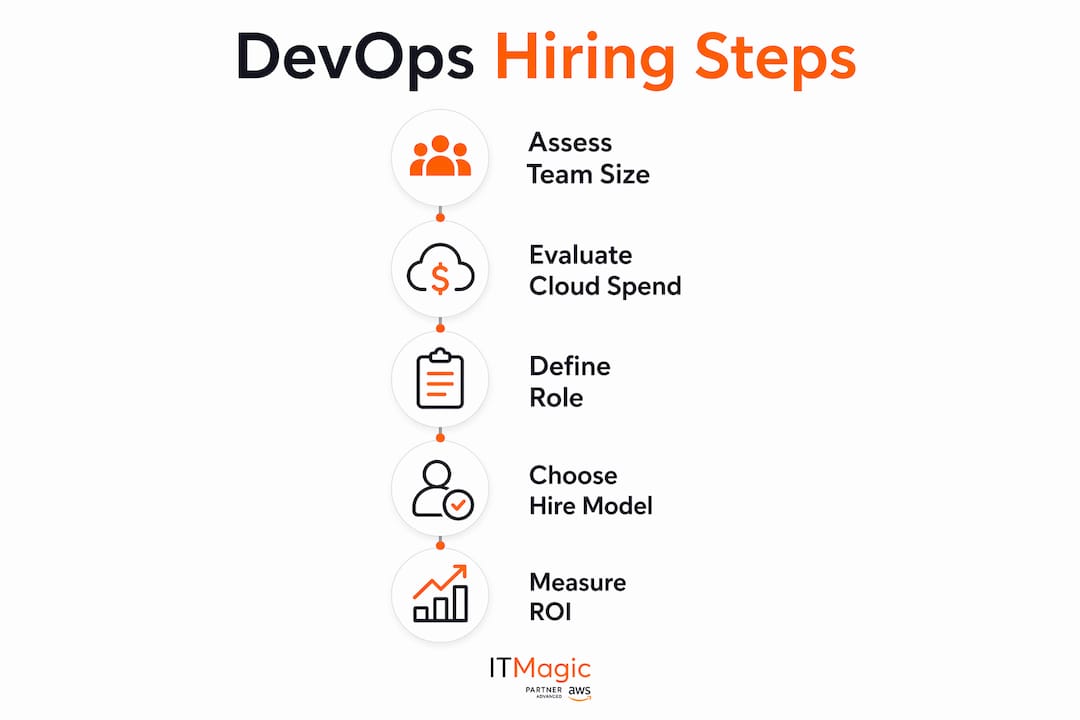
Hiring a DevOps engineer makes sense when your engineering team reaches roughly 10 people, your cloud spend crosses $20,000 per month, or compliance requirements like SOC 2, HIPAA, or PCI DSS enter the picture. These are not arbitrary thresholds. They mark the point where infrastructure complexity outpaces what developers can manage alongside their core work. Knowing when to hire a DevOps engineer, and which specific role to fill, separates companies that scale cleanly from those that accumulate costly technical debt. This guide gives business leaders a clear framework for making that call in 2026.
What operational signs indicate you need a DevOps engineer?

The clearest indicators for DevOps need are measurable, not subjective. When your team starts losing engineering hours to deployment failures, manual provisioning, or unplanned outages, the cost of not hiring becomes concrete. The right time to add a DevOps team member is when those costs exceed the cost of the hire itself.
Watch for these specific signals:
- Engineering team size. A team of 10 or more engineers generates enough infrastructure demand to justify a dedicated role. Below that threshold, a fractional DevOps consultant at roughly 5 hours per week, combined with managed services, is typically more cost-effective.
- Cloud spend above $20,000 per month. At this level, unmanaged infrastructure waste, idle resources, and misconfigured services start costing more than a full-time engineer’s salary. A DevOps hire pays for itself through AWS cost reduction alone.
- Frequent deployment failures or outages. If your team ships code less than once a week because deployments are risky, or if incidents regularly pull developers away from product work, that is a structural problem, not a process one.
- Compliance requirements. SOC 2, HIPAA, and PCI DSS each demand audit trails, access controls, and infrastructure documentation that developers rarely have time to maintain correctly. These requirements mandate specialized compliance expertise, not improvised solutions.
- Security gaps. If no one owns secrets management, IAM policies, or vulnerability scanning, your infrastructure carries risk that grows with every new service you deploy.
One underappreciated signal is developer frustration. When senior engineers spend more than 20% of their time on infrastructure tasks, you are paying product-level salaries for operations work. That ratio alone justifies a dedicated hire.
How do you define the specific DevOps role your team needs?
Running this on your own AWS setup? IT-Magic is an AWS Advanced Tier Partner — we audit, fix, or fully manage it for you.
Get a free consultationPosting a generic “DevOps Engineer” job description is the single most common and expensive mistake in this hiring category. Vague role definitions produce long searches, weak candidate pools, and hires that do not fit the actual work. The industry recognizes four distinct profiles, and each solves a different problem.
- Cloud Infrastructure Engineer. This role owns provisioning, networking, and cloud architecture. The right fit if your primary pain is infrastructure reliability, cost control, or AWS environment design.
- Site Reliability Engineer (SRE). An SRE focuses on uptime, incident response, and service-level objectives. Hire this profile when production stability is the bottleneck and you already have infrastructure in place.
- Platform Engineer. This role builds internal developer tooling, CI/CD pipelines, and self-service infrastructure. The right choice when your developers are slowed by manual processes and lack of standardized environments.
- DevSecOps Engineer. Security is embedded into every part of this role. Hire here when compliance mandates or security incidents have made security a first-class concern, not an afterthought.
Aligning the role to your current tech stack matters as much as the title. A team running Kubernetes on AWS EKS needs a different profile than one running monolithic applications on EC2. Your choice should reflect where your infrastructure is today and where it needs to be in 18 months.
Pro Tip: Before writing the job description, list the three infrastructure problems causing the most pain right now. The role that solves all three is the one to hire.
Which hiring model fits your first DevOps hire?
The hiring model you choose affects speed, cost, and the quality of the eventual fit. No single model works for every situation.
| Hiring model | Best for | Time to fill | Typical cost range |
|---|---|---|---|
| Contract-to-hire | First hire, unproven role scope | 1–2 weeks | Lower upfront, higher long-term |
| Direct hire | Senior or core infrastructure roles | 4–8 weeks | $85,000–$220,000+ annually |
| Project-based contract | Specific migrations or audits | Days to 1 week | Hourly or fixed project fee |
| Managed DevOps service | Pre-threshold teams, interim coverage | Immediate | Subscription or retainer |
Contract-to-hire is the recommended starting point for most first DevOps hires. It lets you evaluate a candidate during real production conditions before committing to a full-time salary and benefits package. The tradeoff is that senior engineers often prefer direct hire with equity. Senior candidates who receive contract offers may decline, which narrows your pool at the top of the market.
Project-based contracts work well for one-time needs: a cloud migration, a compliance audit, or a Kubernetes cluster setup. They do not solve ongoing operational needs.
Pro Tip: If your engineering team is below 10 people and cloud spend is under $20,000 per month, a managed DevOps service is almost always cheaper and faster than a full-time hire. Treat it as a bridge, not a compromise.
How do you run a DevOps hiring process that actually works?
A strong hiring process for DevOps roles looks different from standard engineering hiring. Theoretical questions about algorithms do not predict whether someone can manage a 3:00 AM production incident.
Start with a clear job description that names the specific role, the tech stack (AWS, Kubernetes, Terraform, etc.), and the compliance environment. Vague descriptions attract generalists. Specific descriptions attract specialists.
Source candidates from high-signal channels. Technical communities like DevOps-focused Slack groups, AWS community forums, and referrals from your existing engineers produce better candidates than broad job boards. Specialized staffing firms that pre-vet candidates can compress hiring timelines from 6–8 weeks down to 5–10 business days.
Structure the interview loop around real scenarios, not hypotheticals:
- Walk me through a production incident you owned from detection to resolution.
- How do you approach IAM policy design for a multi-account AWS environment?
- What would you change about our current deployment process after reviewing it for one week?
Evaluate the candidate’s security mindset directly. The best DevOps engineers treat security as a shared responsibility across the team, not a task owned by a separate security department.
A candidate who claims they have never caused a production incident is not a safe hire. They are an inexperienced one. Experienced engineers own their incidents, document them, and use them to build better systems. That pattern of accountability is what you are actually hiring for.
Watch for these red flags:
- No incident history. Either they have not worked in production environments or they are not being honest.
- Security deflection. Phrases like “that’s the security team’s job” signal a siloed mindset that creates gaps.
- Credential-only answers. AWS certifications matter, but candidates who lead with certifications and struggle with scenario questions often lack hands-on depth.
- Resistance to on-call. DevOps roles carry operational responsibility. Candidates who avoid this conversation will avoid the work.
How do you measure ROI after hiring a DevOps engineer?
Measuring the return on a DevOps hire requires tracking the right metrics from day one. Without a baseline, you cannot demonstrate value or make informed decisions about expanding the team.
| Metric | What it measures | Target direction |
|---|---|---|
| Deployment frequency | How often code ships to production | Increase |
| Mean time to recovery (MTTR) | How fast the team resolves incidents | Decrease |
| Infrastructure cost per service | Cloud spend efficiency | Decrease |
| Change failure rate | Percentage of deployments causing incidents | Decrease |
| Compliance audit readiness | Time to produce audit evidence | Decrease |
Track these metrics monthly for the first six months. A well-placed hire typically shows measurable improvement in deployment frequency and MTTR within 90 days. Infrastructure cost savings from cloud cost optimization often take 60–120 days to materialize as the engineer audits existing resources and eliminates waste.
Signs you need to expand the DevOps team include: a single engineer becoming a bottleneck for all infrastructure changes, on-call rotations burning out one person, or compliance requirements growing faster than one person can manage. At that point, the question shifts from whether to hire to which additional profile to add next.
Key Takeaways
Hiring a DevOps engineer at the right threshold, with the right role definition and hiring model, is the single decision that most directly determines whether your infrastructure scales or becomes a liability.
| Point | Details |
|---|---|
| Know your hiring thresholds | Hire when your team hits 10+ engineers, $20K/month cloud spend, or compliance demands. |
| Define the exact role first | Choose between Cloud Engineer, SRE, Platform Engineer, or DevSecOps before posting. |
| Match the hiring model to the situation | Use contract-to-hire for first hires; direct hire for senior roles that require equity. |
| Interview for incident ownership | Candidates who have never caused a production incident are a hiring risk, not a safe bet. |
| Measure ROI from day one | Track deployment frequency, MTTR, and infrastructure cost savings monthly post-hire. |
What I have learned from watching companies hire DevOps engineers too early and too late
Most pre-Series-A startups I have seen make the same mistake: they hire a full-time DevOps engineer at 6 engineers and $8,000 per month in cloud spend because it feels like the responsible thing to do. The engineer spends the first three months with nothing meaningful to manage. They get bored, they leave, and the company restarts a search that costs more than the managed service would have for two years.
The opposite mistake is just as common. A company at 25 engineers and $60,000 per month in cloud spend still has developers managing infrastructure because “we haven’t had a major incident yet.” Then they have one. A misconfigured S3 bucket, an expired certificate, or a runaway autoscaling group that triples the monthly bill overnight. At that scale, the cost of the incident dwarfs the cost of six months of a senior DevOps salary.
The insight that most hiring guides miss is this: the role you define matters more than the timing. I have seen companies hire at exactly the right moment but post such a broad job description that they attracted the wrong person entirely. A Platform Engineer hired to do SRE work will be frustrated and underperforming within 90 days. The cloud-native DevOps role distinctions are not HR formalities. They reflect genuinely different skill sets and career motivations.
Culture fit in DevOps hiring is also underrated. The best DevOps engineers I have worked with were not the ones with the longest list of certifications. They were the ones who treated every incident as a system design problem and every developer complaint as a signal worth investigating. That mindset is harder to screen for than an AWS certification, but it is what actually determines whether the hire succeeds.
— Oleksandr
IT-Magic’s DevOps and cloud infrastructure support
IT-Magic has delivered over 700 infrastructure projects for more than 300 clients since 2010, operating as an AWS Advanced Tier Services Partner. For companies that are not yet at the hiring threshold, or that need expert coverage while a search is underway, IT-Magic acts as a dedicated DevOps and cloud operations partner.
IT-Magic’s team of certified AWS engineers covers Kubernetes implementation, CI/CD pipeline setup, compliance readiness for SOC 2, HIPAA, and PCI DSS, and ongoing infrastructure management. The INTERTOP case study demonstrates how IT-Magic reduced AWS costs significantly through infrastructure redesign. For teams that need reliable Kubernetes operations without the overhead of building an internal team from scratch, IT-Magic’s Kubernetes support services provide a direct path to production-grade reliability.
FAQ
When should you hire your first DevOps engineer?
Hire your first DevOps engineer when your engineering team reaches 10 or more people, cloud spend exceeds $20,000 per month, or compliance requirements like SOC 2 or HIPAA become active obligations.
What is the difference between a DevOps engineer and an SRE?
A DevOps engineer typically owns CI/CD pipelines, infrastructure provisioning, and automation, while an SRE focuses on uptime, incident response, and service-level objectives. The roles overlap but solve different primary problems.
How long does it take to hire a DevOps engineer?
A direct hire search typically takes 4–8 weeks. Partnering with a specialized staffing firm that pre-vets candidates can reduce that timeline to 5–10 business days.
What salary should you expect for a DevOps engineer?
Base salaries range from $85,000 to over $220,000 depending on seniority and location. Senior engineers in major markets command the top of that range and often require equity to accept an offer.
What is the biggest red flag when interviewing DevOps candidates?
A candidate who claims to have never caused a production incident is a significant risk. Experienced engineers own their incidents and use them to build more reliable systems.
Recommended
- DevOps Benefits for Startups: Your 2026 Growth Guide
- DevOps Practices for Founders: Your 2026 Startup Guide
- Build a robust DevOps automation workflow in AWS
- DevOps Maturity Stages: A 2026 Guide for IT Leaders
Alexander founded IT-Magic, an AWS Advanced Tier Services Partner delivering DevOps, cloud architecture, and managed services since 2010. He holds:
- AWS Certified Solutions Architect – Professional
- AWS Certified DevOps Engineer – Professional
- AWS Certified Security – Specialty
- AWS Certified Advanced Networking – Specialty
Talk to a certified AWS team trusted by INTERTOP, Foxtrot, Pandora, and J.Hilburn.
Get a free consultation