
TL;DR:
- Misconfigured RBAC, overprivileged service accounts, and vulnerable images are the most common Kubernetes security issues. Breaches often occur through chains of small oversights rather than a single catastrophic bug. Implementing layered controls and continuous validation reduces the attack surface and mitigates risks effectively.
The most damaging Kubernetes security issues are not exotic zero-days. They are misconfigured RBAC, overprivileged service accounts, vulnerable container images, plain-text secrets, missing NetworkPolicies, and blind spots in runtime telemetry. Token-theft incidents targeting Kubernetes rose 282% in a single year, and most of those breaches traced back to a chain of small oversights rather than a single catastrophic bug.
If you are mid-incident or starting an audit right now, here is where to focus first:
- Isolate any workloads with exposed API server endpoints or public kubelet ports.
- Rotate long-lived service account tokens and shorten their TTL immediately.
- Enable audit logging on the API server if it is not already on.
- Pull runtime telemetry (Falco, AWS GuardDuty for EKS, or equivalent) so you have visibility into what pods are actually doing.
- Tighten RBAC: remove any ClusterRoleBinding that grants
cluster-adminto a non-operator identity.
Pro Tip: Switch service accounts to projected, short-lived tokens (Kubernetes serviceAccountToken volume projection) and restrict API server access to management-plane IPs via security groups or firewall rules. These two changes cut post-exploitation blast radius faster than almost anything else you can do in an afternoon.
Table of Contents
- Why Kubernetes security is architecturally different from VM security
- What are the most common Kubernetes security issues?
- How do attackers chain small weaknesses in Kubernetes?
- How do you map controls and tools to each risk category?
- What does a prioritized remediation plan look like?
- How do you verify that your fixes actually worked?
- How does US cloud compliance shape Kubernetes security?
- How do you detect and respond to a Kubernetes cluster incident?
- How long does Kubernetes remediation actually take?
- What exploitation techniques are specific to Kubernetes?
- Key Takeaways
- The part of Kubernetes security most teams get wrong
- IT-Magic brings production-grade Kubernetes security to your EKS clusters
- Useful sources and further reading
- FAQ
Why Kubernetes security is architecturally different from VM security
Running this on your own AWS setup? IT-Magic is an AWS Advanced Tier Partner — we audit, fix, or fully manage it for you.
Get a free consultationKubernetes exposes a much larger attack surface than a traditional VM fleet, and the blast radius of a single misconfiguration is proportionally larger. The control plane components — the API server, etcd, the scheduler, and the controller manager — are all network-accessible services. The kubelet on every worker node is itself an HTTP API. Compromise any one of them and you can reach the rest.
Etcd is the most sensitive target. It stores the entire cluster state, including secrets, in a key-value store. If etcd is reachable without TLS or authentication, an attacker who touches it has everything: credentials, configuration, and the ability to write arbitrary objects back into the cluster.
Ephemeral workloads and image-based delivery change the defender’s job in a specific way. With VMs, you patch in place. With containers, the “patch” is a new image build and a rollout. That means a vulnerable base image can silently persist across hundreds of pods until someone forces a rebuild. The declarative IaC model (Helm charts, Kustomize overlays, Terraform modules) is powerful, but it also means a single misconfigured template can propagate a bad setting cluster-wide in seconds.
Three frameworks anchor any serious Kubernetes threat assessment:
- Kubernetes Pod Security Standards define three policy levels (Privileged, Baseline, Restricted) that control what a pod is allowed to do at the kernel level.
- MITRE ATT&CK for Containers maps adversary techniques — from initial access through exfiltration — to container-specific tactics, giving defenders a repeatable vocabulary for detection engineering.
- Kubernetes audit logs record every API server request with user, verb, resource, and response code, making them the primary forensic source for any cluster incident.
Visibility gaps tend to cluster in three places: the audit log pipeline (often disabled or not shipped to a SIEM), cloud IAM relationships between pod service accounts and cloud roles (AWS IRSA, GKE Workload Identity), and registry access controls. Auditing cloud IAM alongside RBAC is not optional — strong in-cluster RBAC means nothing if a pod maps to an AWS role with AdministratorAccess.
What are the most common Kubernetes security issues?
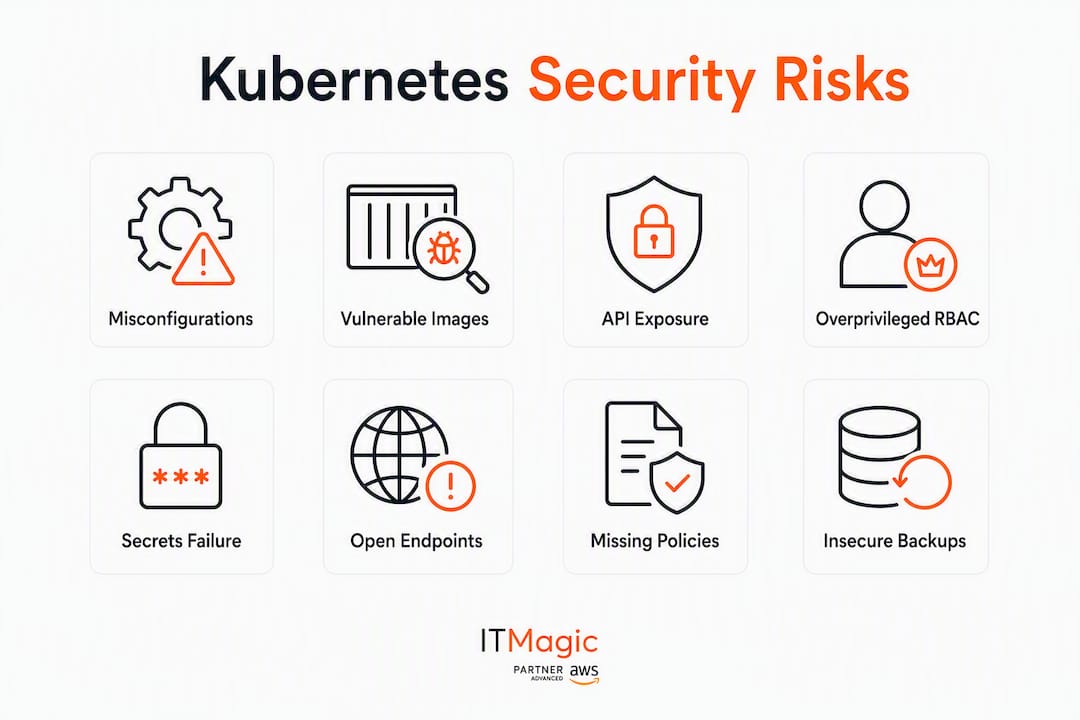
Misconfigurations make up a substantial portion of detected security events in container and Kubernetes environments. The issues below are the ones that actually get exploited in production.
Vulnerable container images and supply-chain risks
Every image you pull is a trust decision. Base images with unpatched CVEs, third-party dependencies with known exploits, and images pulled from public registries without digest pinning all create entry points. Attackers who compromise a public image or a CI pipeline can inject malicious code that runs inside your cluster before you know it exists.

Detection indicators: images with no digest pin in pod specs, registry pull events from unexpected sources, CI pipeline logs showing unsigned image pushes.
Mitigations: scan every image with Trivy, Grype, or Amazon ECR’s built-in scanning before it reaches a registry. Sign images with Sigstore Cosign and enforce signature verification at admission time via Connaisseur or Kyverno. Blocking unsigned or vulnerable images at admission prevents the most common supply-chain exploitation paths.
API server exposure and tooling vulnerabilities
The Kubernetes API server should never be reachable from the public internet. When it is, automated scanners find it within hours. Beyond network exposure, tooling vulnerabilities in the kubectl ecosystem create a separate attack class. CVE-2026-61459 demonstrates this precisely: argument injection in kubectl tooling can redirect commands to an attacker-controlled API server, leaking bearer tokens and enabling full cluster compromise without ever touching the network perimeter.
Detection indicators: API server access from non-management IPs in audit logs, unexpected kubectl invocations in CI logs, bearer token usage from unusual source IPs.
Mitigations: restrict API server endpoint access to management-plane CIDRs. Keep kubectl and all Kubernetes tooling patched. Rotate operator tokens after any tooling upgrade.
Misconfigured RBAC and overprivileged service accounts
RBAC misconfiguration is the most common privilege escalation path in Kubernetes. The default service account in many namespaces has more permissions than it needs, and cluster-admin ClusterRoleBindings are routinely granted to automation accounts “for convenience.” An attacker who gains code execution in any pod with a mounted service account token can immediately query the API to enumerate what that token can do.

Detection indicators: kubectl auth can-i --list --as=system:serviceaccount:<namespace>:<sa> returning broad permissions, ClusterRoleBindings to cluster-admin for non-operator accounts.
Mitigations: audit every RoleBinding and ClusterRoleBinding. Apply least-privilege: grant only the verbs and resources a workload actually needs. Disable automounting of service account tokens on pods that do not need API access (automountServiceAccountToken: false).
Secrets management failures
Kubernetes Secrets are base64-encoded by default, not encrypted. Anyone with read access to the secrets resource in a namespace can decode them in seconds. Long-lived credentials stored as Secrets and never rotated are a persistent liability. The OWASP Kubernetes Top 10 lists secrets management as a top-tier risk for exactly this reason.
Detection indicators: Secrets with creation timestamps months or years old, Secrets readable by broad RoleBindings, etcd backups stored without encryption.
Mitigations: enable etcd encryption at rest using a KMS provider (AWS KMS for EKS). Migrate application secrets to a dedicated secrets manager — AWS Secrets Manager or HashiCorp Vault — and inject them at runtime rather than storing them as Kubernetes objects. Rotate all credentials on a defined schedule.
Pro Tip: Use the Secrets Store CSI Driver with AWS Secrets Manager to mount secrets directly into pods as files, bypassing the Kubernetes Secrets API entirely. This eliminates the base64-in-etcd exposure and gives you centralized rotation without redeploying pods.
Open kubelet endpoints
The kubelet exposes an API on port 10250. If that port is reachable and anonymous authentication is enabled, an attacker can execute commands in any pod on that node without any credentials. This is a direct path to container escape and node compromise.
Detection indicators: port 10250 reachable from outside the node’s VPC subnet, kubelet config showing authentication.anonymous.enabled: true.
Mitigations: set authentication.anonymous.enabled: false and authorization.mode: Webhook in kubelet configuration. Restrict port 10250 to control-plane CIDRs via security groups.
Missing NetworkPolicies
By default, every pod in a Kubernetes cluster can talk to every other pod. There are no network boundaries unless you explicitly create them with NetworkPolicy objects. This means a compromised pod can reach databases, internal APIs, and other workloads across every namespace.
Detection indicators: absence of any NetworkPolicy objects in production namespaces, pod-to-pod traffic logs showing unexpected cross-namespace connections.
Mitigations: implement a default-deny NetworkPolicy in every namespace, then add explicit allow rules for required traffic paths. Use a CNI plugin that enforces NetworkPolicy (Calico, Cilium, or the AWS VPC CNI with network policy support on EKS).
Permissive pod security settings
Pods running as root, with privileged: true, or with hostPID, hostNetwork, or hostPath mounts are one kernel vulnerability away from a full node escape. These settings are often left in place from development environments and never hardened before production.
Detection indicators: pod specs with securityContext.runAsRoot: true, privileged: true, or hostPath volumes in production namespaces.
Mitigations: enforce the Kubernetes Pod Security Standards Restricted profile on all production namespaces. Use OPA/Gatekeeper or Kyverno to block non-compliant pod specs at admission time.
Insecure etcd and backups
Exposed etcd instances allow full cluster state access if not securely configured. Etcd backups stored in S3 buckets without encryption or access controls are equally dangerous — they contain the same data as a live etcd instance.
Mitigations: enforce TLS for all etcd client and peer communication. Enable encryption at rest. Store backups in encrypted S3 buckets with strict bucket policies and no public access.
Unsafe IaC and CI/CD flows
Helm charts and Terraform modules that hard-code credentials, skip image digest pinning, or grant broad RBAC permissions become security debt that compounds with every deployment. CI/CD pipelines with excessive cluster permissions can be weaponized if the pipeline itself is compromised.
Mitigations: run IaC scanning tools (Checkov, KICS, or Terrascan) in every pull request. Grant CI/CD service accounts only the permissions needed for deployment, scoped to specific namespaces.
Lack of runtime telemetry
You cannot detect what you cannot see. Clusters without runtime monitoring have no way to identify a container escape, a cryptominer, or lateral movement until the damage is done.
Mitigations: deploy Falco for kernel-level syscall monitoring. Ship API server audit logs to a SIEM. On EKS, enable AWS GuardDuty for EKS Runtime Monitoring. Define alert rules for high-signal events: unexpected shell execution in a container, service account token reads from unusual processes, and outbound connections to non-approved destinations.
How do attackers chain small weaknesses in Kubernetes?
Unit42 research confirms that Kubernetes breaches rarely hinge on a single catastrophic bug. The typical compromise is a chain: one small oversight enables the next step, and the chain terminates in data exfiltration or cloud account takeover.
A concrete example maps cleanly to MITRE ATT&CK for Containers:
- Initial Access (T1190): Attacker exploits a known CVE in a web application running in a container with an unpatched base image.
- Execution (T1059): Code execution inside the container. The attacker reads
/var/run/secrets/kubernetes.io/serviceaccount/token. - Discovery (T1613): The mounted service account token is used to call the Kubernetes API and enumerate cluster resources and permissions.
- Lateral Movement (T1550.001): The service account has
get/liston Secrets across namespaces. The attacker reads database credentials and API keys. - Cloud Pivot (T1078.004): The pod’s service account maps to an AWS IAM role via IRSA. The attacker calls AWS APIs to enumerate S3 buckets and RDS instances.
- Exfiltration (T1537): Data copied to an attacker-controlled S3 bucket.
Every step in that chain had a control that could have broken it: image scanning at step 1, short-lived projected tokens at step 2, least-privilege RBAC at step 3, secrets rotation at step 4, scoped IRSA roles at step 5, and egress NetworkPolicies at step 6.
Pro Tip: After building your threat model, convert each attack-chain step into a detection rule and a control test. A Falco rule that fires on unexpected token reads, combined with a monthly RBAC audit, interrupts the most common post-exploitation paths before they reach the cloud pivot stage.
How do you map controls and tools to each risk category?
| Risk Category | Control Type | Tools / Standards | Verification Signal |
|---|---|---|---|
| Image supply chain | Scanning + signing | Trivy, Grype, Cosign, ECR scanning | No unsigned images in production; zero critical CVEs at deploy |
| RBAC / identity | Least-privilege audit | kubectl auth can-i, rbac-lookup, Kyverno |
No cluster-admin bindings outside operators |
| Network access | NetworkPolicy enforcement | Calico, Cilium, AWS VPC CNI | Default-deny present in all production namespaces |
| Secrets | KMS encryption + external store | AWS Secrets Manager, Vault, Secrets Store CSI | No plain-text Secrets with age > 90 days |
| API server exposure | Network restriction + patch | Security groups, kubectl version pinning | API server unreachable from non-management IPs |
| Pod security | Admission control | OPA/Gatekeeper, Kyverno, Pod Security Standards | Restricted profile enforced; no privileged pods in prod |
| Runtime visibility | Behavioral monitoring | Falco, GuardDuty for EKS, audit log SIEM pipeline | Alert latency < 5 minutes for high-signal events |
SANS recommends pairing IaC scanning with live-cluster validation to prevent security regressions during rapid deployment cycles. Static checks alone produce false positives and miss runtime drift; the combination catches both.
For CI/CD integration, run Trivy and Checkov in the pull-request pipeline. Gate merges on zero critical image CVEs and zero IaC policy violations. In production, schedule weekly kubectl RBAC audits and daily Falco rule reviews.
Pro Tip: Treat your Falco rule set as code: version-control it, review changes in pull requests, and test rules against synthetic events before deploying to production. A rule that fires on every exec in a container is useless noise; a rule scoped to exec in a pod with no expected shell usage is a genuine signal.
What does a prioritized remediation plan look like?
30-day actions: fast risk reduction
- Enable API server audit logging and ship logs to a SIEM or CloudWatch Logs.
- Rotate all long-lived service account tokens; switch to projected short-lived tokens.
- Remove
cluster-adminClusterRoleBindings from any non-operator identity. - Block anonymous kubelet authentication (
authentication.anonymous.enabled: false). - Enable etcd encryption at rest with a KMS provider.
- Integrate Trivy into the CI pipeline; block images with critical CVEs.
Owners: Security team leads the audit; platform engineers implement token rotation and kubelet config. Effort: Low to medium.
90-day actions: stabilization
- Roll out default-deny NetworkPolicies to all production namespaces.
- Migrate application secrets from Kubernetes Secrets to AWS Secrets Manager via the Secrets Store CSI Driver.
- Enforce Pod Security Standards
Restrictedprofile on production namespaces via OPA/Gatekeeper or Kyverno. - Implement image signing with Cosign and enforce signature verification at admission.
- Run a full RBAC audit using rbac-lookup; remediate all over-permissioned service accounts.
- Combine IaC scanning with live-cluster validation in the deployment pipeline.
Owners: DevOps and platform engineering. Effort: Medium.
180-day actions: sustained controls
- Establish a quarterly RBAC and cloud IAM review cycle.
- Deploy Falco with a tuned rule set; integrate alerts into the incident response workflow.
- Enable AWS GuardDuty for EKS Runtime Monitoring across all clusters.
- Implement a software bill of materials (SBOM) process for all production images.
- Complete a formal Kubernetes threat assessment mapped to MITRE ATT&CK for Containers.
- Achieve and document compliance posture for PCI DSS, SOC2, or HIPAA as applicable.
Owners: Security, platform, and DevOps jointly. Effort: Medium to high.
Cost buckets are roughly: 30-day actions require engineering time only (low cost); 90-day actions add tooling licenses and possible managed service fees (medium); 180-day actions include ongoing managed monitoring and compliance audit costs (higher, but predictable).
How do you verify that your fixes actually worked?
Verification is where most teams stop short. Applying a control and assuming it works is how regressions happen.
API server and RBAC audit
- Run
kubectl auth can-i --list --as=system:serviceaccount:<namespace>:<sa>for every service account in production namespaces. Any result showing broad resource access is a finding. - List all ClusterRoleBindings:
kubectl get clusterrolebindings -o wide. Flag any binding tocluster-adminoutside thekube-systemnamespace. - Check API server audit logs for requests from unexpected source IPs or user agents.
Kubelet and etcd checks
- Confirm
authentication.anonymous.enabled: falsein kubelet config on every node. - Verify etcd is listening only on localhost or internal cluster IPs, not
0.0.0.0. - Confirm etcd encryption:
etcdctl get /registry/secrets/default/test-secretshould return encrypted data, not plain text. - Check etcd backup storage: S3 bucket policy should deny public access and require SSE-KMS.
Network policy validation
- Deploy a test pod in a production namespace and attempt connections to pods in other namespaces. A correctly enforced default-deny policy blocks all unapproved traffic.
- Review CNI plugin logs for policy enforcement events.
Indicators of compromise to watch for
- Unexpected ClusterRoleBinding creation events in audit logs (verb:
create, resource:clusterrolebindings). - Service account token reads from processes that are not the application binary (Falco rule:
k8s_serviceaccount_token_read). - Outbound connections from pods to non-approved external IPs, especially on ports 443 or 4444.
- Lateral cloud API calls from pod IAM roles to services the application does not use (CloudTrail events from unexpected
userAgentstrings).
Pro Tip: Set up a canary ClusterRoleBinding with a distinctive name and no actual permissions. Alert on any read or modification of that object. It is a near-zero false-positive signal that someone is enumerating your RBAC configuration.
How does US cloud compliance shape Kubernetes security?
US-regulated environments add compliance requirements on top of baseline security hygiene, and the cloud providers have built specific features to help meet them.
For PCI DSS workloads on EKS, the cardholder data environment must be network-isolated. That means dedicated node groups, strict NetworkPolicies, and VPC segmentation between CDE and non-CDE namespaces. AWS provides PCI DSS-eligible services including EKS, ECR, and AWS Secrets Manager, but the shared responsibility model means cluster configuration is your responsibility.
HIPAA adds requirements for audit logging, access controls, and encryption of PHI at rest and in transit. AWS offers a HIPAA Business Associate Agreement (BAA) covering EKS. Practically, this means etcd encryption with AWS KMS, TLS everywhere, and audit logs retained for the required period in CloudWatch Logs or S3 with Object Lock.
SOC 2 Type II requires continuous monitoring and evidence of control effectiveness over time. Falco alert logs, RBAC audit reports, and image scanning results all become audit evidence. Automating the collection and retention of these artifacts saves significant time during audits.
AWS-specific features that directly address Kubernetes security challenges include:
- Amazon GuardDuty for EKS: detects anomalous API activity, privilege escalation attempts, and cryptomining behavior using EKS audit logs and runtime monitoring.
- AWS Security Hub: aggregates findings from GuardDuty, ECR image scanning, and AWS Config into a single compliance dashboard.
- AWS Config rules: enforce cluster configuration standards (e.g., EKS logging enabled, public endpoint disabled) and alert on drift.
- Amazon Inspector: continuously scans ECR images for CVEs and surfaces findings in Security Hub.
The NSA/CISA Kubernetes Hardening Guidance remains the authoritative US government baseline for cluster hardening and is explicitly referenced in many federal compliance frameworks.
How do you detect and respond to a Kubernetes cluster incident?
Speed matters. The faster you contain a compromised workload, the shorter the blast radius.
Detection triggers worth wiring into your alerting:
- Falco alert: shell spawned inside a container that has no expected shell usage.
- GuardDuty finding:
Execution:Kubernetes/ExecInPodorPrivilegeEscalation:Kubernetes/PrivilegedContainer. - Audit log event:
createonclusterrolebindingsby a non-operator identity. - CloudTrail event: AWS API calls from an EKS pod role to services outside its normal scope.
Immediate containment steps:
- Cordon the affected node:
kubectl cordon <node>. This prevents new pods from scheduling there. - Isolate the compromised pod with a NetworkPolicy that blocks all ingress and egress.
- Capture the pod’s state before termination:
kubectl describe pod <pod>, logs, and if possible a memory snapshot via Falco or a forensic tool. - Rotate the service account token associated with the compromised pod.
- Revoke any cloud IAM role sessions that the pod’s IRSA role may have established (invalidate via AWS IAM).
Post-containment investigation:
- Pull the full audit log for the service account used by the compromised pod for the 72 hours before detection.
- Check CloudTrail for all API calls made by the associated IAM role.
- Review all ClusterRoleBinding and RoleBinding changes in the same window.
- Scan all images currently running in the cluster for the CVE that enabled initial access.
Document findings in a structured incident report. For US-regulated environments, breach notification timelines under HIPAA (60 days) and state breach notification laws (often 30–45 days) start from the date of discovery, not containment.
How long does Kubernetes remediation actually take?
Honest answer: it depends on cluster size, team capacity, and how far from baseline you are starting. But there are reasonable benchmarks.
Quick wins (hours to days): Enabling audit logging, rotating long-lived tokens, and removing obvious cluster-admin bindings can be done in a single sprint. These require no new tooling and carry low deployment risk.
Medium-effort controls (weeks): Rolling out NetworkPolicies to production namespaces without breaking application traffic takes careful mapping of existing traffic flows. Expect 2–4 weeks for a moderately complex cluster. Migrating secrets to AWS Secrets Manager adds another 1–3 weeks depending on the number of applications.
Sustained programs (months): A full RBAC remediation across dozens of namespaces, implementing image signing end-to-end, and achieving a documented compliance posture for SOC 2 or PCI DSS typically takes 3–6 months. The 180-day plan in the remediation section above reflects this reality.
Cost scales similarly. Tooling for image scanning and admission control is largely open-source (Trivy, Kyverno, Falco) or included in managed service tiers (ECR scanning, GuardDuty for EKS). The real cost is engineering time: a thorough Kubernetes security assessment for a mid-size production cluster typically requires 40–80 hours of senior security engineering effort. Ongoing managed monitoring adds a predictable monthly operational cost that is almost always lower than the cost of a breach.
What exploitation techniques are specific to Kubernetes?
Privilege escalation via container escape
A container running as root with privileged: true or a hostPath mount to / has direct access to the host filesystem and kernel. An attacker with code execution in that container can write to /proc/sysrq-trigger, load kernel modules, or simply chroot to the host filesystem and read node credentials. CVE-2019-5736 (runc container escape) and CVE-2022-0185 (Linux kernel heap overflow) are historical examples of how kernel-level vulnerabilities become full node escapes from inside a container.
API server attacks
Direct API server attacks take two forms. The first is credential-based: stolen bearer tokens (from mounted service accounts, CI/CD pipelines, or kubectl config files) used to call the API directly. The second is tooling-based, as demonstrated by CVE-2026-61459, where argument injection in kubectl redirects commands to an attacker-controlled server, exfiltrating the operator’s bearer token.
Token theft and cloud pivot
After gaining code execution, attackers read the default service account token at /var/run/secrets/kubernetes.io/serviceaccount/token. With that token, they enumerate cluster permissions, read Secrets, and — if the pod’s service account maps to a cloud IAM role — pivot to AWS, GCP, or Azure APIs. This is the most common post-exploitation path in cloud-native environments, and it is why short-lived projected tokens and scoped IRSA roles are so effective as mitigations.
Admission controller bypass
Admission controllers (OPA/Gatekeeper, Kyverno) are only effective if they cover all namespaces and all resource types. Attackers who can create resources in an unprotected namespace, or who find a gap in policy coverage (e.g., a policy that checks Deployments but not DaemonSets), can deploy privileged workloads that bypass all pod security controls.
etcd direct access
If etcd is reachable without authentication, an attacker can read the entire cluster state with a single etcdctl get --prefix /registry command. This returns every Secret, every ConfigMap, every service account token, and every cluster configuration object in plain text (or decryptable form if encryption is not enabled). It is the fastest path to full cluster compromise that does not require any Kubernetes API credentials at all.
Key Takeaways
Securing a Kubernetes cluster requires layering least-privilege access, image hygiene, runtime visibility, and network segmentation — no single control is sufficient on its own.
| Point | Details |
|---|---|
| Misconfiguration dominates | 40% of organizations detected misconfigurations in container or Kubernetes environments; fix RBAC and pod security settings first. |
| Token theft is surging | Kubernetes token-theft incidents increased 282% over the last year; switch to short-lived projected tokens and scope IRSA roles tightly. |
| Chain-breaking beats CVE-chasing | Breaches chain small weaknesses; map your threat model to MITRE ATT&CK for Containers and interrupt the chain at multiple points. |
| Verify, don’t assume | Run kubectl auth can-i audits, test NetworkPolicy enforcement with probe pods, and validate etcd encryption before closing any finding. |
| IT-Magic for managed security | IT-Magic delivers end-to-end Kubernetes security assessment, remediation, and 24/7 managed operations on EKS, covering PCI DSS, SOC2, and HIPAA compliance. |
The part of Kubernetes security most teams get wrong
There is a pattern that shows up repeatedly in production cluster assessments: teams treat Kubernetes security as a checklist to complete once, then move on. They run a scanner, fix the critical CVEs, add a few NetworkPolicies, and consider the work done. Six months later, a new Helm chart introduces a privileged pod, a developer adds a cluster-admin binding “temporarily,” and the scanner findings pile up unreviewed.
The real problem is not ignorance of the controls. Most security engineers know what RBAC least-privilege means. The problem is that Kubernetes clusters are living systems. Every deployment is a potential configuration change. Every new service account is a potential privilege escalation path. Every new image is a potential supply-chain risk. Controls that are not continuously validated drift. And drift, compounded over months, is exactly the condition that makes a 282% increase in token-theft incidents possible.
The teams that actually maintain a strong security posture treat their security controls the same way they treat their application code: version-controlled, tested, reviewed, and monitored for drift. Falco rules live in a Git repository. RBAC audits run on a schedule and produce a report that someone actually reads. Image signing is enforced at admission, not just recommended in a wiki. The network security strategies that work in production are the ones baked into the deployment pipeline, not applied manually after the fact.
One more thing worth saying plainly: cloud IAM is part of your Kubernetes security posture whether you treat it that way or not. An IRSA role with s3:* on * is a cluster-wide vulnerability, regardless of how tight your in-cluster RBAC is. Any serious Kubernetes threat assessment has to include the cloud plane.
IT-Magic brings production-grade Kubernetes security to your EKS clusters
Running a secure Kubernetes cluster in production is not a one-time project. It is an ongoing operational discipline that requires the right tooling, the right controls, and engineers who know where the gaps actually are.
IT-Magic is an AWS Advanced Tier Services Partner that has delivered 700+ infrastructure projects since 2010, with deep specialization in EKS security, compliance, and 24/7 managed operations. The engagement model is straightforward: assessment to identify your actual risk posture, prioritized remediation to close the highest-impact gaps first, and ongoing managed security operations so controls do not drift.
For teams in regulated industries, IT-Magic’s compliance coverage spans PCI DSS, SOC2, and HIPAA, with the audit evidence collection and documentation built into the managed service. The Intertop case study shows what this looks like in practice: a complex AWS infrastructure engagement that delivered measurable cost reduction alongside a hardened, scalable architecture.
If your cluster has not had a formal security assessment, or if your last one was more than six months ago, contact IT-Magic to scope an EKS security review. The gaps that matter most are usually the ones you have not looked for yet.
Useful sources and further reading
- Unit42 / Palo Alto Networks: Understanding Current Threats to Kubernetes Environments — Best for threat modeling, token-theft statistics, and understanding attacker tradecraft in cloud-native environments.
- SANS: Identifying Security Vulnerabilities in Kubernetes Environments — Best for IaC scanning guidance, multi-layer validation strategies, and shift-left practices.
- Trend Micro: A Deep Dive Into Kubernetes Threat Modeling — Best for MITRE ATT&CK mapping, etcd risks, and building repeatable detection frameworks.
- iterasec: Kubernetes Security Assessment — Best for assessment scope, cloud IAM visibility requirements, and understanding what read-only scans miss.
- OWASP Kubernetes Top 10 — Best for a structured risk taxonomy covering insecure workload configuration, supply chain, RBAC, secrets, and logging.
- NVD: CVE-2026-61459 — Reference for the kubectl argument-injection vulnerability and its exploitation path.
- NSA/CISA Kubernetes Hardening Guidance — The US government baseline for cluster hardening; authoritative reference for federal and regulated environments.
- IT-Magic: AWS Secrets Management Best Practices — Practical guidance for secrets management in EKS and cloud-native environments.
FAQ
Why are security teams moving away from self-managed Kubernetes?
Operational complexity and security overhead are the primary drivers. Self-managed clusters require teams to patch control-plane components, manage etcd, and maintain admission controllers manually. Managed services like EKS offload control-plane security to AWS, reducing the attack surface teams must defend directly.
What are the 4 C’s of Kubernetes security?
The 4 C’s are Cloud, Cluster, Container, and Code. Each layer must be secured independently: cloud IAM and network controls, cluster RBAC and admission policies, container image hygiene, and application-level code security. A weakness at any layer can undermine the others.
Is Kubernetes still the right choice for production workloads in 2026?
Yes. Kubernetes remains the dominant container orchestration platform for production workloads, and managed offerings like EKS have reduced the operational burden significantly. The security challenges are real but well-understood, and the tooling ecosystem (Falco, Kyverno, Cosign, GuardDuty for EKS) has matured to address them at scale.
What are the biggest downsides of Kubernetes from a security perspective?
The attack surface is large by design: the API server, etcd, kubelets, and workload identities are all network-accessible services. Default configurations favor availability over security, meaning teams must actively harden every cluster. The declarative model also means a single misconfigured template can propagate a bad setting cluster-wide instantly.
How does IT-Magic approach a Kubernetes security assessment?
IT-Magic conducts a structured assessment covering cluster configuration, RBAC, cloud IAM bindings, image supply chain, secrets management, and runtime visibility. Findings are mapped to risk severity and delivered as a prioritized remediation plan, with optional managed remediation and ongoing 24/7 security operations for EKS clusters.
Recommended
- Kubernetes deployment step by step: IT leader’s guide
- EKS Best Practices for Platform Engineers: 2026 Guide
- How to Set Up Kubernetes: Step-by-Step Guide for IT Leaders
- Top Kubernetes use cases to optimize cloud infrastructure
Alexander founded IT-Magic, an AWS Advanced Tier Services Partner delivering DevOps, cloud architecture, and managed services since 2010. He holds:
- AWS Certified Solutions Architect – Professional
- AWS Certified DevOps Engineer – Professional
- AWS Certified Security – Specialty
- AWS Certified Advanced Networking – Specialty
Talk to a certified AWS team trusted by INTERTOP, Foxtrot, Pandora, and J.Hilburn.
Get a free consultation