

TL;DR:
- Outsourcing DevOps is more cost-effective and faster to implement for companies with fewer than 30 engineers.
- A hybrid model combining a senior in-house lead with an outsourced team offers optimal control, flexibility, and savings.
Outsourcing DevOps beats hiring in-house for most companies under 30 engineers, and the cost gap is wider than most technical leaders expect. A fully loaded in-house DevOps engineer in the US incurs substantial annual costs once you count salary, payroll taxes, benefits, tooling, and recruiting. An outsourced team typically onboards in 2–4 weeks versus 3–6 months for an in-house hire. That said, the right answer depends on four factors:
- Engineering team size: Smaller teams get more value from outsourcing; larger teams with complex, continuous workloads often justify in-house headcount.
- Workload type: Project-based or variable infrastructure work fits outsourcing well. Continuous, deeply embedded DevOps work favors in-house.
- Expertise demands: Specialized skills like Kubernetes, FinOps, or PCI DSS compliance are faster and cheaper to access through a partner than to recruit for.
- Strategic priorities: If DevOps is a core product differentiator or a board-level expectation at IPO scale, in-house ownership makes sense.
For most growth-stage companies, the hybrid model wins: one senior in-house lead who owns architecture and vendor relationships, supported by an outsourced team handling day-to-day operations.
How outsourcing DevOps differs from building an in-house team
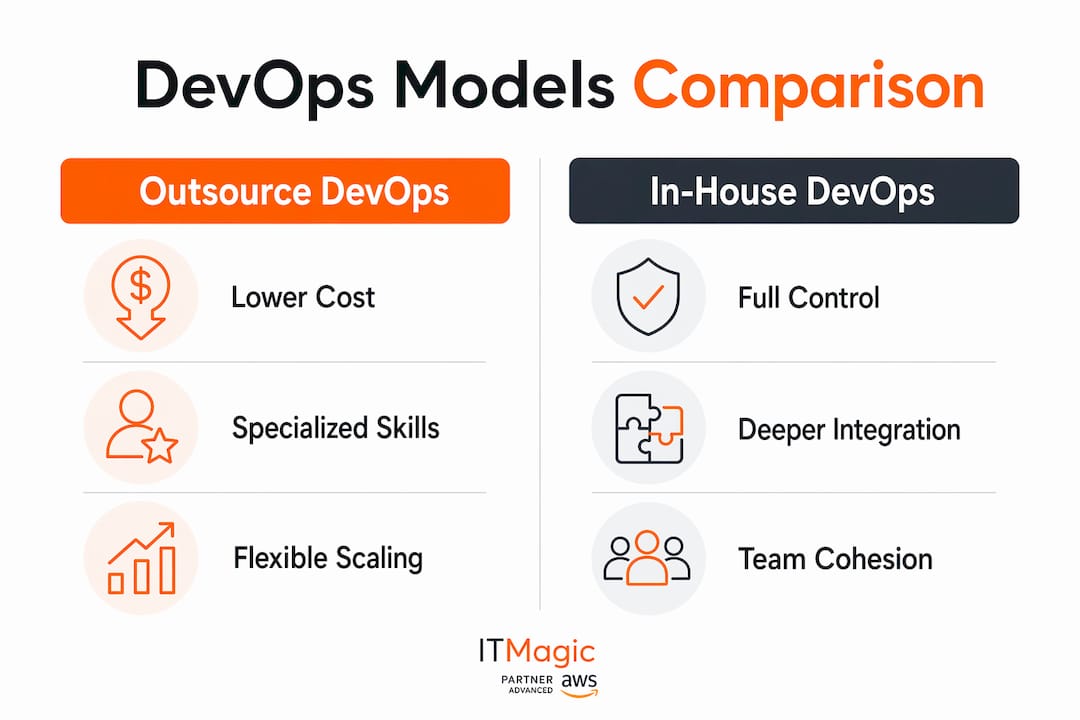
The differences go well beyond cost. Here is how the two models compare across the dimensions that matter most to technical decision-makers.
| Factor | In-house DevOps | Outsourced DevOps |
|---|---|---|
| Time to productivity | multiple months (recruit + onboard) | a few weeks (kickoff + assessment) |
| Year 1 cost (US, per engineer) | $195,000–$280,000 fully loaded | Varies by scope and model |
| Expertise breadth | One engineer’s skill set | Multi-specialist team |
| — | Only with an on-call roster | Typically included in managed services |
| Scalability | Linear hiring costs | Flexible, scale up or down monthly |
| Knowledge retention | Stays in-house but leaves with the hire | Documented in code, shared across team |
| Cultural integration | Deeply embedded | Requires deliberate communication structure |
Key distinctions worth calling out:
- Control: In-house teams give you real-time access and tighter cultural alignment. Outsourced teams can still operate within your repositories, cloud accounts, and IAM policies, so you retain strategic ownership.
- Single-point-of-failure risk: A solo in-house DevOps engineer is a liability. One resignation or illness can halt your pipeline. An outsourced team brings redundancy by design.
- Knowledge documentation: In-house knowledge often lives in one person’s head. Outsourced providers typically codify infrastructure in Terraform modules and runbooks, which actually reduces long-term risk.
How to decide: team size, project type, and expertise needs
Running this on your own AWS setup? IT-Magic is an AWS Advanced Tier Partner — we audit, fix, or fully manage it for you.
Get a free consultationThe DevOps hire vs outsource decision is not permanent. It should match where your company is right now, not where you plan to be in 18 months.
Outsourcing fits when:
- Your engineering team has fewer than about thirty product engineers. Below that threshold, a full-time DevOps hire is unlikely to stay fully utilized.
- Your workload is project-based: a cloud migration, a CI/CD buildout, a compliance deadline. Hiring full-time for a 6-month project rarely makes financial sense.
- You need specialized skills fast. Kubernetes migration, Terraform at scale, or multi-cloud architecture are hard to recruit for outside major tech hubs, and an outsourcing partner with a bench of certified engineers can deliver that expertise immediately.
- Your runway is short. It typically takes several months to hire, onboard, and ramp an in-house DevOps engineer to full effectiveness.
In-house hiring fits when:
- Your team exceeds 30–40 engineers with continuous, complex infrastructure demands.
- Real-time incident response is non-negotiable and timezone overlap with an outsourced team cannot cover it.
- Compliance frameworks such as FedRAMP or certain financial services regulations require that engineers handling infrastructure data are direct employees.
- You are approaching IPO scale, where a fully in-house engineering function is often a board-level expectation.
Pro Tip: Never hire a single in-house DevOps engineer as your only coverage. A solo DevOps hire is prone to burnout and creates a dangerous single point of failure. If you are not ready to build a team of two or more, supplement a senior in-house lead with outsourced operational support instead.
What DevOps outsourcing actually costs versus hiring in-house
Most companies underestimate in-house DevOps costs because they calculate salary alone and ignore everything else. The fully loaded annual cost for a US-based mid-to-senior DevOps engineer includes salary and additional expenses such as payroll taxes, benefits, tooling, and recruiting.
- Employer payroll taxes (approximately 7.65% in the US)
- Health insurance and benefits
- Equipment and SaaS tool licenses
- Recruiting costs, which average $20,000–$40,000 per DevOps hire
- Onboarding ramp-up time (3–6 months of reduced productivity)
- Management overhead and replacement costs if the engineer leaves
Over a 3-year period, outsourcing can cost significantly less than in-house when all overheads are counted. Beyond the direct savings, outsourced providers often deliver proactive FinOps as part of their service, reducing cloud infrastructure spend in ways that partially or fully offset the engagement fee. An in-house engineer focused on keeping the lights on rarely has the bandwidth to run continuous cost optimization. IT-Magic’s AWS cost optimization services are built around exactly this gap.
Why the hybrid model works best for most growing companies

The hybrid model is not a compromise. For Series A to Series B companies, it is usually the most cost-efficient and operationally sound structure available.
Here is what it looks like in practice:
- In-house lead (1 senior engineer): Owns infrastructure architecture, tooling decisions, security policies, and vendor relationships. This person sets the standards that the outsourced team executes against.
- Outsourced team (2–4 engineers): Handles CI/CD pipeline work, infrastructure provisioning, monitoring setup, cloud cost optimization, and routine maintenance within defined guardrails.
The financial case is straightforward. A hybrid team of one senior in-house engineer plus outsourced operational engineers costs significantly less than two fully loaded in-house US engineers, while delivering broader coverage and more flexibility. You retain institutional knowledge in-house while accessing a larger talent pool at lower cost.
IT-Magic operates as exactly this kind of outsourced execution layer. As an AWS Advanced Tier Services Partner, IT-Magic brings certified expertise in Kubernetes (EKS, ECS), Terraform, FinOps, and compliance frameworks including PCI DSS, SOC2, and HIPAA, so your in-house lead can focus on architecture rather than operational firefighting.
Common outsourcing pitfalls and how to avoid them
Outsourcing DevOps fails in predictable ways. Most failures trace back to the same root causes.
- No documented standards: When an outsourced team operates without clear guardrails, you get inconsistent infrastructure, undocumented decisions, and tribal knowledge that lives nowhere. Require infrastructure-as-code from day one, with all code in your own repositories.
- Unclear escalation paths: Define incident response SLAs before the engagement starts, not after the first outage. Agree on escalation channels (a dedicated Slack channel with notification policies, for example) and response time expectations for different severity levels.
- Timezone gaps without a protocol: Async escalation works, but only when the protocol is explicit. For platforms with frequent off-hours incidents, a hybrid model with an in-house lead on call and an outsourced team handling operations is the right structure.
- Vendor lock-in through opacity: Your cloud accounts, IAM policies, and monitoring dashboards should always be yours. A well-structured outsourcing engagement keeps all infrastructure code in your repositories and gives your team full visibility.
- Culture misalignment: Outsourced teams need deliberate communication structures to stay aligned with your product team’s priorities. Weekly syncs, shared sprint cadences, and clear ownership boundaries prevent the “us versus them” dynamic that kills outsourcing partnerships. For retail and network-dependent environments, network outsourcing challenges follow similar patterns worth reviewing.
What IT-Magic brings to your DevOps outsourcing decision
IT-Magic has delivered 700+ projects for 300+ clients since 2010, operating exclusively in infrastructure, automation, compliance, and operations. No software development, no scope creep into product engineering.
Capabilities IT-Magic brings to outsourced engagements:
- Kubernetes and containerization: EKS and ECS implementation, cluster management, and migration from legacy infrastructure.
- FinOps and cloud cost optimization: Proactive AWS cost reduction built into ongoing operations, not treated as a separate project.
- Security and compliance: PCI DSS, SOC2, and HIPAA compliance built into infrastructure design, not bolted on after the fact.
- AWS Advanced Tier Partnership: Access to AWS architectural guidance, support tiers, and partner-only resources that most in-house teams cannot access independently.
Pro Tip: Before engaging any outsourced DevOps partner, ask for their infrastructure-as-code standards documentation and a sample runbook. A provider who cannot show you these before signing is a provider who will create the tribal knowledge problem you are trying to avoid.
IT-Magic’s DevOps outsourcing approach is built around documented standards and defined guardrails from the first week of engagement. For fintech teams navigating compliance requirements, the DevOps in fintech practice covers how outsourced infrastructure can maintain SOC2 and PCI DSS posture without slowing down deployment cycles.
Key Takeaways
For most US companies under 30 engineers, outsourcing DevOps delivers faster time to value and lower total cost of ownership than hiring in-house, with the hybrid model offering the best balance of control and cost efficiency.
| Point | Details |
|---|---|
| In-house cost is underestimated | Fully loaded US DevOps engineer costs $195,000–$280,000 per year, not just base salary. |
| Outsourcing is faster to start | Outsourced teams onboard in 2–4 weeks versus 3–6 months for an in-house hire. |
| Hybrid model wins for growth stage | One senior in-house lead plus an outsourced operational team delivers coverage at lower cost than two in-house engineers. |
| Outsourcing saves significantly over 3 years | Total cost of ownership comparison over 3 years shows outsourcing can cost significantly less than in-house. |
| Documentation prevents failure | Requiring infrastructure-as-code and defined SLAs from day one prevents the most common outsourcing pitfalls. |
FAQ
Outsourcing makes sense when your engineering team has fewer than about thirty product engineers, your workload is project-based or variable, or you need specialized skills like Kubernetes or FinOps faster than your recruiting pipeline can deliver them.
How much does a fully loaded in-house DevOps engineer cost in the US?
The fully loaded annual cost reaches $195,000–$280,000 for a mid-to-senior DevOps engineer in the US, including salary, payroll taxes, benefits, tooling, and recruiting costs.
Can you maintain security and compliance with an outsourced DevOps team?
Yes. A properly structured outsourcing engagement keeps all infrastructure code in your own repositories and cloud accounts, with compliance frameworks like PCI DSS, SOC2, and HIPAA built into the infrastructure design from the start.
What is the hybrid DevOps model?
The hybrid model pairs one senior in-house engineer who owns architecture and standards with an outsourced team of 2–4 engineers who handle day-to-day operations, delivering broader coverage at lower cost than a fully in-house team.
How quickly can an outsourced DevOps team become productive?
Most outsourced DevOps teams are contributing within 2–4 weeks of engagement, compared to the 3–6 months it takes to recruit, onboard, and ramp an in-house hire to full effectiveness.
Alexander founded IT-Magic, an AWS Advanced Tier Services Partner delivering DevOps, cloud architecture, and managed services since 2010. He holds:
- AWS Certified Solutions Architect – Professional
- AWS Certified DevOps Engineer – Professional
- AWS Certified Security – Specialty
- AWS Certified Advanced Networking – Specialty
Talk to a certified AWS team trusted by INTERTOP, Foxtrot, Pandora, and J.Hilburn.
Get a free consultation