


TL;DR:
- DevOps in regulated fintech emphasizes control through automation, traceability, and policy enforcement rather than speed alone. Implementing compliant pipelines with automated evidence, approvals, and recovery enhances operational resilience and audit readiness. Organizational structures fostering collaboration and shared ownership are crucial for genuine DevOps success in achieving both compliance and efficiency.
Most fintech leaders assume DevOps is about shipping code faster. That assumption is expensive. The real value of DevOps in regulated financial environments is not velocity. It is control. It is the ability to prove, at any moment, that your delivery pipeline enforces policy, generates immutable audit evidence, and can recover within a defined time window. Speed is a side effect of doing that well, not the goal.
Table of Contents
- Setting the context: DevOps in regulated fintech
- CI/CD modernization: Automation for stability, evidence, and risk reduction
- Delivery metrics and benchmarks: DORA metrics calibrated for fintech
- Ops mechanics: Infrastructure automation, cloud migration, and error reduction
- Team formation, collaboration, and performance outcomes
- Why real DevOps in fintech is operational control, not just speed
- How IT-Magic helps fintech teams realize DevOps-driven efficiency, security, and compliance
- Frequently asked questions
Key Takeaways
Running this on your own AWS setup? IT-Magic is an AWS Advanced Tier Partner — we audit, fix, or fully manage it for you.
Get a free consultation| Point | Details |
|---|---|
| Regulatory-driven DevOps | Fintech DevOps is shaped by regulatory compliance, governance, and traceability needs. |
| CI/CD automation reduces risk | Automated pipelines ensure stability, auditability, and lower production risk in fintech. |
| Metrics calibrated to compliance | Delivery KPIs like DORA are tailored to fintech’s approval and evidence mandates. |
| Cloud automation accelerates migration | Infrastructure automation increases operational resilience and reduces human error. |
| Team structure shapes results | DevOps outcomes depend on organizational design and collaboration intensity. |
Setting the context: DevOps in regulated fintech
Fintech does not operate in a vacuum. PCI DSS, SOC 2, GDPR, and regional banking regulations create a compliance surface area that traditional DevOps frameworks were never designed to handle. When you bolt a standard CI/CD pipeline onto a payment platform without adapting it for regulatory requirements, you get fast deployments that auditors reject and security teams flag.
The key insight here is that governance and traceability must be first-order concerns in regulated fintech. This is not optional configuration. It means your toolchain, from source repositories through CI/CD orchestration, security scanners, and release management, must operate around a unified data model that captures every decision, approval, and artifact in a reproducible, auditable form.
What does this look like in practice? Consider the major regulatory factors fintech DevOps must account for:
- Change advisory boards (CABs): Automated pipelines must have built-in approval gates that mirror or replace manual CAB reviews
- Immutable audit trails: Every deployment must generate a timestamped, tamper-proof record tied to a specific commit, ticket, and approver
- Policy enforcement at pipeline level: Security policies, data residency rules, and access controls must be enforced automatically, not checked retroactively
- Evidence packaging: Audit-ready artifacts, scan reports, test results, and approval records, must be bundled per release
- Separation of duties: The pipeline must enforce that the person who writes code cannot also approve and deploy it
Building a secure AWS cloud architecture from the ground up around these constraints is what separates compliant fintech infrastructure from generic cloud deployments. Organizations offering AWS for fintech solutions understand that traceability is not a reporting layer you add later. It is the foundation. This is also why modern cloud-native payment infrastructure providers design compliance into the stack from day one, not as an afterthought.
“Treating governance as a pipeline feature rather than an audit-season scramble is the single biggest mindset shift fintech teams need to make.”
CI/CD modernization: Automation for stability, evidence, and risk reduction
With the regulatory landscape clear, let’s look at how automation transforms delivery risk in fintech. A modern CI/CD pipeline in a regulated environment is not just a faster deployment tool. It is a risk management system with a delivery mechanism attached.
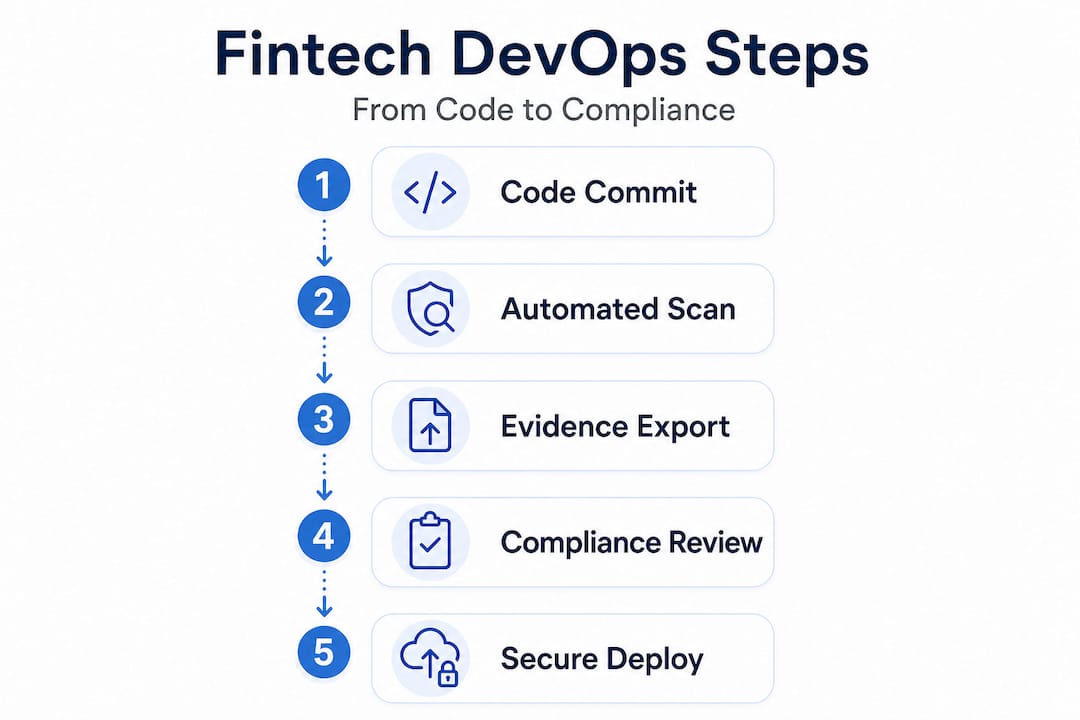
The fintech CI/CD modernization approach typically involves accelerating and de-risking software delivery by integrating security scanning, compliance checks, and auditable evidence directly into every stage of the pipeline. Here is what a compliant fintech pipeline looks like in practice:
- Code commit and branch policy enforcement: The pipeline validates branch naming, commit signatures, and ticket linkage before a build even starts
- Automated static analysis and dependency scanning: SAST tools and software composition analysis (SCA) run on every push, blocking builds that introduce critical vulnerabilities
- Build artifact signing: Each compiled artifact is cryptographically signed, providing a verifiable chain of custody
- Automated policy gates: Compliance rules, data classification checks, and licensing validations run before the artifact can proceed to staging
- Staged approvals with time-boxing: The pipeline routes change requests to designated approvers, with automatic escalation if approvals are delayed beyond a defined window
- Canary and blue/green deployments: Changes roll out incrementally to a small percentage of traffic, allowing automated rollback if error rates spike
- Post-deployment evidence generation: After each release, the pipeline generates a compliance package that includes test results, scan outputs, approval records, and deployment metadata
Compare this to a traditional delivery approach:
| Aspect | Traditional delivery | Fintech DevOps pipeline |
|---|---|---|
| Security scanning | Manual or post-deployment | Automated at every stage |
| Audit evidence | Manually assembled per audit | Auto-generated per release |
| Rollback mechanism | Manual process, hours to days | Automated, minutes |
| Approval workflow | Email or ticketing system | Pipeline-enforced gates |
| Change failure rate | Typically 15-45% for manual processes | Target below 5% with automation |
| Deployment frequency | Weekly or monthly | Daily to weekly with compliance |
Pro Tip: Set up your CI/CD pipeline to automatically export compliance artifacts to an immutable S3 bucket with object lock enabled. This gives auditors self-service access to evidence without disrupting your engineering team during audit cycles.
Investing in CI/CD automation as the backbone of your delivery process also creates a measurable improvement in production stability. Teams that implement staged approvals and automated rollback consistently report lower rates of production incidents tied to deployments. The connection between DevOps agility and cost reduction is direct. Fewer production fires mean fewer all-hands incidents, which are among the most expensive operational events any fintech organization can face. Modern payment automation platforms demonstrate that integrating compliance into the delivery flow actually increases release confidence rather than slowing teams down.

Delivery metrics and benchmarks: DORA metrics calibrated for fintech
Generic DORA benchmarks were built for software companies operating without regulatory overhead. Fintech teams that benchmark themselves against “elite” DORA targets without accounting for mandatory change advisory board reviews, audit requirements, and operational resilience mandates set themselves up for constant disappointment or, worse, compliance shortcuts.
The smarter approach is calibration. DORA-style metrics adapted for fintech account for the reality that a deployment frequency of several times per day is inappropriate when each deployment requires CAB sign-off. The goal is finding the highest sustainable velocity within your regulatory envelope, not chasing raw throughput numbers.
Here is how calibrated fintech benchmarks compare to standard DORA elite targets:
| Metric | DORA elite norm | Fintech calibrated target |
|---|---|---|
| Deployment frequency | Multiple times per day | 1-5 times per week |
| Lead time for changes | Less than 1 hour | 1-3 days (with CAB gates) |
| Change failure rate | Below 5% | Below 3% (stricter for regulated) |
| Mean time to recovery (MTTR) | Less than 1 hour | Under 4 hours (per resilience mandates) |
Why does MTTR carry extra weight in fintech? Regulators in many jurisdictions now publish specific operational resilience expectations. The UK’s FCA, for example, sets impact tolerance thresholds that translate directly into maximum downtime windows for critical payment services. Meeting those windows requires you to engineer recovery into your infrastructure, not just respond faster when things break.
The regulatory constraints shaping these calibrated benchmarks include:
- Change advisory board requirements: Mandatory approvals add lead time that “elite” benchmarks do not account for
- Audit requirements: Each deployment must generate verifiable evidence, adding steps that raw pipeline speed comparisons ignore
- Operational resilience mandates: Regulators increasingly require fintech firms to demonstrate they can recover within defined time windows, making MTTR a regulatory KPI
- Mandatory testing regimes: Penetration testing, disaster recovery drills, and tabletop exercises add overhead that affects overall delivery cadence
For a deeper look at how these metrics connect to regulatory frameworks, the analysis of DORA metrics for regulators breaks down how specific metrics map to compliance requirements. Our own coverage of operational resilience using DORA explains how to structure your measurement program so it satisfies both engineering leadership and compliance officers. Understanding the full picture of AWS infrastructure benefits also helps frame how cloud-native tooling reduces the overhead of hitting calibrated targets.
Ops mechanics: Infrastructure automation, cloud migration, and error reduction
Delivery pipeline optimization is only part of the equation. The infrastructure underneath your applications needs to be as automated and auditable as the pipeline itself.
The leading infrastructure automation techniques fintech DevOps teams use include:
- Infrastructure as code (IaC): Every environment, network configuration, IAM policy, and resource definition is version-controlled and peer-reviewed like application code
- Serverless and managed services: Offloading undifferentiated infrastructure management to cloud-managed services reduces the attack surface and patching burden
- Containerization: Kubernetes on EKS or ECS provides consistent, reproducible environments across development, staging, and production
- Hyperautomation via runbooks: Automated runbooks handle routine operational tasks, from certificate rotation to database patching, without human intervention
- Immutable infrastructure: Rather than patching running servers, new server images are built, tested, and deployed, eliminating configuration drift entirely
The Danske Bank hyperautomation case study illustrates what this looks like at scale. Infrastructure automation and cloud-managed services reduced human error substantially, standardized their environments across regions, and accelerated both migration timelines and patch velocity. The dual-run reduction alone, eliminating the need to maintain parallel legacy and cloud environments for extended periods, generated significant cost savings.
Pro Tip: Build automated runbooks for your three most common operational tasks first, typically certificate rotation, database maintenance, and access provisioning. These cover a large percentage of routine operational hours and are low-risk automation candidates that build team confidence before tackling complex migration workflows.
Standardized environments also create an unexpected compliance benefit. When every environment is provisioned from the same IaC templates, your compliance posture is consistent by default. Auditors can review the template once and know it applies everywhere, rather than sampling individual servers to check for configuration variance. Strong fintech disaster recovery strategies build on this foundation, using IaC to enable rapid environment recreation in a separate region when primary systems fail. The efficiency gains from infrastructure automation also support cross-border payment efficiency by enabling consistent deployment of payment processing environments across multiple jurisdictions.
Team formation, collaboration, and performance outcomes
Technology choices alone do not determine DevOps success. Organizational design and collaboration patterns are equally important and often underweighted in fintech DevOps conversations.
Empirical research on DevOps adoption shows that team structure directly affects which performance outcomes improve. Specifically, teams with separate development and operations functions that maintain limited collaboration tend to improve primarily in MTTR, but show weaker gains in deployment frequency and change failure rate. Fully integrated DevOps teams with shared ownership of both development and operations show broader gains across all four DORA-style metrics.
The practical implications for fintech leadership are significant:
- Integrated squads with shared on-call: When the team that builds a feature is also responsible for its availability in production, incentives align around stability, not just delivery speed
- Platform engineering teams: Dedicated platform teams that build internal developer tooling, the pipelines, the IaC modules, the monitoring dashboards, free product squads to focus on features while maintaining compliance by default
- Cross-functional collaboration rituals: Weekly sync between security, compliance, and engineering is not overhead. It is the mechanism that keeps policy gates current and prevents last-minute audit surprises
- Site reliability engineering (SRE) principles: Formalizing error budgets creates a shared language between engineering and business leadership about acceptable risk
“Many organizations adopt the surface-level vocabulary of DevOps without changing the organizational structures that created their delivery problems in the first place. New tools running inside old silos produce incremental gains at best.”
This connects directly to agile DevOps in cloud environments, where team structure and tooling must reinforce each other to deliver consistent results. A well-structured team operating good tooling consistently outperforms a technically excellent pipeline operated by fragmented, siloed teams.
Why real DevOps in fintech is operational control, not just speed
After working on infrastructure and DevOps for hundreds of fintech clients, the pattern is consistent. The organizations that see transformative results from DevOps are not the ones that chase deployment frequency records. They are the ones that treat DevOps as an operational control system.
Here is the uncomfortable reality most industry guides skip: faster releases can actually increase regulatory risk if the pipeline does not enforce policy automatically. A team that deploys ten times per week without automated policy gates creates ten opportunities per week to introduce a non-compliant change. A team that deploys twice per week with full automated policy enforcement, immutable evidence generation, and staged rollout is operationally safer and more audit-ready.
The executives who get this right align their DevOps KPIs with audit and resilience objectives from the start. They ask not “how fast can we deploy?” but “can we prove to a regulator, right now, that every change in the last 90 days was reviewed, tested, and approved according to our stated policy?” That question drives better architectural decisions than any velocity metric.
Pro Tip: Map every DevOps KPI to a specific compliance or resilience requirement before your next planning cycle. If a metric does not connect to a regulatory obligation or a customer reliability commitment, it is probably optimizing for the wrong thing.
The cloud resilience perspective we publish goes deeper on this alignment, showing how DORA-style measurement can serve both engineering improvement and regulatory reporting simultaneously. The goal is a single source of truth that satisfies your SRE team on Monday and your compliance officer on Friday.
How IT-Magic helps fintech teams realize DevOps-driven efficiency, security, and compliance
The strategies covered in this article represent exactly the kind of work fintech infrastructure teams face every day. Getting pipeline governance right, calibrating DORA metrics for regulatory reality, automating your infrastructure layer, and structuring your teams for genuine collaboration are all solvable problems with the right partner.
At IT-Magic, we have been building and operating compliant cloud infrastructure for fintech clients since 2010, with over 700 projects completed across 300+ clients. Our certified AWS experts specialize in AWS infrastructure support designed for regulated environments, including PCI DSS-compliant architectures, automated policy gates, and audit-ready evidence pipelines. We implement and manage Kubernetes support solutions on EKS and ECS that give your teams the deployment consistency regulated environments demand. Our AWS cost optimization service ensures that compliance controls do not translate into unnecessary infrastructure spend. If you are ready to make DevOps work as an operational control system rather than just a delivery accelerator, we can help you get there.
Frequently asked questions
How does DevOps address regulatory compliance in fintech?
DevOps integrates automated evidence generation and policy enforcement directly into the delivery pipeline, ensuring regulatory requirements are continuously met rather than checked manually at audit time. As governance and traceability are built into the toolchain itself, compliance becomes a pipeline output rather than a separate process.
What are the main benefits of CI/CD automation in fintech?
CI/CD automation reduces delivery risk, improves production stability, and enables continuous compliance by embedding audit controls into every deployment. The fintech CI/CD approach specifically de-risks software delivery by making policy enforcement automatic rather than manual.
How are DORA metrics calibrated for fintech environments?
DORA metrics are adapted to reflect regulatory constraints, with targets set to account for mandatory change advisory board approvals, operational resilience mandates, and audit requirements. Generic DORA metrics for fintech are adjusted so that benchmarks reflect achievable performance within a compliance-heavy delivery cadence.
What infrastructure automation techniques deliver the most value for fintech?
Infrastructure as code, serverless and cloud managed services, and hyperautomation runbooks deliver the highest combined value by reducing human error, standardizing environments across regions, and compressing migration and patch timelines.
Does DevOps always improve delivery outcomes for fintech teams?
Not automatically. Empirical research shows that DevOps impact depends heavily on team structure and collaboration depth, with some team formations improving only MTTR while fully integrated teams see broader gains across all key delivery metrics.
Recommended
- DevOps in cloud: drive agility and 72% cost savings
- Secure AWS cloud architecture steps for fintech: A practical guide
- AWS DevOps explained: accelerate delivery and scale securely
- DORA on AWS: Fintech Cloud Resilience Guide | IT-Magic
Alexander founded IT-Magic, an AWS Advanced Tier Services Partner delivering DevOps, cloud architecture, and managed services since 2010. He holds:
- AWS Certified Solutions Architect – Professional
- AWS Certified DevOps Engineer – Professional
- AWS Certified Security – Specialty
- AWS Certified Advanced Networking – Specialty
Talk to a certified AWS team trusted by INTERTOP, Foxtrot, Pandora, and J.Hilburn.
Get a free consultation