
TL;DR:
- Cloud provisioning automates the allocation and management of cloud resources, significantly reducing deployment times from weeks to minutes. It distinguishes itself from configuration, which prepares resources for use, to prevent drift and ensure reproducibility. Modern practices emphasize IaC, self-service portals with guardrails, and serverless models to enhance speed, governance, and cost efficiency at scale.
Cloud provisioning is the process that determines whether your infrastructure takes weeks to deliver or minutes. By definition, cloud provisioning is the automated allocation, configuration, and management of computing resources — servers, storage, networking, and databases — on demand. Traditional hardware provisioning forced teams to submit tickets, wait for procurement, rack equipment, and configure systems manually, often burning weeks or months before a single workload ran. Cloud provisioning collapses that timeline to seconds through automation. This article explains exactly what cloud provisioning is, how it works, the methods available, and what IT teams need to know to use it well.
Table of Contents
- Key Takeaways
- What is cloud provisioning, really?
- The three types of cloud provisioning
- Provisioning, governance, and the shadow IT problem
- Modern provisioning: serverless and IaC tools
- Best practices for cloud provisioning teams
- My take on what most teams get wrong
- How Itmagic helps with cloud provisioning at scale
- FAQ
Key Takeaways
Running this on your own AWS setup? IT-Magic is an AWS Advanced Tier Partner — we audit, fix, or fully manage it for you.
Get a free consultation| Point | Details |
|---|---|
| Provisioning is not configuration | Provisioning allocates resources; configuration prepares them for use — confusing the two causes drift. |
| Three core methods exist | Manual, automated, and self-service provisioning each suit different team structures and risk profiles. |
| Governance prevents runaway costs | Without ITSM guardrails embedded in provisioning workflows, shadow IT and budget overruns follow. |
| IaC is the gold standard | Tools like Terraform and CloudFormation make provisioning repeatable, auditable, and version-controlled. |
| Serverless shifts the burden | AWS Lambda and Fargate move provisioning responsibility to the provider, cutting idle resource costs. |
What is cloud provisioning, really?
The simplest cloud provisioning definition: it is the act of requesting, allocating, and making cloud resources available for use. You ask for a virtual machine, a database instance, or a load balancer. The cloud platform sets it up. That is provisioning.
What it is not is configuration. Provisioning hands you a blank resource. Configuration turns that resource into something functional by installing software, setting environment variables, and applying security policies. Mixing these two concepts up is one of the most common mistakes teams make, and configuration drift becomes the consequence. When provisioning and configuration steps are not cleanly separated, environments diverge over time, and you lose the ability to reproduce them reliably.
Cloud provisioning applies across the major service models:
- IaaS (Infrastructure as a Service): You provision raw compute, storage, and networking. AWS EC2, EBS volumes, and VPCs are examples.
- PaaS (Platform as a Service): You provision a managed runtime environment. AWS Elastic Beanstalk or RDS handles the underlying infrastructure for you.
- Serverless/FaaS: The provider provisions resources per request. You never directly manage the underlying server.
Understanding cloud provisioning also means recognizing it as an ongoing lifecycle, not a one-time act. Resources get created, scaled, updated, and terminated. Each of those events is a provisioning action, and each one carries cost, security, and compliance implications.
The three types of cloud provisioning
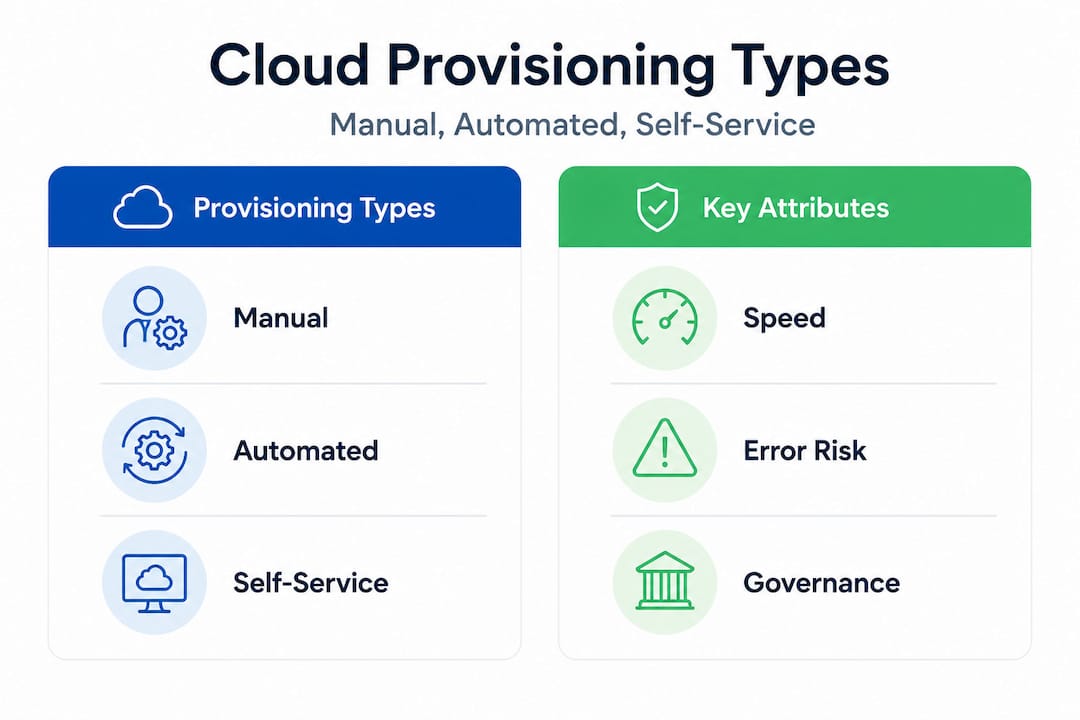
Not every team provisions resources the same way. The method you choose has a direct effect on speed, error risk, and your ability to enforce governance.
Manual provisioning
Manual provisioning means an engineer logs into the AWS Management Console, clicks through wizards, and creates resources by hand. It is the most accessible method and the most dangerous at scale. Every manual step is a chance for misconfiguration, and nothing is automatically documented or reproducible. Teams still use manual provisioning for one-off experiments or proof-of-concept work, but it should never be the primary method in a production environment.
Automated provisioning
Automated provisioning uses scripts, Infrastructure as Code (IaC) templates, or orchestration tools to deploy resources without human clicks. This is where most mature engineering teams operate. AWS CloudFormation uses declarative JSON or YAML templates to define exactly what resources get created, in what state, with rollback and drift detection built in. Terraform offers the same capability across multiple providers. Both tools treat infrastructure like code: versioned, peer-reviewed, and testable.

Self-service provisioning
Self-service provisioning gives developers and application teams the ability to request and spin up resources through a portal or API without involving the infrastructure team in every request. The key word is guardrails. Self-service without policy enforcement creates shadow IT. Self-service with embedded controls — approved instance types, mandatory tagging, budget thresholds, and network boundaries — gives development teams speed without sacrificing security.
| Method | Speed | Error Risk | Governance | Best For |
|---|---|---|---|---|
| Manual | Slow | High | Low | Experiments, one-off tasks |
| Automated (IaC) | Fast | Low | High | Production environments |
| Self-service | Very fast | Medium | Medium-High | Dev teams with guardrails |
Pro Tip: Even if your team uses manual provisioning today, start capturing every manual step as an IaC template. You will build your automation library incrementally without disrupting current workflows.
Provisioning, governance, and the shadow IT problem
Understanding cloud provisioning in isolation is not enough. How provisioning fits inside your broader IT governance model determines whether it creates value or creates problems.
ITSM frameworks like ITIL categorize provisioning under Request Fulfillment. When a developer needs a new environment, that request should move through an approved workflow with defined approvals, cost checks, and security reviews. Bypassing ITIL processes leads directly to shadow IT, where teams spin up resources outside of any tracking or control mechanism.
The consequences are predictable:
- Security gaps: Untracked resources rarely receive patching or security reviews.
- Cost overruns: Resources get provisioned and forgotten, accumulating charges indefinitely.
- Compliance failures: Regulated industries like fintech and healthcare need an auditable record of every resource. Shadow resources break that record.
The solution is not to slow provisioning down with bureaucratic approvals. It is to embed automated guardrails directly in the provisioning workflow. A well-designed self-service portal can provision a compliant environment in under five minutes while still enforcing encryption requirements, network isolation, and mandatory tagging for cost allocation.
“Provisioning should be seen as part of a well-governed ITSM process, balancing developer speed with cost and security controls.”
This balance is what separates teams that scale confidently from teams that hit a wall of technical debt and security incidents at 50 engineers.
Modern provisioning: serverless and IaC tools
The user provisioning market is projected to reach $15 billion by 2031, growing at 13.6% annually, largely driven by demand for automated and serverless resource management. That growth reflects where engineering teams are heading: away from manually managed compute and toward models where provisioning is largely invisible.
Here is how the modern provisioning stack breaks down:
- Serverless compute (AWS Lambda, Fargate): Serverless provisioning models shift provisioning responsibility to the cloud provider entirely. You deploy code or a container. AWS provisions the compute, scales it automatically, and tears it down when idle. You pay only for execution time, not standing capacity.
- Infrastructure as Code: Tools like Terraform and AWS CloudFormation define infrastructure in version-controlled templates. Every environment your team creates — dev, staging, production — is built from the same template, eliminating environment-specific surprises.
- Service Catalog and approved module libraries: Rather than letting teams write IaC from scratch, mature organizations publish pre-approved modules. A developer picks “PostgreSQL 15 on RDS, production-grade” from a catalog, and the approved, security-hardened template deploys automatically.
- CI/CD pipeline integration: Provisioning workflows embedded in CI/CD pipelines mean infrastructure changes get tested, reviewed, and deployed exactly like application code. No more manual handoffs between Dev and Ops.
- Drift detection and rollback: IaC tools continuously compare the deployed state against the declared template. When someone makes a manual change that introduces drift, the tool flags it and can automatically remediate or alert the team.
Pro Tip: Set your IaC tool’s drift detection to run on a schedule in production, not just during deployments. Manual changes made under incident pressure are the most common source of persistent drift.
Best practices for cloud provisioning teams
Getting provisioning right requires more than picking the right tool. These are the practices that separate teams managing infrastructure well from those constantly fighting fires.
- Separate provisioning from configuration explicitly. Use IaC tools (Terraform, CloudFormation) for provisioning and configuration management tools (Ansible, AWS Systems Manager) for configuration. Mixing the two in a single script creates tight coupling that breaks when either layer changes.
- Tag everything at provisioning time. Mandatory tagging policies applied during resource creation are the foundation of cost allocation, security auditing, and lifecycle management. Tagging resources after the fact is always incomplete.
- Automate cost controls at the provisioning layer. Use AWS Service Control Policies (SCPs) and budget alerts to block non-compliant resource types before they are created. Catching a t3.2xlarge deployed in the wrong environment at provisioning time costs nothing. Discovering it three months later costs real money.
- Build provisioning into disaster recovery. If your recovery process requires a human to manually click through a console to rebuild infrastructure, your actual recovery time is unpredictable. Automated provisioning workflows that can rebuild your environment from code are a prerequisite for credible DR.
- Review and retire. Provisioning creates resources. Every provisioning system needs an equally robust deprovisioning process. Orphaned resources are one of the leading sources of cloud cost waste across organizations.
- Version your IaC. Every template change should go through a pull request, code review, and testing pipeline before reaching production. Infrastructure changes that skip review cause the same categories of problems that unreviewed application code does.
The practical goal is a state where any engineer on your team can provision a compliant, production-ready environment from a terminal in under ten minutes, with full confidence that the result matches every other environment built from the same template.
My take on what most teams get wrong
I have worked with engineering teams across fintech, retail, and enterprise environments, and the same misunderstanding comes up repeatedly. Teams treat provisioning as a solved problem the moment they adopt Terraform or CloudFormation. They write templates, they automate deployments, and then they stop thinking about provisioning as a discipline.
What they miss is the governance layer. I have seen organizations with beautiful IaC repositories where developers are still spinning up resources through the console because the self-service portal was too slow or too restrictive. The IaC templates became a documentation exercise, not the actual provisioning path. Shadow IT does not only happen in organizations without automation. It happens in organizations where the automated path is harder than the manual one.
The second gap I see consistently is the confusion between provisioning and configuration at the organizational level. In mature setups, these responsibilities belong to different teams with different toolchains. At smaller organizations, one team owns both, which works fine until the codebase grows complex enough that a configuration change accidentally triggers a reprovisioning event. Separating the two concerns early, even if the same person handles both initially, pays dividends as teams scale.
My honest view is that serverless is changing who owns provisioning, not whether provisioning matters. With AWS Lambda and Fargate, the provisioning of individual compute resources moves to the provider. But the provisioning of the surrounding infrastructure — IAM roles, VPC configuration, API gateways, event sources — remains firmly the team’s responsibility. If anything, serverless architectures require more careful provisioning design, not less, because the components multiply rapidly.
— Oleksandr
How Itmagic helps with cloud provisioning at scale
Itmagic works with engineering teams that need provisioning to work reliably at production scale, not just in demos. As an AWS Advanced Tier Services Partner with 700+ projects delivered since 2010, Itmagic specializes in building the infrastructure automation and governance frameworks that make provisioning fast, controlled, and cost-efficient.
For teams running containerized workloads, Itmagic’s Kubernetes support services cover the provisioning and operations of EKS and ECS environments, including cluster autoscaling, node group management, and workload placement policies. For teams looking to cut waste from their AWS spend, the AWS cost optimization services address provisioning-related cost problems directly, from rightsizing over-provisioned instances to implementing SCPs that prevent expensive resources from being created in the first place.
If provisioning discipline is something your team is building out, it is worth a conversation with an infrastructure team that has done it across dozens of environments.
FAQ
What is cloud provisioning in simple terms?
Cloud provisioning is the automated process of allocating and setting up cloud resources such as servers, storage, and networks so they are ready for use. It reduces deployment time from weeks to minutes compared to traditional hardware provisioning.
How does cloud provisioning work?
Cloud provisioning works through APIs, IaC templates, or self-service portals that send resource requests to a cloud platform, which then allocates and configures the requested infrastructure automatically based on predefined parameters.
What is the difference between provisioning and configuration?
Provisioning allocates the resource and makes it available. Configuration prepares that resource for use by installing software, applying settings, and enforcing policies. Mixing the two is a leading cause of configuration drift.
What are the main benefits of cloud provisioning?
The core benefits of cloud provisioning include faster resource deployment, reduced manual errors, lower operational costs through pay-as-you-go models, and the ability to enforce security and compliance policies automatically at the point of resource creation.
What tools are used for cloud provisioning?
The most widely used tools include AWS CloudFormation, Terraform, and AWS Service Catalog for IaC-based provisioning, plus AWS Lambda and Fargate for serverless models where the provider handles compute provisioning automatically.
Recommended
- Cloud cost optimization strategies for CIOs: a practical guide
- Cloud Computing for Small Business: Benefits and Uses | IT-Magic
- What Is Cloud Migration? Key Types, Benefits & Process Explained | IT-Magic
- Cloud Migration Strategies: Everything You Need to Know | IT-Magic
Alexander founded IT-Magic, an AWS Advanced Tier Services Partner delivering DevOps, cloud architecture, and managed services since 2010. He holds:
- AWS Certified Solutions Architect – Professional
- AWS Certified DevOps Engineer – Professional
- AWS Certified Security – Specialty
- AWS Certified Advanced Networking – Specialty
Talk to a certified AWS team trusted by INTERTOP, Foxtrot, Pandora, and J.Hilburn.
Get a free consultation