

TL;DR:
- Cloud networking involves designing virtual networks using software controls instead of physical hardware, offering elastic scalability and faster provisioning. It relies on VPCs, subnets, and API-driven management, with security and routing managed through cloud-native tools rather than on-premises configurations. Engineers must adapt by learning cloud-specific practices, monitoring with flow logs, and planning for cost-efficient, secure, and highly available architectures.
Cloud networking is defined as the practice of designing, managing, and securing virtual networks within cloud computing environments using software-defined controls rather than physical hardware. For network engineers, mastering cloud networking basics means shifting from CLI-driven device management to API-driven policy configuration across services like AWS VPCs, subnets, and Transit Gateways. The core benefits of cloud networking include elastic scalability, faster provisioning, and a shift from capital expenditure to operational expenditure. This guide covers cloud network architecture, key protocols, security models, and best practices built for engineers who already understand traditional networking and want to apply that knowledge in the cloud.
What are the core components of cloud network architecture?
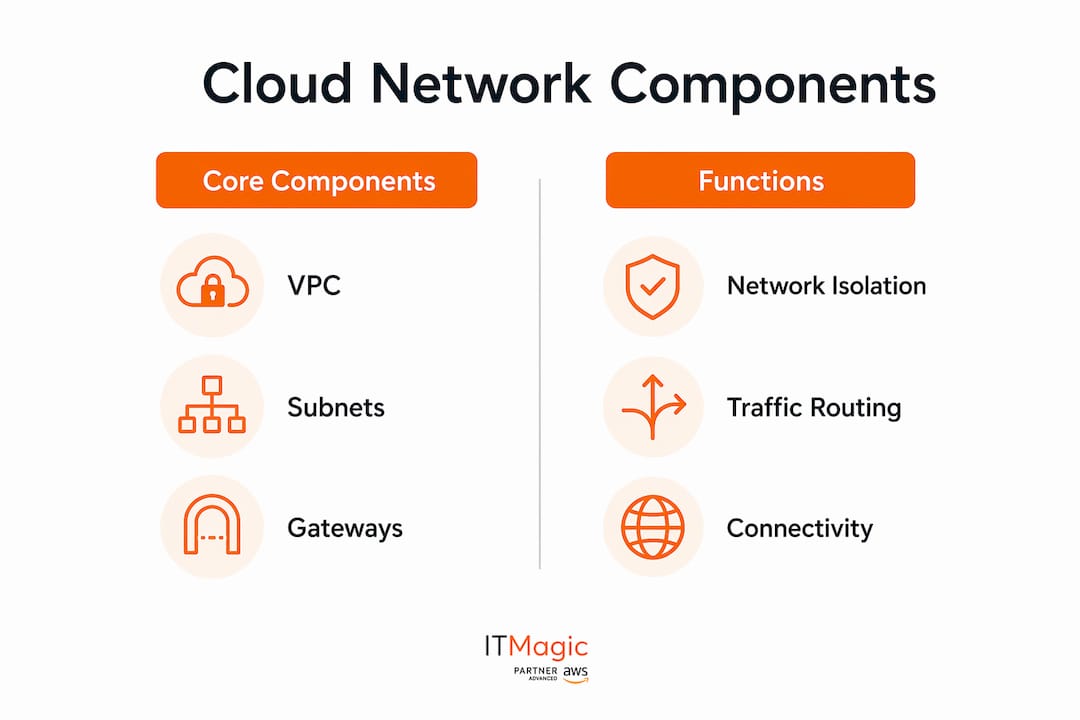
Cloud networks are built on Virtual Private Clouds (VPCs), which are logical partitions of a cloud provider’s network assigned to a single customer. VPCs use private IP ranges defined by RFC 1918: 10.0.0.0/8, 172.16.0.0/12, and 192.168.0.0/16. These ranges are then subdivided into subnets, each mapped to a specific availability zone for fault isolation. Understanding this structure is the starting point for every cloud network design decision you will make.

Subnets divide a VPC into public and private segments. Public subnets route traffic through an internet gateway, making resources reachable from the internet. Private subnets use a NAT gateway to allow outbound internet access without exposing resources directly. This separation is not optional in production environments. It is the baseline for any defensible network design.
Key connectivity components include internet gateways, VPN tunnels, and dedicated interconnects such as AWS Direct Connect. VPN tunnels encrypt traffic between on-premises networks and cloud VPCs over the public internet. Dedicated interconnects provide private, high-throughput paths that bypass the public internet entirely. For hybrid and multi-cloud setups, choosing between these options depends on latency requirements, compliance obligations, and budget.
Software-defined networking (SDN) controllers sit above all of this. They manage routing tables, security group rules, and network ACLs through API calls rather than device-level configuration. This is the fundamental shift that separates cloud networking from traditional networking.
Pro Tip: Design your VPC CIDR blocks with future growth in mind. Overlapping address spaces between VPCs or on-premises networks block peering and cause routing conflicts that are painful to fix after deployment.
| Component | Function |
|---|---|
| VPC | Logical network partition with private IP addressing |
| Subnet | Segment of a VPC mapped to an availability zone |
| Internet gateway | Enables inbound and outbound public internet access |
| NAT gateway | Allows private subnet resources to reach the internet outbound only |
| VPN tunnel | Encrypted connection between on-premises and cloud networks |
| Transit Gateway | Central hub connecting multiple VPCs and on-premises networks |
How does cloud networking differ from traditional networking?
Running this on your own AWS setup? IT-Magic is an AWS Advanced Tier Partner — we audit, fix, or fully manage it for you.
Get a free consultationThe most important shift for network engineers is the decoupling of the control plane from the data plane through SDN. In traditional networking, you configure routing and forwarding directly on physical devices using CLI commands. In cloud networking, you define policies through APIs, and the underlying infrastructure applies them automatically. This means your skills in Cisco IOS or Junos are still relevant conceptually, but the execution layer is entirely different.
Configuration through APIs changes how you troubleshoot. You cannot plug a cable analyzer into a virtual network segment. Physical inspection methods are replaced by VPC flow logs, native monitoring dashboards, and cloud-native observability tools. Flow logs capture metadata about accepted and rejected traffic at the network interface level. They are your primary diagnostic tool for connectivity issues and security investigations.
Cloud routing also works differently from what most engineers expect. Routing tables in cloud environments are implicit, meaning local subnet traffic routes automatically without explicit next-hop configuration. Non-local traffic requires explicit route entries pointing to the correct gateway or peering connection. Mismanaging route priorities creates connectivity black holes that are difficult to trace without proper logging in place.
The Shared Responsibility Model defines the security boundary clearly. Cloud providers secure the physical infrastructure, hypervisors, and global network fabric. You are responsible for security group rules, network ACLs, IAM policies, and subnet access controls. Treating the provider’s infrastructure security as a substitute for your own configuration security is the most common mistake engineers make when moving to cloud networking.
Pro Tip: Enable VPC flow logs from day one, not after an incident. Retroactive logging gaps make post-incident analysis nearly impossible and can create compliance problems under frameworks like PCI DSS and SOC 2.
What are the benefits and challenges of cloud networking?
Elastic scalability is the most immediate benefit engineers notice. Provisioning time drops from weeks to minutes when moving from physical hardware to on-demand virtual resources. That speed changes how teams respond to traffic spikes, new project requirements, and disaster recovery scenarios. A network that took a procurement cycle to expand now scales with an API call.
The cost model also changes fundamentally. Cloud networking shifts infrastructure spend from capital expenditure to operational expenditure through subscription and consumption-based pricing. This gives finance teams predictable monthly costs and gives engineering teams the ability to right-size resources without hardware commitments. The trade-off is that ongoing costs require active management rather than a one-time purchase decision.
The challenges are real and worth naming directly:
- Visibility complexity. Virtual networks lack the physical inspection points engineers rely on in traditional environments. Monitoring requires purpose-built tools and deliberate logging configuration.
- Implicit routing confusion. Engineers accustomed to explicit next-hop configuration frequently misconfigure cloud routing tables, causing silent connectivity failures.
- Data transfer costs. Cross-availability-zone traffic and data transfer out can significantly increase monthly bills if network architecture is not designed with cost awareness from the start. This is one of the most overlooked cost drivers in cloud infrastructure.
- Shared responsibility gaps. Teams that assume the cloud provider handles all security often leave firewall rules and access controls misconfigured.
- Skill translation. Network engineers must learn API-driven tooling, infrastructure-as-code practices, and cloud-native monitoring alongside their existing protocol knowledge.
Cloud networking adoption also drives a broader organizational shift. Teams move from hardware maintenance roles toward policy and security orchestration under a Network-as-a-Service model. That is a career evolution, not just a tooling change.
What are best practices for designing and securing cloud networks?
Effective cloud network design starts with availability zone planning. Distribute subnets across at least two availability zones for every workload that requires high availability. Single-AZ deployments create a hard dependency on one physical data center, which eliminates the resilience that cloud infrastructure is supposed to provide.
Security architecture follows a defense-in-depth model with multiple control layers:
- Security groups act as stateful firewalls at the instance level, controlling inbound and outbound traffic per resource.
- Network ACLs provide stateless filtering at the subnet boundary, adding a second control layer independent of security groups.
- NAT gateways prevent direct inbound access to private subnet resources while allowing necessary outbound connectivity.
- Zero trust principles require that no network path is implicitly trusted, even within the same VPC.
For interconnectivity between VPCs, VPC peering works well for simple, point-to-point connections between a small number of networks. Transit Gateway is the correct choice when you need to connect many VPCs or integrate on-premises networks at scale. Peering does not support transitive routing, meaning traffic cannot flow through a peered VPC to reach a third network. Transit Gateway solves this by acting as a central routing hub.
Effective cloud network design requires planning for availability zones, security layers, and network segmentation before the first resource is deployed. Retrofitting security and segmentation into an existing flat network is significantly more disruptive than building it correctly from the start. Treat your network security strategy as a first-class design requirement, not an afterthought.
Pro Tip: Use infrastructure-as-code tools like AWS CloudFormation or Terraform to define your VPC, subnet, and security group configurations. Code-defined networks are repeatable, auditable, and far less prone to configuration drift than manually managed resources.
Key Takeaways
Cloud networking is the software-defined practice of building and securing virtual networks in cloud environments, and mastering it requires understanding VPCs, routing, SDN, and the Shared Responsibility Model.
| Point | Details |
|---|---|
| VPCs are the foundation | All cloud networks start with VPC design using RFC 1918 private IP ranges and subnet segmentation. |
| SDN replaces CLI management | Network configuration happens through APIs and policy definitions, not device-level commands. |
| Routing is implicit, not explicit | Cloud routing tables handle local traffic automatically; non-local routes require explicit configuration. |
| Security is your responsibility | Cloud providers secure infrastructure; you own firewall rules, ACLs, and access controls. |
| Data transfer costs add up | Cross-AZ and outbound traffic costs require cost-aware architecture from the design phase. |
What I’ve learned from 700+ cloud infrastructure projects
Most network engineers I work with underestimate how much the mental model has to change, not just the toolset. You can learn the AWS console in a week. Unlearning the assumption that the network is a physical thing you can touch takes much longer.
The engineers who adapt fastest are the ones who treat infrastructure-as-code as a networking skill, not a developer skill. When your VPC, subnets, and security groups live in version-controlled Terraform modules, you gain something physical networking never gave you: a complete, auditable history of every configuration change. That history is invaluable during incident response and compliance audits.
The cost visibility issue catches almost everyone off guard. Cross-AZ traffic charges are real, and they compound quickly in microservices architectures where services call each other constantly across zones. I have seen teams triple their monthly AWS bill simply by placing services in different availability zones without accounting for the traffic between them. Designing for cost-aware architecture from day one is not a finance concern. It is an engineering discipline.
My strongest recommendation for engineers new to cloud networking: spend serious time with VPC flow logs before you need them. Build a lab environment, generate traffic, break things intentionally, and practice reading the logs. The engineers who can interpret flow log data quickly are the ones who resolve production incidents in minutes instead of hours. That skill does not come from reading documentation. It comes from deliberate practice in a low-stakes environment.
Cloud networking fundamentals are not complicated. But they require you to let go of physical intuitions and replace them with software and policy thinking. The engineers who make that shift fully are the ones who build infrastructure that actually holds up under production conditions.
— Oleksandr
AWS cloud networking support from IT-Magic
Building a cloud network correctly from the start is significantly cheaper than fixing one that was designed without proper segmentation, security layers, or cost controls.
IT-Magic is an AWS Advanced Tier Services Partner with over 700 delivered projects across cloud architecture, DevOps, and security. The team designs and implements AWS network infrastructure including VPC architecture, Transit Gateway configurations, hybrid connectivity, and compliance-aligned security controls for PCI DSS, SOC 2, and HIPAA environments. If your team is building or migrating cloud infrastructure and wants expert guidance on network design, security, and cost control, IT-Magic’s AWS infrastructure support services are built for exactly that work. You can also explore IT-Magic’s cloud networking setup guide for a practical implementation walkthrough.
FAQ
What is a VPC in cloud networking?
A Virtual Private Cloud (VPC) is a logically isolated network partition within a cloud provider’s infrastructure, using private IP ranges defined by RFC 1918. It is the foundational building block of every cloud network architecture.
How does cloud networking work at a basic level?
Cloud networking uses software-defined controllers to create and manage virtual networks, routing tables, and security rules through APIs rather than physical device configuration. Traffic flows between subnets, gateways, and external networks based on policies you define in the cloud console or through infrastructure-as-code.
What is the Shared Responsibility Model in cloud networking?
The Shared Responsibility Model means the cloud provider secures the physical infrastructure and global network fabric, while you are responsible for configuring security groups, network ACLs, IAM policies, and access controls within your environment.
Why do cross-availability-zone costs matter for network engineers?
Traffic between resources in different availability zones incurs data transfer charges that compound quickly in distributed architectures. Designing services to minimize unnecessary cross-AZ traffic is a core cost-control practice in cloud network architecture.
What monitoring tools replace physical network inspection in cloud environments?
VPC flow logs and native cloud monitoring dashboards replace physical cable analysis and packet sniffing. Flow logs capture metadata on accepted and rejected traffic at the network interface level and are the primary tool for troubleshooting and security investigation.
Recommended
- How to Set Up Cloud Networking: IT Pro Guide
- Network Security Strategies for Cloud Environments in 2026
- Network Security Tips 2026: What IT Teams Must Know
- Cloud Computing for Small Business: Benefits and Uses | IT-Magic
Alexander founded IT-Magic, an AWS Advanced Tier Services Partner delivering DevOps, cloud architecture, and managed services since 2010. He holds:
- AWS Certified Solutions Architect – Professional
- AWS Certified DevOps Engineer – Professional
- AWS Certified Security – Specialty
- AWS Certified Advanced Networking – Specialty
Talk to a certified AWS team trusted by INTERTOP, Foxtrot, Pandora, and J.Hilburn.
Get a free consultation