

TL;DR:
- AWS for fintech offers a scalable, compliant platform with specialized services like Aurora DSQL, AI workflows, and payment cryptography. Implementing strong architecture and governance, including multi-cloud strategies and AI monitoring, reduces operational risks and legal exposure. Early cost control and proactive governance are essential for sustainable, efficient growth in financial technology.
AWS for fintech is the leading cloud infrastructure platform for financial technology firms that need to scale fast, stay compliant, and protect sensitive data. The platform’s depth spans managed payment cryptography, serverless compute, globally distributed databases, and agentic AI workflows. These capabilities address the exact pressure points fintech executives face: regulatory scrutiny, transaction reliability, and the cost of operating at scale. Understanding how to deploy these services correctly separates firms that grow efficiently from those that accumulate technical debt and compliance risk.
How AWS enables scalable and secure fintech infrastructure
AWS gives fintech teams a foundation built for financial workloads, not adapted from general-purpose cloud services. The platform includes PCI DSS and SOC 2 aligned infrastructure, managed blockchain, and AWS Payment Cryptography as purpose-built services. That specificity matters because general cloud platforms force fintech teams to build compliance controls from scratch.

The most important database development for global fintech in 2026 is Amazon Aurora DSQL. It delivers globally distributed ACID transactions with up to 99.999% uptime across active-active multi-region clusters. That architecture eliminates manual reconciliation and batch sync processes that slow down cross-border payment systems.
Scaling on AWS follows a clear pattern for fintech teams:
- Serverless compute via AWS Lambda handles event-driven workloads like payment validation without provisioning fixed servers.
- Amazon EKS and ECS run containerized microservices with auto-scaling policies tied to transaction volume.
- AWS Graviton instances cut compute costs for CPU-intensive fraud detection models.
- Multi-region active-active deployments keep balances and spend controls synchronized with low latency across geographies.
- AWS PrivateLink secures internal service communication without exposing traffic to the public internet.
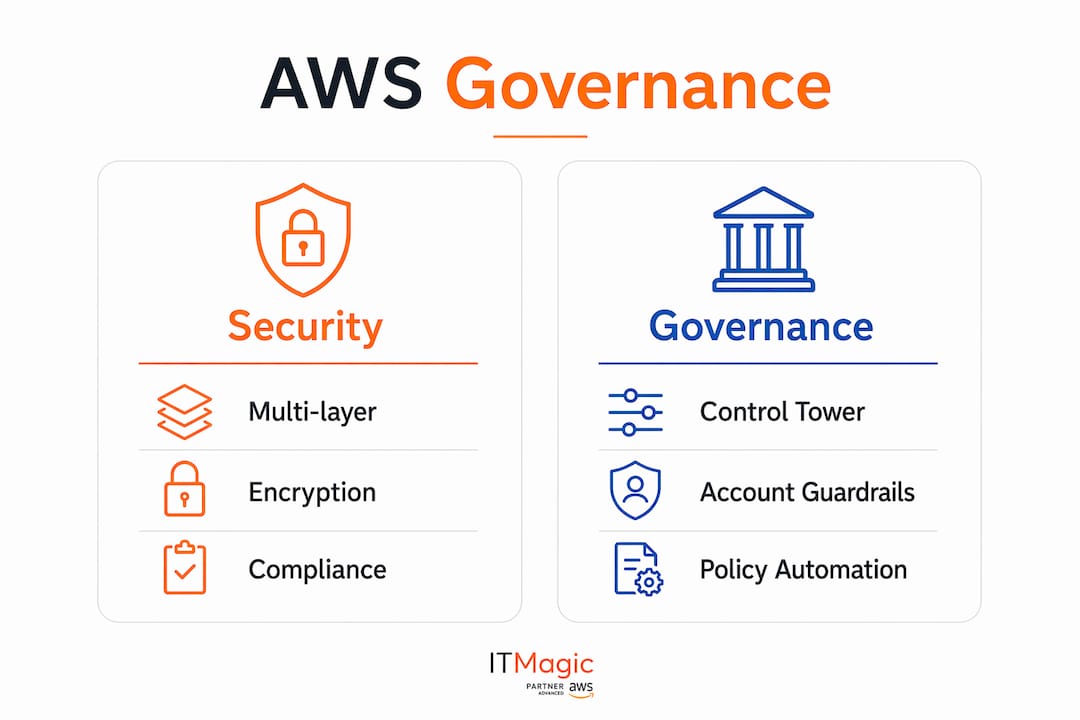
Security on AWS is not a single feature. It is an architecture decision. Fintech teams building on AWS should apply the shared responsibility model precisely: AWS secures the infrastructure layer, and your team secures data, identity, and application configuration. The secure AWS architecture guide from IT-Magic outlines how to structure VPCs, IAM policies, and encryption at rest and in transit for financial workloads.
Pro Tip: Apply AWS Control Tower from day one to enforce guardrails across all accounts. Retrofitting governance controls after a fintech platform scales is significantly more expensive than building them in at the start.
How does agentic AI on AWS change fintech operations?
Running this on your own AWS setup? IT-Magic is an AWS Advanced Tier Partner — we audit, fix, or fully manage it for you.
Get a free consultationAgentic AI on AWS is not a future concept. It is already running in production KYC workflows at financial institutions. Parallel agent execution models on AWS reduce KYC validation time from 3–5 days to near real time. Institutions using this architecture process four times their previous caseloads by running document analysis, identity verification, and fraud detection simultaneously rather than sequentially.
The architecture behind this uses Amazon Bedrock for foundation model access, AWS Lambda for event-driven orchestration, and Amazon S3 for document staging. Each agent handles a discrete task. One agent extracts data from identity documents. Another cross-references sanctions lists. A third scores fraud risk. The orchestration layer routes results and triggers downstream compliance actions without human intervention at each step.
The business case for fintech executives breaks down into four measurable outcomes:
- Throughput increase. Processing four times the caseload with the same headcount directly reduces cost per verification.
- Auditability. Every agent action is logged in AWS CloudTrail, creating a complete audit trail for regulators.
- Accuracy improvement. Dynamic AI-based routing improves results accuracy by matching document types to specialized models rather than running all documents through a single general model.
- Cost reduction. AWS serverless pay-per-use pricing means you pay for actual processing time, not idle server capacity.
Governance is the part most fintech teams underestimate. 62% of financial institutions already deploy AI agents, and 85% expect autonomous AI-driven financial transactions soon. That pace of adoption outstrips governance maturity at most firms. Sensitive data leakage ranks as the top security concern. The practical response is to extend identity governance beyond human users. Non-human identities, meaning AI agents and automated processes, need the same access controls, rotation policies, and monitoring that you apply to human IAM accounts.
Pro Tip: Build AI-specific monitoring dashboards in Amazon CloudWatch that track agent decision rates, exception volumes, and latency. These metrics catch model drift and data quality issues before they create compliance exposure.
Fintech teams integrating AI agents should also connect with AI worker agent frameworks that handle autonomous transaction workflows, since the orchestration patterns used in those environments map directly onto AWS Lambda and Bedrock architectures.
What is cloud concentration risk, and how does multi-cloud address it?
Cloud concentration risk is the operational and regulatory exposure that comes from depending on a single cloud provider for all critical financial services. Regulators including the European Banking Authority and the Digital Operational Resilience Act framework treat single-provider dependency as a systemic risk. A multi-cloud strategy reduces vendor lock-in, improves exit strategies, and aligns fintech operations with DORA and EBA guidelines.
The practical benefits and challenges of multi-cloud adoption in fintech are not equal on both sides.
| Dimension | Single cloud | Multi-cloud |
|---|---|---|
| Vendor lock-in | High | Reduced |
| Regulatory alignment | Partial (DORA risk) | Strong |
| Operational complexity | Lower | Higher |
| Resilience against provider outages | Vulnerable | Protected |
| Cost predictability | Easier to manage | Requires active governance |
Multi-cloud does not mean running identical workloads on two providers simultaneously. The practical pattern is workload segmentation: run core transaction processing on AWS where Aurora DSQL and payment cryptography services are strongest, and place secondary workloads or disaster recovery on a second provider. This gives you regulatory compliance without duplicating your entire infrastructure stack.
The governance challenges of multi-cloud are real. Observability becomes harder when logs and metrics live in separate systems. Security policies need enforcement across providers using tools like HashiCorp Terraform and AWS Organizations in combination. Cost management requires a unified view that most native cloud billing tools do not provide alone. Fintech teams that treat multi-cloud as a procurement decision rather than an architecture decision consistently overspend and underdeliver on resilience.
Enterprise cloud solutions that address multi-cloud governance show that standardizing on a single observability platform, such as Datadog or Grafana, across providers is the fastest way to reduce operational friction in multi-cloud fintech environments.
Practical considerations for fintech leaders deploying AWS solutions
Cost control is the discipline that separates fintech teams that scale profitably from those that grow into unsustainable cloud bills. Cloud bills spiral when fintech teams add functionality without cost-awareness built into their deployment pipelines. The solution is cost engineering from the start, not cost reduction after the fact.
Effective cost engineering on AWS for financial workloads includes:
- Right-sized compute. Match instance types to actual workload profiles. Over-provisioning is the most common source of wasted spend.
- Spot instances for batch jobs. Fraud model training, report generation, and data pipeline runs are all good candidates for spot pricing.
- Automated environment scaling. Use AWS Auto Scaling groups with scheduled scaling for predictable traffic patterns and target tracking for variable loads.
- Reserved Instance commitments. For baseline compute that runs continuously, one-year or three-year Reserved Instances cut costs significantly compared to on-demand pricing.
Connectivity is a less-discussed but critical failure point in fintech cloud deployments. Standard AWS PrivateLink configurations work well under normal load. Under off-peak conditions or during deployments, they can produce reconnection storms and duplicate authorizations without session persistence hardening. Fintech teams processing payments need to implement hardened PrivateLink patterns that maintain session state across reconnections.
Governance for non-human identities is the emerging priority that most fintech infrastructure teams are not yet treating with the same rigor as human IAM. AI agents, automated pipelines, and service accounts all carry access rights. Without rotation policies, least-privilege enforcement, and anomaly detection on non-human identities, they become the most likely attack vector in a mature fintech AWS environment.
Pro Tip: Use AWS IAM Access Analyzer on a weekly schedule to identify unused permissions across both human and non-human identities. Fintech environments accumulate permission drift faster than most teams realize, and regulators increasingly ask for evidence of access reviews.
The key benefits of AWS infrastructure for fintech extend beyond raw compute. The managed service catalog, compliance tooling, and global network footprint together reduce the engineering work required to meet regulatory standards in multiple jurisdictions simultaneously.
Key Takeaways
AWS for fintech delivers the most value when executives treat it as an architecture discipline, not a procurement decision.
| Point | Details |
|---|---|
| Agentic AI cuts KYC time | Parallel agent execution reduces validation from 3–5 days to near real time, quadrupling throughput. |
| Aurora DSQL enables global consistency | Active-active multi-region clusters deliver 99.999% uptime and eliminate batch reconciliation. |
| Multi-cloud mitigates concentration risk | Workload segmentation across providers satisfies DORA and EBA requirements without duplicating full infrastructure. |
| Cost engineering must start early | Right-sized compute, spot instances, and automated scaling prevent disproportionate cloud spend at scale. |
| Non-human identity governance is urgent | 85% of institutions expect autonomous AI transactions soon, making AI-specific access controls a compliance priority. |
What I’ve learned from watching fintech teams adopt AWS
The fintech firms that get the most out of AWS share one trait: they treat infrastructure as a product, not a utility. They assign ownership, set performance targets, and review architecture decisions on a regular cadence. The firms that struggle treat AWS as a place to run servers and are surprised when costs climb or a compliance audit reveals gaps.
The agentic AI shift is the most significant change I have seen in fintech cloud architecture in years. The speed gains are real. Processing KYC cases in near real time instead of days is not an incremental improvement. It changes the economics of customer onboarding entirely. But the governance gap is equally real. Most teams I observe are deploying AI agents faster than they are building the monitoring and identity controls to manage them safely.
Multi-cloud is another area where I see a consistent gap between intent and execution. Executives approve multi-cloud strategies for good regulatory reasons. Then the engineering team discovers that running two cloud environments doubles the operational surface area without doubling the team. The teams that succeed pick a primary cloud, which is almost always AWS for fintech workloads, and use a second provider for specific resilience or regulatory requirements rather than trying to run everything everywhere.
My honest advice to fintech executives: invest in cloud governance before you need it. The cost of retrofitting Control Tower guardrails, IAM policies, and observability tooling into a production fintech environment is three to five times the cost of building them correctly at the start. The firms that do this right are the ones that can move fast without accumulating the kind of technical and compliance debt that slows them down later.
— Oleksandr
How IT-Magic helps fintech teams build on AWS
IT-Magic has delivered over 700 projects for more than 300 clients as an AWS Advanced Tier Services Partner, with deep specialization in fintech cloud infrastructure, compliance, and DevOps.
For fintech teams managing containerized workloads, IT-Magic’s Kubernetes support services cover EKS cluster design, auto-scaling configuration, and security hardening aligned with PCI DSS requirements. For teams concerned about cloud spend, the INTERTOP cost optimization case study shows how IT-Magic reduced AWS costs while improving infrastructure reliability for a high-volume production environment. If you are planning a cloud migration or need to close compliance gaps before a regulatory review, IT-Magic’s certified AWS engineers can assess your current architecture and build a path forward. Reach out through itmagic.pro/industries/aws-for-fintech to start the conversation.
FAQ
What AWS services are most critical for fintech?
Amazon Aurora DSQL, AWS Lambda, Amazon Bedrock, and AWS Payment Cryptography are the most fintech-specific services. They address global transaction consistency, serverless compute, AI orchestration, and payment security respectively.
How does AWS support PCI DSS compliance?
AWS provides PCI DSS-aligned infrastructure, including network segmentation tools, encryption services, and audit logging through AWS CloudTrail. Your team is responsible for application-layer controls under the shared responsibility model.
What is cloud concentration risk in fintech?
Cloud concentration risk is the regulatory and operational exposure from depending on a single cloud provider for critical financial services. Regulators including DORA and the EBA treat it as a systemic risk requiring multi-cloud or exit strategy planning.
How fast can AWS agentic AI process KYC cases?
Parallel agent execution on AWS reduces KYC validation from 3–5 days to near real time. Institutions using this architecture process four times their previous caseloads without adding headcount.
What is the biggest governance risk with AI agents on AWS?
Sensitive data leakage and uncontrolled non-human identity access are the top risks. 85% of financial institutions expect autonomous AI-driven transactions soon, making AI-specific monitoring and least-privilege access controls for agents a current compliance priority.
Recommended
- AWS for Fintech | PCI DSS-Ready, Secure & Scalable Infrastructure
- AWS Security Trends: What CIOs Need to Know for 2026
- Secure AWS cloud architecture steps for fintech: A practical guide
- 5 key benefits of AWS infrastructure for fintech
Alexander founded IT-Magic, an AWS Advanced Tier Services Partner delivering DevOps, cloud architecture, and managed services since 2010. He holds:
- AWS Certified Solutions Architect – Professional
- AWS Certified DevOps Engineer – Professional
- AWS Certified Security – Specialty
- AWS Certified Advanced Networking – Specialty
Talk to a certified AWS team trusted by INTERTOP, Foxtrot, Pandora, and J.Hilburn.
Get a free consultation