
TL;DR:
- Security automation uses technology to detect, investigate, and respond to cyber threats without manual intervention. It significantly improves response speed, reduces analyst workload, and lowers breach costs through continuous monitoring and AI-driven decision-making. Implementing a unified platform enhances operational efficiency, compliance, and risk management for organizations.
Security automation is defined as the use of technology to automatically detect, investigate, and respond to cyber threats without requiring manual intervention at every step. Tools like SIEM platforms, EDR solutions, and AI-driven orchestration systems now form the backbone of modern security operations. Organizations integrating these technologies report measurable gains in speed, accuracy, and analyst capacity. The role of automation in security has shifted from a convenience to an operational requirement, particularly as threat volumes outpace what human teams can handle alone.
What is the role of automation in security operations?
Security automation covers the full threat lifecycle: detection, triage, investigation, containment, and remediation. Platforms like Microsoft Sentinel, Splunk SOAR, and Palo Alto XSOAR execute response playbooks in seconds, compared to the hours or days a manual workflow requires. The industry term for this discipline is security orchestration, automation, and response, commonly abbreviated as SOAR. SOAR sits at the intersection of data aggregation, workflow automation, and AI-assisted decision-making.

The core benefit is speed. Automated systems can correlate thousands of events per second, flag anomalies, and trigger containment actions before an analyst even opens a ticket. That speed matters because the average dwell time for an attacker inside a network is still measured in days, not minutes. Cutting detection-to-response time from hours to seconds directly reduces the blast radius of any breach.
AI plays a central role here. Machine learning models trained on historical threat data can identify behavioral patterns that rule-based systems miss entirely. The role of AI in security is not to replace analysts but to filter noise, prioritize alerts, and surface the cases that genuinely need human judgment.
How does automation reduce analyst workload and improve efficiency?
Running this on your own AWS setup? IT-Magic is an AWS Advanced Tier Partner — we audit, fix, or fully manage it for you.
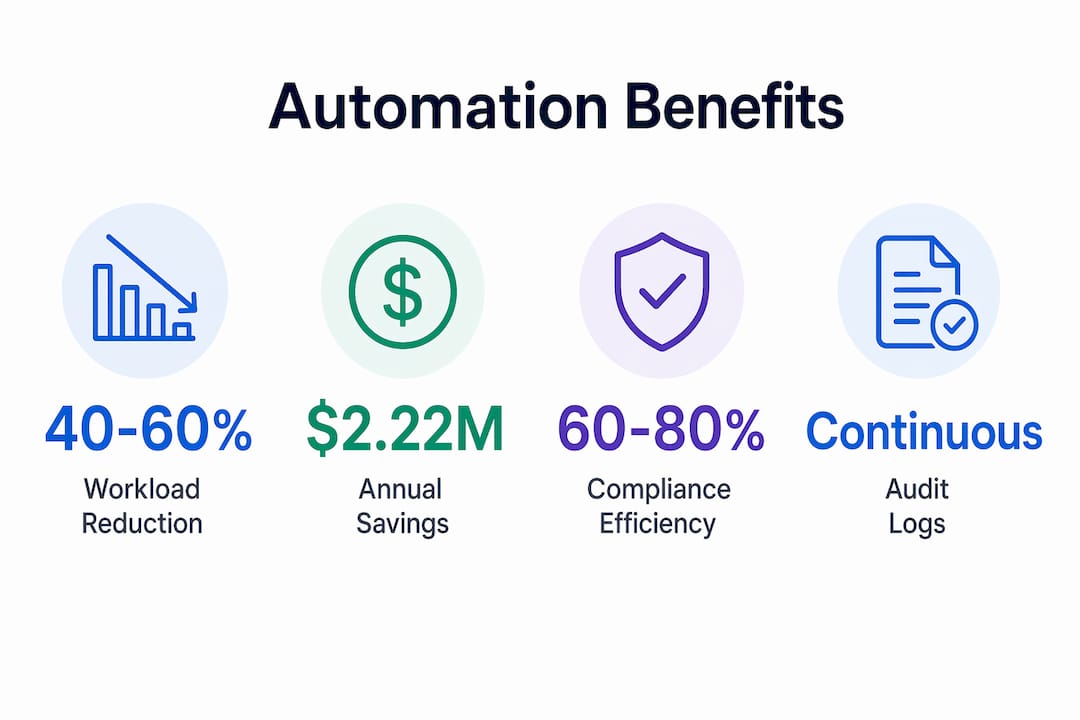
Get a free consultationSecurity automation reduces analyst workloads by 40–60%, freeing teams to focus on threat hunting and strategic work rather than manual triage. That shift matters because most security operations centers are understaffed relative to alert volume. Automation absorbs the repetitive work so analysts can apply expertise where it counts.
The efficiency gains compound at scale. Automation manages a 63% increase in alerts while simultaneously reducing manual handling by 35%. That combination is what makes automation security solutions viable for growing organizations that cannot simply hire their way out of the alert backlog.
Key tasks that automation handles without analyst involvement include:
- Alert triage and deduplication: Correlating events across SIEM, EDR, and cloud logs to eliminate duplicate alerts
- Threat enrichment: Pulling context from threat intelligence feeds like VirusTotal, Shodan, or MITRE ATT&CK automatically
- Incident containment: Isolating compromised endpoints or revoking credentials based on predefined thresholds
- Evidence collection: Packaging forensic artifacts for post-incident review without manual extraction
The shift from reactive triage to proactive threat hunting is the real productivity gain. Analysts who previously spent 70% of their time on alert queues can now spend that time on adversary simulation, red team exercises, and architectural risk reviews.
Pro Tip: Avoid building your automation stack from five disconnected point tools. Fragmented toolsets create handoff gaps where threats slip through. A unified platform that shares detection context across triage, response, and reporting will outperform any collection of siloed tools.
How does automation lower breach costs and improve risk management?
Organizations integrating AI and security automation save an average of $2.22 million annually on breach-related costs compared to those relying on manual processes. That figure reflects faster containment, reduced dwell time, and lower remediation overhead. The financial case for automation is no longer theoretical.
The mechanism behind those savings is continuous exposure management. Instead of running quarterly vulnerability scans, automated systems test infrastructure continuously, confirm patch efficacy, and prioritize remediation based on exploitability rather than CVSS score alone. This approach is sometimes called VulnOps, where AI continuously tests exploits against live infrastructure to filter false positives and confirm that patches actually close the vulnerability.
Shared data context between detection and response tools is what makes this work in practice. When your EDR, SIEM, and vulnerability scanner all feed into a single control plane, the remediation workflow carries full context about the threat actor’s behavior, the affected asset’s criticality, and the patch status. Without that shared context, teams remediate in the dark.
Key risk management outcomes from automated security workflows include:
- Reduced mean time to detect (MTTD): Automated correlation cuts detection from hours to minutes
- Reduced mean time to respond (MTTR): Playbook-driven containment executes in seconds
- Continuous patch validation: AI confirms remediation success rather than assuming it
- Lateral movement prevention: Automated network segmentation limits attacker progression after initial compromise
“Security operations must evolve from human-paced manual processes to time-critical, continuously operating automated workflows driven by AI. Periodic vulnerability management is no longer sufficient against adversaries who operate at machine speed.”
The impact of automation on security risk is most visible in regulated industries. Healthcare organizations running HIPAA-compliant environments and fintechs under PCI DSS face breach costs that dwarf the investment in automation tooling. The math is straightforward: automate early, or pay the breach premium later.
How does automation simplify compliance monitoring and reporting?
Automating compliance monitoring cuts manual compliance effort by 60–80%, which directly lowers audit risk and reduces the burden on security and legal teams. That reduction comes from replacing periodic manual evidence collection with continuous, automated logging. The result is an organization that is always audit-ready rather than scrambling before each review cycle.
Here is how a mature compliance automation workflow operates in practice:
- Continuous log collection: Automated tools capture every configuration change, access event, and policy deviation in real time, feeding centralized repositories like AWS CloudTrail or Azure Monitor.
- Policy enforcement checks: Automated controls verify that configurations match approved baselines. Any drift triggers an alert or an automatic rollback, depending on severity.
- Evidence packaging: When an audit request arrives, automated systems generate pre-formatted evidence bundles mapped to specific GDPR, HIPAA, or PCI DSS controls. No manual extraction required.
- Reporting and dashboards: Compliance dashboards show control status in real time, giving security leaders a live view of posture rather than a point-in-time snapshot.
Automated compliance tools generate continuous audit-ready logs that simplify regulatory reporting across frameworks including GDPR, HIPAA, and PCI DSS. That capability is particularly valuable for organizations operating across multiple regulatory jurisdictions simultaneously.
Pro Tip: Use automation to enforce consistent policy application across every environment, not just production. Development and staging environments are common audit findings because manual processes rarely cover them with the same rigor. Automated policy enforcement closes that gap.
What are the current challenges and future trends in security automation?
The most common strategic mistake is treating automation as a tool upgrade rather than an operational mandate. Organizations that bolt automation onto existing manual workflows see marginal gains. Organizations that redesign their operations around automation see transformational ones. The distinction is architectural, not technical.
Agentic AI represents the next evolution. Unlike traditional rule-based playbooks that execute fixed response sequences, agentic AI workflows adapt autonomously to evolving threats. An agentic system can observe an attack pattern, reason about the attacker’s likely next move, and execute a preemptive containment action without waiting for a human to approve each step. Platforms like Torq and Swimlane are already deploying agentic architectures in production environments.
Governance is the hardest problem in this space. AI systems generate large numbers of non-human identities, including service accounts, API tokens, and automated credentials. Non-human identities generated by AI expand attack surfaces and demand automated credential governance to prevent misuse. The Cloud Security Alliance has flagged this as one of the top emerging risks in agentic AI deployments.
| Challenge | Current State | Emerging Solution |
|---|---|---|
| Alert fatigue | High false positive rates overwhelm analysts | AI-driven triage with behavioral context |
| Fragmented toolsets | Siloed tools create detection gaps | Unified SOAR platforms with shared data context |
| Agentic AI governance | Non-human identities lack consistent oversight | Automated credential lifecycle management |
| Vulnerability management | Periodic scans miss fast-moving threats | VulnOps with continuous AI-driven exploit testing |
| Compliance coverage | Manual processes miss dev and staging environments | Policy-as-code with automated drift detection |
The future of security automation points toward unified control planes that share detection and remediation context across every layer of the stack. Security teams that build toward that architecture today will be positioned to absorb AI-driven threats that current tools cannot yet handle. You can explore how this intersects with broader AI-driven operational shifts across cloud and infrastructure environments.
Key Takeaways
Security automation delivers its full value only when implemented as a unified operational architecture, not as a collection of disconnected tools layered onto manual processes.
| Point | Details |
|---|---|
| Workload reduction is measurable | Automation cuts analyst workloads by 40–60%, freeing capacity for strategic threat hunting. |
| Financial ROI is proven | Organizations save an average of $2.22 million annually on breach costs by integrating AI and automation. |
| Compliance effort drops sharply | Automated monitoring reduces manual compliance work by 60–80% and keeps organizations audit-ready continuously. |
| Agentic AI changes the response model | Rule-based playbooks are giving way to adaptive AI workflows that act without waiting for human approval. |
| Unified architecture is the deciding factor | Fragmented tools create gaps; a single control plane sharing detection and remediation context closes them. |
Why I think most security teams are automating in the wrong order
Most teams I work with start automation at the alert layer. They deploy a SOAR platform, connect it to their SIEM, and declare victory when ticket volume drops. That is the wrong starting point. Alert automation is the last mile, not the foundation.
The teams that see the biggest operational gains start at the infrastructure layer. They automate configuration enforcement, credential rotation, and patch validation first. By the time an alert fires, the environment is already hardened against the most likely follow-on moves. The alert layer then handles a smaller, cleaner set of genuine incidents rather than a flood of noise generated by misconfigured assets.
The governance question around agentic AI also gets underestimated. I have seen organizations deploy autonomous response workflows without any audit trail for the decisions those systems make. When a regulator asks why a specific account was suspended or a network segment was isolated, “the AI decided” is not an acceptable answer. Human governance over automated decisions is not optional. It is the control that makes the rest of the automation defensible.
The organizations that treat automation as an operational discipline rather than a product purchase are the ones building security programs that scale. The others are buying tools and wondering why their posture is not improving.
— Oleksandr
How IT-Magic helps you build automated, compliant security on AWS
IT-Magic has delivered 700+ infrastructure projects since 2010, with deep specialization in secure AWS environments, compliance automation, and DevOps operations. If your organization is working toward PCI DSS, HIPAA, or SOC 2 readiness, IT-Magic’s certified AWS engineers design the infrastructure and automation workflows that make continuous compliance achievable without manual overhead.
From AWS infrastructure support with built-in security controls to HIPAA-compliant cloud environments and PCI DSS readiness toolkits, IT-Magic covers the full stack. You can also review real-world outcomes in IT-Magic’s client case studies to see how automated security and compliance have been implemented across fintech, healthcare, and enterprise environments.
FAQ
What is security automation in cybersecurity?
Security automation is the use of technology to automatically detect, investigate, and respond to threats without manual intervention at each step. It typically involves SIEM, EDR, and SOAR platforms working together across the full incident lifecycle.
How much does automation reduce analyst workload?
Security automation reduces analyst workloads by 40–60%, allowing teams to shift from manual alert triage to higher-value threat hunting and strategic security work.
What are the compliance benefits of automated security systems?
Automated compliance monitoring cuts manual compliance effort by 60–80% and generates continuous audit-ready logs, making regulatory reporting for GDPR, HIPAA, and PCI DSS significantly faster and more reliable.
What is agentic AI in security automation?
Agentic AI refers to autonomous systems that adapt their response actions based on observed threat behavior, going beyond fixed rule-based playbooks. These systems can execute containment actions without waiting for human approval at each decision point.
How does automation lower the cost of security breaches?
Organizations using AI and security automation save an average of $2.22 million annually on breach-related costs, primarily through faster detection, reduced dwell time, and lower remediation overhead compared to manual processes.
Alexander founded IT-Magic, an AWS Advanced Tier Services Partner delivering DevOps, cloud architecture, and managed services since 2010. He holds:
- AWS Certified Solutions Architect – Professional
- AWS Certified DevOps Engineer – Professional
- AWS Certified Security – Specialty
- AWS Certified Advanced Networking – Specialty
Talk to a certified AWS team trusted by INTERTOP, Foxtrot, Pandora, and J.Hilburn.
Get a free consultation