
TL;DR:
- Site Reliability Engineering applies software principles to cloud operations, improving automation, observability, and reliability. It drives faster incident responses, enforces error budgets, and integrates with DevOps, while emerging AI tools and security collaboration reshape the role in 2026. Successful implementation depends on organizational culture, clear metrics, and deliberate planning.
Site Reliability Engineering (SRE) is the discipline that applies software engineering principles to operations, making cloud systems reliable, measurable, and repeatable at scale. SRE teams implementing comprehensive automation achieve 82% faster incident response and 47% fewer change failures. That single data point explains why the role of SRE in cloud has moved from a Google-specific experiment to a standard function inside engineering organizations worldwide. SREs work with tools like Prometheus, Grafana, PagerDuty, and AWS CloudWatch to enforce Service Level Objectives (SLOs), manage error budgets, and automate the toil that would otherwise consume your operations team.
What are the primary responsibilities of SRE in cloud environments?
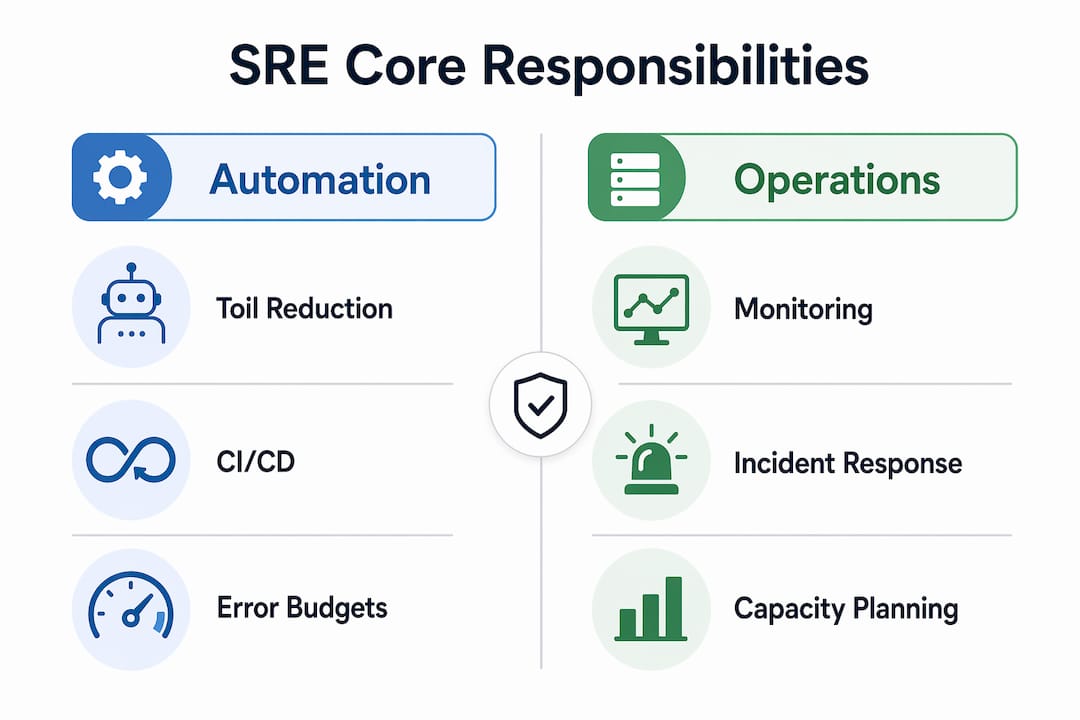
SRE responsibilities in cloud environments cover six core areas: toil reduction, monitoring and observability, incident response, capacity planning, deployment management, and reliability engineering. Each area maps directly to keeping your services available and your costs predictable.

Reducing manual toil through automation
Google caps manual toil at 50% to keep SREs focused on engineering work rather than repetitive operational tasks. CI/CD pipelines managed by SREs reduce deployment failures by 70%. That means every hour your SRE spends writing automation scripts pays back in fewer 2 a.m. incidents.
Monitoring and observability
SRE teams achieve a median MTTD of 4.2 minutes compared to 18 minutes for non-SRE teams. That is a 4x improvement in detection speed. Faster detection limits blast radius. An undetected database connection leak that runs for 18 minutes can cascade into a full service outage; caught in 4 minutes, it is a ticket.
Incident response and error budget enforcement
SREs own the error budget: a calculated allowance for downtime derived from your SLO. When the budget is exhausted, new feature releases stop until reliability is restored. This is not a soft guideline. SREs often hold formal veto power over production releases when error budgets are exceeded, which requires significant soft skills to manage friction with product teams.
Capacity planning and deployment management
SREs forecast cloud resource needs using historical traffic data and growth models. On AWS, this means right-sizing EC2 instances, setting Auto Scaling policies, and reviewing Reserved Instance coverage. Poor capacity planning is one of the top drivers of both outages and wasted cloud spend.
Pro Tip: Track your error budget burn rate weekly, not monthly. A budget burning at 3x the expected rate on day 10 of a 30-day window gives you 20 days to course-correct before you hit zero.
How does SRE integrate with DevOps and cloud native technologies?
Running this on your own AWS setup? IT-Magic is an AWS Advanced Tier Partner — we audit, fix, or fully manage it for you.
Get a free consultationSRE and DevOps are complementary, not competing. DevOps is a culture and set of practices focused on delivery velocity. SRE is a specialization focused on reliability outcomes. Experts advise starting with SRE first if reliability is your primary pain point, then layering DevOps culture to increase delivery velocity. The sequencing matters because trying to move fast on an unstable foundation creates compounding problems.
Cloud native SRE goes further. It shifts from manual runbooks to software abstractions like circuit breakers, retries, and fallback mechanisms to design for failure and scalability. On Kubernetes clusters running on Amazon EKS or Google GKE, SREs configure liveness probes, pod disruption budgets, and horizontal pod autoscalers. These are not operational workarounds. They are reliability features baked into the system design.
The table below clarifies how SRE, DevOps, and cloud engineering differ in focus and ownership.
| Dimension | SRE | DevOps | Cloud engineering |
|---|---|---|---|
| Primary focus | Reliability outcomes and SLOs | Delivery velocity and culture | Infrastructure provisioning and architecture |
| Key metric | Error budget consumption | Deployment frequency | Resource utilization and cost |
| Tooling ownership | Monitoring, incident response, automation | CI/CD pipelines, testing | Terraform, AWS CDK, networking |
| Relationship to releases | Can veto releases on reliability grounds | Accelerates release cycles | Enables infrastructure for releases |
| Cloud native role | Designs for failure using abstractions | Automates build and test | Builds the platform SRE and DevOps run on |
SRE owns reliability outcomes while platform engineering owns the tooling to achieve that reliability. The overlap is common and healthy. Internal developer platforms built by platform engineers become the substrate SREs instrument and monitor. Understanding this boundary prevents the organizational confusion that leads to duplicated work and accountability gaps.
What are the emerging trends in SRE for cloud operations in 2026?
Cloud infrastructure SRE is evolving faster in 2026 than at any point since Google published the original SRE book in 2016. Three trends are reshaping the function.
-
AI-assisted incident management. Agentic SRE platforms automate diagnosis and remediation of incidents, allowing SREs to scale reliability without increasing headcount linearly. Modern SRE is shifting from “humans doing operations” to “humans supervising AI agents” that perform automated incident correlation and remediation. Tools like PagerDuty AIOps and AWS DevOps Guru are early examples of this shift in production environments.
-
Security integration. SRE responsibilities increasingly include collaborating with security teams on runtime protection and vulnerability remediation in cloud native environments. Security is no longer a separate lane. SREs carry the shared context about system behavior that security teams need to distinguish an attack from a misconfiguration.
-
The political dimension of error budgets. Error budget enforcement is technically straightforward. Organizationally, it is contentious. When a product team has a quarterly launch deadline and the SRE says the error budget is gone, that conversation requires more than technical authority. It requires trust built over months of transparent reporting and shared goals.
“The hardest part of SRE is not the technology. It is convincing a VP of Product that a reliability freeze protects the business more than the feature they want to ship.” — TechCerted, 2026
The move toward autonomous cloud operations also introduces new challenges. Automated remediation systems can mask underlying problems if they resolve symptoms without root cause analysis. SREs must design feedback loops that surface patterns, not just suppress alerts.
How can organizations implement SRE best practices for cloud reliability?
Building an effective SRE function requires deliberate sequencing. Dropping a team of SREs into a chaotic cloud environment without foundational work produces frustration, not reliability. Follow these steps to get the implementation right.
-
Audit your current reliability posture. Measure your existing MTTD, MTTR, and deployment failure rate before you hire or restructure. You cannot set meaningful SLOs without a baseline.
-
Define SLIs and SLOs for your critical services. Start with two or three services that directly affect revenue or user experience. Availability, latency at the 99th percentile, and error rate are the standard starting points.
-
Build your monitoring stack before your SRE team. SREs need observability tools for SREs in place to do their jobs. Prometheus and Grafana for metrics, the ELK Stack or AWS OpenSearch for logs, and Jaeger or AWS X-Ray for distributed tracing form a solid foundation.
-
Automate toil systematically. Catalog every manual operational task. Rank by frequency and time cost. Automate the top five before moving on. This is how you free SRE capacity for higher-value reliability work.
-
Align error budgets with business cycles. A SaaS company with monthly billing cycles should align its error budget reporting to that cadence. Misaligned reporting creates confusion about whether reliability is improving or degrading.
SRE requires deep cloud infrastructure knowledge including networking, IAM, managed services, and cost optimization to be effective. Hiring SREs who understand AWS cost levers, not just uptime metrics, gives you a team that improves reliability and controls spend simultaneously.
Pro Tip: Tie SRE team goals to business outcomes, not just technical metrics. “Reduce P1 incident duration by 40%” lands differently in a board review than “improve MTTR.” Both measure the same thing; one speaks the language of business risk.
Key takeaways
The role of SRE in cloud operations is defined by ownership of reliability outcomes through automation, observability, and error budget discipline, not by headcount or tooling alone.
| Point | Details |
|---|---|
| Automation drives reliability | SRE automation delivers 82% faster incident response and 47% fewer change failures. |
| Detection speed matters | SRE teams detect incidents in 4.2 minutes versus 18 minutes for non-SRE teams. |
| Error budgets enforce balance | Error budgets give SREs formal authority to pause releases and protect system stability. |
| SRE and DevOps are sequential | Implement SRE first to fix reliability, then layer DevOps culture to accelerate delivery. |
| AI is reshaping the role | Agentic SRE platforms let small teams scale reliability without proportional headcount growth. |
Why SRE is a culture problem as much as a technical one
I have worked with organizations that bought every monitoring tool on the market and still had four-hour outages every quarter. The tools were not the problem. The problem was that nobody owned reliability as an outcome. SRE changes that by making reliability a first-class engineering concern with metrics, budgets, and accountability.
What surprises most decision-makers is how much of SRE work is organizational rather than technical. The error budget conversation I described earlier is one example. Another is the ongoing negotiation between SRE teams and development teams about what counts as toil versus what counts as a product feature. These conversations require SREs who can read a room as well as they can read a flame graph.
I am also skeptical of organizations that treat AI-assisted incident management as a shortcut to skipping SRE fundamentals. Agentic systems are powerful, but they learn from your historical incident data. If your incident data is incomplete or your runbooks are inconsistent, the AI inherits those problems. You still need humans who understand the system deeply enough to supervise the agents and catch the edge cases.
The organizations getting the most from SRE in 2026 are the ones that treat it as a long-term investment in system culture, not a six-month tooling project. That shift in framing changes how you hire, how you measure success, and how you explain the function to stakeholders who want to know why reliability engineering costs what it does.
— Oleksandr
How IT-Magic supports your SRE and cloud reliability goals
IT-Magic has delivered AWS infrastructure support for 300+ clients since 2010, with a team of certified AWS experts who specialize in the exact disciplines SRE demands: monitoring, automation, incident management, and cost control. Whether you are building an SRE function from scratch or scaling an existing one on AWS or Kubernetes, IT-Magic brings the infrastructure depth your team needs. From Kubernetes support services on EKS and ECS to observability stack implementation and reliability reviews, IT-Magic acts as a dedicated cloud operations partner. If your organization is ready to move from reactive firefighting to proactive reliability engineering, the IT-Magic team is the right starting point.
FAQ
What is the role of SRE in cloud operations?
SRE applies software engineering principles to cloud operations, owning reliability outcomes through automation, monitoring, incident response, and error budget management. The goal is to keep services available and predictable while reducing manual operational work.
How does SRE differ from DevOps in cloud environments?
SRE focuses on reliability outcomes and enforces SLOs, while DevOps focuses on delivery velocity and culture. The two are complementary: implement SRE first to stabilize your systems, then use DevOps practices to accelerate delivery on that stable foundation.
What tools do SREs use in cloud infrastructure?
SREs commonly use Prometheus and Grafana for metrics, AWS CloudWatch and X-Ray for AWS-native observability, PagerDuty for incident management, and Terraform or AWS CDK for infrastructure automation. The specific stack depends on your cloud platform and service architecture.
Why do SRE teams have veto power over releases?
When an error budget is exhausted, new releases increase reliability risk without any remaining tolerance for failure. SREs hold veto authority in this scenario to protect system stability, which requires strong cross-team communication to execute without damaging product relationships.
How does AI change the SRE role in 2026?
AI-assisted platforms like PagerDuty AIOps and AWS DevOps Guru automate incident correlation and remediation, shifting SREs from direct operators to supervisors of automated systems. This lets small SRE teams manage reliability at a scale that would otherwise require significantly larger headcount.
Recommended
- AWS cloud operations tutorial: optimize and scale smart
- Cloud Resilience Explained for IT Leaders in 2026
- How to automate cloud operations for scalable AWS
- Network Security Strategies for Cloud Environments in 2026
Alexander founded IT-Magic, an AWS Advanced Tier Services Partner delivering DevOps, cloud architecture, and managed services since 2010. He holds:
- AWS Certified Solutions Architect – Professional
- AWS Certified DevOps Engineer – Professional
- AWS Certified Security – Specialty
- AWS Certified Advanced Networking – Specialty
Talk to a certified AWS team trusted by INTERTOP, Foxtrot, Pandora, and J.Hilburn.
Get a free consultation