

TL;DR:
- Most cloud projects fail during planning due to poorly structured architecture, leading to increased costs and security risks. A comprehensive planning process includes workload mapping, security, governance, and cost strategies, emphasizing automation and documentation from the start. Continuous monitoring and governance are vital for evolving cloud environments, with platform thinking and AI workload optimization shaping future best practices.
Most cloud projects don’t fail during deployment. They fail during planning, or rather, the absence of it. A poorly structured cloud architecture planning guide is the difference between a scalable, cost-efficient platform and a sprawling mess of siloed services that drains budget and creates security exposure. Cost overruns motivate cloud redesign for nearly 44% of organizations post-migration, which means the pain is predictable and largely avoidable. This guide walks IT professionals and business leaders through every critical phase: preparation, landing zone setup, design strategy, cost optimization, governance, and ongoing refinement.
Table of Contents
- Key takeaways
- What a cloud architecture planning guide actually covers
- Step-by-step execution of the cloud architecture design process
- Advanced cost and design strategies for efficient cloud use
- Governance, verification, and continual improvement
- What I’ve learned from years of cloud architecture work
- How Itmagic supports your cloud architecture goals
- FAQ
Key takeaways
Running this on your own AWS setup? IT-Magic is an AWS Advanced Tier Partner — we audit, fix, or fully manage it for you.
Get a free consultation| Point | Details |
|---|---|
| Prepare before you build | Audit workloads, compliance requirements, and governance needs before touching any cloud configuration. |
| Landing zones take 4-12 weeks | Budget time for foundational setup before production workloads go live. |
| Governance needs two tiers | Combine preventive controls with detective controls to avoid both bottlenecks and blind spots. |
| Cost strategy starts at design | Embedding cost forecasting during architecture planning prevents expensive re-architecture later. |
| Platform thinking reduces waste | Moving from fragmented tools to shared platforms accelerates deployments and lowers operational overhead. |
What a cloud architecture planning guide actually covers
Too many teams skip straight to choosing services and regions. The cloud architecture design process starts well before any console login. You need answers to three foundational questions before anything else: What are you running, who needs access, and what happens if it breaks?
Start by mapping your workloads. Categorize them by criticality, data sensitivity, compliance requirements, and expected growth. A fintech startup migrating a payment processing engine has very different constraints than a media company moving its content delivery infrastructure. Both need a plan, but the plan looks completely different.
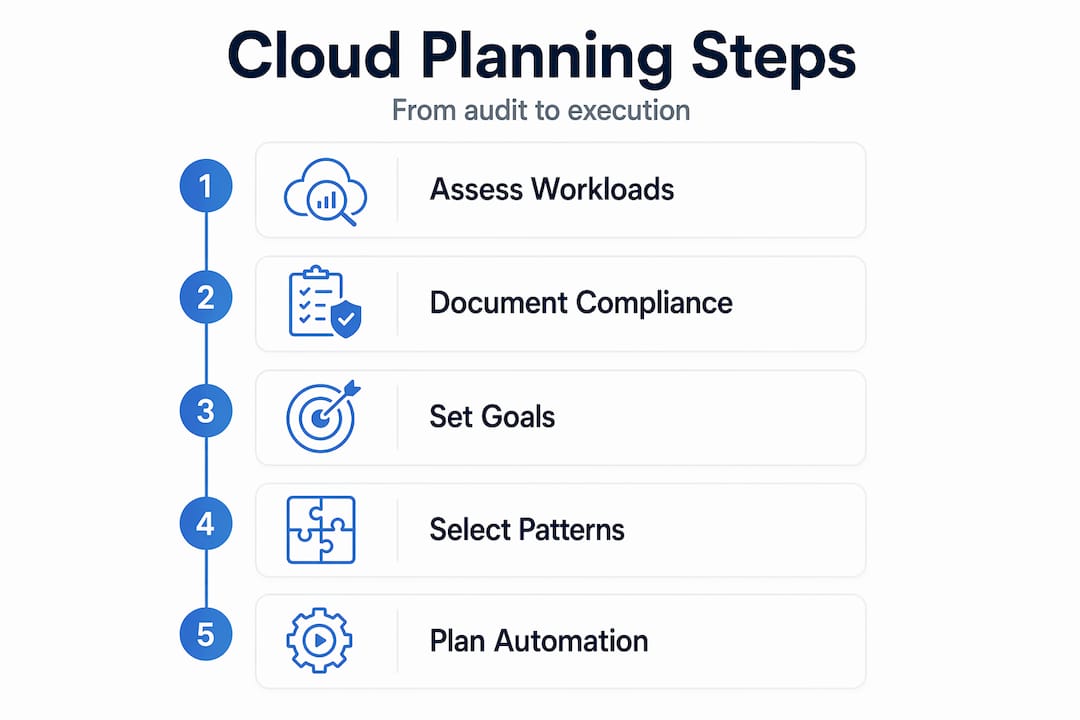
Compliance requirements deserve early, explicit documentation. FedRAMP Moderate requires 325 controls while FedRAMP High requires 421, with the highest implementation density in Access Control, Audit and Accountability, and Configuration Management. Even if you’re not government-facing, mapping your architecture to NIST control families provides a defensible baseline for security audits and partner reviews.
Here’s an overview of the core tools and frameworks that belong in every cloud infrastructure planning effort:
| Tool or Framework | Purpose | When to Use |
|---|---|---|
| AWS Well-Architected Framework | Architecture review against six pillars | Design and post-deployment review |
| Infrastructure as Code (Terraform, CDK) | Repeatable, auditable deployments | From day one |
| Landing Zone Accelerators | Baseline environment setup | Before production workloads |
| NIST 800-53 Control Catalog | Compliance mapping | During governance design |
| FinOps Framework | Cost accountability and forecasting | Alongside architecture planning |
Organizational goals matter just as much as technical requirements. If leadership is targeting a 30% infrastructure cost reduction in 18 months, that objective should shape every design decision from the start, not get layered on after migration.
Step-by-step execution of the cloud architecture design process
With preparation complete, you move into actual architecture design and landing zone deployment. This is where cloud infrastructure planning becomes concrete.
-
Foundation phase (weeks 1-4). Set up your core account or subscription structure. Establish management accounts, billing hierarchies, and identity providers. Define your tagging taxonomy now. Tagging debt is painful to clean up later.
-
Network design (weeks 2-5). Define your VPC or VNet topology. Decide between hub-and-spoke, flat network, or segmented network models based on workload isolation requirements. Document IP address ranges early to avoid conflicts during expansion.
-
Security baseline (weeks 3-7). Apply least-privilege IAM policies, configure centralized logging, and enable threat detection services. The six pillars of AWS Well-Architected, including operational excellence, security, reliability, performance efficiency, cost optimization, and sustainability, provide the review structure for this phase.
-
Logging and audit trails (weeks 4-8). Centralize logs in a dedicated, write-protected account or subscription. Route all API activity, network flow logs, and security events into a SIEM or log aggregation platform. This is non-negotiable for compliance and incident response.
-
Cost management setup (weeks 6-10). Configure budget alerts, cost allocation by team or product, and anomaly detection. Connect this to your FinOps process so engineers get spending visibility before costs escape control.
-
Handoff and documentation (weeks 10-12). Landing zone deployment typically takes 4-12 weeks for foundational setup before production workloads move in. Document every decision, especially the ones you rejected and why. Future you will be grateful.
The best cloud architecture best practices center on one principle: automate what you can, document what you can’t. Infrastructure as Code should cover every resource from day one. Tools like Terraform or AWS CDK give you a reproducible, auditable record of your environment. Drift, where live infrastructure diverges from code, is one of the leading causes of security incidents and compliance failures.
Pro Tip: Set up automated policy checks in your CI/CD pipeline using tools like AWS Config or Open Policy Agent. Catching a misconfiguration before it deploys costs minutes. Catching it after a breach costs months.
For deeper guidance on applying these principles to AWS specifically, Itmagic’s resource on scalable AWS architecture walks through the practical application in detail.
Advanced cost and design strategies for efficient cloud use
Getting the architecture deployed is one challenge. Keeping it cost-effective and adaptable as requirements evolve is another. This is where cloud design strategy separates mature teams from reactive ones.

Cost forecasting belongs at the design table, not the finance review. Nearly half of organizations re-architect workloads specifically because of cost overruns. The fix is embedding a FinOps mindset before the first resource gets provisioned. For a structured approach, Itmagic’s guide on cloud cost management for CIOs provides a practical starting point.
When selecting cloud design patterns, match the pattern to the workload, not to what the team already knows. Azure architects recommend pattern selection based on specific workload constraints and trade-offs rather than implementation convenience. A retry pattern makes sense for a loosely coupled microservice. It can create cascading failures in a tightly coupled transactional system. The choice requires deliberate analysis.
Here’s how common cloud deployment strategies compare across key dimensions:
| Strategy | Best For | Key Trade-off |
|---|---|---|
| Lift and shift | Speed of migration | Higher ongoing costs, limited optimization |
| Re-platforming | Moderate optimization with low risk | Partial benefit, requires targeted effort |
| Re-architecting | Maximum efficiency and scalability | High upfront cost and complexity |
| Serverless-first | Variable workloads, fast iteration | Cold starts, vendor lock-in risk |
| Containerized (Kubernetes) | Portability and scaling consistency | Operational complexity |
Two trends are reshaping how advanced teams approach the cloud architecture design process in 2026.
The first is platform thinking, which consolidates fragmented infrastructure into shared, standardized internal platforms. Instead of each product team building its own pipeline, network configuration, and observability stack, they consume standardized platform capabilities. Developer productivity increases. Fragmentation decreases. Governance becomes enforceable at the platform level rather than applied inconsistently across dozens of teams.
The second is AI workload architecture. The local-first inference pattern is worth understanding here. By routing 70-80% of documents to deterministic local processing, organizations reduce expensive cloud AI calls by 75%. This hybrid approach means you only invoke costly cloud AI services for genuinely ambiguous cases, not for every document regardless of complexity.
Pro Tip: When designing for AI workloads, classify your inputs before routing them. Structured, predictable inputs rarely need cloud AI inference. Build the classification logic first and treat cloud AI as the exception rather than the rule.
Governance, verification, and continual improvement
A deployed architecture is not a finished architecture. Landing zones evolve over time and require continuous refinement as new services, team structures, and compliance requirements emerge. Treating your cloud environment as a living platform is the core mindset shift that separates organizations that scale well from those that accumulate technical debt.
Effective governance operates on two tiers, and using only one creates problems. Preventive controls block non-compliant actions before they happen. Detective controls flag deviations after the fact. Running only preventive controls creates bottlenecks where teams cannot move without approvals. Running only detective controls means your environment drifts before anyone notices.
The cloud architecture checklist for ongoing operations should cover these areas:
- Architectural drift monitoring. Run weekly or monthly Well-Architected Reviews against production environments. Automate AWS Config rules or Azure Policy to flag out-of-compliance resources in real time.
- Security posture review. Continuously validate that IAM roles follow least privilege. Rotate credentials. Review Security Hub or Defender for Cloud findings on a defined cadence.
- Cost variance tracking. Monitor actual spend against forecasted spend weekly. Assign cost ownership to specific teams and require explanations for anomalies over a defined threshold.
- Migration risk management. When moving new workloads, test in staging first. Use phased rollouts or blue-green deployments to limit blast radius if something goes wrong.
- KPI reporting. Track deployment frequency, change failure rate, mean time to recovery, and infrastructure cost per user or transaction. These metrics tell you whether your architecture is actually working.
The biggest pitfall in this phase is treating verification as a one-time event. An architecture review at launch tells you where you started. Ongoing monitoring tells you where you are.
What I’ve learned from years of cloud architecture work
I’ve seen organizations spend six months building what they thought was a solid cloud foundation, only to spend the next 18 months unraveling decisions made in the first two weeks. The pattern is almost always the same: governance was treated as a phase two problem, and by phase two, there were 200 resources deployed with inconsistent tagging, overlapping roles, and no audit trail.
My honest take is that most cloud architecture challenges are governance problems wearing a technical costume. The instinct is to jump to services and configurations. The discipline is to start with controls, accountability structures, and documentation standards. That discipline is what separates teams that scale from teams that scramble.
Platform thinking is the clearest signal I’ve seen that cloud engineering is maturing. The organizations I work with that have invested in internal platforms are moving faster than their competitors, not because they have better engineers, but because those engineers aren’t rebuilding the same infrastructure patterns repeatedly.
On cost, the uncomfortable truth is that architecture complexity and cloud spend are directly correlated. Every additional service, integration point, and cross-region dependency adds cost and operational burden. Simplicity is not a compromise. It is a design goal.
— Oleksandr
How Itmagic supports your cloud architecture goals
If the phases described in this guide feel like a lot to manage in parallel with running existing operations, that’s because they are. Cloud architecture planning done well requires dedicated expertise across infrastructure design, security, governance, and cost management simultaneously.
Itmagic has delivered 700+ cloud projects for organizations ranging from fintech startups to enterprise clients since 2010. The team’s Kubernetes support services help organizations run containerized workloads with the reliability and operational consistency that production environments demand. For cost optimization specifically, the INTERTOP case study shows how Itmagic delivered measurable AWS cost reduction while improving infrastructure scalability. Whether you’re designing a new landing zone, implementing governance automation, or optimizing an existing environment, Itmagic acts as a dedicated cloud and DevOps partner. Reach out to start a conversation about your architecture needs.
FAQ
What is a cloud architecture landing zone?
A landing zone is a pre-configured, governed cloud environment that establishes security baselines, network topology, identity management, and logging before production workloads are deployed. Initial setup typically takes 4-12 weeks depending on organizational complexity.
How long does cloud architecture planning take?
The planning phase varies by organization size and workload complexity, but most teams should budget 6 to 16 weeks from initial assessment through landing zone deployment before moving production workloads into a new cloud environment.
What are the most common cloud architecture mistakes?
The most frequent mistakes are skipping governance setup, treating cost management as a post-migration problem, and choosing design patterns based on team familiarity rather than workload requirements. All three create expensive re-architecture projects later.
How do preventive and detective controls differ?
Preventive controls block non-compliant actions before they occur, such as restricting resource creation outside approved regions. Detective controls identify and alert on deviations after they happen. Effective governance requires both, since relying on either one alone creates either bottlenecks or blind spots.
When should you use platform thinking in cloud architecture?
Platform thinking becomes valuable when multiple teams are independently building similar infrastructure patterns. Consolidating those into shared, standardized platforms reduces fragmentation and lets engineering teams focus on product work rather than infrastructure plumbing.
Recommended
- Cloud architecture: A practical guide for scalable AWS
- Cloud cost optimization strategies for CIOs: a practical guide
- Cloud Infrastructure Explained: Scale, Secure, Optimize AWS
- The CTO’s guide to securing AWS infrastructure for scale
Alexander founded IT-Magic, an AWS Advanced Tier Services Partner delivering DevOps, cloud architecture, and managed services since 2010. He holds:
- AWS Certified Solutions Architect – Professional
- AWS Certified DevOps Engineer – Professional
- AWS Certified Security – Specialty
- AWS Certified Advanced Networking – Specialty
Talk to a certified AWS team trusted by INTERTOP, Foxtrot, Pandora, and J.Hilburn.
Get a free consultation