

TL;DR:
- Single Sign-On (SSO) centralizes user authentication, enabling access to multiple cloud applications with a single login. It enhances security by reducing credential reuse, enforcing consistent policies, and providing centralized audit logs, while operationally simplifying onboarding and offboarding processes. Most failures stem from misconfiguration rather than technical flaws, emphasizing the importance of strong governance and disciplined IdP management.
Single Sign-On (SSO) is defined as a centralized authentication method that allows users to verify their identity once and gain access to multiple cloud applications without logging in again. The industry standard term for this capability is federated identity management, and SSO is its most widely deployed expression. Tools like Okta, Microsoft Entra ID, and AWS IAM Identity Center have made SSO the default access model for organizations running distributed cloud workloads. For IT managers and cloud security teams, understanding the role of SSO in cloud environments is no longer optional. It directly determines your attack surface, your audit posture, and how fast you can revoke access when something goes wrong.
How single sign-on works technically in the cloud
SSO authenticates users once at a centralized Identity Provider (IdP), which then issues security tokens or assertions trusted by every connected cloud application. The user never re-enters credentials for each app. Instead, the IdP vouches for them through a signed token.

The most common protocol carrying these assertions is SAML 2.0, though OAuth 2.0 and OpenID Connect (OIDC) are standard in modern SaaS and API-driven architectures. Each cloud application maintains a trust relationship with the IdP, accepting its tokens as proof of authentication. This is the “federation” in federated identity management.
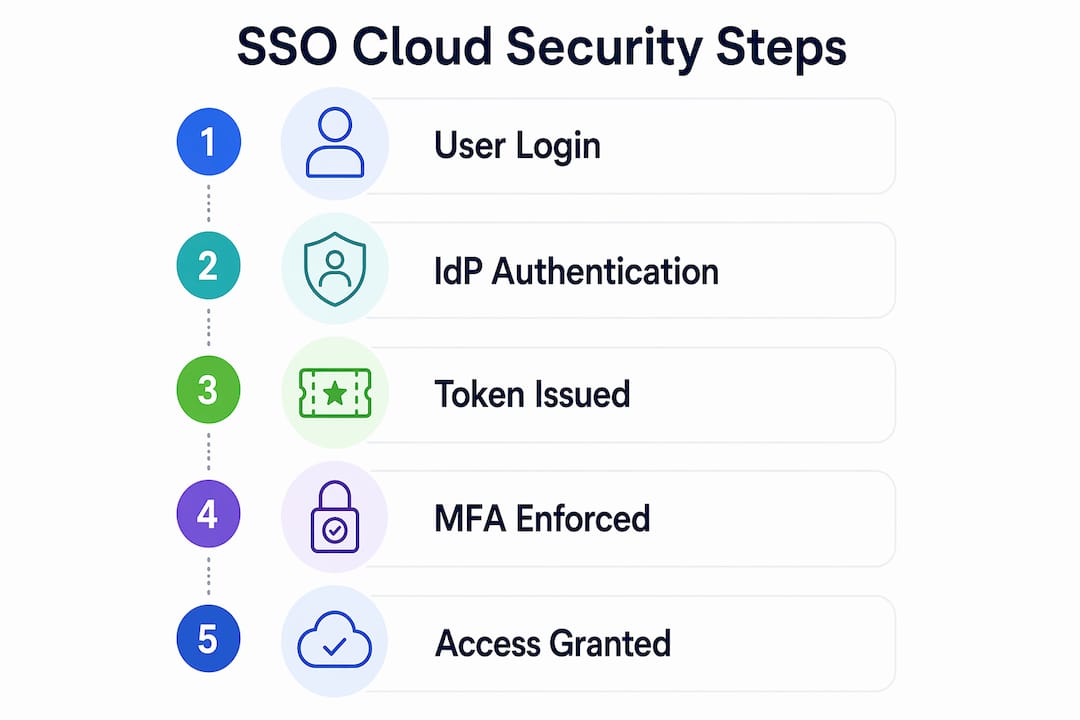
Here is the core authentication flow in a cloud SSO deployment:
- The user attempts to access a cloud application such as AWS Console, Google Workspace, or Salesforce.
- The application redirects the unauthenticated request to the configured IdP (Okta, Microsoft Entra ID, or AWS IAM Identity Center).
- The IdP verifies the user’s credentials, applies MFA if configured, and generates a signed SAML assertion or OIDC token.
- The token is passed back to the application via the browser, which validates the signature against the IdP’s public certificate.
- The application grants access based on the claims embedded in the token, such as group membership or role assignment.
This model is fundamentally different from independent app logins, where each application stores and validates its own credentials. With SSO, no application ever sees the user’s password. That distinction has significant security implications.
Pro Tip: Always configure your IdP to enforce session timeouts and token expiration. A long-lived token that is never invalidated is functionally equivalent to a password written on a sticky note.
What security benefits does SSO deliver for cloud services?
Running this on your own AWS setup? IT-Magic is an AWS Advanced Tier Partner — we audit, fix, or fully manage it for you.
Get a free consultationSSO reduces password reuse and credential fatigue by collapsing dozens of application logins into a single authenticated session. Credential reuse is one of the most exploited attack vectors in cloud environments, and SSO eliminates the conditions that create it.
The security advantages extend well beyond password hygiene:
- Reduced attack surface. SSO centralizes authentication, meaning credentials are stored and validated in one hardened system rather than scattered across dozens of SaaS applications with varying security standards.
- Consistent policy enforcement. Every access decision flows through the IdP, so MFA requirements, IP restrictions, and device compliance checks apply uniformly across all connected applications.
- Faster incident response. When a user account is compromised, security teams disable it in one place. Access to every connected application is revoked immediately, not application by application.
- Centralized audit trails. All authentication events are logged at the IdP, giving security teams a single source of truth for access reviews and compliance reporting.
“Identity providers in cloud SSO must be treated as critical security systems; protecting tokens and assertions is vital to prevent unauthorized access through forgery or theft.” — NIST guidance on identity federation
The integration of SSO with MFA is where the security model becomes genuinely strong. MFA at the IdP level means users authenticate with a second factor once, and that verification carries across every application in the federation. Organizations that enforce MFA only at the application level end up with inconsistent coverage and user friction that drives workarounds.
Operational advantages of centralized access management via SSO
Centralized access management through SSO gives IT teams a single control plane for managing permissions, role assignments, and user lifecycle events across all cloud services. Without it, onboarding a new employee means provisioning accounts in AWS, Salesforce, GitHub, Jira, and every other tool independently.
The operational gains are concrete:
- Faster onboarding. Assign a user to the correct group in the IdP and they immediately inherit access to every application mapped to that group.
- Reliable offboarding. Centralized session authority means deprovisioning happens in one action. Without it, organizations face policy divergence and delayed deprovisioning that leaves former employees with active access.
- Role-based access control at scale. IdP group memberships map directly to application roles, making it practical to enforce least-privilege access across hundreds of users and dozens of applications.
- Simplified compliance reporting. Audit logs from a single IdP satisfy access review requirements for SOC 2, PCI DSS, and HIPAA far more efficiently than collecting logs from each application separately.
Pro Tip: Treat your IdP group structure as infrastructure. Version-control your group definitions and role mappings the same way you manage Terraform configurations. This makes access reviews auditable and rollbacks possible.
The role of identity management in cloud environments has shifted from a back-office IT function to a core security control. Organizations running more than 20 cloud applications without centralized SSO governance are operating with fragmented access policies that are nearly impossible to audit consistently. This connects directly to broader cloud security strategies that treat identity as the new perimeter.
Common implementation approaches and challenges with cloud SSO
The three most widely deployed SSO solutions for cloud environments are AWS IAM Identity Center, Okta, and Microsoft Entra ID. Each targets a different primary use case.
| Solution | Primary use case | Protocol support | Notable integration |
|---|---|---|---|
| AWS IAM Identity Center | Multi-account AWS access | SAML 2.0, OIDC | Okta, Entra ID, Google Workspace |
| Okta | Enterprise SaaS federation | SAML, OIDC, SCIM | 7,000+ app catalog |
| Microsoft Entra ID | Microsoft 365 and hybrid AD | SAML, OIDC, WS-Fed | Azure, M365, on-prem AD |
AWS IAM Identity Center was renamed from AWS SSO in 2022 and now serves as the recommended entry point for centralized human access management across AWS accounts. It integrates directly with Okta and Microsoft Entra ID as external IdPs, which means organizations already running either platform can extend their existing identity governance into AWS without rebuilding it.
Most SSO failures in production deployments are not conceptual. They are protocol-level configuration errors. Common AWS SSO failures include case-sensitive NameID mismatches, incorrectly formatted Assertion Consumer Service (ACS) URLs, and clock synchronization drift between the IdP and service provider. These issues cause cryptic login failures that are difficult to diagnose without access to raw SAML response data.
The recommended troubleshooting sequence for SAML-based SSO failures is:
- Capture the raw SAML response using browser developer tools or a SAML tracer extension.
- Decode the Base64 assertion and verify the NameID format matches exactly what the application expects (case-sensitive).
- Confirm the ACS URL in the IdP configuration matches the service provider’s metadata exactly, including trailing slashes.
- Check server time synchronization. A drift of more than five minutes will cause assertion validation to fail.
- Validate the signing certificate has not expired and matches the certificate registered in the service provider.
SSO must be planned around a strong identity platform with consistent policies. Poor session and token management can increase risk rather than reduce it, particularly when token lifetimes are set too long or refresh logic is misconfigured.
One critical operational note: AWS IAM Identity Center is designed for interactive human access with automatic token refresh. It is not suited for unattended automation or CI/CD pipelines. Those workflows require dedicated IAM roles with scoped permissions, not SSO sessions.
Practical use cases of SSO in multi-cloud and SaaS environments
The SSO impact on user experience and security becomes most visible in organizations managing multi-account AWS environments or large SaaS portfolios. A developer at a fintech company might need access to five AWS accounts, GitHub, Jira, Datadog, and PagerDuty. Without SSO, that is seven separate credential sets to manage and seven separate places to revoke access during an incident.
With AWS IAM Identity Center connected to Okta as the upstream IdP, the same developer authenticates once through Okta, and permission sets in IAM Identity Center grant scoped access to each AWS account automatically. The "aws configure sso` CLI command integrates this flow into terminal-based workflows, so engineers access AWS resources without storing long-term access keys locally.
Practical SSO use cases that deliver measurable security and productivity gains include:
- Multi-account AWS access. IAM Identity Center permission sets replace the need for individual IAM users in each account, reducing credential sprawl across large AWS organizations.
- SaaS portfolio management. Connecting Google Workspace, Microsoft 365, Slack, and GitHub to a single IdP gives security teams one place to enforce MFA and review access.
- Remote workforce access. SSO combined with device trust policies in Okta or Entra ID ensures only managed, compliant devices can authenticate, regardless of network location.
- Retail and e-commerce environments. AWS retail deployments frequently use SSO to manage access across production, staging, and analytics environments without duplicating IAM configurations.
- DevOps CLI access. Engineers use SSO-issued temporary credentials for AWS CLI and SDK calls, eliminating the security risk of long-lived access keys stored in
.aws/credentialsfiles.
Distributed microservices and SaaS stacks increasingly require SSO as a foundational identity architecture element. Fragmented user identification across microservices creates audit gaps and makes consistent policy enforcement practically impossible at scale.
Key takeaways
SSO is the foundational identity control for cloud environments, and organizations that treat it as an optional convenience rather than a security requirement will face audit failures, slow incident response, and credential sprawl at scale.
| Point | Details |
|---|---|
| SSO centralizes authentication | One IdP issues tokens trusted by all connected cloud apps, eliminating per-app credential storage. |
| Security gains are structural | Reduced attack surface, consistent MFA enforcement, and single-point revocation are the core security outcomes. |
| Protocol details cause most failures | SAML NameID mismatches, ACS URL errors, and clock drift account for the majority of SSO login failures in production. |
| Automation requires separate IAM roles | AWS IAM Identity Center handles interactive access only; CI/CD pipelines need dedicated IAM roles, not SSO sessions. |
| IdP governance is non-negotiable | Treating the IdP as critical infrastructure with version-controlled group mappings is the difference between scalable access management and chaos. |
Why most SSO problems are actually governance problems
After working through SSO deployments across AWS environments of varying scale, the pattern I see most often is not technical failure. It is governance failure dressed up as a technical problem. An organization deploys Okta or Microsoft Entra ID, connects it to AWS IAM Identity Center, and considers the job done. Six months later, they have 40 groups with overlapping permissions, no documented mapping between groups and application roles, and an offboarding process that still requires manual tickets to three different teams.
The SSO infrastructure works perfectly. The governance around it does not. Token lifetimes are set to defaults nobody reviewed. Group membership is managed informally. The IdP itself has five administrators with no access review cadence. This is where the real risk lives.
My recommendation is to treat your IdP with the same operational discipline you apply to your AWS root account. Limit administrative access, require MFA for IdP admin logins, and run quarterly access reviews against your group-to-role mappings. The network security strategies that matter most in 2026 are the ones built around identity, and SSO is only as strong as the governance layer sitting above it.
The future direction here is zero trust architecture, where SSO becomes one component of a continuous verification model rather than a one-time authentication gate. Organizations that build disciplined SSO governance now will find the transition to zero trust significantly easier. Those that treat SSO as a checkbox will find it becomes a liability.
— Oleksandr
How IT-Magic helps you implement and govern cloud SSO
IT-Magic has delivered cloud identity and access management architecture across 700+ projects for clients in fintech, retail, and enterprise. As an AWS Advanced Tier Services Partner, we design IAM Identity Center configurations, connect external IdPs like Okta and Microsoft Entra ID to AWS environments, and build the group-to-permission-set mappings that make SSO governance auditable and scalable. We also support the containerized workloads where identity management gets complex. Our Kubernetes support services cover the access control layer for EKS clusters, ensuring SSO policies extend into your container infrastructure without creating separate credential silos. If your organization is deploying SSO across a multi-account AWS environment or needs to bring your current identity architecture into compliance with SOC 2 or PCI DSS, IT-Magic provides the infrastructure expertise to do it correctly from the start.
FAQ
What is the role of SSO in cloud environments?
SSO acts as a centralized authentication control that issues trusted tokens to multiple cloud applications after a single user login. This eliminates per-application credential management and gives IT teams one point for policy enforcement, access revocation, and audit logging.
How does SSO improve cloud security?
SSO reduces credential reuse risks, enforces consistent MFA policies across all connected applications, and shrinks the attack surface by centralizing where credentials are stored and validated. Revoking access at the IdP immediately cuts off all connected applications.
What protocols does cloud SSO use?
The most common protocols are SAML 2.0 for enterprise application federation and OIDC (OpenID Connect) for modern SaaS and API-based integrations. AWS IAM Identity Center supports both, and most enterprise IdPs including Okta and Microsoft Entra ID support all three major standards.
Why do SSO deployments fail in AWS environments?
Most failures trace to SAML configuration errors: case-sensitive NameID mismatches, incorrect ACS URLs, expired signing certificates, or server clock drift exceeding five minutes. These are protocol-level issues, not SSO concept failures, and they are resolved by validating the raw SAML assertion against the service provider’s metadata.
Is SSO suitable for automated cloud workflows?
SSO sessions are designed for interactive human access and include automatic token refresh for that use case. Automated pipelines and CI/CD workflows require dedicated IAM roles with scoped permissions because unattended processes cannot complete interactive authentication flows.
Alexander founded IT-Magic, an AWS Advanced Tier Services Partner delivering DevOps, cloud architecture, and managed services since 2010. He holds:
- AWS Certified Solutions Architect – Professional
- AWS Certified DevOps Engineer – Professional
- AWS Certified Security – Specialty
- AWS Certified Advanced Networking – Specialty
Talk to a certified AWS team trusted by INTERTOP, Foxtrot, Pandora, and J.Hilburn.
Get a free consultation