
TL;DR:
- Choosing the right infrastructure automation tool category before selecting a brand helps focus on solving core deployment, configuration, or governance needs. Implementing a control plane early reduces complex custom tooling, while integrating policy-as-code from the start prevents costly remediations. A phased approach with clear success metrics accelerates adoption and ensures reliable, scalable infrastructure management.
Pick the right tool class before you pick a brand. For multi-cloud provisioning, Terraform or its open-source fork OpenTofu anchors most stacks. Single-cloud teams get deeper integration from native tools like AWS CloudFormation or Azure Bicep. Developer-driven infrastructure as code (IaC) with real programming languages points to Pulumi. Day-2 configuration and patching belongs to Ansible, Puppet, or Chef. Kubernetes GitOps runs on Argo CD or Flux. Governance, drift control, and multi-engine orchestration call for a control plane like Spacelift or Terraform Cloud/Enterprise, with Checkov scanning policies at the pull-request stage.
Quick job-to-tool map:
- Multi-cloud provisioning: Start a Terraform or OpenTofu pilot on a non-production VPC; define state backend and locking on day one.
- Single-cloud native (AWS): Trial CloudFormation or AWS CDK with a single service stack; validate drift detection via AWS Config.
- Developer-driven IaC: Run a Pulumi proof-of-concept in TypeScript or Python against a staging environment.
- Day-2 config and patching: Deploy Ansible against a small fleet; measure patch cycle time before and after.
- Kubernetes GitOps: Install Argo CD in a dev cluster; sync one application from a Git repo and verify reconciliation.
- Governance and drift control: Layer Spacelift or Terraform Cloud over an existing Terraform stack; enable Checkov in CI and set a drift-check schedule.
Table of Contents
- What do ‘infrastructure automation’ and ‘infrastructure as code’ actually mean?
- Which tool category fits your environment?
- Top infrastructure automation tools grouped by use case
- How do you evaluate and pilot infrastructure automation tools?
- What does a realistic adoption timeline look like?
- When should you hire a managed infrastructure automation partner?
- Key Takeaways
- The part most teams get wrong about infrastructure automation
- IT-Magic accelerates your infrastructure automation pilot
- Useful sources and further reading
- FAQ
What do ‘infrastructure automation’ and ‘infrastructure as code’ actually mean?
Running this on your own AWS setup? IT-Magic is an AWS Advanced Tier Partner — we audit, fix, or fully manage it for you.
Get a free consultationInfrastructure automation is the practice of replacing manual, click-driven infrastructure tasks with repeatable, code-driven processes: provisioning servers, configuring networks, patching fleets, and enforcing security policies without human intervention at each step. Infrastructure as code (IaC) is the dominant technique for achieving that: you describe desired infrastructure state in version-controlled files, and a tool applies the diff.
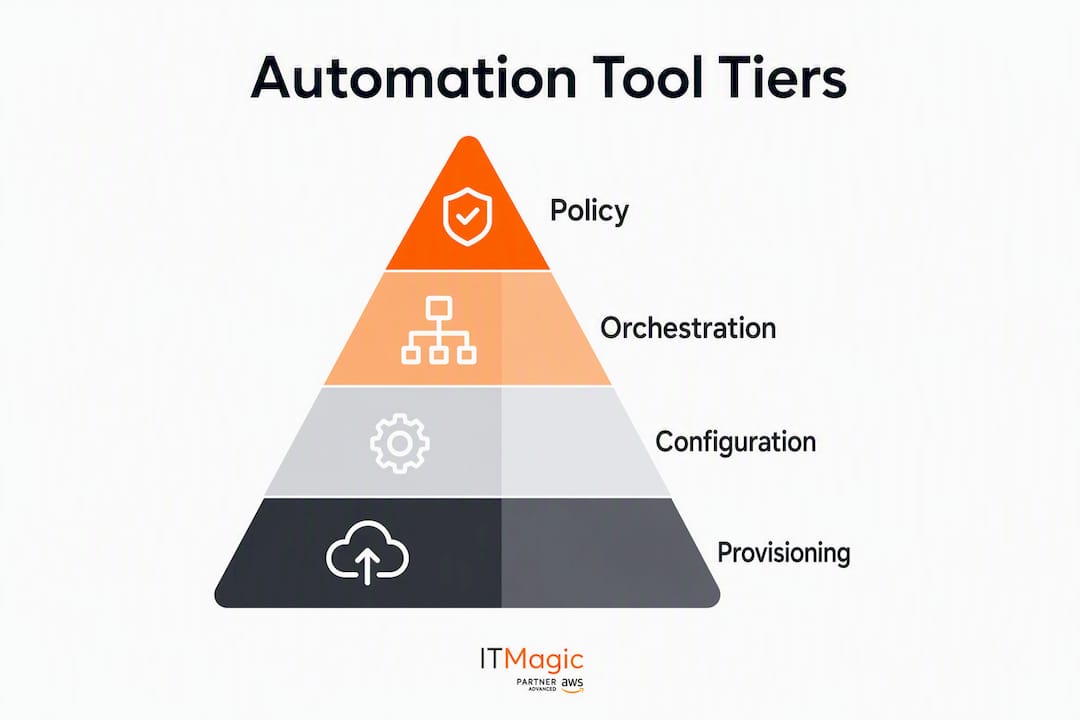
Those two terms are often used interchangeably, but they are not the same thing. IaC is one layer of a broader automation stack. Above it sits configuration management (enforcing runtime state on existing machines), orchestration (coordinating workflows across multiple tools and enforcing governance), and GitOps (using a Git repository as the single source of truth for both application and infrastructure state, with a controller that continuously reconciles live state to the repo).
Policy-as-code is the practice of expressing security and compliance rules as code evaluated at plan or pull-request time, using frameworks like Open Policy Agent or tools like Checkov.
| Dimension | Provisioning engine | Config management | Orchestration/control plane | GitOps controller |
|---|---|---|---|---|
| Primary job | Create/destroy infra resources | Enforce runtime state on existing nodes | Coordinate workflows, approvals, drift, policy | Sync Git repo state to a live cluster |
| Execution model | Plan/apply diff | Push or pull agent | Wraps other engines; adds governance layer | Pull-based; controller runs in-cluster |
| State handling | Explicit state file (Terraform, Pulumi) or stack (CloudFormation) | Desired-state idempotency; no central state file | Delegates to underlying engine; adds audit log | Git commit is the state; controller detects drift |
| Typical languages | HCL, YAML, general-purpose (Python, TypeScript) | YAML, Ruby DSL, Puppet DSL | Varies by platform; often HCL or YAML | YAML manifests, Helm charts, Kustomize |
Which tool category fits your environment?
Choosing the right category before choosing a brand cuts your candidate list in half. Here is how the main categories map to real problems.

IaC provisioning engines solve the “create and version my infrastructure” problem. They are the right starting point for any team that currently provisions by hand or through fragile scripts. Multi-cloud teams almost always anchor here first.
Configuration management tools solve the day-2 problem: keeping a running fleet patched, configured, and compliant after provisioning. If your biggest pain is configuration drift across hundreds of VMs or bare-metal nodes, this is the category to prioritize, not a new provisioning engine.
GitOps controllers solve the Kubernetes synchronization problem. They are purpose-built for teams running workloads on Kubernetes who want Git to be the authoritative source for both application and cluster configuration. They do not replace a provisioning engine; they complement it.
Orchestration and governance platforms solve the “we have multiple IaC engines and no central policy enforcement” problem. Teams that have grown past a single Terraform monorepo and now run Terraform, Ansible, and CloudFormation side by side need a control plane that adds approvals, drift detection, and policy-as-code across all of them.
Policy-as-code and scanning tools solve the “misconfigurations reach production” problem. Integrating scanning into CI so that a misconfigured S3 bucket or open security group fails a pull request is far cheaper than remediating it post-deployment.
Network automation tools solve device configuration at scale: routers, switches, firewalls, and load balancers managed through code rather than SSH sessions.
Quick selection signals:
- Single cloud, fastest access to new services → native tools (CloudFormation, ARM/Bicep).
- Multi-cloud or cloud-agnostic → Terraform or OpenTofu.
- Developer team that wants real programming languages → Pulumi.
- Large VM or bare-metal fleet → Ansible, Puppet, or Chef.
- Kubernetes-first → Argo CD or Flux.
- Compliance, audit, or multi-engine governance → orchestration layer plus Checkov.
Top infrastructure automation tools grouped by use case
Product fit depends on the job, not the leaderboard. The profiles below are grouped by primary use case so you can build a two-to-three tool shortlist for a pilot.
Multi-cloud provisioning
Terraform (HashiCorp) is the de facto standard for multi-cloud provisioning. Its HCL syntax is readable, its provider ecosystem covers virtually every cloud and SaaS service, and its plan/apply workflow gives teams a reviewable diff before any change lands. The state file is powerful but requires careful backend configuration (S3 + DynamoDB locking on AWS, for example). Large monorepos can become slow without module decomposition.
- Strengths: massive provider library, mature community, readable HCL, strong CI/CD integration.
- Limitations: state file management complexity at scale; BSL license change in 2023 prompted some teams to evaluate alternatives.
OpenTofu is the community-governed, open-source fork of Terraform maintained under the Linux Foundation. It is wire-compatible with Terraform HCL and providers, so migration is low-friction. Teams choosing OpenTofu trade-off vendor lock-in for the responsibility of managing their own platform, security patches, and integrations.
- Strengths: open governance, no BSL restrictions, Terraform workflow compatibility.
- Limitations: smaller commercial support ecosystem; teams carry more platform maintenance burden.
Code-first provisioning
Pulumi lets engineers write infrastructure in TypeScript, Python, Go, C#, or Java, using the same testing frameworks and IDEs they already know. It is a strong fit for developer-centric organizations where the ops team and the app team overlap. State is managed through Pulumi Cloud or a self-hosted backend.
- Strengths: real programming languages, strong testing story, good multi-cloud coverage.
- Limitations: steeper learning curve for ops-focused teams; smaller community than Terraform.
Single-cloud native provisioning
AWS CloudFormation provisions AWS resources through JSON or YAML templates and integrates natively with IAM, AWS Config, and Service Catalog. The AWS Cloud Development Kit (CDK) sits on top of CloudFormation and lets teams write infrastructure in TypeScript, Python, or Java, generating CloudFormation templates at synth time. Native tools give the deepest integration and earliest access to new AWS services.
- Strengths: zero-cost, native AWS drift detection, tight IAM integration.
- Limitations: verbose templates; limited outside AWS.
Azure Resource Manager (ARM) and Bicep serve the same role on Azure. Bicep is a domain-specific language that compiles to ARM JSON, offering cleaner syntax without leaving the native Azure toolchain. ARM/Bicep is the right choice when your estate is Azure-only and you want first-party support for every new Azure service on day one.
Google Cloud Deployment Manager and its successor Google Cloud Infrastructure Manager (built on OpenTofu) handle GCP-native provisioning. Infrastructure Manager is the current recommended path for new GCP deployments, offering Terraform-compatible workflows with native GCP integration.
Configuration management
Ansible is agentless, uses SSH, and describes tasks in YAML playbooks. It is the most accessible entry point for teams new to configuration management and works well for patching, application deployment, and ad-hoc automation. At large scale, execution time grows without Ansible Automation Platform’s parallelism features.

Puppet uses a declarative DSL and an agent-based pull model. It excels at enforcing desired state across large, heterogeneous fleets where consistency over time matters more than speed of initial setup. The learning curve is steeper than Ansible.
Chef uses Ruby-based recipes and cookbooks. It is a strong fit for teams with Ruby expertise and complex, code-driven configuration logic. Like Puppet, it uses an agent model and is well-suited to large enterprise fleets.
Configuration management tools remain critical for day-2 operations, patching, and enforcing desired state across fleets. Ansible, Puppet, and Chef are the primary choices; the right one depends on your team’s language familiarity and whether you need agentless simplicity or agent-based continuous enforcement.
Kubernetes GitOps
Argo CD is a declarative GitOps controller for Kubernetes. It continuously reconciles cluster state to a Git repository, provides a visual UI for deployment status, and supports multi-cluster deployments. It is the most widely adopted GitOps tool for application delivery on Kubernetes.
Flux is a CNCF-graduated GitOps toolkit that takes a more modular, controller-based approach. It integrates tightly with Helm and Kustomize and is a strong fit for platform teams that prefer composable, CLI-driven workflows over a UI.
Orchestration and governance
Spacelift is an orchestration/control plane that runs Terraform, OpenTofu, Pulumi, CloudFormation, Ansible, and Kubernetes workflows and adds policy-as-code, approvals, drift detection, and stack dependencies on top. Teams that have multiple IaC engines benefit from an orchestration layer that reduces custom self-service wrappers and centralizes governance. Spacelift is a strong fit for platform engineering teams managing dozens of stacks across multiple engines.
Terraform Cloud / Terraform Enterprise provides remote state management, team-based access controls, policy enforcement via Sentinel, and a run pipeline for Terraform and OpenTofu. Terraform Enterprise is the self-hosted version for organizations with data residency or air-gap requirements.
Policy scanning
Checkov is an open-source static analysis tool for IaC files (Terraform, CloudFormation, Kubernetes manifests, ARM templates, Bicep, and more). It runs in CI and flags misconfigurations before they reach production. Integrating Checkov into CI so misconfigurations surface at pull-request time, not in production, is one of the highest-ROI security practices for IaC teams.
Pro Tip: Run Checkov as a required CI check on every pull request that touches IaC files. A failed Checkov gate is far cheaper to fix than a misconfigured security group discovered during a SOC 2 audit.
Enterprise platforms
HPE Morpheus is a hybrid cloud management platform that abstracts provisioning across VMware, AWS, Azure, GCP, and bare metal. It is aimed at large enterprises managing mixed on-prem and cloud estates, with self-service catalogs, cost governance, and policy enforcement built in.
VMware Cloud Foundation (VCF) bundles vSphere, vSAN, NSX, and vRealize Automation into a single stack for private and hybrid cloud. It is the right choice for organizations with significant VMware investments that need automated lifecycle management of the full stack.
IBM Rapid Infrastructure Automation targets large enterprise and government environments, providing automated provisioning and lifecycle management across IBM Cloud and hybrid topologies. It integrates with IBM’s broader automation portfolio (including Ansible Automation Platform) and is suited to regulated industries with complex compliance requirements.
How do you evaluate and pilot infrastructure automation tools?
Effective automation correlates with lower configuration drift and reduced operational toil when core automation primitives are available. Evaluate tools against those primitives first, not against feature marketing.
Priority evaluation dimensions:
- Best-for / primary use case — Does the tool actually solve your top job (provisioning, config management, GitOps, governance)?
- Cloud and platform support — Multi-cloud, single-cloud native, on-prem, or hybrid? Does it cover every environment in your estate?
- State management and drift detection — How does the tool detect and report drift? How frequently? What is the remediation path?
- Policy-as-code and security integration — Does it integrate with Checkov, Open Policy Agent, or a native policy framework? Can policies block a run?
- Ease of use and learning curve — Developer-friendly (Pulumi, Ansible) vs. ops-oriented (Puppet, Chef)? What is your team’s existing skill set?
- Operational model — Agentless push (Ansible, Terraform) vs. agent-based pull (Puppet, Chef) vs. GitOps pull (Argo CD, Flux)?
- Scalability and performance — How does it perform at 500 stacks? 5,000 nodes? What are the known bottlenecks?
- Licensing and TCO — Open-source, OSS-compatible fork, hosted SaaS, or enterprise license? What is the total cost including engineering time for wrappers and integrations?
- Ecosystem and integrations — CI/CD hooks (GitHub Actions, GitLab CI, Jenkins), secrets managers (HashiCorp Vault, AWS Secrets Manager), observability platforms, and CMDB integrations.
Pilot checklist:
- Define pilot scope: one service, one environment, one team.
- Set success metrics before day one: time-to-apply, drift occurrences per week, mean time to remediate (MTTR), cost delta.
- Define rollback criteria: what triggers a rollback and who approves it?
- Run a Checkov scan on all IaC files before the first apply.
- Validate secrets integration: no plaintext credentials in state files or logs.
- Test drift detection: manually change a resource and verify the tool detects and reports it within the agreed window.
- Confirm CI/CD hooks: every merge to main triggers a plan; every merge to a protected branch requires an approval gate.
Questions to ask vendors or validate in a trial:
- What state backends are supported, and how is state locking handled?
- How does the tool integrate with AWS Secrets Manager or HashiCorp Vault?
- What is the drift detection frequency, and can it trigger automated remediation?
- How are approvals and change windows enforced in the run pipeline?
- What CI/CD systems does the tool support natively?
- What are the enterprise SLA and support tier options?
- How are breaking provider upgrades handled?
- What audit log retention and export options exist for compliance?
What does a realistic adoption timeline look like?
| Phase | Duration | Key activities | Owner |
|---|---|---|---|
| Pilot | Weeks 1–4 | Scope one service; stand up state backend; run first plan/apply; integrate Checkov in CI | Platform engineer + DevOps lead |
| Validate | Weeks 5–8 | Measure success metrics; test drift detection and rollback; run policy-as-code gates | DevOps lead + security engineer |
| Expand | Weeks 9–16 | Onboard two to three additional services; add secrets integration; document runbooks | Platform team |
| Govern | Weeks 17+ | Add orchestration/control plane; enforce policy-as-code org-wide; automate drift remediation | Platform team + compliance |
Cost factors to budget:
- Tool licensing: open-source tools are free to download but carry engineering time for platform maintenance; SaaS control planes (Terraform Cloud, Spacelift) charge per resource or per run.
- Engineering time for wrappers and self-service modules: often underestimated; plan for two to four weeks of engineering per major integration.
- Training: budget for certifications (HashiCorp Terraform Associate, AWS DevOps Engineer Professional) and internal enablement sessions.
- CI/CD integration: pipeline changes, secret scanning, and approval gates add one to two weeks per CI system.
- State backend and backup: S3 + DynamoDB for Terraform state costs are low but require IAM policy design and backup testing.
Common pitfalls:
- Building custom orchestration instead of adopting a control plane. Teams that write their own approval workflows, drift checkers, and self-service portals around a provisioning engine spend months on tooling instead of infrastructure. Adopt an orchestration layer that already has these features.
- Skipping policy-as-code in the pilot. Adding Checkov or Open Policy Agent after the fact means retrofitting hundreds of existing resources. Start in CI from week one.
- Under-resourcing drift detection. Drift that goes undetected for weeks creates compliance gaps and incident risk. Set a drift-check schedule in the pilot and define who owns remediation.
- Treating the provisioning engine as the whole stack. A provisioning engine handles day-0 and day-1. You still need configuration management for day-2, a GitOps controller for Kubernetes, and a governance layer for scale.
For practical patterns on building automation workflows in AWS, the IT-Magic blog covers CI/CD integration and state management in detail.
When should you hire a managed infrastructure automation partner?
Enterprises prefer managed services when compliance, uptime SLAs, and predictable cost and operations are priorities. The decision is not about capability; it is about where your team’s time is best spent.
| Dimension | Prefer DIY | Prefer managed |
|---|---|---|
| Scale | Small team, single cloud, low stack count | Large estate, multi-cloud, dozens of services |
| Compliance needs | No regulated data; internal audits only | PCI DSS, SOC 2, HIPAA; external audits; evidence collection required |
| Internal skills | Strong IaC and DevOps bench; capacity to maintain tooling | Limited IaC expertise; team focused on product, not platform |
| Time-to-market | Pilot timeline is flexible; learning is part of the goal | Pilot must complete in weeks; production deadline is fixed |
| 24/7 support | Business-hours coverage is sufficient | On-call coverage required; SLA-backed incident response needed |
A managed partner delivers outcomes that are hard to replicate with a small internal team: pilot completion in a defined window, policy-as-code rollout with compliance evidence, CI/CD integration across multiple pipelines, 24/7 on-call coverage, and cost savings from rightsizing and reserved instance optimization. The concrete metrics that matter are reduced drift occurrences, shorter MTTR, and faster pilot completion, not tool count.
When evaluating a managed partner, ask for:
- Evidence of relevant certifications (AWS Advanced Tier, HashiCorp partner status).
- Reference engagements in your industry (fintech, retail, healthcare).
- A defined pilot engagement model with fixed scope, timeline, and success criteria.
- Clear escalation paths and SLA terms for incident response.
IT-Magic has delivered numerous infrastructure projects since 2010 as an AWS Advanced Tier Services Partner, with certified expertise across DevOps, security, and networking. For teams that need compliance guardrails (PCI DSS, SOC 2, HIPAA) alongside automation, that combination of certifications and delivery track record reduces the risk of a first automation pilot significantly.
Key Takeaways
The most effective infrastructure automation stack pairs a provisioning engine for day-0/day-1 work with a configuration management tool for day-2 ops, a GitOps controller for Kubernetes, and a governance layer for policy enforcement and drift control.
| Point | Details |
|---|---|
| Job-first tool selection | Match the tool class to the job before evaluating brands; provisioning, config management, GitOps, and governance are distinct problems. |
| Policy-as-code from day one | Integrate Checkov or Open Policy Agent in CI during the pilot; retrofitting policies to existing resources is costly and error-prone. |
| Orchestration at scale | Add a control plane (Spacelift, Terraform Cloud) once you manage multiple stacks or engines; building custom governance from scratch wastes months. |
| Pilot with defined metrics | Measure time-to-apply, drift occurrences per week, MTTR, and cost delta before and after; no metrics means no proof of value. |
| IT-Magic for managed delivery | IT-Magic provides pilot-to-production managed automation on AWS, including IaC implementation, policy-as-code onboarding, and 24/7 support for compliance-driven teams. |
The part most teams get wrong about infrastructure automation
The conventional wisdom says: pick the most popular tool, follow the community tutorials, and you will be fine. After working through dozens of infrastructure automation engagements, the pattern that actually causes projects to stall is not tool selection. It is scope creep in the governance layer.
Teams adopt Terraform, get comfortable with it, and then start building. They write a custom Slack-based approval bot. They build a homegrown drift checker that queries the state file on a cron job. They create a self-service portal that wraps Terraform with a Python API. Six months later, they are maintaining three internal tools instead of shipping infrastructure. The provisioning engine is fine; the scaffolding around it has become the product.
The counterintuitive recommendation: adopt an orchestration control plane before you feel like you need one. The moment you have more than ten stacks or more than one IaC engine in your organization, the cost of a control plane is lower than the cost of the custom tooling you will inevitably build without one. Spacelift, Terraform Cloud, and similar platforms exist precisely because every team that skipped them eventually rebuilt the same features from scratch.
One pattern that consistently improves deployment velocity and reduces incidents: treat policy-as-code as a first-class CI check from the very first pilot sprint, not a compliance checkbox added before an audit. Teams that run Checkov on every pull request catch misconfigured IAM policies, open security groups, and unencrypted storage buckets before they ever reach a plan. The ones that add it later spend weeks remediating findings across hundreds of existing resources.
For long-term maintainability, the single most useful practice is keeping your orchestration layer thin and your provisioning modules opinionated. A control plane that enforces policy and routes approvals is valuable. A control plane that also contains business logic, custom resource types, and environment-specific hacks becomes a liability. Keep the logic in the modules; keep the control plane generic.
IT-Magic accelerates your infrastructure automation pilot
Selecting tools is the easy part. Getting a production-grade automation stack running with policy enforcement, secrets integration, drift detection, and compliance evidence in place is where most teams lose weeks.
IT-Magic is an AWS Advanced Tier Services Partner that has completed 700+ infrastructure projects since 2010. For teams that need to move from a tool shortlist to a running pilot fast, the difference is a team that has already solved the hard parts: state backend design, Checkov integration in CI, Kubernetes GitOps on EKS, and 24/7 on-call coverage with SLA-backed incident response.
Services matched to common automation needs:
- Kubernetes and GitOps support: Argo CD or Flux on EKS, with GitOps workflows and cluster policy enforcement.
- AWS cost optimization: Rightsizing, reserved instance planning, and cost governance tied to your automation rollout.
To scope a pilot engagement or discuss your automation requirements, contact IT-Magic directly.
Useful sources and further reading
Provisioning engines and IaC
- Gartner Peer Insights: Infrastructure Automation and Orchestration Tools — Peer reviews and ratings for enterprise IA&O tools; useful for vendor shortlisting and enterprise validation.
- OpenTofu official documentation — Reference docs for the open-source Terraform fork; start here before evaluating OpenTofu for a migration.
GitOps and Kubernetes
- Argo CD documentation — Official docs for Argo CD; covers installation, application sync, and multi-cluster setup.
- Flux documentation — Official Flux docs; covers the GitOps toolkit, Helm controller, and Kustomize integration.
Configuration management
- Ansible documentation — Official Ansible docs; covers playbooks, roles, inventory, and Ansible Automation Platform.
Policy, security, and orchestration
- Checkov documentation — Official Checkov docs; covers supported frameworks, CI integration, and custom policy authoring.
Community resources
- awesome-iac on GitHub — Community-curated list of IaC integrations, linters, test frameworks, and modules; useful for pilot planning and tool discovery.
| Category | Resource | Best used for |
|---|---|---|
| Provisioning | Gartner Peer Insights | Enterprise vendor validation |
| Provisioning | OpenTofu docs | OpenTofu migration and setup |
| GitOps | Argo CD docs | Kubernetes GitOps implementation |
| Config management | Ansible docs | Playbook authoring and fleet automation |
| Policy/security | Checkov docs | CI policy scanning setup |
| Community | awesome-iac | Linters, test frameworks, module discovery |
FAQ
What are infrastructure automation tools?
Infrastructure automation tools replace manual provisioning, configuration, and operations tasks with repeatable, code-driven processes. They cover IaC engines (Terraform, CloudFormation), configuration management (Ansible, Puppet, Chef), GitOps controllers (Argo CD, Flux), and governance platforms (Spacelift, Terraform Cloud).
What is the most popular IaC tool?
Terraform is the most widely adopted IaC provisioning engine for multi-cloud environments, with a large provider ecosystem and an active community. OpenTofu, its open-source fork, is gaining adoption among teams that need Terraform-compatible workflows without the HashiCorp BSL license.
What automation tools are commonly used to manage infrastructure?
A typical production stack combines a provisioning engine (Terraform or CloudFormation), a configuration management tool (Ansible for most teams), a GitOps controller (Argo CD or Flux for Kubernetes), and a policy scanner (Checkov in CI). Larger organizations add an orchestration control plane like Spacelift or Terraform Cloud for governance at scale.
When should a team use a managed service instead of DIY tools?
When compliance requirements (PCI DSS, SOC 2, HIPAA), tight delivery timelines, or limited internal IaC expertise are factors, a managed partner like IT-Magic reduces risk and accelerates time-to-production compared to building and maintaining the full automation stack internally.
How do you automate infrastructure management effectively?
Start with a scoped pilot on one service, define success metrics (time-to-apply, drift occurrences, MTTR) before day one, integrate Checkov in CI from the first sprint, and add an orchestration control plane before you build custom governance tooling. That sequence avoids the most common pitfall: months spent maintaining homegrown wrappers instead of shipping infrastructure.
Recommended
- Top Cloud DevOps Trends Shaping AWS Success in 2026
- How to Automate Infrastructure Workflow for IT Teams
- Advantages of Infrastructure Automation for Technical Leaders
- What Is IaC in DevOps? A 2026 Guide for Engineers
Alexander founded IT-Magic, an AWS Advanced Tier Services Partner delivering DevOps, cloud architecture, and managed services since 2010. He holds:
- AWS Certified Solutions Architect – Professional
- AWS Certified DevOps Engineer – Professional
- AWS Certified Security – Specialty
- AWS Certified Advanced Networking – Specialty
Talk to a certified AWS team trusted by INTERTOP, Foxtrot, Pandora, and J.Hilburn.
Get a free consultation