

TL;DR:
- Infrastructure as Code automates infrastructure management through version-controlled configurations, enabling rapid, consistent, and auditable cloud operations. It enhances scalability, reduces errors, and supports compliance in regulated industries by replacing manual processes with repeatable workflows. Successful implementation hinges on disciplined practices, proper state management, and integrating AI as an assisted tool under human review.
Infrastructure as Code (IaC) is defined as the practice of provisioning and managing computing infrastructure through machine-readable configuration files rather than manual processes or interactive tools. IaC sits at the core of modern DevOps automation, turning server configurations, network rules, and cloud resources into versioned, repeatable code. Tools like Terraform, Ansible, and AWS CloudFormation have made this practice standard across engineering teams. When combined with CI/CD pipelines, IaC cuts deployment time from hours to minutes and reduces configuration errors at scale.
What is IaC in DevOps and why does it matter?
IaC in DevOps means your infrastructure follows the same workflow as your application code: written, reviewed, tested, and deployed through automated pipelines. Instead of an engineer manually clicking through an AWS console or running ad hoc shell scripts, the desired state of your environment is declared in code and applied consistently every time.

This matters because manual infrastructure management does not scale. A team managing ten servers can survive inconsistency. A team managing ten thousand cannot. IaC extends the DevOps lifecycle to infrastructure itself, enabling policy enforcement, automated rollbacks, and environment parity across development, staging, and production.
The term “IaC” is sometimes used interchangeably with “infrastructure automation,” but the two are not identical. Infrastructure automation can mean running scripts. IaC specifically means defining infrastructure as a declarative or imperative source of truth, stored in version control, and applied through a controlled workflow. That distinction matters when you are designing systems that need to be auditable and reproducible.
What are the key benefits of IaC in DevOps workflows?
Running this on your own AWS setup? IT-Magic is an AWS Advanced Tier Partner — we audit, fix, or fully manage it for you.
Get a free consultationThe most direct benefit is speed. Combining IaC with automated CI/CD pipelines reduces deployment time by 75%, cutting a three-hour process down to under 45 minutes. That is not a marginal improvement. It fundamentally changes how often teams can ship and how quickly they can respond to incidents.
Beyond speed, IaC delivers these concrete advantages:
- Elimination of snowflake environments. Up to 90% of organizations cite the need to eliminate unique, manually configured environments that cannot be reliably reproduced. IaC replaces those fragile setups with repeatable definitions.
- Reduced merge conflicts. Teams using IaC with GitHub Actions report 40% fewer merge conflicts, because infrastructure changes go through pull request reviews rather than undocumented manual edits.
- Environment consistency. IaC supports CI/CD by ensuring environment parity, which shortens release cycles and makes test results trustworthy.
- Auditability. Every infrastructure change becomes a commit with a timestamp, author, and reason. This is critical for compliance frameworks like PCI DSS and HIPAA.
- Collaboration at scale. Infrastructure changes reviewed via pull requests bring the same discipline to ops work that code review brought to software development.
Pro Tip: Before writing a single line of Terraform or Ansible, define your environment boundaries in a README. Teams that document their infrastructure intent first make far fewer destructive changes during implementation.
The collaboration benefit is underrated. When a junior engineer proposes a security group change via a pull request, a senior engineer can catch the mistake before it reaches production. That review loop does not exist in manual infrastructure management.
How does IaC compare to traditional infrastructure management?
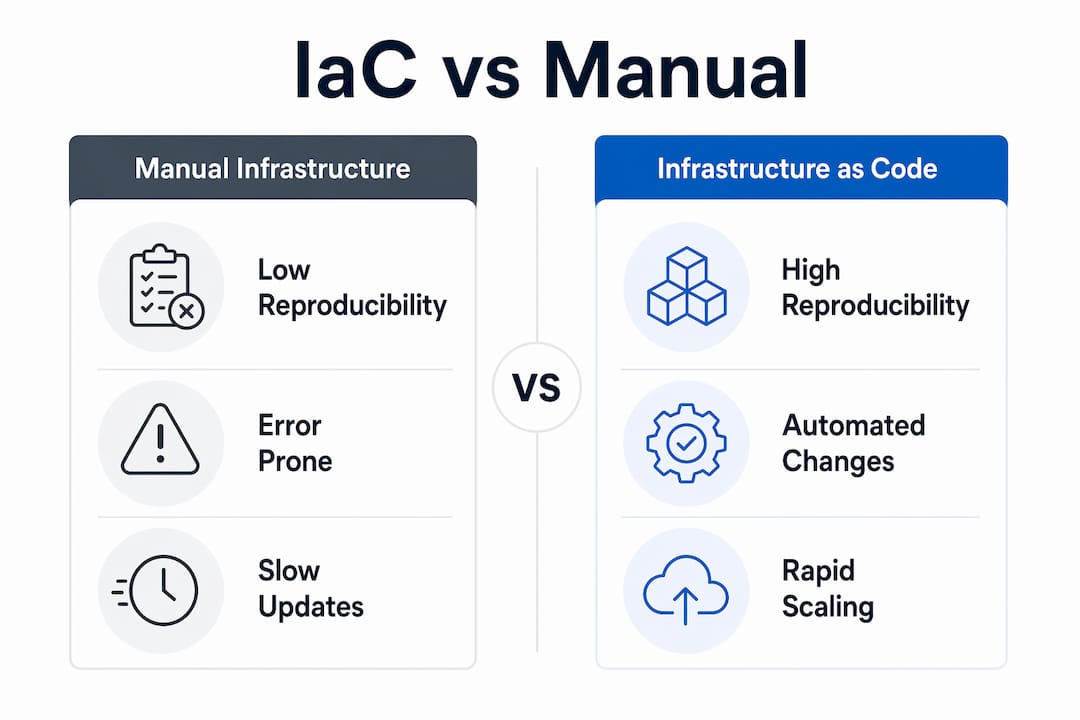
Manual infrastructure management relies on engineers executing steps directly against live systems. The result is configuration drift, where servers that started identical gradually diverge as different people apply different fixes over time. IaC transforms fragile manual processes into version-controlled, auditable workflows reviewed via pull requests.
The table below captures the practical differences between the two approaches:
| Characteristic | Manual infrastructure | Infrastructure as Code |
|---|---|---|
| Reproducibility | Low. Relies on tribal knowledge and runbooks. | High. Any environment can be rebuilt from code. |
| Version control | None. Changes are undocumented or tracked in tickets. | Full. Every change is a commit with history. |
| Error rate | High. Human steps introduce inconsistency. | Low. Automated application reduces human error. |
| Audit trail | Weak. Hard to trace who changed what and when. | Strong. Git history provides complete traceability. |
| Scaling speed | Slow. Each new environment requires manual effort. | Fast. New environments spin up from existing modules. |
| Compliance readiness | Difficult. Evidence collection is manual and incomplete. | Built-in. Change records exist by default. |
The compliance angle deserves emphasis. For fintech and healthcare companies operating under PCI DSS or HIPAA, manual infrastructure creates an audit nightmare. IaC turns compliance evidence collection from a quarterly scramble into a continuous, automated process. That alone justifies adoption for regulated industries.
What are the primary IaC tools for DevOps in 2026?
The IaC tool ecosystem has matured significantly, and choosing the right tool depends on your cloud provider, team skills, and pipeline architecture. Here are the tools that dominate production environments today:
- Terraform (HashiCorp): The most widely adopted declarative IaC tool. Manages multi-cloud resources through a provider model. State management is its defining feature and its most common failure point.
- Ansible (Red Hat): An imperative, agentless configuration management tool. Excellent for application-layer configuration and hybrid environments. Red Hat Ansible is evolving to incorporate AI-driven automation as task triggers layered on deterministic workflows.
- AWS CloudFormation: AWS-native declarative IaC. Deep integration with AWS services makes it reliable for AWS-only stacks, though its JSON/YAML syntax is verbose compared to Terraform’s HCL.
- Pulumi: Uses general-purpose languages like Python, TypeScript, and Go to define infrastructure. Preferred by teams that want to apply software engineering patterns directly to infrastructure code.
- GitHub Actions: Primarily a CI/CD orchestrator, but increasingly used to trigger and validate IaC deployments as part of pull request workflows.
The declarative versus imperative distinction matters in practice. Declarative tools like Terraform and CloudFormation let you define the desired end state and let the tool figure out how to get there. Imperative tools like Ansible execute steps in sequence. Most mature teams use both: Terraform for cloud resource provisioning, Ansible for configuration management on top of those resources.
Pro Tip: Match your IaC tool to your pipeline, not the other way around. If your team already runs GitHub Actions for application CI/CD, integrating Terraform into that same pipeline is far less disruptive than introducing a separate orchestration layer.
What challenges and best practices should engineers know when implementing IaC?
The most common failure point in IaC implementations is state management. State corruption from concurrent changes is the leading cause of broken Terraform deployments in team environments. The fix is straightforward: use remote backends with locking. On AWS, that means S3 for state storage and DynamoDB for lock management. Without locking, two engineers running "terraform apply` simultaneously can corrupt the state file and leave your infrastructure in an undefined condition.
Beyond state management, these practices separate teams that succeed with IaC from those that struggle:
- Define infrastructure before scripting pipelines. Retrofitting IaC into existing pipelines is a major pitfall. Build your infrastructure definitions first, then orchestrate the pipeline around them.
- Test your infrastructure code. Tools like Terratest and Kitchen-Terraform let you write unit and integration tests for infrastructure modules. Teams that skip testing discover failures in production instead of CI.
- Version your modules. Pinning module versions in Terraform prevents upstream changes from silently breaking your deployments.
- Separate state by environment. Keep development, staging, and production state files in separate backends. A failed apply in staging should never touch production state.
- Enforce least privilege in CI/CD roles. The IAM role your pipeline uses to apply Terraform should have only the permissions required for that specific stack.
Pro Tip: Treat your IaC repository with the same rigor as your application repository. Require peer review for all changes, enforce branch protection rules, and run automated linting with tools like tflint or checkov on every pull request.
The mindset shift required here is real. Successful IaC adoption requires treating infrastructure definition as code, with the same emphasis on review, testing, and iterative improvement that software development demands. Teams that treat IaC as “just scripts” accumulate technical debt as fast as any poorly maintained codebase.
How does IaC integrate with AI and automation trends in DevOps?
AI is entering the IaC workflow at every layer, and the results are promising but require careful governance. The industry has settled on three maturity levels for infrastructure automation with AI: human-approved single actions, supervised AI-assisted workflows, and fully autonomous operations for trusted systems. Most production environments in 2026 operate at the first or second level.
The practical value of AI in IaC today is boilerplate acceleration. GitHub Copilot can generate a working Terraform module for an ECS service with an ALB in seconds. Spacelift Intent and similar tools can translate natural language descriptions into IaC configurations. This reduces the time engineers spend on repetitive scaffolding and lets them focus on architecture decisions.
The risk is equally real. AI tools can hallucinate resources, generating plausible-looking Terraform code that references non-existent AWS resource types or misconfigures security settings. An AI-generated security group rule that opens port 22 to 0.0.0.0/0 will pass syntax validation and fail only at the security review stage, if there is one.
“AI should be a force multiplier for IaC, not a replacement for engineering judgment. Every AI-generated infrastructure change needs a human reviewer who understands what the code will actually provision.”
Balancing AI in IaC requires placing AI agents behind approval gates and audit trails, with human review remaining central in production environments. The teams getting the most value from AI-assisted IaC are those that use it to generate first drafts and accelerate debugging, while keeping a senior engineer in the review loop for every change that touches production.
Key takeaways
IaC in DevOps is the practice of defining infrastructure as versioned, testable code, and it is the foundational requirement for reliable, scalable, and auditable cloud operations.
| Point | Details |
|---|---|
| Core definition | IaC provisions and manages infrastructure through code, replacing manual configuration with repeatable, versioned workflows. |
| Speed and consistency | IaC with CI/CD cuts deployment time from hours to minutes and eliminates configuration drift across environments. |
| Tool selection matters | Terraform, Ansible, AWS CloudFormation, and Pulumi serve different use cases; match tools to your pipeline and team skills. |
| State management is critical | Use remote backends with locking (S3 and DynamoDB on AWS) to prevent state corruption in team environments. |
| AI is an accelerator, not a replacement | AI tools speed up IaC authoring but require human review gates to catch hallucinations and security misconfigurations. |
Why IaC is a mindset shift, not just a tooling upgrade
After working on infrastructure automation across dozens of AWS environments, the pattern I see most often is teams that adopt Terraform but keep their old habits. They write IaC, but they also make manual changes in the console “just this once.” Within six months, their state file no longer reflects reality, and they are back to the same firefighting they had before.
The teams that get IaC right treat their infrastructure repository as the single source of truth, without exception. If a change is not in code, it does not exist. That discipline is harder to build than learning Terraform syntax, and it requires buy-in from everyone who touches infrastructure, not just the DevOps lead.
I have also seen teams over-invest in AI-assisted IaC generation before they have solid review processes in place. GitHub Copilot can write a VPC module in 30 seconds, but if no one on the team understands what it generated, you have accelerated your way into a security gap. The right sequence is: build review discipline first, then layer in AI acceleration.
For IT engineers navigating AI integration in 2026, IaC is the foundation that makes AI-assisted infrastructure safe to use. Without version control, testing, and approval gates, AI-generated infrastructure code is just a faster way to make mistakes.
The most underrated IaC practice is clear ownership. In large teams, every module and every environment should have a named owner who is responsible for its health. Shared ownership of infrastructure code produces the same result as shared ownership of anything else: nobody takes responsibility until something breaks.
— Oleksandr
How IT-Magic helps you implement IaC on AWS
IT-Magic has delivered IaC-driven infrastructure across 700+ projects since 2010, working exclusively on AWS environments for startups, fintech, and enterprise clients. Our certified engineers design Terraform and Ansible workflows that integrate directly into your CI/CD pipelines, with state management, security controls, and compliance documentation built in from day one.
If you are running containerized workloads, our Kubernetes support services cover EKS cluster provisioning, scaling, and operational management through IaC. For teams that need a reliable foundation for their entire AWS environment, our AWS infrastructure support provides ongoing operational coverage alongside your IaC implementation. You can also explore our IaC guide for IT leaders for a deeper look at how we approach infrastructure automation in practice.
FAQ
What does IaC mean in DevOps?
IaC stands for Infrastructure as Code. It means managing and provisioning infrastructure through machine-readable configuration files stored in version control, rather than through manual processes or interactive configuration tools.
What is the difference between Terraform and Ansible for IaC?
Terraform is a declarative tool that defines the desired end state of cloud resources, while Ansible is an imperative tool that executes configuration steps in sequence. Most teams use Terraform for cloud provisioning and Ansible for application-layer configuration on top of those resources.
Why is state management important in IaC?
State management tracks the current condition of your infrastructure so IaC tools know what changes to apply. Without remote backends and locking mechanisms like S3 and DynamoDB, concurrent changes from multiple engineers can corrupt the state file and leave infrastructure in an undefined state.
How does IaC support CI/CD pipelines?
IaC integrates with CI/CD tools like GitHub Actions to automatically provision and update infrastructure as part of the deployment pipeline. This ensures environment consistency across development, staging, and production, making test results reliable and release cycles shorter.
Is IaC suitable for regulated industries like fintech or healthcare?
IaC is particularly well-suited for regulated industries because every infrastructure change is recorded as a versioned commit with an author and timestamp. This built-in audit trail directly supports compliance requirements under frameworks like PCI DSS and HIPAA.
Alexander founded IT-Magic, an AWS Advanced Tier Services Partner delivering DevOps, cloud architecture, and managed services since 2010. He holds:
- AWS Certified Solutions Architect – Professional
- AWS Certified DevOps Engineer – Professional
- AWS Certified Security – Specialty
- AWS Certified Advanced Networking – Specialty
Talk to a certified AWS team trusted by INTERTOP, Foxtrot, Pandora, and J.Hilburn.
Get a free consultation