

TL;DR:
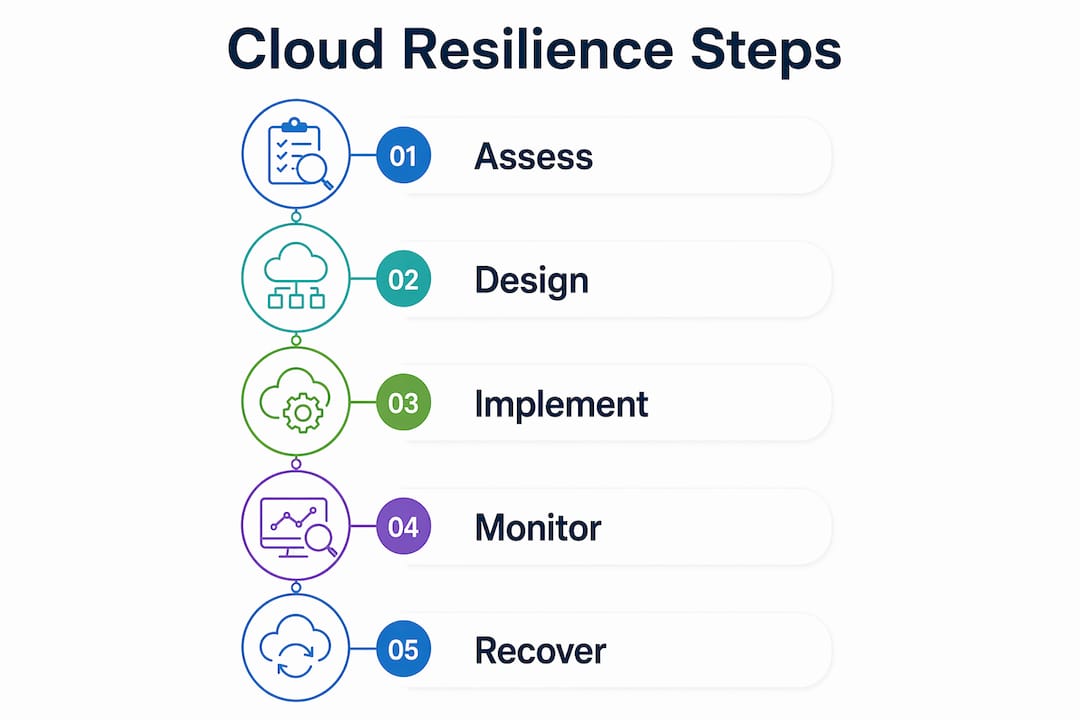
- Cloud resilience is the ongoing discipline of designing systems that withstand failures, recover automatically, and minimize service disruption. IT leaders must assess their crucial workloads, map external dependencies, and align RTO and RPO targets with SLAs to prioritize investments in redundancy and failover strategies. Continuous validation through testing, observability, and automation ensures resilient cloud architectures that adapt to evolving threats and operational realities.
Cloud resilience is defined as your infrastructure’s ability to withstand failures, adapt to disruptions, and recover to full operation with minimal service impact. The Microsoft Azure Cloud Adoption Framework, AWS Well-Architected Framework, and Google Cloud Reliability Pillar all treat resilience not as a feature you add, but as a discipline you practice continuously. For IT leaders and developers, knowing how to improve cloud resilience means building systems where failure is expected, contained, and recovered from automatically. The strategies in this article are drawn from those authoritative frameworks and from real-world implementation patterns across hundreds of production environments.
How to assess your cloud resilience baseline
Before you architect anything, you need to know which systems matter most and what threatens them. Microsoft’s Azure Cloud Adoption Framework recommends starting with a Business Impact Analysis (BIA) and iterative risk assessments to define mitigation and resiliency priorities. A BIA forces you to classify every workload by criticality: what breaks if this goes down, how fast does it hurt, and how much data loss is tolerable?
The output of a BIA is a tiered workload map. Tier 1 workloads (payment processing, authentication, order management) demand near-zero Recovery Time Objectives (RTO) and Recovery Point Objectives (RPO). Tier 3 workloads (internal reporting dashboards, batch analytics) can tolerate hours of downtime without material business impact. This classification directly determines where you invest in redundancy, replication, and automated failover.
Risk assessment runs in parallel. You identify threats (region outages, dependency failures, misconfigurations, DDoS attacks) and score them by likelihood and impact. The Cloud Security Alliance recommends redundancy and load distribution with automated failover as baseline controls for any workload exposed to demand spikes or external threats.
One critical and often skipped step: map your external dependencies. Third-party APIs, SaaS authentication providers, and DNS resolvers are invisible failure points until they take you down. AWS Resilience Hub uses DNS log analysis and failure-mode assessments to surface hidden dependencies that block failover. Treat dependency mapping as an ongoing task, not a one-time audit.
Pro Tip: Align your RTO and RPO targets directly with SLA commitments to your customers. If your SLA promises 99.9% uptime, your Tier 1 workloads need an RTO measured in minutes, not hours. This alignment prevents over-engineering low-criticality systems and under-investing in critical ones.
- Classify workloads into criticality tiers using BIA output
- Define RTO and RPO targets per tier before selecting architecture patterns
- Score threats by likelihood and business impact, not just technical severity
- Map all external dependencies, including DNS, third-party APIs, and shared services
- Review and update risk assessments after every major infrastructure change
What architectural strategies improve cloud resilience?
Running this on your own AWS setup? IT-Magic is an AWS Advanced Tier Partner — we audit, fix, or fully manage it for you.
Get a free consultationThe foundation of a reliable cloud system is fault isolation. AWS architecture emphasizes fault isolation boundaries and multi-AZ and multi-region failover as core resilience design. The principle is simple: a failure in one zone, region, or service boundary must not cascade into adjacent systems. In practice, this means deploying across multiple Availability Zones as a minimum, and across multiple regions for Tier 1 workloads.

Containers and Infrastructure as Code (IaC) tools like Terraform and AWS CloudFormation eliminate configuration drift, which is one of the most common sources of silent resilience failures. When every environment is defined in code and deployed identically, you remove the human error that causes “it works in staging but fails in production” scenarios. HashiCorp’s Well-Architected Framework advocates automated processes and failure isolation as the foundation for reducing manual error in recovery workflows.
Elastic scalability is the other half of the architectural equation. A system that cannot scale under load will fail under load, regardless of how well it handles single-node failures. AWS Auto Scaling, Kubernetes Horizontal Pod Autoscaler, and AWS EKS node groups all provide mechanisms to absorb demand spikes without manual intervention. Graceful degradation, where non-critical features are disabled under stress while core functions continue, is a design pattern that separates resilient systems from brittle ones.
Pro Tip: Design failure domains before you design features. Draw a boundary around every component that can fail independently, then verify that no single boundary failure can take down more than one tier of your application. This exercise consistently reveals hidden coupling that architecture diagrams miss.
| Strategy | Trade-off: cost | Trade-off: complexity | Recovery speed |
|---|---|---|---|
| Multi-AZ deployment | Low to medium | Low | Seconds to minutes |
| Multi-region active/passive | Medium to high | Medium | Minutes |
| Multi-region active/active | High | High | Near-zero |
| Pilot light standby | Low | Medium | Minutes to hours |
| Warm standby | Medium | Medium | Minutes |
| Backup and restore | Low | Low | Hours |
How can you operationalize resilience with observability and automated recovery?
Architecture decisions only deliver value if your operational layer can detect failures and respond faster than humans can. Google Cloud’s Reliability Pillar identifies centralized monitoring, graceful degradation, and automated recovery as the three operational practices that convert architectural resilience into actual uptime. Without all three, you have a resilient design that fails silently.
Here is a practical sequence for operationalizing resilience:
- Deploy centralized observability. Use AWS CloudWatch, Azure Monitor, or Google Cloud Operations Suite to aggregate logs, metrics, and traces across all services. Set alert thresholds based on SLA-derived error budgets, not arbitrary percentages.
- Implement automated failover. AWS Application Recovery Controller, Azure Front Door, and AWS Elastic Load Balancing all support health-check-driven traffic routing. When a target fails its health check, traffic shifts automatically without a human in the loop.
- Define and instrument RTO and RPO. RTO and RPO metrics tie directly to backup frequency and failover mechanics. Instrument your systems to measure actual recovery time during incidents, not just theoretical targets.
- Run fault injection tests. AWS Fault Injection Simulator and Chaos Monkey-style experiments inject real failures into production or staging environments to validate that your failover paths actually work. Teams that skip this step discover their gaps during actual outages.
- Automate runbooks. Convert manual recovery procedures into AWS Systems Manager Automation documents or equivalent. Automated recovery workflows reduce mean time to recovery and eliminate the variability of human execution under pressure.
Pro Tip: Set a monthly “resilience drill” on your team calendar. Pick one failure scenario, inject it in a non-production environment, and measure actual RTO against your target. Teams that practice recovery recover faster. Teams that only plan for recovery discover their plans are wrong at the worst possible time.
What are the best practices for disaster recovery?
Disaster recovery (DR) and resilience are related but distinct. Resilience keeps your system running through failures. DR restores your system after failures exceed your resilience limits. Both are required. A system with excellent resilience but no DR plan is one major regional outage away from extended downtime.
AWS Elastic Disaster Recovery enables near-zero data loss and rapid recovery through cross-region backup replication. Azure Site Recovery provides similar orchestrated failover for workloads running on Azure or on-premises. The choice between these tools is secondary to the choice of DR model, which should be driven by your RTO and RPO targets.
The four standard DR models, ordered from lowest to highest cost and fastest to slowest recovery, are:
- Active/active multi-region: Zero RTO, near-zero RPO. Traffic runs across regions simultaneously. Most expensive and complex.
- Warm standby: A scaled-down but live replica runs in a secondary region. RTO measured in minutes. Moderate cost.
- Pilot light: Core infrastructure is provisioned but idle in a secondary region. RTO measured in tens of minutes to hours.
- Backup and restore: Data is backed up to a secondary region. RTO measured in hours. Lowest cost, highest recovery time.
DR testing is where most organizations fail. A DR plan that has never been tested is not a DR plan. It is a hypothesis. Schedule full DR failover tests at least twice per year, document the actual RTO achieved, and update your runbooks based on what breaks. IT-Magic’s cloud resilience assessments consistently find that untested DR plans contain at least one critical gap that would extend recovery time by hours.
| DR model | Primary tool | Typical RTO | Typical RPO |
|---|---|---|---|
| Active/active | AWS Route 53, Azure Traffic Manager | Near-zero | Near-zero |
| Warm standby | AWS Elastic Disaster Recovery | 5 to 30 minutes | Minutes |
| Pilot light | AWS CloudFormation, Azure Site Recovery | 30 to 60 minutes | Minutes to hours |
| Backup and restore | AWS Backup, Azure Backup | 1 to 4 hours | Hours |
Key takeaways
Improving cloud resilience requires a continuous cycle of assessment, architectural design, operational instrumentation, and tested disaster recovery, not a single deployment decision.
| Point | Details |
|---|---|
| Start with a BIA | Classify workloads by criticality before selecting architecture patterns or DR models. |
| Design for fault isolation | Multi-AZ is the minimum; multi-region active/active is required for near-zero RTO targets. |
| Instrument RTO and RPO | Measure actual recovery time during drills, not just theoretical targets from architecture docs. |
| Test DR plans regularly | Untested recovery plans contain gaps. Schedule full failover tests at least twice per year. |
| Automate recovery workflows | Automated runbooks reduce mean time to recovery and eliminate human error under pressure. |
What I’ve learned building resilient systems at scale
After working across hundreds of AWS environments, the pattern I see most often is this: organizations treat resilience as a project with a completion date. They deploy multi-AZ, configure backups, and mark the ticket done. Six months later, a dependency they never mapped takes down their payment service for four hours.
Failing to continuously validate resiliency assumptions leads to gaps that eventually cause customer-visible outages. Microsoft’s own engineers are explicit about this. The systems I’ve seen hold up best under real incidents are the ones where resilience is a recurring operational ritual, not a one-time architecture decision.
The other thing I push hard on is dependency mapping. Most teams map their own services well. Almost no team maps their external dependencies with the same rigor. Your authentication provider, your payment gateway, your CDN: these are failure points you do not control. Google Cloud’s Reliability Pillar makes the point that reliability must be owned across all teams, not just operations. That ownership has to extend to third-party dependencies too.
The cost conversation is real and worth having directly. Not every workload needs active/active multi-region. The teams that get this right are the ones who tie RTO and RPO targets to actual business impact numbers, then let those numbers drive the architecture decision. When you can show that four hours of downtime costs $200,000, the business case for warm standby writes itself.
— Oleksandr
How IT-Magic helps you build resilient AWS environments
IT-Magic has delivered AWS DevOps services across 700+ projects since 2010, with a consistent focus on infrastructure that holds up under real-world conditions.
Our team of certified AWS engineers implements the full resilience stack: multi-AZ and multi-region architectures, Infrastructure as Code with Terraform and AWS CloudFormation, automated failover with AWS Application Recovery Controller and Elastic Load Balancing, and fault injection testing to validate recovery paths before incidents happen. We also design and test DR plans using AWS Backup and AWS Elastic Disaster Recovery, with documented RTO and RPO targets tied to your actual SLAs. If you want to know where your current environment stands, our AWS infrastructure audit identifies resilience gaps and prioritizes remediation by business impact. For teams running containerized workloads, our Kubernetes support services cover EKS resilience patterns including pod disruption budgets, node group failover, and cluster autoscaling.
FAQ
What is cloud resilience?
Cloud resilience is the ability of a cloud-based system to withstand failures, adapt to disruptions, and recover to normal operation with minimal service impact. It encompasses architectural redundancy, automated failover, observability, and tested recovery processes.
How is cloud resilience different from disaster recovery?
Resilience keeps a system operational through failures by absorbing and routing around them automatically. Disaster recovery restores a system after failures exceed resilience limits, typically involving failover to a secondary region or restoration from backup.
What are RTO and RPO in cloud resilience?
Recovery Time Objective (RTO) is the maximum acceptable time to restore a service after a failure. Recovery Point Objective (RPO) is the maximum acceptable data loss measured in time. Both metrics, as Oracle’s DR guidance explains, directly determine which DR model and replication strategy your architecture requires.
How often should you test disaster recovery plans?
DR plans should be tested with full failover exercises at least twice per year. Teams that only test annually consistently discover that runbooks are outdated and actual RTO exceeds targets by a significant margin.
What is the first step to improve cloud resilience?
The first step is a Business Impact Analysis to classify workloads by criticality and define RTO and RPO targets per tier. Without this classification, architecture and DR investments are made without a clear priority framework.
Recommended
- Network Security Strategies for Cloud Environments in 2026
- AWS cloud security: 7 essential strategies for 2026
- What Is Cloud Risk Management: A 2026 Guide for Leaders
- AWS Security Trends: What CIOs Need to Know for 2026
Alexander founded IT-Magic, an AWS Advanced Tier Services Partner delivering DevOps, cloud architecture, and managed services since 2010. He holds:
- AWS Certified Solutions Architect – Professional
- AWS Certified DevOps Engineer – Professional
- AWS Certified Security – Specialty
- AWS Certified Advanced Networking – Specialty
Talk to a certified AWS team trusted by INTERTOP, Foxtrot, Pandora, and J.Hilburn.
Get a free consultation