


TL;DR:
- Managed IT providers handle cloud security, compliance, and cost optimization, easing fintech teams’ burden.
- They deliver 30% higher deployment efficiency and 86% faster remediation times.
- Effective selection, architecture, and ongoing partnership are crucial for maximizing benefits.
Fintech teams building on AWS often assume that a talented in-house engineering team is enough to stay secure, compliant, and cost-efficient. That assumption gets expensive fast. Compliance mandates like PCI DSS and SOC 2 evolve constantly, cloud costs spiral without dedicated oversight, and security gaps appear faster than internal teams can close them. Benchmarks show 30% deployment efficiency gains and 86% faster remediation when companies partner with top managed IT service providers. This guide breaks down what these providers actually do, how to evaluate them, and how to implement them without the common pitfalls that slow fintech teams down.
Key Takeaways
| Point | Details |
|---|---|
| Major efficiency gains | Fintechs see up to 30% faster deployments and 86% quicker issue resolution by choosing managed IT providers for AWS. |
| Compliance and security edge | Leading managed IT partners deliver advanced compliance automation that keeps fintechs audit-ready with less manual effort. |
| Provider selection matters | The right managed IT provider brings deep AWS and fintech expertise, enabling automation, security, and scalable growth. |
| Common pitfalls to avoid | Neglecting SRE best practices or over-automating without planning can undermine the value of managed services. |
What is a managed IT services provider?
Running this on your own AWS setup? IT-Magic is an AWS Advanced Tier Partner — we audit, fix, or fully manage it for you.
Get a free consultationA managed IT services provider, or MSP, is a company that takes on ongoing responsibility for a defined set of IT functions, typically under a service-level agreement. In the AWS context, this means the provider manages your cloud infrastructure, security posture, cost optimization, and compliance controls, so your internal team can focus on product and growth.
For fintech startups and scaling companies, the scope matters a lot. A generic MSP might handle help desk tickets and endpoint monitoring. An AWS-focused managed provider operates at a completely different level. They architect multi-account environments, enforce guardrails using AWS Organizations and Control Tower, run automated security scanning, and maintain the audit trails regulators expect.
Typical service coverage from a serious AWS managed provider includes:
- Infrastructure management: Provisioning, scaling, patching, and monitoring AWS environments across regions
- Security and compliance: Continuous monitoring, vulnerability management, and support for PCI DSS, SOC 2, and HIPAA
- Cost optimization: Reserved instance management, rightsizing, and FinOps reporting
- Automation and IaC: Terraform and CDK-based deployments that reduce human error and speed up delivery
- Incident response: 24/7 alerting and remediation with defined SLAs
The market for these services has matured significantly. Accenture, Deloitte, and Capgemini lead in the Forrester Wave for Application Modernization and Multicloud Managed Services, reflecting deep investment in cloud-native tooling and compliance expertise.
A managed IT provider is not a vendor you call when things break. It is an operational partner embedded in your cloud strategy from day one.
For CTOs evaluating managed AWS services, the key distinction is operational depth. The right provider does not just monitor your environment. They improve it continuously, aligning your AWS footprint with both business goals and regulatory requirements.
Core benefits for fintech and startups on AWS
Fintech companies face a unique combination of pressure: move fast, stay compliant, and do not blow the budget. Managed IT providers are built to address all three simultaneously, which is why adoption among fintech startups has accelerated sharply.
Compliance without the overhead
PCI DSS, SOC 2, and increasingly ISO 27001 require continuous evidence collection, access control enforcement, and audit-ready logging. Building this internally demands dedicated security engineers, compliance tooling, and months of setup. A managed provider brings pre-built frameworks, automated evidence collection, and teams who have done this dozens of times. That translates directly to faster certification cycles and fewer audit surprises.
Quantified efficiency gains
| Metric | In-house average | Managed provider benchmark |
|---|---|---|
| Deployment frequency | Baseline | +30% improvement |
| Remediation time | Baseline | 86% faster |
| Security incident response | Hours to days | Minutes to hours |
| Cost visibility | Reactive | Proactive FinOps |
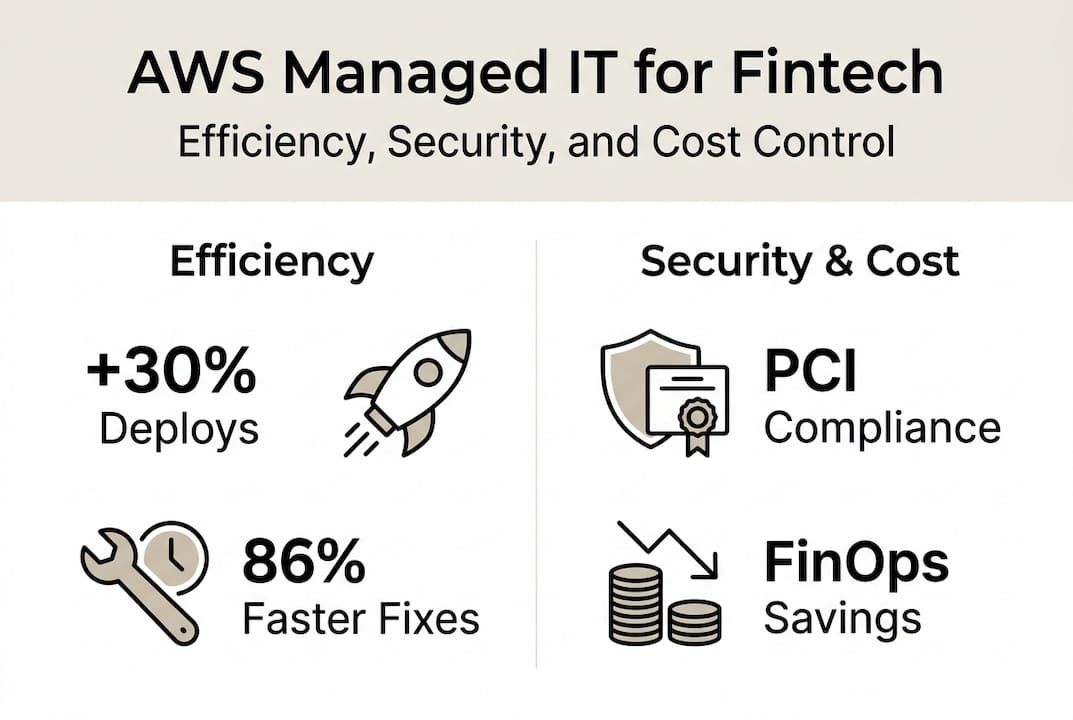
Benchmarks confirm 30% deployment efficiency gains and 86% remediation time reduction for fintech teams using expert-led managed services. These are not theoretical numbers. They reflect real infrastructure programs with automated pipelines and security tooling already in place.
Cost control through FinOps
AWS bills grow in unexpected ways. Idle resources, untagged workloads, and over-provisioned instances are the usual culprits. Managed providers implement cloud cost optimization practices from day one, including reserved instance planning, savings plans, and automated rightsizing. This is not a one-time cleanup. It is an ongoing discipline.
Key cost management practices your provider should deliver:
- Tagging policies enforced at account level
- Monthly FinOps reviews with actionable recommendations
- Automated alerts for budget anomalies
- Reserved instance and savings plan coverage reporting
Pro Tip: Ask any prospective provider to show you a sample FinOps report from a current client. The detail and actionability of that report will tell you more about their operational maturity than any sales deck.
For fintech startups preparing for their first AWS framework review, a managed provider can compress months of preparation into weeks by applying proven architecture patterns and pre-validated compliance controls.
Choosing the right managed IT provider: What matters most
Not all managed IT providers are equal, and the gap between a strong AWS partner and a generic MSP can cost you months of rework and compliance exposure. Here is how to make a confident, structured selection.
Top selection criteria
- AWS credentials and specialization: Look for AWS Advanced Tier or Premier Tier partners with active competencies in Security, DevOps, or Financial Services. These designations require validated customer outcomes, not just certifications.
- Fintech compliance track record: Ask for specific examples of PCI DSS or SOC 2 implementations on AWS. Generic compliance experience does not transfer cleanly to fintech environments.
- Infrastructure as Code maturity: Your provider should deploy everything via Terraform, CDK, or CloudFormation. Manual console changes in a regulated environment are a liability.
- Automation depth: CI/CD pipeline management, automated security scanning, and self-healing infrastructure are table stakes for serious AWS partners.
- Engagement model clarity: Understand exactly what is included in the retainer versus what triggers additional billing. Ambiguity here creates friction fast.
Provider comparison overview
| Provider | AWS specialization | Fintech compliance | IaC support | Best for |
|---|---|---|---|---|
| Accenture | Deep | Strong | Yes | Enterprise fintech |
| Deloitte | Deep | Strong | Yes | Regulated industries |
| Capgemini | Strong | Moderate | Yes | Mid-market |
| Boutique AWS partners | Focused | Often specialized | Yes | Startups and scale-ups |
Accenture, Deloitte, and Capgemini lead in end-to-end AWS managed services for fintech, but their engagement minimums often exclude early-stage startups. That is where specialized top AWS partners with fintech focus deliver outsized value at a fraction of the cost.
For startups specifically, the engagement model matters as much as the service catalog. A fixed monthly retainer with clear scope beats a time-and-materials model that creates billing uncertainty. Look for providers who offer tiered packages aligned to your growth stage.
If you want a broader framework for evaluating partners, cloud consulting tips can help you structure the right questions before your first call.
Implementing managed IT for AWS: Best practices and pitfalls
Choosing the right provider is only half the work. The transition and ongoing partnership require deliberate structure, especially in fintech where compliance continuity matters.
Architecture and governance patterns that work
The most effective AWS environments managed by external providers share a common foundation. They use AWS Organizations and Control Tower for multi-account governance, Terraform or CDK for all infrastructure changes, and FinOps tooling for continuous cost visibility. This is not optional architecture. It is the baseline that makes managed services actually manageable.
Key implementation best practices:
- Define account boundaries early: Separate production, staging, and development accounts from day one using AWS Organizations
- Establish a shared services account: Centralize logging, monitoring, and security tooling in a dedicated account
- Automate compliance evidence collection: Use AWS Config, Security Hub, and CloudTrail from the start, not as a retrofit
- Agree on change management processes: Every infrastructure change should go through a pull request and automated pipeline, even urgent fixes
Security automation in fintech
For PCI DSS environments, your provider should deploy AWS DevOps support pipelines that include automated security scanning at every stage. Static analysis, container image scanning, and runtime threat detection via GuardDuty should be non-negotiable. Pair this with AWS security consulting to validate your controls against current regulatory requirements.

Common rollout pitfalls
The most frequent mistake is treating the handoff as a one-time event. Managed IT is not a migration project with a finish line. It is an ongoing operational relationship. Teams that fail to establish weekly sync cadences, shared runbooks, and clear escalation paths end up with a provider managing infrastructure in a vacuum.
Pro Tip: In the first 30 days, run a joint architecture review with your provider. Map every AWS resource to a business function and assign ownership. This single exercise prevents months of confusion about who is responsible for what.
Another common pitfall is skipping the tagging strategy. Without consistent resource tagging, cost allocation becomes guesswork and compliance reporting becomes a manual nightmare.
A practitioner’s perspective: What most fintech teams overlook in managed IT
Here is something most provider comparison articles will not tell you: automation is not free, and more of it is not always better. We have seen fintech teams pay for sophisticated automation pipelines that required more maintenance than the manual processes they replaced. The real skill is knowing which workflows to automate and which to leave as lightweight, human-reviewed steps.
The teams that get the most from managed IT treat their provider as an embedded platform engineering function, not a support desk. They share product roadmaps, invite providers into architecture decisions early, and measure the relationship on outcomes like deployment frequency and mean time to recovery, not just ticket resolution time.
Another overlooked factor is the value of infrastructure support from providers with actual AWS Competency designations in Financial Services or Security. These competencies require AWS to validate real customer outcomes. They are a meaningful signal that the provider has solved fintech-specific problems before, not just passed certification exams.
Fintechs that treat managed IT as a commodity, shopping purely on price, consistently underinvest in onboarding and governance setup. That shortcut costs them during their first compliance audit.
Take the next step with AWS managed services
If the patterns above resonate with where your team is right now, you do not have to figure out the next steps alone.
IT-Magic has delivered 700+ cloud projects for fintech and startup clients since 2010 as an AWS Advanced Tier Services Partner. We specialize in AWS infrastructure support, compliance-ready architecture, and the kind of operational depth that shows up in your audit results, not just your dashboards. Whether you need a well-architected review to find gaps in your current setup or full-scope DevOps services to accelerate delivery, we bring the fintech-specific AWS expertise your team needs. Reach out to start a conversation about your infrastructure goals.
Frequently asked questions
How do managed IT services improve AWS security for fintech?
Managed IT providers automate compliance monitoring and rapid remediation, deploying proven tools like GuardDuty for PCI DSS detection across fintech AWS environments. This reduces exposure time from days to minutes without requiring a dedicated internal security team.
What are the top selection criteria for a fintech-focused managed IT provider?
Prioritize AWS Advanced Tier credentials, a documented fintech compliance track record, Infrastructure as Code maturity, and transparent pricing models. Accenture, Deloitte, and Capgemini lead the enterprise segment, while specialized boutique partners often serve startups more effectively.
How do managed IT providers reduce AWS costs for startups?
They implement FinOps best practices including automated rightsizing, reserved instance planning, and tagging enforcement, turning reactive cloud spend into a predictable, optimized line item.
What is the typical ROI from using a managed IT provider for AWS?
Benchmarks show 30% deployment efficiency gains and 86% faster remediation for fintech teams using expert-led managed services, translating directly into faster product delivery and lower compliance risk.
Alexander founded IT-Magic, an AWS Advanced Tier Services Partner delivering DevOps, cloud architecture, and managed services since 2010. He holds:
- AWS Certified Solutions Architect – Professional
- AWS Certified DevOps Engineer – Professional
- AWS Certified Security – Specialty
- AWS Certified Advanced Networking – Specialty
Talk to a certified AWS team trusted by INTERTOP, Foxtrot, Pandora, and J.Hilburn.
Get a free consultation