

TL;DR:
- A hybrid cloud combines private and public cloud infrastructures, offering organizations workload control and flexibility. Its success relies on deep integration, orchestration, and strategic workload placement, often utilizing Kubernetes for portability. Proper architecture, security considerations, and ongoing operational management are essential for reaping its cost, capacity, and compliance benefits.
A hybrid cloud is a computing environment that integrates private and public cloud infrastructure, allowing organizations to run workloads across both platforms while sharing data and applications between them. Unlike a standalone private data center or a fully public cloud deployment, the hybrid model gives IT teams precise control over where each workload runs. Technologies like AWS Outposts, Azure Stack, and Kubernetes make this integration technically viable at enterprise scale. For organizations managing sensitive data, legacy systems, or unpredictable demand spikes, the hybrid cloud definition covers exactly the kind of flexibility they need without forcing an all-or-nothing migration.
What is hybrid cloud architecture?
Hybrid cloud architectures divide into two distinct models: homogeneous and heterogeneous. Understanding which model fits your environment is the single most consequential architectural decision you will make before deployment.

Homogeneous vs. heterogeneous models
A homogeneous hybrid cloud uses a single vendor’s private and public components. AWS Outposts paired with AWS EC2, or Azure Stack paired with Azure public cloud, are the clearest examples. The private environment mirrors the public cloud’s APIs, tooling, and management plane, which reduces operational friction significantly. Your teams use one console, one CLI, and one set of IAM policies across both environments.
A heterogeneous hybrid cloud combines components from multiple vendors. VMware on-premises paired with AWS, or OpenStack private cloud connected to Google Cloud Platform, are common configurations. Heterogeneous environments demand sophisticated vendor-neutral orchestration layers to prevent fragmentation, and the operational complexity is substantially higher. Monitoring, identity federation, and network policy all require custom integration work.
| Model | Vendors | Complexity | Best for |
|---|---|---|---|
| Homogeneous | Single vendor (e.g., AWS, Azure) | Lower | Teams prioritizing operational simplicity |
| Heterogeneous | Multiple vendors (e.g., VMware + AWS) | Higher | Organizations with existing multi-vendor investments |
Pro Tip: If you are starting a hybrid cloud deployment from scratch, a homogeneous architecture with AWS Outposts or Azure Stack cuts your time-to-production by months compared to integrating disparate vendor stacks.
The orchestration challenge in heterogeneous environments is not just technical. It creates organizational overhead. Your SRE team needs expertise in multiple vendor APIs, your cost reporting spans disconnected billing systems, and your security posture requires policy enforcement across incompatible control planes. Many organizations underestimate this burden until they are already committed to the architecture.
What benefits does hybrid cloud offer to organizations?
Running this on your own AWS setup? IT-Magic is an AWS Advanced Tier Partner — we audit, fix, or fully manage it for you.
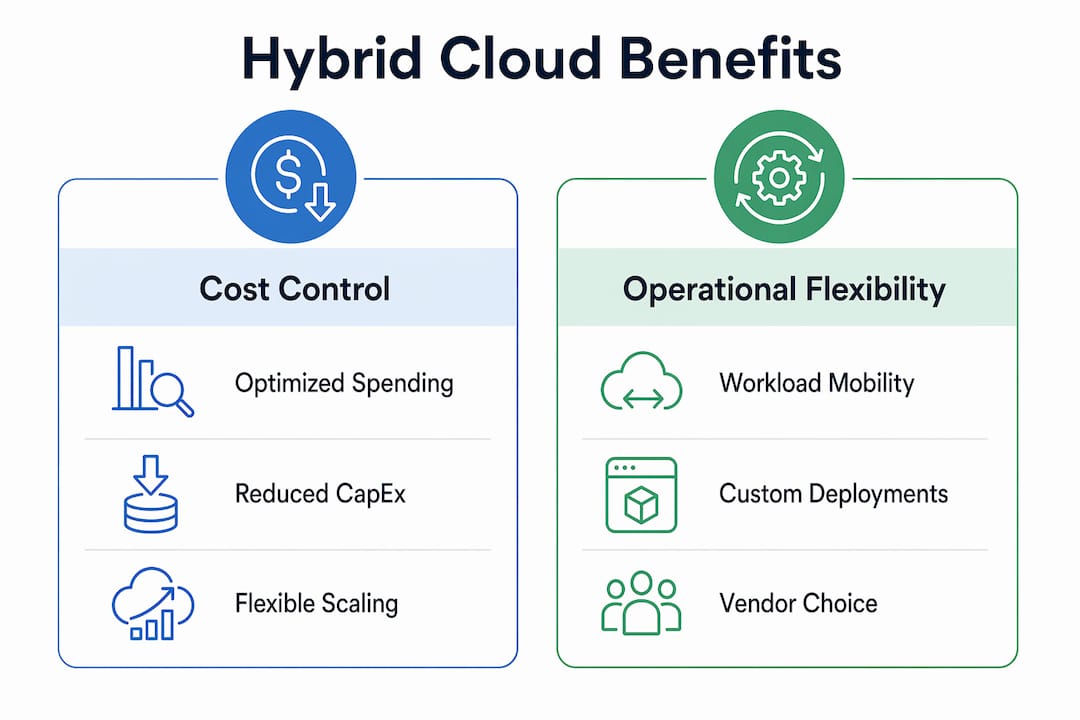
Get a free consultationThe business case for hybrid cloud rests on three pillars: cost control, operational flexibility, and compliance. Each is measurable, not theoretical.
50% of organizations that migrated to hybrid cloud reported optimized costs, and 45% increased IT capacity without adding capital expenses. Those numbers reflect a structural advantage: you pay for public cloud resources only when demand requires them, while your private infrastructure handles baseline workloads at predictable cost.
Key operational benefits include:
- Workload placement control. Sensitive financial or health data stays on-premises for regulatory compliance, while compute-intensive analytics jobs burst to AWS or Azure on demand.
- Legacy application support. Applications that cannot be refactored for public cloud continue running on private infrastructure without blocking cloud adoption elsewhere.
- High availability. Public cloud regions provide geographic redundancy for disaster recovery without the capital cost of building a second data center.
- On-demand scalability. Retail and media companies absorb traffic spikes without overprovisioning private hardware year-round.
“Hybrid cloud lets organizations scale with public cloud innovation while keeping sensitive data on-premises for compliance and performance.” This is the pragmatic middle ground that most enterprises actually need, not the theoretical purity of full cloud migration.
Netflix and Uber both leverage mixed private and public cloud infrastructure to dynamically manage workloads at scale. Netflix uses AWS for global content delivery while maintaining tighter control over specific data processing pipelines. Uber’s approach similarly separates latency-sensitive operations from scalable batch processing. These are not edge cases. They are the operational model that high-growth organizations converge on when they face real-world constraints.
The cloud cost optimization guide for CIOs covers how hybrid placement decisions directly affect unit economics, particularly for organizations running mixed workloads across AWS and on-premises infrastructure.
How does hybrid cloud differ from multi-cloud and full cloud?
These three terms describe fundamentally different operating models, and conflating them leads to poor architectural decisions.
Hybrid cloud requires orchestration between private and public platforms. The defining characteristic is integration: data and applications move between environments through managed connections, shared identity systems, and unified monitoring. Multi-cloud, by contrast, involves running workloads across multiple public clouds without deep integration between them. A company using AWS for compute and Google Cloud for machine learning, with no shared data plane, is running multi-cloud, not hybrid.
| Model | Private infra | Integration depth | Primary driver |
|---|---|---|---|
| Hybrid cloud | Yes | High (orchestrated) | Compliance, legacy, cost |
| Multi-cloud | No | Low (siloed) | Vendor redundancy, best-of-breed |
| Full cloud | No | N/A | Simplicity, speed |
Full cloud migration moves all workloads to a single public cloud provider. It maximizes simplicity and developer velocity but eliminates the control that regulated industries require. For a fintech company under PCI DSS, or a healthcare organization under HIPAA, full cloud migration is often not a viable option without significant architectural investment in the public cloud’s compliance controls.
Pro Tip: Multi-cloud is often the result of organizational politics rather than technical planning. Teams adopt different clouds independently, and integration is bolted on later. Hybrid cloud, done correctly, starts with integration as a first-class design requirement.
The practical implication for IT leaders: if your primary concern is vendor redundancy across public providers, multi-cloud is the right frame. If your concern is controlling where specific data lives while still accessing public cloud scale, hybrid is the correct model. Mixing up these definitions leads to architecture reviews that solve the wrong problem.
How to deploy hybrid cloud environments effectively
Deployment quality determines whether your hybrid cloud delivers on its promise or becomes an expensive management burden. Five practices separate successful deployments from troubled ones.
1. Use Kubernetes for workload portability
Container orchestration via Kubernetes is the primary abstraction layer that makes hybrid portability practical. AWS EKS, Azure AKS, and on-premises Kubernetes clusters share a common API surface, so workloads defined as Kubernetes manifests run consistently across environments. Without containerization, moving a workload between private and public infrastructure requires significant re-engineering.
2. Invest in dedicated network connections
High-performance dedicated connections like AWS Direct Connect and Azure ExpressRoute are necessary for SLA compliance in hybrid environments. Public internet connections introduce latency variability and security exposure that make them unsuitable for production data flows between private and public cloud. Budget for dedicated connectivity from day one, not as an afterthought.
3. Implement unified orchestration and automation
Managing two environments with separate toolchains doubles your operational overhead. Platforms like HashiCorp Terraform, Ansible, and AWS Systems Manager provide infrastructure-as-code capabilities that span private and public environments. A single pipeline that provisions resources in both environments reduces configuration drift and makes compliance audits tractable.
4. Use service meshes to avoid vendor lock-in
Service meshes are effective for connecting distributed hybrid cloud services without creating hard dependencies on a single vendor’s networking stack. Istio and Linkerd both operate across Kubernetes clusters regardless of where those clusters run. This preserves your ability to shift workloads between providers as pricing, performance, or compliance requirements change.
5. Address security and compliance from the architecture stage
Key security considerations for hybrid deployments:
- Federate identity across environments using a single identity provider such as AWS IAM Identity Center or Azure Active Directory.
- Encrypt data in transit between private and public environments, not just at rest.
- Apply consistent security group and network policy rules across both environments using infrastructure-as-code.
- Define data residency requirements before workload placement, not after.
Data Fabric provides a unified data management layer that maintains consistency as workloads move between clouds. NetApp’s approach to Data Fabric specifically addresses the challenge of ensuring data portability without sacrificing governance, which is a critical requirement for organizations under SOC 2 or HIPAA.
Key takeaways
Hybrid cloud succeeds when integration, orchestration, and workload placement are treated as first-class architectural requirements from day one, not retrofitted after deployment.
| Point | Details |
|---|---|
| Architecture model matters | Choose homogeneous for simplicity or heterogeneous for flexibility, knowing the complexity trade-off upfront. |
| Cost and capacity gains are measurable | 50% of hybrid adopters optimized costs; 45% grew IT capacity without capital expenditure increases. |
| Hybrid is not multi-cloud | Hybrid requires deep integration between private and public; multi-cloud runs siloed public workloads. |
| Kubernetes is the portability layer | EKS, AKS, and on-premises Kubernetes clusters share an API surface that makes workload movement practical. |
| Security must be designed in | Identity federation, dedicated connections, and data residency decisions belong in the architecture phase. |
Why hybrid cloud is harder than vendors make it look
I have worked on hybrid cloud deployments across fintech, retail, and enterprise clients since before “hybrid cloud” was a standard term. The honest observation is this: the technology works, but the organizational and operational complexity is consistently underestimated.
Vendors like AWS and Azure have done an excellent job making the on-ramp look smooth. AWS Outposts ships as a rack, plugs into your data center, and extends the AWS control plane on-premises. That part genuinely works. What vendors do not advertise is the ongoing cost of keeping two environments synchronized. Drift happens. A security policy updated in your AWS account does not automatically propagate to your on-premises Kubernetes cluster. A network change in your data center can silently break connectivity to your public cloud VPC. These are not edge cases. They are the daily operational reality of hybrid environments.
The organizations I have seen succeed with hybrid cloud share one characteristic: they treat it as a product, not a project. They assign ownership, build runbooks, and invest in observability tooling like Datadog or Dynatrace that spans both environments. The organizations that struggle treat hybrid cloud as a one-time migration event and then wonder why operational costs keep climbing.
My recommendation for IT leaders evaluating hybrid cloud in 2026: start with a homogeneous architecture if you have any choice in the matter. The reduction in orchestration complexity pays dividends for years. And invest in Kubernetes expertise early. It is the one technology that genuinely abstracts the difference between private and public infrastructure, and it will be the foundation of hybrid deployments for the foreseeable future.
— Oleksandr
How IT-Magic helps you build and operate hybrid cloud
IT-Magic has delivered 700+ cloud infrastructure projects since 2010, including hybrid deployments for fintech and enterprise clients running mixed AWS and on-premises environments.
For organizations adopting Kubernetes as their hybrid portability layer, IT-Magic’s Kubernetes support services cover cluster architecture, EKS and ECS deployment, and ongoing operations across private and public environments. For teams focused on controlling hybrid cloud spend, our AWS cost optimization services identify placement inefficiencies and right-sizing opportunities across your full infrastructure footprint. Both services are delivered by certified AWS engineers who specialize in infrastructure, not software development. Contact IT-Magic to discuss your hybrid cloud architecture.
FAQ
What is a hybrid cloud in simple terms?
A hybrid cloud is an IT environment that connects private on-premises infrastructure with a public cloud provider, allowing workloads and data to move between them. The key requirement is integration: the two environments must be orchestrated, not simply coexisting.
What are the main benefits of hybrid cloud?
The primary benefits are cost optimization, scalability, and compliance flexibility. Organizations can run sensitive workloads on-premises while bursting to public cloud for variable demand, and 50% report cost optimization after adopting hybrid cloud.
How does hybrid cloud differ from multi-cloud?
Hybrid cloud integrates private and public infrastructure through orchestration and shared data planes. Multi-cloud runs workloads across multiple public cloud providers without deep integration between them. The distinction matters because the tooling, governance, and operational models are fundamentally different.
What is the role of Kubernetes in hybrid cloud?
Kubernetes provides a consistent API surface across on-premises and public cloud clusters, making it the primary tool for workload portability in hybrid environments. AWS EKS, Azure AKS, and self-managed clusters all accept the same manifest definitions.
Is hybrid cloud right for regulated industries?
Hybrid cloud is particularly well-suited for regulated industries like fintech and healthcare. It allows organizations to keep sensitive data on-premises for PCI DSS or HIPAA compliance while using public cloud resources for non-regulated workloads and disaster recovery.
Recommended
- Multi-Cloud Strategy for IT Leaders: 2026 Guide
- Cloud Infrastructure Explained: Scale, Secure, Optimize AWS
- Cloud Architecture Planning Guide for IT Leaders
- Cloud Migration Strategies: Everything You Need to Know | IT-Magic
Alexander founded IT-Magic, an AWS Advanced Tier Services Partner delivering DevOps, cloud architecture, and managed services since 2010. He holds:
- AWS Certified Solutions Architect – Professional
- AWS Certified DevOps Engineer – Professional
- AWS Certified Security – Specialty
- AWS Certified Advanced Networking – Specialty
Talk to a certified AWS team trusted by INTERTOP, Foxtrot, Pandora, and J.Hilburn.
Get a free consultation