

TL;DR:
- A multi-cloud strategy involves intentionally distributing workloads across multiple public cloud providers to leverage their unique strengths and reduce dependency on any single vendor.
- While offering benefits like flexibility, resilience, and compliance, it introduces significant operational costs, complexity, and egress fees that require deliberate planning and governance.
A multi-cloud strategy is the deliberate distribution of workloads and data across two or more public cloud providers to leverage their unique strengths and reduce dependency on any single vendor. AWS, Microsoft Azure, and Google Cloud Platform (GCP) are the three dominant providers most organizations combine. According to Flexera’s 2025 State of the Cloud report, 87% of enterprises report a multi-cloud strategy, though most operate with one primary and one secondary provider rather than true parity across platforms. The core purpose is not to use every cloud available. It is to place each workload where it performs best, costs least, or meets a specific compliance requirement.
What is multi-cloud strategy and why does it matter?
A multi-cloud strategy, as the industry defines it, is the intentional use of multiple public cloud platforms within a single architecture. This is distinct from accidental multi-cloud, which happens when teams adopt different clouds independently without a governing plan. The difference matters because unplanned multi-cloud generates cost and complexity without the corresponding benefits.

Organizations adopt this model for four concrete reasons: flexibility to select best-fit services per workload, risk mitigation against provider outages or pricing changes, compliance with data residency laws that require data to stay within specific geographic or jurisdictional boundaries, and access to specialized capabilities. For example, a financial services firm might run its core transaction processing on AWS while using Azure OpenAI Service for its fraud detection models and GCP BigQuery for analytics. Each placement is deliberate, not default.
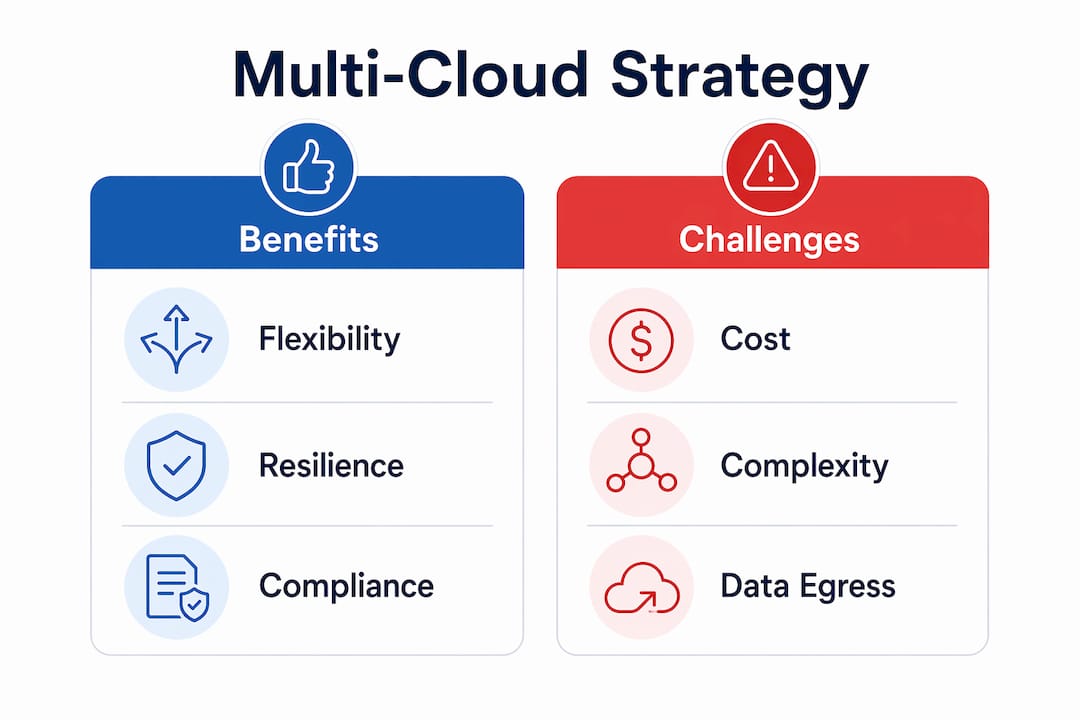
Multi-cloud strategies allow organizations to combine best-of-breed cloud services to better support business goals and legacy constraints. That flexibility is the real value proposition, not simply avoiding lock-in.
What benefits do multi-cloud strategies offer to organizations?
Running this on your own AWS setup? IT-Magic is an AWS Advanced Tier Partner — we audit, fix, or fully manage it for you.
Get a free consultationThe advantages of a multi-cloud approach are real, but they require deliberate architecture to materialize. Here are the primary benefits IT leaders cite:
- Vendor independence. Distributing workloads across AWS, Azure, and GCP reduces negotiating leverage any single provider holds over your contracts and pricing.
- Resilience through redundancy. Cross-cloud failover means a regional outage at one provider does not take down your entire production environment.
- Cost arbitrage. Compute and storage pricing varies meaningfully across providers. Running batch workloads on GCP Spot VMs while keeping stateful services on AWS can reduce total cloud spend.
- Regulatory compliance. Some jurisdictions require data to remain within national borders. Multi-cloud lets you place data on whichever provider has a compliant region without redesigning your entire architecture.
- Access to specialized services. Azure Cognitive Services, GCP’s Vertex AI, and AWS SageMaker each have distinct strengths. Multi-cloud lets your teams use the right tool for each AI or analytics use case.
“The real value of multi-cloud lies in flexibility and control to shape organizational cloud roadmaps, not just avoiding lock-in.” — The case for a multi-cloud world
Unified identity and cost visibility across clouds are prerequisites for capturing these benefits. Tools like Okta, Microsoft Entra ID, CloudHealth, and Kubecost provide centralized governance across providers. Without them, the operational picture fragments quickly and the cost savings evaporate.
What are the main challenges and trade-offs involved?
Multi-cloud is not free complexity. Every benefit comes with a corresponding cost, and IT leaders who underestimate this end up with architectures that are harder to operate and more expensive than a well-designed single-cloud setup.
The most significant trade-offs, ranked by impact:
- Operational overhead. Organizations using multi-cloud spend 45% more time on cloud management compared to single-cloud setups. That is not a rounding error. It translates directly into headcount, tooling costs, and slower incident response.
- Cost of resilience. Multi-cloud architectures targeting 99.99% availability cost 2.5x to 3x more than single-cloud multi-region implementations with comparable SLAs. The redundancy you gain comes at a steep price.
- Data egress fees. Moving data between cloud providers costs between $0.085 and $0.09 per GB. At 5 TB per day, that is $13,500 to $15,000 monthly in transfer costs alone, before any compute or storage charges.
- Security consistency. Each provider has its own IAM model, network security primitives, and compliance tooling. Maintaining consistent security policies across AWS, Azure, and GCP requires dedicated engineering effort and a unified policy layer.
- Skill requirements. Multi-cloud architects earn 25 to 35% more than single-cloud specialists because true multi-cloud depth requires expertise in abstraction layers, cross-cutting concerns, and provider-specific internals simultaneously.
Pro Tip: Before committing to multi-cloud, calculate your projected egress costs based on actual data flow between providers. Many teams discover that data gravity alone makes certain workload placements economically unviable.
Building a cloud-agnostic platform to abstract away provider differences increases operational overhead by about 40% due to lowest-common-denominator constraints. You lose the native features that make each cloud valuable in the first place.
Multi-cloud vs. single-cloud vs. hybrid cloud: which fits your needs?
These three cloud deployment models solve different problems. Conflating them leads to poor architecture decisions.
| Model | Definition | Best fit | Key trade-off |
|---|---|---|---|
| Single-cloud | All workloads on one provider, multiple regions | Most SaaS and mid-market enterprises | Vendor dependency, but lower complexity |
| Multi-cloud | Workloads distributed across two or more public clouds | Enterprises with regulatory, M&A, or best-of-breed requirements | Higher cost and operational overhead |
| Hybrid cloud | Mix of public cloud and private infrastructure (on-premises or colocation) | Regulated industries, legacy systems, data sovereignty | Integration complexity between environments |
The most important distinction is between multi-cloud and hybrid cloud. Multi-cloud means multiple public clouds. Hybrid cloud means a combination of public cloud and private infrastructure. A bank running AWS for its customer-facing applications and an on-premises data center for core banking systems is hybrid, not multi-cloud.
Single-cloud with cross-region failover often delivers similar availability at significantly lower cost and complexity than multi-cloud for most workloads. This is the recommendation for mid-market SaaS companies that have not yet hit the specific triggers that justify multi-cloud.
Pro Tip: If your primary driver for multi-cloud is vendor lock-in fear, consider portable abstractions like Kubernetes and Terraform first. You can achieve meaningful portability without the full operational cost of running two production clouds simultaneously.
Multi-cloud genuinely outperforms single-cloud in three scenarios: when a merger or acquisition brings incompatible cloud environments together, when a specific regulatory requirement mandates geographic separation across providers, and when a workload requires a proprietary service that only one provider offers at the required scale.
What decision framework should guide multi-cloud adoption?
Multi-cloud is not a strategy by itself but a way to address specific concerns like risk management or cost optimization. That framing should anchor every adoption decision. Start with the problem, not the architecture.
A practical scoring approach evaluates five decision factors before committing to multi-cloud:
- Regulatory requirements: Does any jurisdiction mandate data placement on a specific provider or region?
- Workload fit: Does a specific workload require a proprietary service only available on one provider?
- Team expertise: Does your engineering team have the depth to operate two or more clouds in production?
- Cost modeling: Have you calculated total cost of ownership including egress, tooling, and staffing?
- Negotiation leverage: Is your spend large enough that multi-cloud credibly improves your contract position?
If you score high on two or more of these factors, targeted multi-cloud is worth evaluating. If you score high on four or five, strategic multi-cloud is likely justified. If you score high on one or zero, a well-architected single-cloud deployment with multi-region failover is almost certainly the better path.
The most common trap is premature adoption. Fear-driven multi-cloud adoption is a costly mistake for smaller teams that lack the operational maturity to manage the added complexity. A 50-person engineering organization running two production clouds will spend a disproportionate share of its capacity on infrastructure operations rather than product development.
Acquisitions and compliance mandates are the two most legitimate drivers of multi-cloud in practice. When a company acquires a business running on Azure and the acquiring company runs on AWS, multi-cloud is not a choice. It is a reality that requires a governance strategy. Similarly, when a GDPR or HIPAA requirement mandates specific data handling that only one provider supports in a given region, multi-cloud becomes a compliance necessity rather than an architectural preference.
Key takeaways
A multi-cloud strategy delivers real benefits in flexibility, resilience, and compliance, but only when adopted for specific, measurable reasons rather than as a default architecture.
| Point | Details |
|---|---|
| Multi-cloud definition | The deliberate use of two or more public clouds to place workloads where they perform best. |
| Adoption is widespread but shallow | 87% of enterprises report multi-cloud, but most rely on one primary provider with a secondary. |
| Complexity has a price | Multi-cloud teams spend 45% more time on management and pay 2.5x to 3x more for equivalent resilience. |
| Egress costs are real | Transferring 5 TB per day between clouds costs $13,500 to $15,000 monthly in egress fees alone. |
| Use a decision framework | Evaluate regulatory, workload, expertise, cost, and leverage factors before committing to multi-cloud. |
Why most teams get multi-cloud backwards
After working with over 300 clients on cloud infrastructure since 2010, I have watched the same pattern repeat: a leadership team reads about multi-cloud adoption rates, decides the organization needs a multi-cloud strategy, and tasks the engineering team with building one. The result is almost always a fragmented architecture that costs more, breaks more, and delivers less than a focused single-cloud setup would have.
The teams that get multi-cloud right start from a specific constraint, not a trend. A fintech client of ours adopted Azure for Microsoft 365 integration and compliance tooling while keeping their core AWS infrastructure intact. That was not a strategic multi-cloud initiative. It was a practical response to a real requirement. The architecture followed the business need, not the other way around.
The other mistake I see consistently is treating cloud-agnostic tooling as a free option. Replacing managed services like AWS RDS or GCP Cloud SQL with self-managed PostgreSQL on Kubernetes to avoid lock-in sounds reasonable until you account for the operational burden. You trade a managed service SLA for a self-managed system that your team now owns end to end. For most organizations, that trade is not worth it.
My honest recommendation: build excellence on your primary cloud first. Use cloud migration strategies to consolidate and optimize before you expand. Add a second provider only when a specific workload, regulation, or acquisition makes it unavoidable. Then govern it deliberately with unified identity, centralized cost visibility, and a clear owner for cross-cloud operations.
— Oleksandr
How IT-Magic helps you implement multi-cloud without the overhead
Managing multi-cloud complexity requires more than good intentions. It requires the right tooling, the right architecture, and a team that has done it before. IT-Magic has delivered 700+ cloud infrastructure projects since 2010, including multi-cloud environments where Kubernetes serves as the portability layer across AWS EKS and other providers. Our Kubernetes support services cover cluster design, operations, security hardening, and cost optimization across cloud environments. For organizations looking at the cost side of multi-cloud, our work with INTERTOP demonstrates what disciplined AWS infrastructure scaling can deliver in real cost reduction. If you are evaluating whether multi-cloud is the right move for your organization, or you are already running multiple clouds and need to bring order to the complexity, IT-Magic’s certified AWS architects can help you build a governance model that actually works.
FAQ
What is the difference between multi-cloud and hybrid cloud?
Multi-cloud uses two or more public cloud providers such as AWS, Azure, or GCP. Hybrid cloud combines a public cloud with private infrastructure, such as an on-premises data center or colocation facility.
Why do most enterprises adopt a multi-cloud strategy?
The primary drivers are vendor independence, regulatory compliance requiring specific data placement, access to specialized services on different providers, and resilience through cross-cloud redundancy. Mergers and acquisitions also force multi-cloud environments when acquired companies run on different platforms.
Is multi-cloud more expensive than single-cloud?
Multi-cloud architectures targeting 99.99% availability cost 2.5x to 3x more than equivalent single-cloud multi-region setups. Data egress fees between providers add further costs, reaching $13,500 to $15,000 monthly at 5 TB per day of cross-cloud data transfer.
When should an organization avoid multi-cloud?
Organizations with small engineering teams, limited cloud budgets, or no specific regulatory or workload driver should avoid multi-cloud. Single-cloud with multi-region failover delivers comparable availability at significantly lower cost and operational complexity for most mid-market workloads.
What tools support multi-cloud governance?
Okta and Microsoft Entra ID provide unified identity management across providers. CloudHealth and Kubecost deliver centralized cost visibility. Terraform and Kubernetes serve as infrastructure and workload portability layers across AWS, Azure, and GCP environments.
Recommended
- Network Security Strategies for Cloud Environments in 2026
- What Is Cloud Risk Management: A 2026 Guide for Leaders
- AWS cloud security: 7 essential strategies for 2026
- Cloud Architecture Planning Guide for IT Leaders
Alexander founded IT-Magic, an AWS Advanced Tier Services Partner delivering DevOps, cloud architecture, and managed services since 2010. He holds:
- AWS Certified Solutions Architect – Professional
- AWS Certified DevOps Engineer – Professional
- AWS Certified Security – Specialty
- AWS Certified Advanced Networking – Specialty
Talk to a certified AWS team trusted by INTERTOP, Foxtrot, Pandora, and J.Hilburn.
Get a free consultation