

TL;DR:
- Cloud cost savings are often offset by organizational misalignment and resource waste.
- Combining AWS best practices with FinOps frameworks promotes proactive cost management.
- Visibility through tagging and continuous governance is essential for sustainable cloud cost control.
Cloud migration promises savings, but the bill often tells a different story. Many organizations discover that moving workloads to AWS actually increases spend when governance lags behind growth. The assumption that cloud equals cheaper is one of the most expensive myths in IT. Organizations waste 32% of cloud spend on average, according to FinOps research, and that number climbs fast in fintech and enterprise environments with complex multi-account architectures. This guide gives you a structured, actionable path to cloud cost optimization, built on AWS best practices and real FinOps principles, so you can stop reacting to invoices and start controlling them.
Key Takeaways
| Point | Details |
|---|---|
| Cloud spend waste is common | Up to 32% of cloud budgets are wasted each year without proactive management. |
| Frameworks enable action | Combining AWS and FinOps frameworks delivers structure for sustained cost savings. |
| Visibility is the foundation | Effective tagging and cost allocation are the first critical steps toward optimization. |
| Fastest savings areas | Right-sizing, Spot Instances, and commitment plans offer the largest, fastest reductions. |
| Culture drives success | Lasting cloud savings require cross-team ownership and a FinOps mindset, not just technology. |
Why cloud costs spiral: structure and incentives
Running this on your own AWS setup? IT-Magic is an AWS Advanced Tier Partner — we audit, fix, or fully manage it for you.
Get a free consultationTraditional IT budgets are relatively transparent. You buy hardware, you depreciate it, you know the cost. Cloud billing works differently. Resources spin up in seconds, charges accumulate across dozens of services, and the monthly invoice arrives long after the decisions that caused it. By then, the damage is done.
The deeper problem is organizational. Engineering teams are typically rewarded for shipping features and maintaining uptime. Nobody gets a bonus for trimming EC2 costs. Finance teams see the bill but lack the technical context to interpret it. The result is a gap where engineers rewarded for uptime, not cost efficiency, make provisioning decisions that are technically sound but financially wasteful.
“When nobody owns the cloud bill, everybody ignores it. Cost accountability has to be designed into your team structure, not bolted on after the fact.”
This misalignment creates a cycle of reactive cleanup. Teams over-provision to avoid incidents, costs balloon, and then a quarterly review triggers a scramble to cut. That scramble often breaks things. Sustainable cost optimization best practices require proactive design, not emergency surgery.
Common patterns that drive cost escalation include:
- Orphaned resources: Snapshots, unattached EBS volumes, and idle load balancers that nobody deleted
- Over-provisioned instances: Teams requesting large instance types “just in case”
- Missing lifecycle policies: S3 buckets growing indefinitely with no tiering or expiration rules
- Shadow spend: Dev and test environments running 24/7 when they only need to run during business hours
The FinOps framework addresses these structural issues by treating cloud cost management as a shared responsibility across engineering, finance, and product teams.
Frameworks for cloud cost optimization: AWS and FinOps
Two frameworks give you the structure to move from reactive to proactive cost management. Used together, they cover both the technical and organizational dimensions of the problem.
The AWS Well-Architected Cost Optimization Pillar organizes best practices into five areas: Cloud Financial Management, Expenditure and Usage Awareness, cost-effective resources, managing demand and supply, and ongoing optimization. It gives your engineering team a technical checklist grounded in AWS architecture.
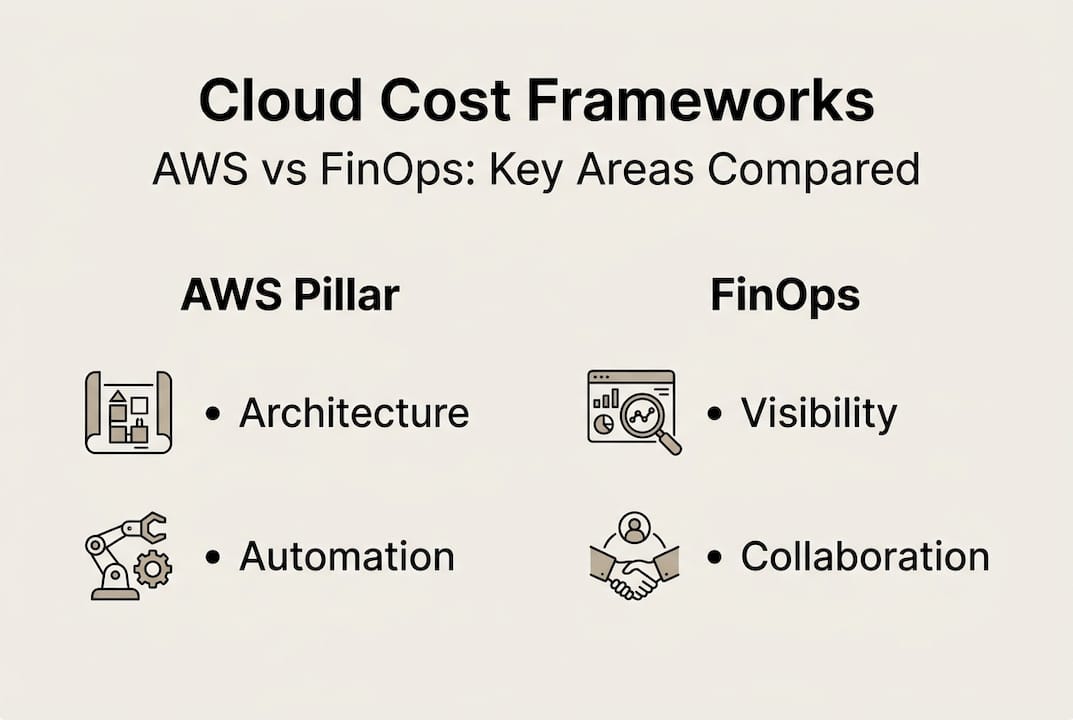
The FinOps Framework operates in three phases: Inform (make costs visible), Optimize (act on what you see), and Operate (build a culture that sustains savings). Its core principle is that everyone takes ownership of their cloud usage.
| Dimension | AWS Well-Architected Pillar | FinOps Framework |
|---|---|---|
| Focus | Technical architecture | People, process, and culture |
| Primary users | Engineering teams | Cross-functional (Eng, Finance, Product) |
| Key actions | Right-sizing, commitments, lifecycle | Tagging, showback, chargeback, governance |
| Cadence | Architecture reviews | Continuous operational cycle |
| Output | Optimized infrastructure | Shared accountability and savings culture |
The financial impact is real. FinOps delivers 20 to 35% savings in year one for most organizations, with some mature programs reaching 70%. A Well-Architected Review is often the fastest way to identify gaps and prioritize actions across both frameworks.
Key benefits of combining both approaches:
- Aligns technical decisions with financial outcomes
- Creates shared language between engineering and finance
- Builds a repeatable process instead of one-time fixes
- Scales naturally as your AWS footprint grows
Essential practices: visibility, tagging, and cost allocation
You cannot optimize what you cannot see. Before you right-size a single instance or purchase a Savings Plan, you need reliable data about where your money is actually going.
Tagging and the AWS Cost and Usage Report (CUR) are the foundation of that visibility. CUR delivers daily, line-item billing data that you can query in Athena or load into a BI tool. Tags let you slice that data by team, environment, product, or cost center. Without both, you are flying blind.
For startups and fintech companies especially, tagging is essential early. Retrofitting a tagging strategy onto a mature AWS environment is painful and time-consuming. Getting it right from the start saves months of cleanup work later.
Here is a recommended tagging implementation sequence:
- Define your taxonomy. Decide which dimensions matter: team, environment (prod/staging/dev), product, cost center, and owner at minimum.
- Implement at the source. Enforce tags via AWS Service Control Policies (SCPs) or tag policies in AWS Organizations so resources cannot be created without required tags.
- Activate cost allocation tags. Enable your tags in the AWS Billing console so they appear in CUR and Cost Explorer.
- Audit regularly. Run weekly reports on tag coverage. Untagged resources are a red flag for orphaned or shadow spend.
Pro Tip: Use AWS Config rules to automatically flag non-compliant resources. Pair this with a Lambda function that notifies resource owners via Slack or email when tags are missing. Automation makes compliance sustainable.
Once tagging is in place, allocate spend to business units. This shifts cost conversations from abstract totals to concrete team-level accountability. Finance and engineering suddenly have a shared view of the numbers, which is where real tagging and cost allocation improvements begin.
Quickest wins: right-sizing, commitments, and Spot Instances
With visibility established, you can act. Three levers deliver the largest and fastest savings in most AWS environments.
Right-sizing is the process of matching instance types and sizes to actual workload requirements. Right-sizing delivers the fastest ROI because underutilized resources are nearly universal. AWS Compute Optimizer analyzes CloudWatch metrics and recommends specific downsizes. In practice, many teams find 30 to 40% of their compute is over-provisioned.

Savings Plans and Reserved Instances reward commitment with significant discounts. Savings Plans save up to 72% compared to On-Demand pricing for predictable workloads. Spot Instances go further, offering up to 90% savings for interruptible workloads like CI/CD pipelines, ML training jobs, and batch processing.
| Optimization lever | Typical savings | Best for | Risk level |
|---|---|---|---|
| Right-sizing | 20 to 40% | All workloads | Low |
| Savings Plans | Up to 72% | Steady-state compute | Low to medium |
| Reserved Instances | Up to 72% | Predictable DB/compute | Medium |
| Spot Instances | Up to 90% | Batch, CI/CD, ML | Medium (interruption) |
Pro Tip: Track your Effective Savings Rate (ESR), which measures actual savings from commitments against your total On-Demand spend. A healthy ESR tells you whether your commitment portfolio is working. If ESR is below 30% and you have predictable workloads, you are leaving money on the table.
Prioritization by company type matters:
- Startups: Focus on tagging first, then Spot Instances savings for dev and test workloads
- Fintech: Balance Spot usage against compliance requirements for workload availability
- Enterprise: Prioritize Savings Plans and multi-account governance before chasing Spot discounts
Governing, scaling, and optimizing for the long term
Quick wins fade without governance. The organizations that sustain cloud savings over years are the ones that operationalize cost management as a continuous process, not a quarterly project.
The FinOps Operate phase requires budgets, anomaly alerts, and governance to maintain savings as your environment scales. Here is how to build that foundation:
- Set account-level and service-level budgets in AWS Budgets with alerts at 80% and 100% of threshold.
- Enable AWS Cost Anomaly Detection to catch unexpected spend spikes automatically. Configure it to alert on both absolute dollar amounts and percentage changes.
- Schedule regular optimization reviews (monthly at minimum) with representatives from engineering, finance, and product.
- Document and enforce policies for resource lifecycle, instance type selection, and commitment purchasing authority.
Sustaining a cost-conscious culture requires more than tooling:
- Assign named owners to cost centers and make spend visible in team dashboards
- Include cloud cost KPIs in engineering team objectives
- Celebrate wins publicly when teams reduce their spend
- Review AWS best practices regularly as new services and pricing models emerge
On governance structure: centralized FinOps teams work well for enterprises that need consistency across many accounts. Decentralized models give business units more autonomy but require stronger guardrails. Most mature organizations use a hybrid, where a central team sets policy and tooling, and individual teams own their execution.
Start with AWS-native tools before adding third-party platforms. Cost Explorer, Compute Optimizer, and Budgets cover most needs at zero additional cost. Expand to platforms like CloudHealth or Apptio only when your complexity justifies the investment. Refer to FinOps principles to guide that maturity progression.
The overlooked reality: why tech culture, not just tools, determines cloud savings
After working with hundreds of AWS environments, we have noticed a consistent pattern. The organizations that struggle most with cloud costs are not the ones with the worst tooling. They are the ones where engineering and finance operate in separate worlds.
You can deploy every AWS-native cost tool available and still watch your bill climb if nobody feels personally accountable for the numbers. Tools surface data. Culture determines whether anyone acts on it. The FinOps principles make this explicit: decisions are made by those closest to the work, and everyone takes ownership.
“The CIOs who win at cloud cost management are not the ones who bought the best FinOps platform. They are the ones who changed how their teams think about spending other people’s money.”
The most effective intervention we have seen is simple: show engineers their team’s monthly AWS bill in a format they understand, and tie it to something they care about. That visibility alone changes behavior faster than any policy. Pair it with how FinOps drives results in practice, and you have a foundation that scales.
Focus on FinOps principles and organizational alignment before chasing vendor features. The culture is the differentiator.
Partner with experts for lasting optimization
Understanding the frameworks is one thing. Applying them to a complex, live AWS environment under real business pressure is another challenge entirely.
At IT-Magic, we have delivered AWS cost optimization services for startups, fintech companies, and enterprise clients since 2010, with 700+ projects completed across 300+ clients. Our certified AWS engineers combine architecture reviews, tagging audits, commitment analysis, and governance design into a structured engagement. We also provide ongoing AWS infrastructure support to ensure savings persist as your environment evolves. If you want a clear picture of where your money is going and a concrete plan to reduce it, a Well-Architected Framework Review is the right starting point.
Frequently asked questions
What is the fastest way to reduce cloud costs?
Right-sizing resources and using Spot Instances deliver the quickest results. Right-sizing and Spot Instances can return savings within days of implementation with minimal architectural risk.
How much can FinOps save my organization in the first year?
Most organizations achieve 20 to 35% savings in year one with a structured FinOps program, and some reach 40 to 70% with a mature approach applied across all accounts.
What tagging strategy works best for startups in the cloud?
Make tagging mandatory at resource creation using SCPs, and audit tag coverage weekly to catch gaps before they become invisible cost centers.
How do I avoid commitment lock-in when optimizing AWS costs?
Analyze at least 90 days of workload data before committing, and favor Savings Plans over Reserved Instances for flexibility. Commitment lock-in risk decreases significantly when you match commitment term to workload predictability.
What tools should I use first for cost optimization in AWS?
Start with Cost Explorer and Compute Optimizer before investing in third-party platforms. Native AWS tools first gives you the data foundation you need before adding complexity with external FinOps solutions.
Alexander founded IT-Magic, an AWS Advanced Tier Services Partner delivering DevOps, cloud architecture, and managed services since 2010. He holds:
- AWS Certified Solutions Architect – Professional
- AWS Certified DevOps Engineer – Professional
- AWS Certified Security – Specialty
- AWS Certified Advanced Networking – Specialty
Talk to a certified AWS team trusted by INTERTOP, Foxtrot, Pandora, and J.Hilburn.
Get a free consultation