


TL;DR:
- DevOps in the cloud is a strategic approach focused on culture, automation, measurement, and sharing.
- Elite AWS teams achieve order-of-magnitude improvements in deployment speed, reliability, and cost savings.
- Success depends on organizational adoption, native tooling, automation, and fostering a blameless, accountable culture.
Most technology leaders assume DevOps is just a fancier word for automation. It is not. AWS Well-Architected DevOps Guidance defines it as a structured approach enabling high-velocity, secure software delivery across your entire cloud organization. The gap between teams that treat DevOps as a tooling checklist and those that treat it as a strategic operating model is enormous, measured in deployment frequency, recovery time, and real dollars saved on AWS. This article breaks down what DevOps actually means in cloud environments, which AWS-native practices deliver the biggest returns, and what pitfalls even experienced teams consistently miss.
Key Takeaways
| Point | Details |
|---|---|
| DevOps drives cloud agility | Embracing DevOps in AWS enables rapid deployments and flexible scaling essential for modern teams. |
| Substantial cost savings | Proper DevOps practices can reduce AWS cloud expenses by up to 72 percent through automation and right-sizing. |
| Culture trumps tools | Successful DevOps depends as much on organizational culture and leadership as on tool selection. |
| Avoid common pitfalls | Understanding edge cases in serverless, automation, and multi-cloud can protect your cloud investment. |
What DevOps means for cloud environments
Running this on your own AWS setup? IT-Magic is an AWS Advanced Tier Partner — we audit, fix, or fully manage it for you.
Get a free consultationDevOps did not originate in the cloud, but the cloud is where it reaches its full potential. In traditional IT, infrastructure was provisioned manually, releases were batched into quarterly cycles, and security was bolted on at the end. Cloud environments flip that model entirely. Resources are programmable, deployments can happen dozens of times a day, and security controls can be embedded directly into the delivery pipeline.
The AWS Well-Architected DevOps guidance structures this transformation around five core sagas: organizational adoption, everything as code, CI/CD pipelines, observability, and automated governance. Each saga builds on the last. You cannot have meaningful observability if your infrastructure is not defined as code. You cannot enforce governance automatically if your pipelines are still partially manual.
At its core, DevOps in cloud rests on four pillars:
- Culture: Shared ownership between development, operations, and security teams
- Automation: Eliminating manual, error-prone steps from provisioning to deployment
- Measurement: Using real data to drive decisions, not intuition
- Sharing: Reusable modules, runbooks, and institutional knowledge across teams
“The organizations that extract the most value from cloud are not the ones with the most tools. They are the ones that have rebuilt how their teams think about ownership, feedback, and failure.”
This distinction matters for CTOs. Buying a CI/CD tool does not make you a DevOps organization. Rebuilding your operating model around continuous feedback and shared accountability does. Pairing that cultural shift with AWS cost optimization practices is where the real financial leverage appears. For a deeper look at DevOps best practices specific to AWS in 2026, the landscape has matured considerably beyond simple pipeline automation.
Key AWS DevOps practices and tools
Elite AWS teams do not just pick tools at random. They map each practice to a specific business problem and choose the right instrument for the job. Here is how the core practices break down:
| Practice | AWS-native tool | Popular alternative |
|---|---|---|
| Infrastructure as Code | CloudFormation, CDK | Terraform |
| CI/CD pipelines | CodePipeline, CodeBuild | Jenkins, GitHub Actions |
| Multi-account management | AWS Organizations | Manual account setup |
| Observability | CloudWatch, X-Ray | Datadog, Grafana |
| Secret management | Secrets Manager | HashiCorp Vault |
According to AWS DevOps best practices, the core methodologies powering high-performing teams in 2026 are Infrastructure as Code, CI/CD, multi-account strategies, observability, and embedded DevSecOps. These are not optional layers. They are the foundation.
Embedding security into your CI/CD pipeline is one of the highest-leverage moves you can make. Here is a practical sequence:
- Add static code analysis (e.g., Checkov or cfn-nag) as the first pipeline stage
- Run automated unit and integration tests in a sandboxed environment
- Enforce IAM least-privilege policies via policy-as-code checks
- Deploy to staging with automated rollback triggers on health check failures
- Promote to production only after all gates pass, with audit logs written automatically
This approach directly supports cost reduction strategies because catching misconfigurations early prevents expensive remediation later. Teams running DevOps for e-commerce workloads especially benefit, since a single misconfigured auto-scaling policy can inflate costs by thousands of dollars overnight.
Pro Tip: If you are building on AWS exclusively, start with AWS CDK rather than Terraform. CDK gives you native type safety, faster iteration cycles, and tighter integration with AWS services. Save Terraform for multi-cloud scenarios where its provider ecosystem genuinely adds value. The Well-Architected DevOps guidance reinforces this: native tooling reduces operational overhead when your footprint is AWS-first.
Business outcomes: Velocity, cost savings, and reliability
The numbers behind elite DevOps performance are not incremental improvements. They are order-of-magnitude differences. DORA research shows elite vs. low performers are separated by 127x faster lead time, 182x more frequent deployments, and an 8x lower change failure rate. These are not theoretical benchmarks. They reflect what real teams achieve when DevOps is implemented with discipline.

| Metric | Elite performer | Low performer |
|---|---|---|
| Deployment frequency | Multiple times/day | Once every 1-6 months |
| Lead time for changes | Less than 1 hour | 1-6 months |
| Change failure rate | 0-15% | 46-60% |
| Recovery time | Less than 1 hour | 1 week to 1 month |
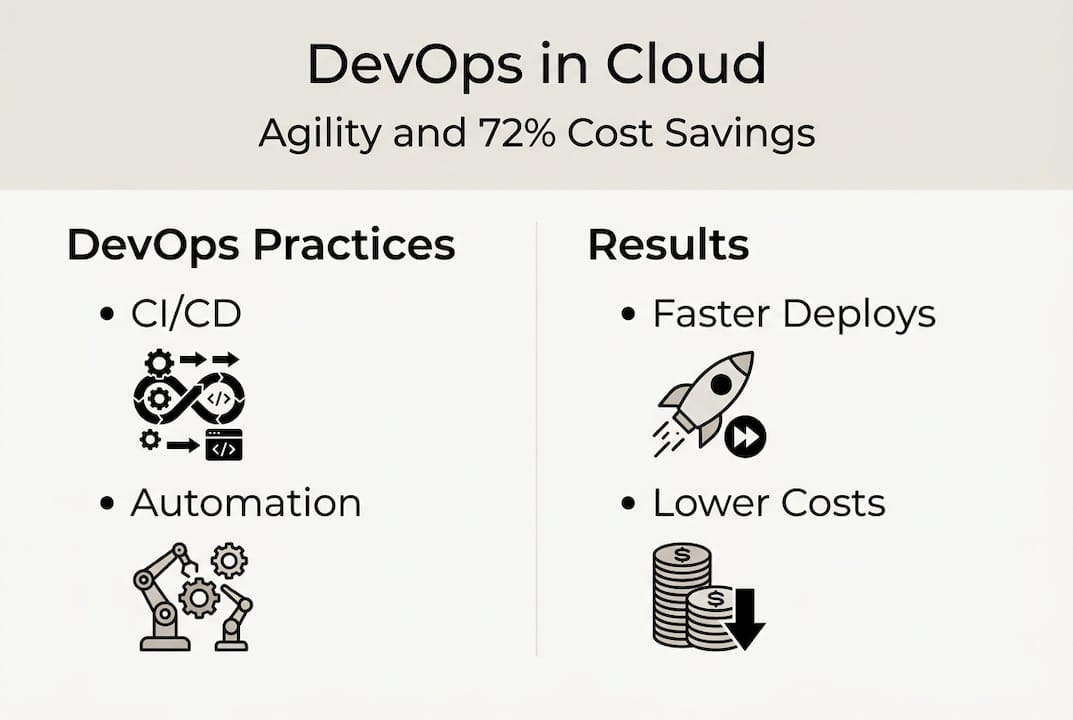
On the financial side, AWS cost optimizations via DevOps practices yield up to 72% reductions in cloud spend. That figure comes from combining automated rightsizing, reserved capacity planning, and eliminating idle resources through infrastructure lifecycle automation.
The business wins stack up quickly:
- Faster product launches: Shorter lead times mean features reach customers in hours, not months
- Stronger uptime: Automated rollbacks and chaos engineering reduce mean time to recovery dramatically
- Lower operational costs: Rightsizing and spot instance strategies, like those covered in EC2 spot instance savings, compound over time
- Happier engineering teams: Automation removes toil, reducing burnout and attrition
- Regulatory confidence: Automated governance makes compliance audits faster and less painful
For CTOs managing board-level conversations about cloud ROI, these numbers matter. Linking DevOps maturity to financial outcomes is easier when you have a structured framework, like the one outlined in cloud cost strategies for CIOs. The AWS cost optimization guide provides a solid starting point for tying infrastructure decisions to measurable savings.
Common pitfalls and nuanced best practices
Most DevOps failures are not caused by choosing the wrong tool. They are caused by underestimating the operational complexity that emerges at scale. Here are the traps that catch even experienced teams:
- IaC drift: Infrastructure defined in code diverges from what is actually running when teams make manual changes in the console. Enforce a policy of zero manual changes in production and run drift detection on a schedule.
- Serverless cold starts: Lambda functions handling latency-sensitive workloads can suffer from cold start delays that degrade user experience. Hybrid serverless and container architectures often perform better than pure serverless for these cases.
- Manual steps in CI/CD: A single manual approval gate that is not documented or monitored becomes a bottleneck and a security risk. Automate or formally gate every step.
- Over-provisioned Kubernetes clusters: Teams running EKS often provision nodes for peak load and never scale down. Cluster autoscaler and Karpenter solve this, but only if configured correctly from the start.
- Multi-cloud complexity: Multi-cloud skepticism is well-founded. Unless you have a specific regulatory or vendor risk reason, running workloads across AWS and another provider doubles your operational surface area without proportional benefit.
AWS DevOps best practices are clear: prefer AWS-native tooling for single-cloud environments, use hybrid serverless and container patterns for flexibility, and treat automation as a baseline requirement, not a nice-to-have. Teams navigating AWS migration challenges often discover these pitfalls mid-migration, which is the worst time to course-correct.
Pro Tip: Set up baseline automation before you write a single line of application code on a new AWS environment. That means automated account vending, guardrails via Service Control Policies, and a working CI/CD skeleton. Everything else builds on this foundation.
Why DevOps success is more about culture than tools
Here is the uncomfortable truth we have seen across hundreds of AWS projects: organizations that invest heavily in tooling but neglect culture consistently underperform compared to teams with modest tooling and strong shared ownership.
DORA data is unambiguous. Elite performance correlates with healthy culture, psychological safety, and leadership sponsorship, not with which CI/CD platform you chose. AWS guidance reinforces this by making organizational adoption the first saga in its DevOps framework, not the last.
The biggest missed opportunity we see is not technical. It is the CTO who approves a DevOps toolchain budget but does not restructure team incentives, on-call ownership, or post-incident review culture. Tools without accountability produce dashboards nobody acts on. The teams that win are the ones where a failed deployment triggers a blameless retrospective, not a blame session. That shift, more than any platform decision, is what separates elite performers from the rest. Explore how IT-Magic approaches this organizational dimension alongside technical delivery.
How IT-Magic can support your AWS DevOps journey
Putting these practices into production requires more than reading a framework. It requires experienced hands who have navigated the edge cases, the organizational friction, and the cost traps that come with real AWS environments at scale.
IT-Magic is an AWS Advanced Tier Services Partner with 700+ projects delivered since 2010. We specialize in AWS DevOps services including CI/CD pipeline design, IaC implementation, and DevSecOps integration. Our team also covers AWS infrastructure support for ongoing operations and resilience, and dedicated AWS cost optimization services to ensure your cloud spend is always working as hard as your team. Whether you are a fintech startup or an enterprise scaling globally, we act as your dedicated cloud and DevOps partner, not a software vendor.
Frequently asked questions
What is the main benefit of using DevOps in the cloud?
The main benefit is faster, more reliable software delivery combined with significantly lower infrastructure costs. DevOps practices yield up to 72% AWS cost reductions and 127x faster lead times compared to low-performing teams.
Which AWS tools are most important for DevOps?
The core stack includes CloudFormation or CDK for infrastructure as code, CodePipeline for CI/CD, and AWS Organizations for multi-account governance. These methodologies form the foundation of every high-performing AWS DevOps environment.
How do elite DevOps teams compare to average teams?
Elite teams deploy far more frequently, recover from failures in under an hour, and maintain much lower change failure rates. DORA research shows a 182x deployment frequency gap and 8x lower failure rate between elite and low performers.
What pitfalls should I avoid with DevOps on AWS?
The most common traps are IaC drift from manual console changes, serverless cold starts in latency-sensitive workloads, and multi-cloud complexity that adds overhead without clear benefit. Hybrid architectures and strict automation baselines help avoid most of these issues.
Alexander founded IT-Magic, an AWS Advanced Tier Services Partner delivering DevOps, cloud architecture, and managed services since 2010. He holds:
- AWS Certified Solutions Architect – Professional
- AWS Certified DevOps Engineer – Professional
- AWS Certified Security – Specialty
- AWS Certified Advanced Networking – Specialty
Talk to a certified AWS team trusted by INTERTOP, Foxtrot, Pandora, and J.Hilburn.
Get a free consultation