

TL;DR:
- The AWS Well-Architected Framework provides best practices to build secure, reliable, and cost-effective cloud systems.
- Regular, incremental reviews focusing on the six pillars foster continuous improvement and prevent costly mistakes.
- Automating security, scaling, and recovery processes ensures sustainable, high-performing AWS environments.
Running workloads on AWS without a structured approach is like building a skyscraper without blueprints. Companies move fast, spin up services, and then face surprise cost spikes, security gaps, or unexplained downtime. The AWS Well-Architected Framework is a set of best practices, design principles, and questions organized into six pillars for building secure, high-performing, resilient, efficient, and sustainable systems on AWS. This guide breaks down every pillar, the core design principles, and the practical steps you need to implement the framework and stop leaving reliability, security, and cost savings on the table.
Key Takeaways
| Point | Details |
|---|---|
| Framework overview | The AWS Well-Architected Framework provides proven guidance for building secure, reliable, efficient, and sustainable cloud systems. |
| Six foundational pillars | Adopting all six pillars ensures your AWS workloads are robust, cost-effective, and environmentally responsible. |
| Practical steps | Regular reviews and incremental improvements drive the greatest long-term gains with the framework. |
| Common pitfalls | Most failures stem from ignoring Security or Cost Optimization pillars and skipping continuous assessments. |
What is the AWS Well-Architected Framework?
Running this on your own AWS setup? IT-Magic is an AWS Advanced Tier Partner — we audit, fix, or fully manage it for you.
Get a free consultationAt its core, the AWS Well-Architected Framework is a structured knowledge base built by AWS architects who spent years watching organizations make the same costly mistakes. AWS developed it to give teams a repeatable, evidence-based way to evaluate their cloud workloads and align architecture decisions with actual business outcomes.
The framework’s best practices cover building secure, efficient, reliable, and sustainable systems on AWS, and they apply equally to a ten-person startup and a Fortune 500 enterprise. Whether you are running a single microservice or a multi-region platform, the framework gives you a consistent lens for evaluation.
The framework is built around three core components:
- Design principles: High-level rules that shape how you architect systems (for example, stop guessing capacity and instead scale dynamically).
- Best practices: Specific, actionable guidance tied to each pillar, such as encrypting data at rest or using managed services to reduce operational burden.
- Pillar questions: Structured questions that help teams self-assess their workloads and identify gaps before they become incidents.
Here is a quick overview of the framework’s structure:
| Component | Purpose | Example |
|---|---|---|
| Design principles | Set architectural direction | Scale dynamically, not manually |
| Best practices | Actionable guidance per pillar | Automate patching, enable MFA |
| Pillar questions | Self-assessment prompts | How do you manage service limits? |
| Lenses | Domain-specific extensions | Serverless, HPC, SaaS |
For industries with complex compliance requirements, like AWS for retail or fintech, the framework’s structured approach is especially valuable because it maps architecture decisions directly to risk management.
Pro Tip: Many teams treat the framework as a one-time compliance audit. It is not. Think of it as a continuous improvement engine. The most mature teams revisit it quarterly, tracking progress across pillars rather than checking boxes once and moving on. Teams using e-commerce cloud strategies built on this framework consistently report fewer incidents and lower infrastructure costs over time.
The six pillars: Foundation of cloud success
Understanding the components, the next step is mastering the six pillars at the core of the framework. Each pillar targets a distinct dimension of cloud quality, and together they create a system that is resilient, secure, and affordable.
The six pillars are Operational Excellence, Security, Reliability, Performance Efficiency, Cost Optimization, and Sustainability. Here is what each one means in practice:
- Operational Excellence: Focuses on running and monitoring systems to deliver business value. A real-world example: automating deployment pipelines so teams can push updates without manual intervention, reducing human error.
- Security: Covers identity management, data protection, and threat detection. Example: enforcing least-privilege IAM policies so a compromised credential cannot escalate to full account access.
- Reliability: Ensures workloads recover from failures automatically. Example: designing multi-AZ architectures so a single data center outage does not take down your application.
- Performance Efficiency: Guides teams to use the right resource types and sizes. Example: switching from over-provisioned EC2 instances to right-sized instances or serverless functions, cutting latency and cost simultaneously.
- Cost Optimization: Eliminates waste and matches spending to actual usage. Explore AWS cost optimization best practices to see how teams routinely cut cloud bills by 20 to 40 percent.
- Sustainability: Minimizes the environmental impact of cloud workloads by improving resource utilization and reducing unnecessary compute.
| Pillar | Core focus | Key IT benefit |
|---|---|---|
| Operational Excellence | Automation and observability | Fewer incidents, faster recovery |
| Security | Identity, data, and threat controls | Reduced breach risk |
| Reliability | Fault tolerance and recovery | Higher uptime |
| Performance Efficiency | Right-sizing and scaling | Lower latency, better UX |
| Cost Optimization | Waste elimination | Predictable, lower spend |
| Sustainability | Resource efficiency | Reduced carbon footprint |
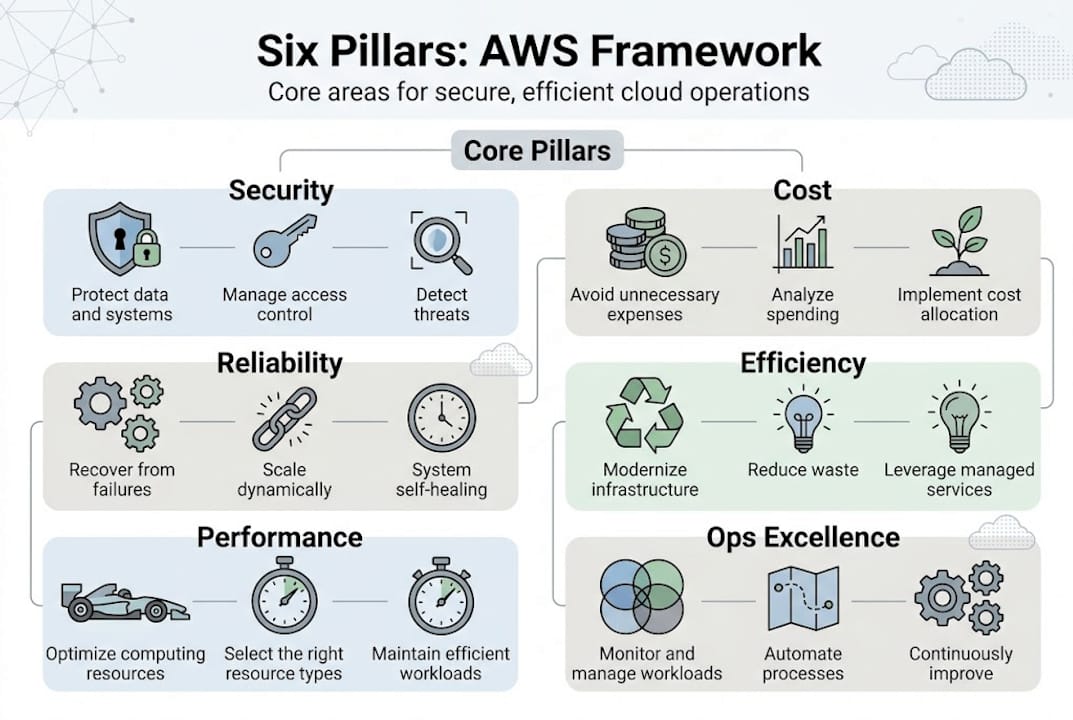
The pillars are not independent. Improving Reliability often requires better Operational Excellence practices like automated runbooks. Cutting costs through right-sizing directly supports Performance Efficiency. Teams that treat the pillars as interconnected rather than siloed get the most value. For practical cloud cost reduction strategies, combining the Cost Optimization and Performance Efficiency pillars is the fastest path to measurable savings.

Design principles and best practices
Now that we know the supporting pillars, let’s see how clear design principles fuel the framework’s practical value.
Design principles are the rules that prevent the most common architectural mistakes. The framework groups them by pillar, but several apply universally. Here are the most impactful ones:
- Stop guessing capacity. Use auto-scaling and load testing to match resources to actual demand instead of over-provisioning for peak loads that rarely happen.
- Test recovery procedures. Do not assume your backup works. Regularly simulate failures using tools like AWS Fault Injection Simulator to confirm your systems actually recover.
- Automate to make experimentation easier. Automation reduces the cost of change, which means teams can iterate faster without fear of breaking things.
- Implement changes incrementally. Small, frequent deployments are easier to roll back than large, infrequent ones. This is the foundation of any mature CI/CD pipeline.
- Use managed services to reduce operational burden. Services like Amazon RDS, EKS, and Lambda offload undifferentiated heavy lifting so your team focuses on business logic.
The framework also includes domain-specific lenses for areas like high performance computing, serverless architectures, and SaaS platforms. These lenses extend the core framework with targeted questions and best practices relevant to your specific workload type.
“The biggest shift we see in mature AWS environments is the move from manual operations to fully automated pipelines. Teams that automate security controls, scaling, and patching spend less time firefighting and more time building features that matter.”
Pro Tip: A disproportionate number of high-profile cloud outages trace back to ignoring just two principles: not testing recovery procedures and deploying large changes infrequently. If your team only adopts two practices from this framework, make them automated testing and incremental deployments.
For organizations in high-transaction environments, AWS for e-commerce implementations show that applying these design principles reduces both incident frequency and mean time to recovery by measurable margins. Working with top AWS partners who have deep framework experience accelerates this process significantly.
Implementing the framework: Steps and common pitfalls
Equipped with those principles and best practices, here is how to apply the framework effectively and avoid missteps.
A Well-Architected Review is the formal process for evaluating a workload against the framework. Here is a practical step-by-step approach:
- Identify the workload scope. Pick a specific workload rather than trying to review your entire AWS environment at once. Start with your most business-critical application.
- Run a self-assessment using the AWS Well-Architected Tool. This free AWS console tool walks you through the pillar-based assessment questions and automatically generates a report of high-risk items.
- Prioritize findings by risk and business impact. Not every finding needs immediate action. Focus first on high-risk Security and Reliability gaps, then address Cost Optimization and Performance issues.
- Build an improvement plan with owners and deadlines. Each finding should have a named owner, a remediation action, and a target date. Without accountability, findings sit unresolved for months.
- Implement changes incrementally. Apply the framework’s own principle here: small changes, tested thoroughly, are safer than a massive refactor.
- Schedule the next review. The framework delivers compounding value when reviews happen regularly, not as a one-off event.
Common pitfalls to avoid:
- Treating the review as a compliance checkbox. Teams that do this miss the continuous improvement value entirely.
- Involving only the infrastructure team. Security, development, and business stakeholders all have context that improves findings quality.
- Ignoring Cost Optimization findings. These often represent the fastest wins. Strategies like cutting AWS costs with spot instances can reduce compute spend by 60 to 90 percent with minimal architectural change.
- Skipping the improvement plan. A review without a documented action plan is just a list of problems.
- Reviewing too infrequently. Cloud environments change fast. A workload that passed review six months ago may have drifted significantly.
Pro Tip: Involve a cross-functional team in every review. Developers know about technical debt, security teams know about threat vectors, and finance teams know about budget constraints. All three perspectives together produce a far more actionable improvement plan than any single team working alone. For teams that want structured support, AWS cost optimization services can accelerate both the review process and the remediation work.
A practical view: What most guides miss about AWS Well-Architected Framework
Most articles about the AWS Well-Architected Framework present it as a destination. Get all six pillars to green, and you are done. That framing is wrong, and it leads organizations to either over-engineer their first review or abandon the process after one cycle.
The framework’s real value is in the rhythm, not the result. Teams that run quarterly reviews and focus on measurable, incremental progress consistently outperform teams that attempt a comprehensive overhaul once a year. The two pillars that deliver the fastest, most tangible returns are Cost Optimization and Security. Start there.
Automation is what makes the framework sustainable. Manual enforcement of best practices degrades over time as teams grow and environments change. When you automate security controls, scaling policies, and compliance checks, the pillars maintain themselves. That is the insight most guides skip entirely.
Our experience across 700+ projects confirms one counterintuitive truth: small, fast iterations almost always outperform big-bang overhauls. Revisiting AWS cost optimization in practice every quarter with a focused scope beats a once-a-year marathon review every time.
Supercharge your AWS cloud with expert support
Ready to put the framework’s principles into action without the learning curve?
At IT-Magic, we have helped 300+ clients across startups, fintech, and enterprise implement the AWS Well-Architected Framework in ways that produce real, measurable results. Our certified AWS experts handle everything from initial workload assessments to full remediation across all six pillars. We specialize in AWS infrastructure support, AWS DevOps services, and AWS cost optimization services so your team gets targeted help exactly where it matters most. Whether you need a one-time Well-Architected Review or an ongoing cloud operations partner, we are ready to help you build a faster, safer, and more cost-efficient AWS environment.
Frequently asked questions
Why should my organization use the AWS Well-Architected Framework?
It ensures your AWS workloads meet proven standards for security, reliability, efficiency, and cost-effectiveness, reducing the risk of costly incidents and wasted spend.
How often should we perform a Well-Architected Review?
Experts recommend conducting reviews quarterly and whenever major workload changes occur, using the pillar-based assessment process to track continuous improvement.
What happens if we ignore one of the pillars?
Neglecting any of the six pillars increases the risk of security incidents, unexpected downtime, or runaway cloud costs in your environment.
What are AWS Well-Architected Lenses?
Lenses extend the framework with domain-specific guidance for areas like serverless computing, analytics, and high performance computing workloads.
Alexander founded IT-Magic, an AWS Advanced Tier Services Partner delivering DevOps, cloud architecture, and managed services since 2010. He holds:
- AWS Certified Solutions Architect – Professional
- AWS Certified DevOps Engineer – Professional
- AWS Certified Security – Specialty
- AWS Certified Advanced Networking – Specialty
Talk to a certified AWS team trusted by INTERTOP, Foxtrot, Pandora, and J.Hilburn.
Get a free consultation