
TL;DR:
- FinOps consulting aligns finance, engineering, and business teams to improve cloud cost accountability and business value. Most engagements begin with a rapid assessment, followed by modeling, governance, and measurement to build a lasting cost discipline. Success depends on cultural shifts, cross-team collaboration, and continuous cycle reinforcement rather than just tools or quick savings.
FinOps consulting is defined as a cross-functional advisory practice that aligns finance, engineering, and business teams around cloud cost accountability and measurable business value. The discipline draws on the FinOps Foundation’s FinOps Framework, which structures cloud financial management into three continuous phases: Inform, Optimize, and Operate. Organizations that engage financial operations consulting do not simply cut cloud spend. They build the governance models, unit economics discipline, and cultural accountability needed to treat cloud cost as a first-class business metric, on par with performance and security.
What does a FinOps consulting engagement involve?
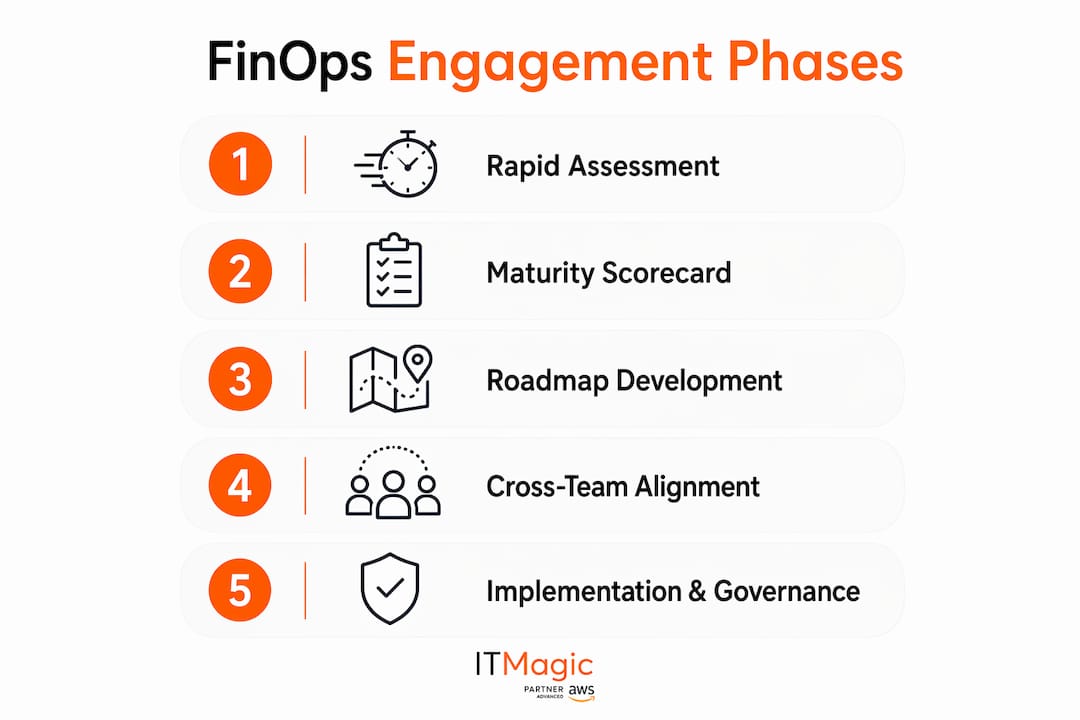
A structured FinOps consulting engagement follows a defined sequence of phases, each with clear deliverables. Most engagements begin with a rapid assessment, then move into modeling, roadmap development, governance design, and ongoing measurement.
Phase breakdown
- Diagnose. Consultants audit your current cloud spend, tagging coverage, allocation accuracy, and team ownership. This phase surfaces waste and identifies where cost data is unreliable.
- Model. The team builds a unit economics model tied to your specific business outcomes. Metrics like cost per active user, cost per API call, or cost per transaction replace generic dashboards.
- Roadmap. A prioritized plan maps quick wins to longer-term governance changes, sequenced to fit your finance and management cycles.
- Govern. Consultants help establish a Cloud Cost Center of Excellence, define ownership roles, and set up tagging policies and allocation frameworks.
- Measure. KPIs are agreed upon with executive sponsors, and reporting cadences are built into existing management reviews.
Many engagements begin with a rapid assessment lasting approximately 3 weeks, delivering maturity benchmarks and executive-ready scorecards. That compressed timeline means finance leaders can see an ROI identification report before committing to a full program.
| Deliverable | Purpose |
|---|---|
| Maturity scorecard | Benchmarks current FinOps capability against industry standards |
| Unit economics model | Ties cloud spend to product margin and business outcomes |
| Executive alignment session | Builds cross-team sponsorship for governance changes |
| Governance framework | Defines ownership, tagging policy, and allocation rules |
| KPI dashboard | Tracks progress against agreed cost and efficiency targets |

Cross-team involvement is non-negotiable. Finance, IT, and product leadership must all participate from the first week. Engagements that exclude any one of these groups consistently stall at the governance phase.
Pro Tip: Ask your consulting partner to deliver the maturity scorecard before the roadmap. A scorecard without a roadmap is just a report. A roadmap without a scorecard is just a wish list.
How do FinOps consultants implement best practices and cultural shifts?
Running this on your own AWS setup? IT-Magic is an AWS Advanced Tier Partner — we audit, fix, or fully manage it for you.
Get a free consultationFinOps is fundamentally a cultural and operational change, not a tooling procurement. This distinction matters because organizations that buy a cost visibility platform without changing how teams think about spend see minimal lasting improvement.
The cultural shift has three concrete components:
- Cost as a first-class metric. Engineering teams must track cost with the same rigor they apply to latency and uptime. This means cost appears in sprint reviews, architecture decisions, and incident postmortems.
- Assigned ownership. Every cloud resource needs a named owner from a business team. Anonymous spend is unmanaged spend. A Cloud Cost Center of Excellence formalizes this ownership and gives it executive backing.
- Showback before chargeback. Teams need to see their costs before they are held financially accountable for them. Showback reporting builds trust and awareness before the organization transitions to chargeback models.
FinOps consulting shifts focus from tool-led optimization to CFO-owned unit-economics discipline, aligning cloud spend with product margin and business outcomes. This is the most significant strategic shift in how cloud financial management is practiced today.
Unit economics work only when the metrics are specific. Cost-per-unit metrics must correlate to actual business outcomes, not just aggregate spend totals. A SaaS company tracking cost per active user can defend its cloud budget to a CFO in a single sentence. A company tracking only total monthly AWS spend cannot.
Tagging discipline underpins all of this. Without consistent resource tagging, allocation is guesswork and showback reports are unreliable. Consultants typically spend a significant portion of the Diagnose phase auditing and correcting tagging gaps before any modeling begins.
Pro Tip: Run a tagging coverage report before your first consulting session. If fewer than 80% of your resources carry cost-allocation tags, plan for at least two weeks of remediation before meaningful showback reporting is possible.
What are the main challenges and common pitfalls in FinOps projects?
Most FinOps programs fail not because of bad tooling but because of predictable organizational mistakes. Finance and operations leaders who know these pitfalls in advance avoid the most costly delays.
- Rushing chargeback. Implementing chargeback prematurely destroys organizational support. Practitioners recommend running showback reporting for at least one full quarter before introducing financial accountability to engineering teams.
- Insufficient tagging. Poor tagging coverage makes cost allocation inaccurate. Inaccurate allocation makes showback reports untrustworthy. Untrustworthy reports kill adoption.
- Siloed ownership. When finance owns the FinOps program without engineering buy-in, or vice versa, governance frameworks never get enforced. Both groups must co-own the outcome.
- No executive sponsor. Without a named executive sponsor who has agreed on KPIs, FinOps programs drift after the initial assessment. The sponsor role is not ceremonial. It requires active participation in quarterly reviews.
- Underestimating AI workload volatility. AI and machine learning workloads spike unpredictably. Standard forecasting models built for stable web workloads break down when GPU compute costs fluctuate by orders of magnitude week to week. FinOps strategy development must account for this explicitly.
- One-size rollout in multi-business-unit environments. A chargeback model that works for a mature engineering team will alienate a team that has never tracked cloud costs. Gradual, team-by-team rollout produces better adoption than a company-wide launch.
For organizations managing cloud computing at enterprise scale, these pitfalls compound quickly. The larger the organization, the more critical it is to sequence the rollout carefully.
What results and ROI can organizations expect from FinOps consulting?
The business case for financial operations consulting is concrete. Cloud spend optimization assessments have yielded multi-million-dollar savings, improved governance, and enhanced financial accountability within weeks of engagement. A company running $3M in monthly cloud spend, for example, can identify substantial savings opportunities within the first three-week assessment window.
| Outcome | What it means for your organization |
|---|---|
| Savings identification | Specific waste items found and prioritized within weeks |
| Forecast accuracy | Finance teams can predict cloud spend with confidence |
| Governance clarity | Every dollar has an owner and a business justification |
| CFO-level defensibility | Cloud budget discussions are grounded in unit economics |
| Cross-team collaboration | Finance and engineering share a common cost language |
Forecast accuracy is the outcome finance leaders undervalue most. When engineering teams own their cost metrics and report against them in management cycles, the finance team stops being surprised by cloud invoices. That predictability has direct value in budget planning and board-level reporting.
Continuous optimization and governance are long-term aspects of a mature FinOps operating model, not one-time events. Organizations that treat the initial assessment as the end of the engagement miss most of the value. The Inform, Optimize, and Operate cycle repeats continuously as infrastructure and team structures evolve.
A mature program also cycles through these phases as new workload categories emerge. AI infrastructure, SaaS licensing, and data egress costs each require their own unit economics models. Consultants who build the framework correctly make it extensible to new cost categories without rebuilding from scratch.
How can finance leaders prepare for a FinOps consulting engagement?
Preparation determines how much value you extract from the first three weeks. Leaders who arrive with clean data and clear governance goals move faster and spend less time on remediation.
- Assemble the right team. Include at least one representative from finance, one from IT or cloud operations, and one from product or engineering leadership. All three must have decision-making authority, not just advisory roles.
- Run a tagging audit. Pull a current report on tagging coverage across your cloud accounts. Identify which teams own untagged resources and assign remediation tasks before the engagement starts.
- Define your governance goals upfront. Know whether your primary goal is cost reduction, forecast accuracy, or chargeback implementation. Each goal requires a different sequencing of the roadmap phases.
- Name an executive sponsor. This person agrees on KPIs with the consulting team and participates in milestone reviews. Without this role filled before day one, governance frameworks stall at the approval stage.
- Start with showback, not chargeback. Commit to at least one quarter of showback reporting before introducing financial accountability to engineering teams. This builds the trust that makes chargeback sustainable.
- Integrate FinOps into existing cycles. FinOps engagements run alongside management cycles from day one. Map your consulting milestones to your existing quarterly planning and budget review calendar.
For a deeper look at how AWS-specific cost controls fit into this preparation, the cloud cost optimization guide for CIOs covers the infrastructure decisions that affect FinOps program outcomes most directly.
Key Takeaways
Effective FinOps consulting requires cultural accountability, phased governance, and unit economics discipline before any tooling investment delivers lasting results.
| Point | Details |
|---|---|
| Start with a maturity assessment | A 3-week rapid assessment delivers benchmarks and ROI identification before full commitment. |
| Showback precedes chargeback | Run at least one quarter of showback reporting to build trust before financial accountability begins. |
| Cost must be a first-class metric | Engineering teams track cost alongside performance and security, not as an afterthought. |
| Executive sponsorship is non-negotiable | A named sponsor with agreed KPIs keeps governance frameworks from stalling after the assessment. |
| FinOps is continuous, not a project | The Inform, Optimize, and Operate cycle repeats as infrastructure and workload categories evolve. |
What most leaders miss about FinOps consulting success
The organizations I see get the most from FinOps consulting are not the ones with the best tooling. They are the ones that treat the consulting engagement as a change management program with a cloud cost angle, not the other way around.
The most common mistake I observe is expecting the consulting team to deliver savings without changing how internal teams operate. A maturity scorecard sitting in a shared drive does nothing. The value comes from the conversations it forces between finance and engineering, and those conversations only happen when there is cultural pressure to have them.
Patience with maturity progression matters more than most leaders expect. Moving from ad hoc cost awareness to a fully governed chargeback model takes quarters, not weeks. Organizations that push too fast generate resistance and end up with governance frameworks that exist on paper but are ignored in practice.
The evolving nature of cloud spend categories also demands ongoing attention. AI workloads, SaaS licensing, and data transfer costs each behave differently from traditional compute spend. A FinOps program built only for EC2 and RDS will miss a growing share of the bill. The best consulting engagements build frameworks that adapt, not ones that freeze the cost model at the point of initial delivery.
Clear communication with all stakeholders, including those who are skeptical of cost accountability, is what separates programs that sustain themselves from those that fade after the first quarterly review.
— Oleksandr
IT-Magic’s AWS cost optimization services for FinOps execution
Designing a FinOps strategy is one thing. Executing it at the infrastructure level is another. IT-Magic is an AWS Advanced Tier Services Partner with over 700 projects delivered since 2010, specializing in the AWS-level work that makes FinOps governance frameworks actually function.
IT-Magic’s AWS cost optimization services cover reserved instance planning, rightsizing, tagging enforcement, and cost allocation architecture. These are the infrastructure decisions that determine whether your FinOps program produces real savings or just better-looking dashboards. For teams working through the proven steps for cloud savings that complement a FinOps roadmap, IT-Magic provides the technical depth to move from strategy to measurable results.
FAQ
What is FinOps consulting?
FinOps consulting is an advisory practice that aligns finance, engineering, and business teams around cloud cost accountability using the FinOps Foundation’s Framework. It delivers governance models, unit economics discipline, and continuous optimization processes.
How long does a FinOps consulting engagement take?
Most engagements begin with a rapid assessment of approximately 3 weeks, producing a maturity scorecard and ROI identification report. Full governance implementation typically spans several quarters.
What is the difference between showback and chargeback in FinOps?
Showback reports cloud costs to teams without billing them directly, building awareness and trust. Chargeback allocates actual financial responsibility. Practitioners recommend at least one full quarter of showback before introducing chargeback.
What does a FinOps unit economics model measure?
A unit economics model tracks specific cost-per-unit metrics tied to business outcomes, such as cost per active user, cost per API call, or cost per transaction. These metrics let engineering and finance teams speak a common language about cloud spend.
When should an organization hire a FinOps consultant?
An organization should engage a FinOps consultant when cloud spend has grown beyond what internal teams can allocate accurately, when forecasting is unreliable, or when finance and engineering teams lack a shared cost accountability model.
Recommended
- DevOps in fintech: efficiency, security, and compliance
- DevOps Practices for Founders: Your 2026 Startup Guide
- Cloud cost optimization strategies for CIOs: a practical guide
- AWS for Fintech: The 2026 Executive Guide
Alexander founded IT-Magic, an AWS Advanced Tier Services Partner delivering DevOps, cloud architecture, and managed services since 2010. He holds:
- AWS Certified Solutions Architect – Professional
- AWS Certified DevOps Engineer – Professional
- AWS Certified Security – Specialty
- AWS Certified Advanced Networking – Specialty
Talk to a certified AWS team trusted by INTERTOP, Foxtrot, Pandora, and J.Hilburn.
Get a free consultation