
TL;DR:
- Private cloud provides dedicated hardware, enabling organizations to control security, compliance, and performance without sharing resources. It prevents noisy neighbor issues, offers predictable costs, and secures proprietary AI data and workloads. Automation and proper workload classification are essential for effective private cloud scaling and cost efficiency.
Private cloud is defined as dedicated computing infrastructure operated exclusively for a single organization, delivering full control over security, compliance, and performance. For IT decision-makers in regulated industries, this distinction is not academic. Rising public cloud costs, tightening data sovereignty laws, and the compute demands of AI workloads are pushing organizations to reconsider shared infrastructure. The question of why choose private cloud comes down to three concrete drivers: predictable costs, enforceable compliance with frameworks like PCI DSS, HIPAA, and FedRAMP, and the elimination of performance risks that shared tenancy creates. This guide addresses each driver with specificity.
What are the main benefits of choosing private cloud?
Private cloud delivers four advantages that public cloud architectures cannot reliably match: resource exclusivity, configurable security, cost stability, and audit-ready compliance.
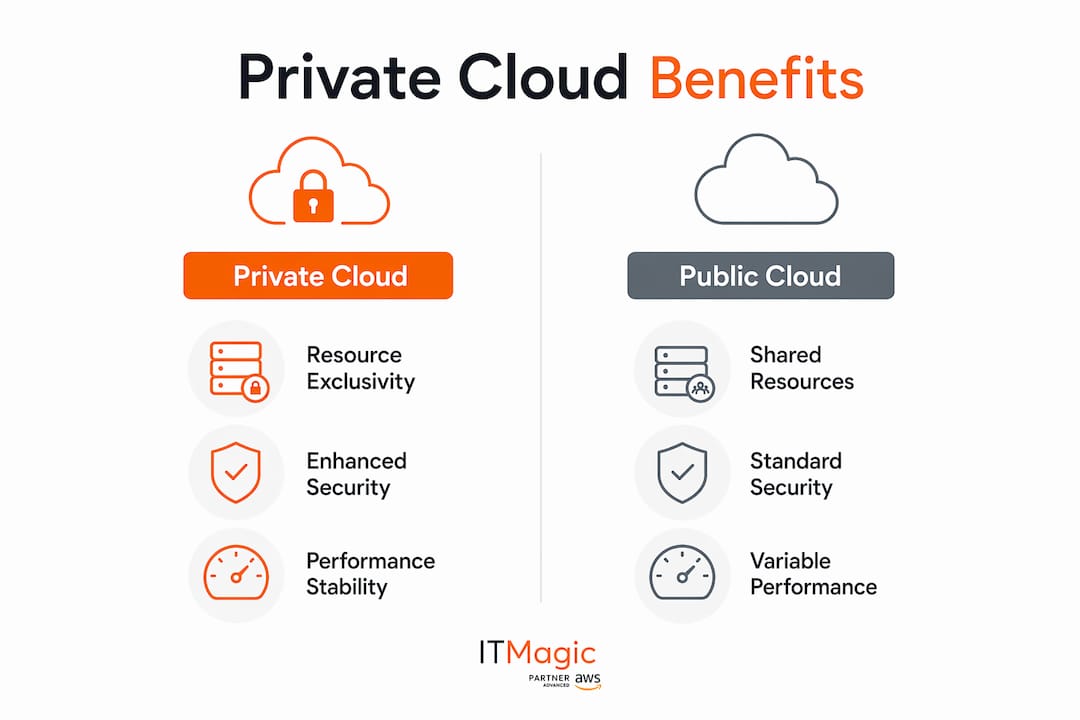
Dedicated hardware eliminates shared risk. In a public cloud, your workloads share physical servers with other tenants. That shared model creates unpredictable performance and exposes you to cross-tenant attack vectors. Private cloud removes both risks by giving your organization exclusive access to compute, storage, and networking.
Security controls exceed public cloud defaults. Public cloud providers offer security configurations within their own policy boundaries. Private cloud lets your security team define those boundaries from the ground up. You can implement tailored encryption standards and access controls that match your exact threat model rather than a vendor’s generalized one.

Cost predictability improves financial planning. Public cloud billing fluctuates with usage, making accurate budgeting difficult for finance and IT teams. Stable, predictable costs in private cloud environments remain consistent regardless of minor resource usage changes. That stability lets you commit to multi-year infrastructure budgets with confidence.
The core private cloud advantages in practice include:
- Resource isolation: Mission-critical applications receive guaranteed compute and memory allocations, not shared pools.
- Custom network topology: You define VLANs, firewall rules, and routing policies without vendor constraints.
- Compliance-ready architecture: Audit logs, data residency controls, and encryption are configured to your regulatory standard, not a shared baseline.
- Predictable billing: Fixed infrastructure costs replace variable per-hour charges, simplifying IT budget cycles.
- Workload portability: Private environments support containerized workloads via Kubernetes, making migration and scaling more controlled.
Pro Tip: Before committing to private cloud, map your workload categories. Baseline, regulated, and latency-sensitive workloads belong in private cloud. Bursty, experimental, or globally distributed workloads often cost less in public cloud. Mixing both in a hybrid model is the most cost-effective architecture for most enterprises.
How does private cloud improve security and compliance?
Running this on your own AWS setup? IT-Magic is an AWS Advanced Tier Partner — we audit, fix, or fully manage it for you.
Get a free consultationPrivate cloud is the preferred infrastructure model for regulated industries because it grants direct control over data residency and infrastructure configuration. Compliance mandates like PCI DSS, HIPAA, and FedRAMP require organizations to demonstrate that data is stored, processed, and transmitted within defined boundaries. Public cloud environments make that demonstration difficult because the underlying infrastructure is shared and managed by a third party.
The compliance advantages of private cloud follow a clear sequence:
- Data residency control. You specify exactly which physical locations store regulated data. This satisfies GDPR’s data localization requirements and FedRAMP’s jurisdiction mandates without relying on a vendor’s contractual assurances.
- Custom encryption policies. Private cloud lets you implement encryption at rest and in transit using algorithms and key management systems you control. FIPS 140-2 validated modules, for example, can be deployed without waiting for a vendor to support them.
- Granular access controls. Role-based access control, multi-factor authentication, and privileged access management are configured to your internal policies. Audit trails capture every access event in a format your compliance team specifies.
- Dedicated firewall and network segmentation. You define network zones, ingress and egress rules, and intrusion detection policies. No other tenant’s traffic crosses your network boundary.
- Simplified audit transparency. Security monitoring tools integrate directly with your SIEM platform. Auditors receive logs from infrastructure you own, not redacted exports from a shared provider.
Pro Tip: Map each compliance requirement to a specific infrastructure control before you design the private cloud architecture. PCI DSS Requirement 3, for example, mandates encryption of stored cardholder data. Defining that control at the architecture stage is far cheaper than retrofitting it after deployment.
Does private cloud eliminate “noisy neighbor” performance issues?
The noisy neighbor problem is a structural flaw in multi-tenant public cloud environments. When another tenant runs a resource-intensive workload on shared hardware, your application’s performance degrades. Dedicated hardware resources in private cloud prevent this by design. Your compute, memory, and network bandwidth are never shared.
The performance comparison between public and private cloud environments is most visible in latency-sensitive workloads:
| Workload type | Public cloud risk | Private cloud outcome |
|---|---|---|
| Real-time transaction processing | Latency spikes from shared CPU contention | Consistent sub-millisecond response times |
| High-frequency database queries | I/O throttling during neighbor spikes | Dedicated storage I/O with no contention |
| AI model inference | GPU allocation delays in shared pools | Reserved GPU capacity with guaranteed throughput |
| Video streaming or media processing | Bandwidth fluctuation from shared network | Dedicated network bandwidth with stable throughput |
For mobile and web applications where performance directly affects user experience, this consistency is not optional. A financial services firm running real-time fraud detection cannot tolerate the latency variance that shared infrastructure introduces.
Pro Tip: Run a 30-day performance baseline on your current environment before migrating to private cloud. Capture p95 and p99 latency metrics for each critical workload. Those numbers become your acceptance criteria for the private cloud deployment.
How does private cloud support AI workloads and scalability in 2026?
AI infrastructure is the most significant new driver of private cloud adoption. Enterprises are shifting AI model training and inference to private cloud to reduce costs and protect proprietary training data from exposure in shared environments. Public cloud GPU instances are expensive and subject to availability constraints. Private cloud gives AI teams reserved GPU capacity and direct control over the data pipelines feeding those models.
The scalability model for private cloud differs from public cloud elasticity in one critical way: it requires deliberate planning.
- Capacity planning replaces on-demand provisioning. Private cloud scales through pre-approved hardware additions, not instant API calls. This means your infrastructure team must forecast demand 60 to 90 days ahead rather than reacting in real time.
- Automation is non-negotiable. Cloud-style automation and self-service are critical for achieving elastic scalability in private environments. Infrastructure as Code tools like Terraform and Ansible replace manual provisioning and eliminate the bottlenecks that make private cloud feel slow.
- Hybrid architecture handles burst demand. Private cloud handles regulated and predictable workloads while public cloud absorbs bursty or experimental demand. This split is the dominant architecture strategy in 2026, not a compromise.
- Kubernetes enables workload portability. Container orchestration with Kubernetes on private infrastructure gives AI and application teams the same deployment experience they expect from public cloud, without the shared tenancy risks.
- Data sovereignty protects AI assets. Proprietary training datasets and model weights are among the most valuable assets an organization owns. Keeping them on private infrastructure removes the legal and security ambiguity of storing them in a shared provider’s environment.
The organizations that succeed with private cloud scalability treat it as a product, not a project. They build internal self-service portals, automate provisioning pipelines, and measure infrastructure delivery time the same way a public cloud team would.
Key Takeaways
Private cloud is the right choice for organizations that require enforceable compliance, consistent performance, and cost predictability that public cloud cannot guarantee by design.
| Point | Details |
|---|---|
| Compliance by design | Private cloud supports PCI DSS, HIPAA, and FedRAMP through direct control over data residency and encryption. |
| Performance consistency | Dedicated hardware eliminates noisy neighbor issues and guarantees stable latency for mission-critical workloads. |
| Cost predictability | Fixed infrastructure costs replace variable public cloud billing, enabling accurate multi-year IT budgeting. |
| AI workload security | Private cloud protects proprietary training data and provides reserved GPU capacity for model training and inference. |
| Automation is required | Infrastructure as Code and self-service provisioning are necessary to achieve cloud-like scalability in private environments. |
What I have learned from watching organizations choose private cloud
The organizations that get private cloud right share one habit: they treat it like a product from day one. The ones that struggle treat it like a server room with a better name.
The most common mistake I see is skipping automation. Teams spend months designing the perfect network topology and compliance architecture, then deploy it with manual provisioning processes. Within six months, the infrastructure team becomes a bottleneck. Developers wait days for new environments. The private cloud starts to feel slower than the public cloud it replaced. The problem is never the hardware. The problem is the absence of Infrastructure as Code practices, specifically tools like Terraform and Ansible, that make the environment self-service.
The second mistake is treating private cloud as a permanent destination for every workload. The workload alignment principle that defines 2026 cloud strategy is clear: private cloud handles regulated, predictable, and latency-sensitive work. Public cloud handles everything else. Organizations that force all workloads into private cloud end up over-provisioning hardware and under-utilizing it. That is the opposite of cost efficiency.
The compliance argument for private cloud is stronger than ever. Regulatory pressure on data residency is increasing across every major jurisdiction. Organizations that built their compliance posture on public cloud contractual assurances are discovering those assurances do not satisfy auditors the way direct infrastructure control does. Private cloud closes that gap definitively.
My advice to IT leaders evaluating this decision: start with your compliance requirements and your most latency-sensitive workloads. If those two categories represent a significant portion of your infrastructure spend, private cloud will pay for itself. Build the automation layer before you build anything else.
— Oleksandr
How IT-Magic supports your private cloud and hybrid strategy
Running a private cloud environment alongside AWS requires the same discipline that makes either model work: automated infrastructure, clear cost controls, and compliance-ready architecture. IT-Magic has delivered AWS infrastructure support for 300+ clients since 2010, helping organizations build hybrid environments where private cloud handles regulated workloads and AWS absorbs the rest. The team holds certifications across DevOps, security, and networking, and has direct experience with PCI DSS, SOC2, and HIPAA compliance implementations. If your organization is evaluating how to structure a hybrid cloud architecture or needs to reduce AWS operational costs while maintaining private cloud control, IT-Magic’s certified engineers can design and operate that environment for you.
FAQ
What is private cloud and why does it matter for compliance?
Private cloud is dedicated computing infrastructure operated exclusively for one organization. It matters for compliance because it gives organizations direct control over data residency, encryption, and audit logging required by frameworks like PCI DSS, HIPAA, and FedRAMP.
Is private cloud worth the cost compared to public cloud?
Private cloud delivers better cost predictability than public cloud because billing is fixed rather than usage-based. For organizations running stable, regulated workloads, the total cost of ownership over three to five years typically favors private cloud.
How does private cloud handle AI workloads?
Private cloud provides reserved GPU capacity and keeps proprietary training data on infrastructure the organization controls. This reduces both the cost and the security risk of running AI model training and inference in shared public cloud environments.
What is the noisy neighbor problem and does private cloud solve it?
The noisy neighbor problem occurs when another tenant’s workload consumes shared resources and degrades your application’s performance. Private cloud solves it completely by providing dedicated hardware where no other tenant’s workload can affect your compute, memory, or network bandwidth.
Can private cloud scale as fast as public cloud?
Private cloud scales more slowly than public cloud by default because it requires capacity planning rather than on-demand provisioning. Organizations that implement Infrastructure as Code tools like Terraform and automated self-service provisioning can achieve cloud-like scaling speeds within their private environment.
Recommended
- Why Choose Cloud Scaling for Your Business in 2026
- Multi-Cloud Strategy for IT Leaders: 2026 Guide
- Network Security Strategies for Cloud Environments in 2026
- What Is Cloud Risk Management: A 2026 Guide for Leaders
Alexander founded IT-Magic, an AWS Advanced Tier Services Partner delivering DevOps, cloud architecture, and managed services since 2010. He holds:
- AWS Certified Solutions Architect – Professional
- AWS Certified DevOps Engineer – Professional
- AWS Certified Security – Specialty
- AWS Certified Advanced Networking – Specialty
Talk to a certified AWS team trusted by INTERTOP, Foxtrot, Pandora, and J.Hilburn.
Get a free consultation