
TL;DR:
- Cloud resilience involves designing systems that maintain continuous operation and recover swiftly from failures, with responsibility shared between providers and customers. Effective strategies include layered architecture, fault injection testing, and prioritizing critical workloads through business impact analysis and IAM controls, to prevent failures from escalating during incidents. Regular chaos engineering experiments and isolating cyber recovery environments are essential to ensure comprehensive and resilient cloud operations.
Cloud resilience is defined as the ability of your cloud infrastructure and applications to maintain continuous operation and recover quickly from disruptions, whether caused by hardware failure, software bugs, cyberattacks, or regional outages. This concept sits at the heart of every serious cloud strategy. Microsoft’s Azure Cloud Adoption Framework defines resiliency as maintaining operations and availability during failures, and critically, it frames this as a shared responsibility between the cloud provider and the customer. Understanding cloud resilience explained in full means recognizing that AWS and Azure handle the physical infrastructure, but your team owns the architecture decisions that determine whether your workloads survive a failure event.
What cloud resilience explained actually covers
Cloud resilience is not a single technology or setting. It is a layered capability built from several distinct but interdependent concepts, and conflating them leads to dangerous gaps in your planning.
The four terms you need to distinguish are:
- Reliability refers to a system’s ability to perform its intended function under stated conditions for a defined period. It is a design property.
- Availability is the percentage of time a system is operational and accessible. AWS and Azure publish service-level agreements (SLAs) that express availability as a number like 99.99%.
- Resilience is the broader capability to absorb disruption and recover. A system can have high availability under normal conditions but poor resilience under novel failure modes.
- Disaster recovery (DR) is the specific process of restoring systems and data after a major disruption. DR is one component of resilience, not a synonym for it.
Business continuity (BC) sits above all of these. It describes how your organization keeps operating during and after a disruption, covering people, processes, and technology together. Two metrics anchor every BC and DR plan: Recovery Time Objective (RTO), which is the maximum acceptable downtime, and Recovery Point Objective (RPO), which is the maximum acceptable data loss measured in time.
Microsoft recommends setting business-driven reliability targets using the Azure Well-Architected Framework and grounding BC, HA, and DR concepts in measurable goals. This matters because teams that skip this step end up over-engineering low-priority workloads while under-protecting critical ones. The AWS Well-Architected Framework takes the same position, requiring you to define reliability targets before selecting architectural patterns.
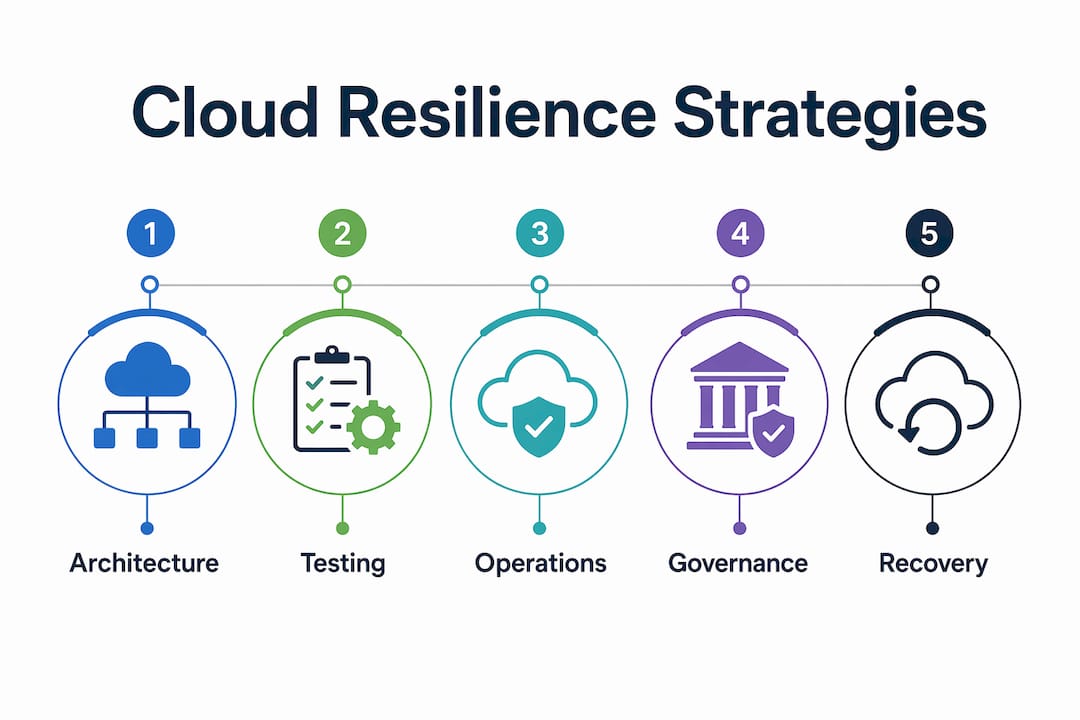
Which cloud resilience strategies improve system robustness?
Running this on your own AWS setup? IT-Magic is an AWS Advanced Tier Partner — we audit, fix, or fully manage it for you.
Get a free consultationArchitectural pattern selection is where cloud resilience strategies either succeed or fail in practice. Four DR patterns represent the main spectrum of options, each with distinct cost and recovery speed trade-offs.

| Pattern | RTO | RPO | Cost | Best for |
|---|---|---|---|---|
| Backup and restore | Hours | Hours | Low | Non-critical workloads |
| Pilot light | Minutes to hours | Minutes | Medium | Core systems with budget constraints |
| Warm standby | Minutes | Seconds to minutes | Medium-high | Business-critical applications |
| Active-active | Near zero | Near zero | High | Mission-critical, revenue-generating systems |
ITU Online highlights that workload-specific choices drive these decisions, not a single blanket policy. A fintech payment processor and an internal HR portal do not belong in the same DR tier. Applying the fintech disaster recovery logic more broadly, you can tier your workloads by business impact and assign patterns accordingly.
Fault tolerance and automatic failover are the mechanisms that make these patterns work at runtime. Elastic scalability handles demand spikes without manual intervention, which prevents a traffic surge from becoming an outage. Multi-region and multi-AZ deployments extend your failure domain separation, but they introduce latency, data replication complexity, and cost that must be justified by your RTO and RPO targets.
The most underappreciated risk in architectural design is correlated failure. BCG’s 2026 research shows that organizations must design and test for multi-layer correlated failures and recovery paths that operate independently from degraded control planes. This means a single-region outage can simultaneously take down your primary workload, your monitoring stack, and your deployment pipeline if they share the same failure domain. Designing for isolated failure domains across compute, networking, identity, and observability layers is the architectural discipline that separates genuinely resilient systems from ones that merely look resilient on paper.
Pro Tip: When designing multi-AZ or multi-region architectures, map your control-plane dependencies separately from your data-plane dependencies. Your recovery path must remain functional even when the primary control plane is unavailable.
How does resilience testing work in cloud environments?
Designing for resilience is necessary but not sufficient. The only way to know whether your architecture actually holds up is to break it deliberately, under controlled conditions, before a real incident does it for you.
Chaos engineering is the practice of intentionally injecting failures into production or production-like environments to expose weaknesses. AWS Fault Injection Service (AWS FIS) is the primary tool for this on AWS, providing a managed service for orchestrating fault injection experiments with built-in safety controls.
Honeycomb’s experience with AWS FIS is one of the clearest documented examples of this practice at scale:
- Honeycomb orchestrated over 50 failure injections using AWS FIS in production environments, validating resilience across a wide range of failure scenarios.
- Each experiment used stop conditions linked to Amazon CloudWatch alarms, which triggered automated rollback if a test began causing real customer impact.
- The safety lever approach meant that fault injection experiments could run in live environments without risking uncontrolled outages.
- The program identified specific weak points in Honeycomb’s architecture that would not have surfaced through design review alone.
- Results fed directly into remediation work, closing gaps before they became incidents.
Cyber resilience recovery requires a separate and more specialized workflow. When ransomware or a destructive cyberattack hits, your standard backups and credentials may themselves be compromised. AWS describes a recovery approach that isolates the recovery environment completely from production, uses validation pipelines to verify backup integrity before restore, and applies a Rebuild-Restore-Rotate framework: rebuild the environment from clean infrastructure-as-code, restore validated data, then rotate all credentials and secrets. This sequence prevents malware or compromised credentials from spreading during the recovery process itself.
Pro Tip: Never assume your most recent backup is clean. Build a validation pipeline that scans and tests backup integrity on a schedule, not just at restore time. Discovering a corrupted backup during an active incident is one of the most preventable failures in cloud operations.
What operational practices sustain cloud resilience over time?
Architecture and testing create the foundation. Operational discipline is what keeps that foundation solid as your environment evolves.
Business impact analysis (BIA) is the starting point for any serious resilience program. The Cloud Security Alliance connects BIA directly to operational resilience planning, using it to prioritize which systems receive the most investment in redundancy, testing, and recovery automation. Without BIA, teams default to protecting everything equally, which in practice means protecting nothing well.
Key operational practices that sustain cloud infrastructure reliability include:
- Identity and access management (IAM) hardening. Organizations consistently underestimate IAM’s impact on resilience. Integrating Zero Trust principles with operational resilience planning reduces blast radius when credentials are compromised. The Cloud Security Alliance’s Zero Trust guidance links IAM directly to incident impact severity reduction.
- Break-glass procedures. BCG’s research identifies control-plane and identity provider outages as common failure modes during real incidents. Break-glass access, which is pre-authorized emergency access that bypasses normal controls, must be documented, tested, and stored in a location that remains accessible when your primary identity provider is down.
- Supply chain and dependency mapping. Cloud disaster recovery must cover the entire service chain, including IAM, network configurations, and automation dependencies, not just data backup. A restored database is useless if the network configuration or IAM role that grants access to it was not also recovered.
- Governance and documentation cadence. Resilience plans decay. Architecture changes, team members leave, and dependencies shift. Quarterly reviews of DR runbooks, RTO/RPO targets, and test results keep your program calibrated to your actual environment.
Network security strategies for cloud environments intersect directly with resilience here. Segmentation, least-privilege access, and anomaly detection all reduce the probability and blast radius of events that would otherwise trigger your recovery procedures.
Key takeaways
Cloud resilience requires layered architecture, validated recovery workflows, and sustained operational governance working together. Technology design alone does not produce resilience.
| Point | Details |
|---|---|
| Resilience is a shared responsibility | Cloud providers secure the infrastructure; customers own the architecture decisions that determine survivability. |
| Match DR patterns to business impact | Backup-restore, pilot light, warm standby, and active-active each carry distinct cost and recovery speed trade-offs. |
| Test with fault injection | Tools like AWS FIS expose real weaknesses that design reviews miss; safety levers make live testing safe. |
| Isolate cyber recovery environments | Ransomware recovery requires a clean, separate environment and validated backups before any restore begins. |
| BIA and IAM drive prioritization | Business impact analysis and Zero Trust IAM determine where resilience investment produces the most protection. |
Why most resilience programs fail at the worst possible moment
I have seen organizations invest heavily in multi-region AWS architectures, pass their internal DR reviews, and still face extended outages during real incidents. The pattern is almost always the same: the architecture was designed for isolated, single-component failures, but the actual event was correlated. The primary region went down, and so did the monitoring stack, the deployment pipeline, and the identity provider that the recovery runbook assumed would be available.
The uncomfortable truth is that most resilience programs are tested against scenarios the team designed. That is not testing. That is confirmation. Real resilience requires testing against scenarios you did not anticipate, which is exactly what chaos engineering with tools like AWS FIS forces you to confront.
The second failure mode I see consistently is treating IAM as a security concern rather than a resilience concern. When your identity provider is degraded or your credentials are compromised in a ransomware event, your entire recovery workflow depends on having pre-staged, isolated credentials and break-glass access that were set up before the incident. Teams that skip this step discover the gap at the worst possible time.
My recommendation for any IT leader reading this: separate your critical identity and management layers from your primary environment today, not after your next incident review. And run at least one chaos engineering experiment per quarter that your team did not design. The discomfort of a controlled failure is far cheaper than the cost of an uncontrolled one.
— Oleksandr
How IT-Magic supports your cloud resilience program
Building resilient cloud infrastructure requires more than good architecture diagrams. It requires continuous operational expertise, proactive monitoring, and the ability to respond when systems behave unexpectedly. IT-Magic has delivered over 700 cloud infrastructure projects for 300+ clients since 2010, with a specific focus on AWS environments where reliability and compliance are non-negotiable.
Our Kubernetes support services are designed for teams running containerized workloads on Amazon EKS or ECS who need expert management of high availability, automated failover, and recovery workflows. If your organization is working through how to improve cloud resilience across containerized infrastructure, our certified AWS engineers can assess your current architecture, identify failure domains, and implement the operational controls that keep your systems running. Contact IT-Magic to discuss your resilience requirements.
FAQ
What is cloud resilience in simple terms?
Cloud resilience is the ability of your cloud infrastructure to keep operating and recover quickly when something goes wrong, whether that is a hardware failure, software bug, cyberattack, or regional outage. It combines architectural design, recovery planning, and operational discipline into a single capability.
How does cloud resilience differ from disaster recovery?
Disaster recovery is one component of cloud resilience, specifically the process of restoring systems after a major disruption. Cloud resilience is broader, covering fault tolerance, high availability, business continuity, and the operational practices that prevent disruptions from becoming disasters in the first place.
What is the shared responsibility model in cloud resilience?
Cloud providers like AWS and Microsoft Azure are responsible for the physical infrastructure, including hardware, networking, and the underlying platform. Customers are responsible for the architecture decisions, configurations, data protection, and recovery workflows that determine how their workloads survive failures within that infrastructure.
Which cloud resilience strategies offer the fastest recovery?
Active-active multi-region deployments provide near-zero RTO and RPO but carry the highest cost and complexity. Warm standby configurations offer recovery in minutes at lower cost and are the most practical choice for business-critical workloads that cannot justify full active-active investment.
How often should cloud resilience be tested?
Resilience testing should run continuously in some form, with automated fault injection experiments running regularly and full DR exercises conducted at least twice per year. Honeycomb’s use of AWS Fault Injection Service, running over 50 failure injections in production with automated safety controls, demonstrates that frequent live testing is operationally feasible when proper stop conditions are in place.
Recommended
- Network Security Strategies for Cloud Environments in 2026
- What Is Cloud Risk Management: A 2026 Guide for Leaders
- AWS Security Trends: What CIOs Need to Know for 2026
- AWS cloud security: 7 essential strategies for 2026
Alexander founded IT-Magic, an AWS Advanced Tier Services Partner delivering DevOps, cloud architecture, and managed services since 2010. He holds:
- AWS Certified Solutions Architect – Professional
- AWS Certified DevOps Engineer – Professional
- AWS Certified Security – Specialty
- AWS Certified Advanced Networking – Specialty
Talk to a certified AWS team trusted by INTERTOP, Foxtrot, Pandora, and J.Hilburn.
Get a free consultation