
TL;DR:
- Cloud compliance audits verify that customer-controlled cloud environments meet regulatory and governance standards, emphasizing control ownership and evidence. Continuous monitoring and automation reduce preparation costs and improve audit readiness by ensuring real-time compliance visibility. Most audit findings stem from customer configuration gaps rather than provider infrastructure issues, highlighting the importance of governance discipline.
Cloud compliance audits are the systematic verification that your organization’s cloud environment meets regulatory, contractual, and internal governance requirements. With 82% of data breaches involving cloud-hosted data and average breach costs reaching $6.08 million in the finance sector, the role of audits in cloud compliance has shifted from a periodic checkbox exercise to a continuous, strategic discipline. Audits do not simply validate what your cloud provider does. They scrutinize the controls your organization owns, configures, and operates every day.
What responsibilities do audits verify in shared responsibility cloud models?
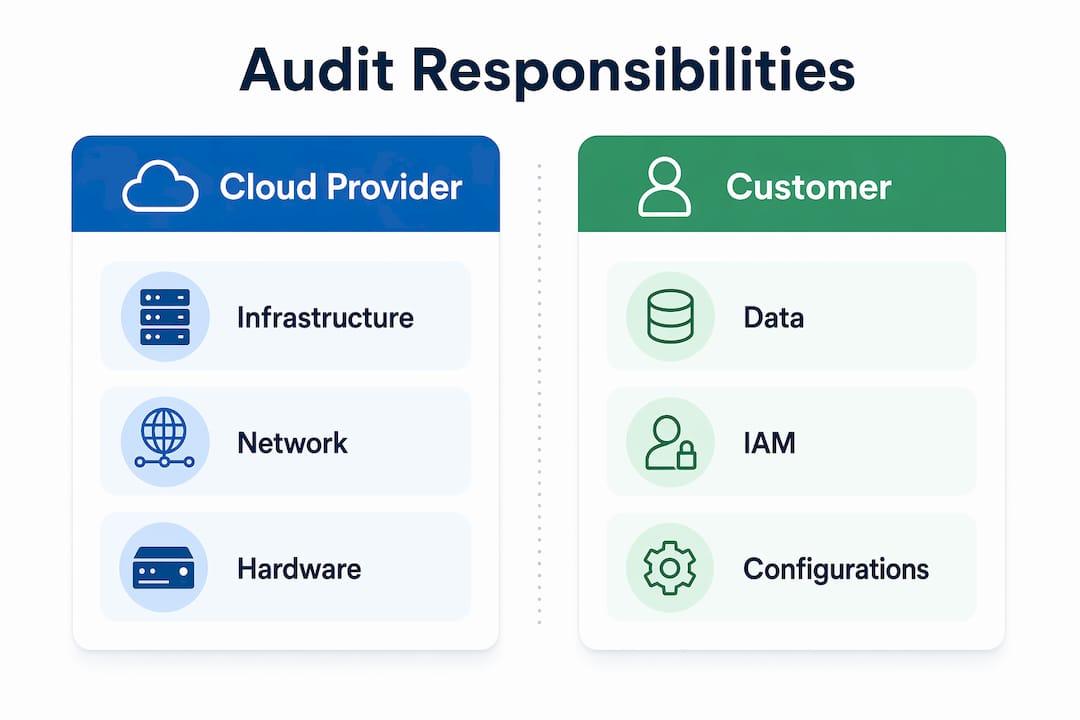
The shared responsibility model is the foundational concept that defines what your cloud provider secures versus what your organization must secure. AWS and Azure both publish explicit responsibility matrices, but the practical boundary is often misunderstood in ways that create real audit exposure.

In an IaaS model, the provider secures physical infrastructure, hypervisors, and network hardware. Your organization owns the operating system, middleware, application code, identity and access management (IAM), data encryption, and network configuration. In a PaaS model, the provider absorbs more of the stack, but data classification, access controls, and application-level logging remain your responsibility. In a SaaS model, the provider manages nearly everything except user access governance and data handling practices.
95% of security failures occur in customer-managed layers such as IAM configurations, data controls, and environment settings. That figure means auditors spend the majority of their time examining what your team built and configured, not what AWS or Azure built. This is the compliance shield fallacy: assuming that because your provider holds a SOC 2 or ISO 27001 certification, your own environment is automatically compliant. It is not.
Cloud compliance audits under frameworks like SOC 2, ISO 27001, PCI DSS, and HIPAA all require your organization to demonstrate control design, evidence of operation, and governance documentation. Auditors look for documented change approvals, access review records, encryption configurations, and logging completeness, not just the existence of technical controls.
| Cloud model | Provider responsibility | Customer audit scope |
|---|---|---|
| IaaS (e.g., AWS EC2) | Physical, network, hypervisor | OS, IAM, data, network config, logging |
| PaaS (e.g., AWS RDS) | Runtime, OS, storage | Data classification, access, app logging |
| SaaS (e.g., Salesforce) | Infrastructure, application | User access governance, data handling |
Pro Tip: Review your Data Processing Agreements and Service Level Agreements with every cloud provider annually. Contractual ambiguity in shared responsibility boundaries is a documented source of audit failures, and DPAs define exactly where provider obligation ends and yours begins.
How do audits ensure compliance through evidence collection and monitoring?
Running this on your own AWS setup? IT-Magic is an AWS Advanced Tier Partner — we audit, fix, or fully manage it for you.
Get a free consultationTraditional cloud compliance audits operate as point-in-time snapshots. An auditor arrives, requests evidence for a defined period, and your team scrambles to compile screenshots, access logs, and configuration exports. This model is expensive, stressful, and increasingly inadequate for cloud environments that change daily.
Continuous auditing and monitoring transform compliance from a reactive annual event into ongoing, real-time assurance. The practical difference is significant: instead of reconstructing six months of evidence under deadline pressure, your team maintains a living audit trail that is always current.
Automation is what makes continuous compliance operationally viable. Key tools and approaches include:
- AWS Audit Manager automatically collects evidence mapped to frameworks like PCI DSS and SOC 2, eliminating manual screenshot collection for dozens of controls.
- Cloud Security Posture Management (CSPM) tools continuously scan configurations against security benchmarks and flag deviations before they become audit findings.
- Infrastructure-as-Code (IaC) artifacts such as Terraform or AWS CloudFormation templates serve as automated audit evidence, proving that infrastructure was provisioned according to approved, version-controlled specifications.
- Immutable log storage using services like AWS CloudTrail with S3 Object Lock preserves tamper-proof audit trails that satisfy auditor requirements for log integrity.
- Event-driven compliance triggers alert your team when a configuration drifts from its approved baseline, enabling correction before the next audit cycle.
Automating evidence collection reduces audit preparation costs by over 60% compared to manual methods. For a compliance team supporting multiple frameworks simultaneously, that reduction translates directly into headcount and budget that can be redirected toward control improvement rather than evidence gathering.
Pro Tip: Build audit readiness into your cloud architecture from day one. Retrofitting logging, tagging, and evidence collection into an existing environment costs three to five times more than designing those capabilities in at the start.
Compliance dashboards that aggregate findings from AWS Security Hub, CSPM tools, and your ticketing system give executives real-time visibility into compliance posture. This matters not just for auditors but for board-level reporting, where regulators increasingly expect continuous monitoring evidence rather than annual attestations.
What are the common audit findings and risks in cloud compliance audits?
Understanding where cloud compliance audits most frequently fail helps you prioritize remediation before an auditor identifies the same gaps. 57% of organizations have experienced cloud compliance failures traced directly to customer-side misconfigurations rather than provider infrastructure issues.
The most frequent audit findings fall into predictable categories:
- Over-privileged IAM accounts. Service accounts and human users with broader permissions than their roles require. Auditors test least-privilege adherence by comparing assigned permissions against actual usage patterns. Identity governance is the most frequent source of cloud audit findings, with misconfigurations in OAuth tokens, service accounts, and cross-account trusts being particularly pervasive.
- Stale credentials. Unused access keys, dormant user accounts, and expired certificates that remain active. These represent both a security risk and a direct audit failure under frameworks like PCI DSS and SOC 2.
- Configuration drift. Security group rules that were temporarily opened and never closed, S3 buckets with public access enabled, or encryption settings that were modified without a change approval record.
- Insufficient logging. Missing CloudTrail coverage for specific regions or services, log retention periods shorter than framework requirements, or logs stored in mutable locations that cannot prove integrity.
- Data protection lapses. Unencrypted data at rest or in transit, missing data classification tags, and backup configurations that do not meet recovery time objectives defined in your compliance framework.
- Governance gaps. Absence of documented change management processes, missing access review records, or control owners who cannot produce evidence that their controls operated throughout the audit period.
Each of these findings carries compounding risk. A configuration error is a technical problem. A configuration error without a change approval record is a governance failure. A governance failure under PCI DSS or HIPAA can result in fines, loss of certification, and mandatory remediation timelines that disrupt operations far beyond the audit itself.
How can organizations prepare for and improve cloud compliance audits?
Audit readiness is not a project you complete before an audit. It is an operational discipline you maintain continuously. Organizations that treat it as a project consistently face the same findings cycle after cycle.
The following practices define what effective audit preparation looks like in practice:
- Assign explicit control owners. Every control in your compliance framework must have a named individual responsible for its operation and evidence. Organizations with maintained control mappings complete audits 60% faster than those without. Ownership without documentation is not ownership.
- Map cloud controls to compliance frameworks. Build a control matrix that links each AWS configuration, IAM policy, or logging rule to the specific framework requirement it satisfies. This eliminates the guesswork auditors face and accelerates evidence review.
- Conduct monthly compliance reviews. Regular penetration testing and monthly reviews catch control drift before it becomes a major audit finding. A monthly cadence surfaces issues when they are cheap to fix rather than when they are expensive to explain.
- Integrate audit readiness into your CI/CD pipeline. Policy-as-code tools like AWS Config Rules or Open Policy Agent validate every infrastructure change against your compliance baseline before it reaches production.
- Maintain updated documentation. Auditors evaluate governance behind technical controls as much as the controls themselves. Documented change approvals, access review records, and risk assessments are evidence of a functioning compliance program, not bureaucratic overhead.
For retail organizations managing cardholder data environments on AWS, the combination of AWS Config, AWS Audit Manager, and a structured AWS compliance checklist provides a practical foundation for continuous PCI DSS readiness. The same architecture applies to healthcare organizations under HIPAA and financial services firms under SOC 2.
| Preparation area | Tool or method | Framework benefit |
|---|---|---|
| Evidence collection | AWS Audit Manager, IaC artifacts | SOC 2, PCI DSS, ISO 27001 |
| Configuration monitoring | AWS Config, CSPM tools | All major frameworks |
| Access governance | IAM Access Analyzer, access reviews | SOC 2, HIPAA, PCI DSS |
| Log integrity | CloudTrail with S3 Object Lock | PCI DSS, HIPAA |
| Control ownership | Control matrix documentation | All major frameworks |
Cloud infrastructure monitoring that feeds directly into your compliance dashboard closes the gap between operational visibility and audit evidence, making both functions more efficient simultaneously.
Key takeaways
Effective cloud compliance audits require continuous evidence collection, explicit control ownership, and governance discipline across customer-managed layers, not reliance on provider certifications alone.
| Point | Details |
|---|---|
| Audits focus on customer controls | 95% of cloud security failures occur in customer-managed layers, not provider infrastructure. |
| Automation cuts preparation costs | Automated evidence collection reduces audit prep costs by over 60% compared to manual methods. |
| Identity governance is the top risk | Over-privileged accounts and stale credentials are the most frequent source of audit findings. |
| Control ownership accelerates audits | Organizations with maintained control mappings complete audits 60% faster than those without. |
| Continuous monitoring replaces snapshots | Real-time compliance visibility enables faster threat response and eliminates end-of-cycle scramble. |
Why audits are a governance problem, not just a technical one
After working with organizations across fintech, healthcare, and retail on AWS compliance programs, the pattern I see most often is this: the technical controls are largely in place, but the governance layer is missing. Logging is enabled, but nobody owns the evidence. Encryption is configured, but there is no documented change approval proving it was intentional. IAM policies exist, but access reviews have not been conducted in 18 months.
Auditors are trained to find exactly this gap. A well-maintained security program alongside a compliance framework is what passes audits. The framework tells you what to do. The security program proves you actually did it, consistently, over time.
The shift I advocate for is treating audit readiness as an engineering problem. When your IaC templates are the source of truth for infrastructure, when your CI/CD pipeline enforces policy before deployment, and when your compliance dashboard reflects real-time posture, the annual audit becomes a confirmation of what you already know rather than a discovery of what you missed.
The organizations that struggle most are those that staff up for audits and then stand down afterward. Compliance is not seasonal. Cloud environments change every day, and your controls need to keep pace with that change. Investing in automated evidence tooling and assigning genuine control ownership are the two decisions that separate organizations that pass audits confidently from those that pass them narrowly and expensively.
— Oleksandr
Strengthen your audit readiness with IT-Magic
IT-Magic has delivered cloud compliance programs for 300+ clients across fintech, retail, and enterprise environments since 2010, all built on AWS. Our team of certified AWS experts designs and operates infrastructure that is audit-ready by default, with logging, IAM governance, and configuration monitoring built into every environment from the start. If your organization is preparing for SOC 2, PCI DSS, or HIPAA audits and needs a partner who understands both the technical and governance requirements, our Kubernetes support services include compliance-focused configuration management and continuous monitoring that keeps your audit posture current. Contact IT-Magic to build a cloud environment that passes audits without the scramble.
FAQ
What is the role of audits in cloud compliance?
Cloud compliance audits verify that your organization’s cloud environment meets regulatory, contractual, and internal governance requirements by evaluating customer-owned controls, configurations, and evidence of operation. They are distinct from provider certifications and focus on what your team builds and manages.
Why can’t I rely on my cloud provider’s certifications for compliance?
Provider certifications like AWS SOC 2 or ISO 27001 cover the provider’s infrastructure, not your configurations, data, or access controls. Overreliance on provider certifications is a documented audit failure pattern because customer-managed layers are audited independently regardless of provider compliance status.
How does continuous auditing differ from traditional cloud audits?
Traditional audits are point-in-time snapshots that require manual evidence collection at audit time. Continuous auditing maintains a real-time compliance posture through automated evidence generation, configuration monitoring, and compliance dashboards, reducing both preparation costs and the risk of undetected control drift.
What are the most common findings in cloud compliance audits?
The most frequent findings are over-privileged IAM accounts, stale credentials, configuration drift, insufficient logging, and missing governance documentation. These issues stem from customer-side management gaps rather than provider infrastructure failures.
How do I build a cloud environment that is always audit-ready?
Assign explicit control owners, map every cloud control to its framework requirement, automate evidence collection with tools like AWS Audit Manager, and conduct monthly compliance reviews. Organizations that integrate these practices into daily operations complete audits significantly faster and with fewer findings than those that prepare reactively.
Recommended
- What is cloud compliance: A guide for IT decision-makers
- AWS compliance checklist: Step-by-step guide for enterprise security
- What Is Cloud Risk Management: A 2026 Guide for Leaders
- AWS cloud security: 7 essential strategies for 2026
Alexander founded IT-Magic, an AWS Advanced Tier Services Partner delivering DevOps, cloud architecture, and managed services since 2010. He holds:
- AWS Certified Solutions Architect – Professional
- AWS Certified DevOps Engineer – Professional
- AWS Certified Security – Specialty
- AWS Certified Advanced Networking – Specialty
Talk to a certified AWS team trusted by INTERTOP, Foxtrot, Pandora, and J.Hilburn.
Get a free consultation