
TL;DR:
- PCI DSS compliance on AWS involves implementing security controls within a shared responsibility model, with AWS securing the infrastructure and the customer securing workloads and data. Achieving full compliance typically takes four to twelve months, depending on the environment’s scope and maturity. Continuous monitoring, correct scope definition, and proper use of native AWS services are essential for maintaining compliance and passing audits.
PCI DSS compliance on AWS is defined as the full implementation of Payment Card Industry Data Security Standard controls within an AWS environment, governed by the AWS shared responsibility model. AWS holds PCI DSS Level 1 Service Provider status, the highest certification available, which means AWS secures the underlying infrastructure. Your team is responsible for securing everything built on top of it: workloads, configurations, data flows, and access policies. Getting that boundary wrong is the most common reason audits fail. Achieving full compliance typically takes 4–12 months, depending on your Cardholder Data Environment scope and existing architecture maturity.
What is PCI DSS compliance on AWS, and how does scope work?
The Cardholder Data Environment, or CDE, is the set of systems, networks, and processes that store, process, or transmit cardholder data. Defining it correctly on AWS is the single most consequential decision in your compliance program. Failing to define correct audit scope leads to costly remediation and failed audits. Every system connected to the CDE, even indirectly, falls within scope unless you can prove otherwise through documented segmentation.

Mapping data flows across AWS accounts and services
Start by tracing every path cardholder data takes through your AWS environment. Use AWS VPC Flow Logs and CloudTrail to identify which services touch payment data. Document each flow in a data flow diagram that your Qualified Security Assessor (QSA) can review. Gaps in this diagram become gaps in your audit.
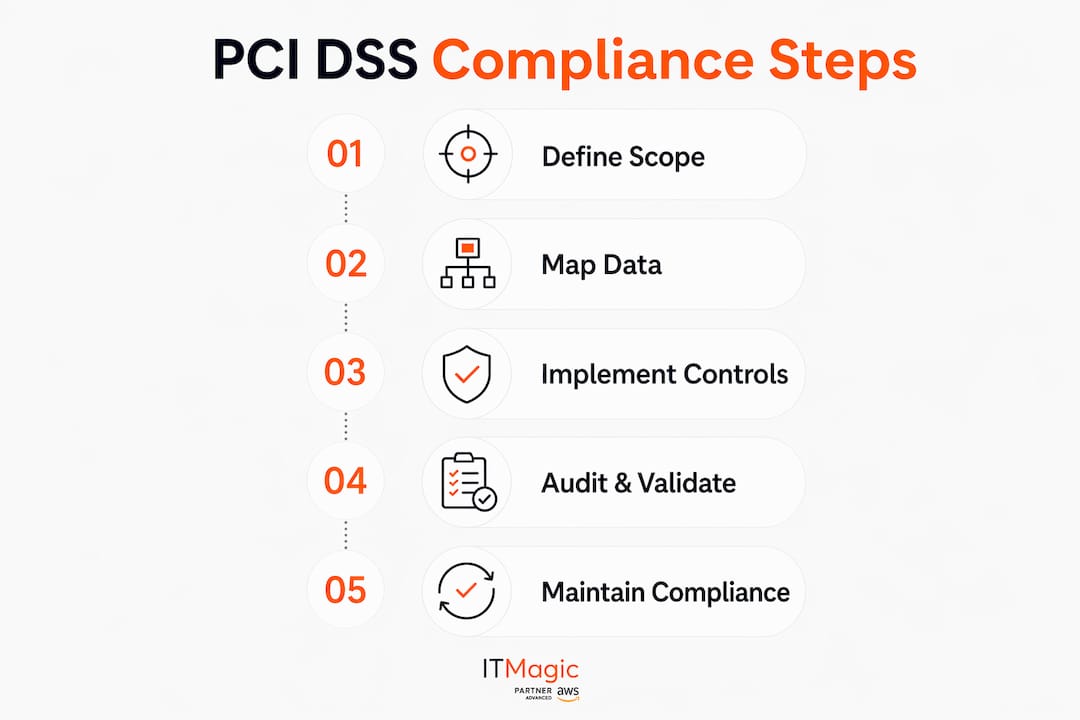
Isolate the CDE using dedicated AWS accounts, VPCs, and private subnets. Network segmentation is not optional. It reduces the number of systems in scope, which directly reduces your audit burden and remediation costs. AWS Transit Gateway and VPC peering connections that cross into the CDE must be documented and controlled.
When selecting AWS services, distinguish between AWS-managed services and customer-managed configurations. Services like Amazon RDS with encryption enabled and Amazon S3 with bucket policies shift some controls to AWS, but you still own the configuration. Third-party integrations, including payment gateways and SaaS tools connected to your AWS environment, must be documented as part of your scope boundary.
- Map all data flows using VPC Flow Logs and CloudTrail before defining scope boundaries.
- Use dedicated AWS accounts per environment (production, staging, development) to limit CDE sprawl.
- Apply private subnets for all systems that store or process cardholder data.
- Document every third-party integration that touches the CDE, including API connections.
- Review scope boundaries quarterly, not just at audit time.
Pro Tip: Create a living scope document in Confluence or a similar tool and tie it to your AWS Config change notifications. When a new resource appears in a CDE-adjacent account, your team gets an alert before it becomes an audit finding.
How do you implement key PCI DSS requirements with AWS native services?
Running this on your own AWS setup? IT-Magic is an AWS Advanced Tier Partner — we audit, fix, or fully manage it for you.
Get a free consultationAWS provides a full set of native services that map directly to PCI DSS control requirements. The key is knowing which service covers which requirement and configuring each one correctly. AWS Security Groups, NACLs, VPCs, KMS, CloudTrail, Config, and GuardDuty are the core services for PCI DSS control implementation. Using them without proper configuration still leaves you exposed.
Network security controls
Security Groups act as stateful firewalls at the instance level. NACLs provide stateless filtering at the subnet level. Together, they enforce the principle of least privilege for network access. AWS Network Firewall adds deep packet inspection for environments requiring more granular traffic control.
Encryption requirements
TLS 1.2+ for data in transit and AWS KMS for data at rest are non-negotiable PCI DSS requirements. KMS key rotation should be enabled on all customer-managed keys. Disable older TLS versions on all load balancers and API endpoints. Store encryption keys separately from the data they protect.
Access control and authentication
IAM policies must follow least-privilege principles. Every human user accessing CDE systems needs MFA enabled. Service accounts should use IAM roles, not long-lived access keys. AWS IAM Access Analyzer identifies overly permissive policies automatically.
Logging, monitoring, and vulnerability management
| Control Area | AWS Service | PCI DSS Requirement |
|---|---|---|
| Audit logging | CloudTrail | Requirement 10 |
| Configuration monitoring | AWS Config | Requirements 1, 2, 10 |
| Threat detection | GuardDuty | Requirement 11 |
| Vulnerability scanning | AWS Inspector | Requirement 11 |
| Security posture | Security Hub | Multiple requirements |
Regular internal vulnerability scanning and quarterly external ASV scans supported by penetration testing maintain your ongoing security posture. AWS Inspector automates internal scanning for EC2 instances and container images. External ASV scans must come from a PCI SSC-approved vendor regardless of what Inspector reports.
Pro Tip: Enable GuardDuty’s PCI DSS threat intelligence rule sets from day one. They flag behaviors specific to payment card data theft, such as unusual API calls to S3 buckets containing card data, that generic threat detection misses.
What does the PCI DSS audit and validation process look like on AWS?
Validation requires three recurring activities: an annual Attestation of Compliance (AOC) or Report on Compliance (ROC), quarterly ASV scans, and regular penetration testing. The AOC applies to most merchants. The ROC applies to Level 1 merchants and service providers. Your QSA determines which document you need.
AWS Artifact is the portal where you retrieve AWS’s own compliance reports, including its PCI DSS AOC and Responsibility Summary. The Responsibility Summary is a critical document. It maps each PCI DSS requirement to either AWS’s responsibility, your responsibility, or a shared responsibility. Read it before your audit, not during it.
AWS provides PCI DSS compliance reports in OSCAL (JSON) format, which is machine-readable. That format allows you to pull AWS’s compliance posture directly into automated workflows and CI/CD pipelines. It turns a previously manual document review into a real-time data feed.
| Validation Activity | Frequency | Responsible Party |
|---|---|---|
| AOC or ROC submission | Annual | Customer (with QSA) |
| ASV vulnerability scan | Quarterly | Approved Scanning Vendor |
| Penetration testing | Annual minimum | Customer or third party |
| AWS Responsibility Summary review | Before each audit | Customer |
| Targeted Risk Analysis (TRA) documentation | As required | Customer |
PCI DSS v4.0 requires formal Targeted Risk Analysis documentation when you use compensating controls or customized approaches. This is not optional. Your QSA will ask for it, and “we use AWS” is not a sufficient answer. Document the specific risk, the control you chose, and why it meets the intent of the original requirement.
AWS Audit Manager and Security Hub simplify evidence collection but do not replace human procedural documentation. Real compliance work still requires written policies, training records, and incident response procedures. Tools facilitate. People document.
How do you maintain continuous PCI DSS compliance in AWS?
Continuous compliance is best maintained by embedding PCI DSS controls into daily workflows using AWS Config, GuardDuty, and CI/CD pipeline integration. The annual audit is a snapshot. Your security posture is a film. Treating the audit as the goal produces a compliant snapshot of a non-compliant reality.
AWS Config rules let you define the desired state of every resource in your CDE. When a configuration drifts, Config flags it immediately. You can write custom rules for PCI-specific requirements, such as enforcing encryption on all EBS volumes or blocking public S3 buckets in CDE accounts.
- Set AWS Config rules to alert on any CDE resource that loses encryption, opens a public port, or changes its IAM policy.
- Use GuardDuty findings as input to your incident response runbooks, not just as dashboard alerts.
- Pull OSCAL-format compliance reports into your CI/CD pipeline to detect drift between deployments.
- Run internal vulnerability scans after every major infrastructure change, not just on a fixed schedule.
- Review your AWS compliance checklist after each AWS service update that touches your CDE.
For teams running containerized workloads, AWS EKS compliance requires Pod Security Standards, namespace network policies, and audit logging. Physical single-tenancy is not required and not practical. Namespace isolation with enforced network policies achieves the same control objective more efficiently. Audit logging at the Kubernetes API server level is a separate requirement from CloudTrail and must be configured explicitly.
Pro Tip: Treat every Terraform or CloudFormation pull request as a potential compliance event. Add a policy-as-code step using Open Policy Agent or AWS CloudFormation Guard to block any infrastructure change that would put a CDE resource out of compliance before it reaches production.
The most common pitfall in sustained compliance is staff turnover. When the person who built the compliance program leaves, institutional knowledge walks out with them. Document every control, every exception, and every compensating measure in a system your whole team can access and update.
Wholesale and retail organizations managing compliance across complex supply chains face similar challenges: the controls are well-defined, but operationalizing them across distributed systems requires deliberate process design, not just tool selection.
Key Takeaways
PCI DSS compliance on AWS succeeds when you treat it as a continuous security program built on correct CDE scoping, native AWS controls, and automated monitoring, not as an annual audit event.
| Point | Details |
|---|---|
| Define CDE scope first | Map all data flows and segment the CDE before implementing any controls. |
| Use AWS native services correctly | Configure CloudTrail, Config, GuardDuty, KMS, and Security Groups for specific PCI DSS requirements. |
| Validate on schedule | Submit annual AOC or ROC, run quarterly ASV scans, and document Targeted Risk Analyses. |
| Automate drift detection | Integrate OSCAL-format AWS reports into CI/CD pipelines to catch configuration changes in real time. |
| Document human controls | Audit Manager and Security Hub assist evidence collection but cannot replace written policies and training records. |
What I’ve learned after years of PCI DSS work on AWS
The shared responsibility model sounds simple until you are sitting across from a QSA who asks who is responsible for a specific control. I have seen compliance teams confidently point to AWS’s AOC as proof that a requirement is covered, only to discover that the requirement in question sits entirely on the customer side of the line. Reading the AWS Responsibility Summary before the audit, not during it, is the difference between a clean finding and a remediation sprint.
The second thing I have learned is that automation does not replace judgment. AWS Config rules catch drift. GuardDuty catches anomalies. Neither one writes your incident response policy or trains your staff on how to handle a suspected card data breach. The teams that pass audits cleanly are the ones that use automation to handle the repeatable work and reserve human attention for the decisions that require it.
Cloud-native architectures require a genuine mindset shift. Auditors trained on physical data centers sometimes look for controls that do not translate directly to AWS. Namespace isolation in EKS is not the same as a locked server room, but it achieves the same security objective. Your job as a compliance officer is to explain that equivalence clearly and back it up with documentation. The AWS shared responsibility model gives you the framework. Your documentation gives it teeth.
— Oleksandr
IT-Magic’s PCI DSS readiness tools for AWS teams
IT-Magic has delivered compliance-focused AWS infrastructure for fintech and payment-processing clients since 2010, across 700+ projects. The work consistently shows that the gap between “we think we’re compliant” and “we passed the audit” comes down to evidence quality and scope accuracy.
The PCI DSS 4.0 Readiness Scorecard & Evidence Toolkit gives compliance officers a structured way to assess their current AWS environment against every PCI DSS v4.0 requirement, identify gaps, and collect audit-ready evidence. For teams running containerized workloads, IT-Magic’s Kubernetes support services cover EKS audit logging, Pod Security Standards, and namespace policy enforcement as part of a compliance-ready architecture. If you want a clear picture of where your AWS environment stands before your next QSA engagement, the readiness toolkit is the right starting point.
FAQ
What is the AWS shared responsibility model for PCI DSS?
AWS secures the underlying infrastructure, including physical data centers, hardware, and the hypervisor layer. You are responsible for securing your workloads, configurations, access policies, and cardholder data.
How long does PCI DSS compliance on AWS take to achieve?
Achieving full compliance typically takes 4–12 months, depending on the size and complexity of your Cardholder Data Environment and the maturity of your existing security controls.
What AWS services are required for PCI DSS compliance?
The core services are Security Groups, NACLs, AWS KMS, CloudTrail, AWS Config, GuardDuty, Security Hub, and AWS Inspector. Each maps to specific PCI DSS requirements covering network security, encryption, logging, and vulnerability management.
Is AWS Inspector sufficient for PCI DSS vulnerability scanning?
AWS Inspector covers internal vulnerability scanning for EC2 instances and container images. Quarterly external scans must still come from a PCI SSC-approved Scanning Vendor (ASV), regardless of Inspector results.
What is a Targeted Risk Analysis in PCI DSS v4.0?
A Targeted Risk Analysis is formal documentation required when you use a compensating control or customized approach. It explains the specific risk, the control chosen, and why that control meets the intent of the original PCI DSS requirement.
Recommended
- PCI DSS on AWS: A Clear Path to Audit Readiness | IT-Magic
- The CTO’s guide to securing AWS infrastructure for scale
- Secure AWS cloud architecture steps for fintech: A practical guide
- What is cloud compliance: A guide for IT decision-makers
Alexander founded IT-Magic, an AWS Advanced Tier Services Partner delivering DevOps, cloud architecture, and managed services since 2010. He holds:
- AWS Certified Solutions Architect – Professional
- AWS Certified DevOps Engineer – Professional
- AWS Certified Security – Specialty
- AWS Certified Advanced Networking – Specialty
Talk to a certified AWS team trusted by INTERTOP, Foxtrot, Pandora, and J.Hilburn.
Get a free consultation