
TL;DR:
- Financial services technology consulting focuses on cloud modernization, secure integrations, and compliance for U.S. banks and fintechs.
- A credible partner delivers phased, risk-managed projects with documented compliance and measurable outcomes like resilience and audit readiness.
Financial services technology consulting delivers cloud-enabled modernization, secure core integrations, and regulated-product delivery for U.S. banks and fintechs. The single best move for any regulated institution right now: engage a cloud-first partner with AWS expertise, documented PCI DSS and SOC 2 experience, FFIEC familiarity, and a phased delivery model that keeps regulators comfortable at every milestone. IT-Magic is built for exactly that role, combining AWS Advanced Tier credentials with hands-on compliance and infrastructure delivery for fintech clients.
Table of Contents
- What does financial services technology consulting actually cover?
- What measurable outcomes should you expect?
- How are consulting engagements typically structured?
- Which architecture patterns reduce risk in regulated finance?
- What compliance requirements must your partner cover?
- How do you choose the right technology consulting partner?
- What do real consulting engagements look like?
- Emerging technology trends shaping financial services consulting
- Why technology projects fail without change management
- How do legacy systems make integration harder, and what actually helps?
- Key Takeaways
- The gap between what consulting promises and what actually ships
- IT-Magic brings AWS expertise to regulated fintech infrastructure
- Useful sources
- FAQ
What does financial services technology consulting actually cover?
Running this on your own AWS setup? IT-Magic is an AWS Advanced Tier Partner — we audit, fix, or fully manage it for you.
Get a free consultationTechnology consulting for financial services is not a single service. It is a coordinated set of infrastructure, integration, and compliance disciplines that a regulated institution needs to ship products faster without breaking audit trails or exposing customer data. Bain & Company’s fintech consulting practice describes the model as combining strategy, digital transformation, and AI to modernize technology, data, and operations while targeting sustainable growth.
The core service areas a credible partner should cover:
- DevOps and automation. Building CI/CD pipelines, infrastructure-as-code, and automated testing gates that shorten release cycles and reduce human error in production deployments. See IT-Magic’s guide on DevOps in fintech for a practical breakdown.
- Payments and gateway integrations. Connecting to instant-payment rails, card networks, and third-party processors. Fiserv’s platform illustrates the complexity: high-volume transaction processing demands resilience and latency controls that shape every architectural decision.
D24 Fintech’s consulting model adds enterprise risk management and regulatory advisory to this list, which matters for institutions navigating licensing or cross-border compliance obligations.
What measurable outcomes should you expect?
The outcomes that matter to a CFO or CTO are time-to-market, cost-to-serve reduction, operational resilience, fraud reduction, and regulatory audit readiness. BCG’s fintech consulting practice notes that as the sector matures, consulting focus is shifting toward sustainable profitability and efficient use of third-party spend rather than growth-at-all-costs. That shift changes what you should put in your RFP.
Benchmark to use in procurement: Cloud-native AWS architectures for fintech can target 99.99% availability SLAs, and well-structured AWS infrastructure for fintech delivers measurable cost reductions through auto-scaling and reserved-instance optimization.
Concrete KPIs worth writing into contract terms:
- Operational resilience: RTO and RPO targets documented in a disaster recovery strategy and tested quarterly.
- Audit readiness: — Time to produce a complete evidence package for an examiner, measured in hours rather than weeks.
Fixed-scope projects work when the deliverable is well-defined, such as a cloud migration with a clear cutover date. Managed services contracts suit ongoing operations where you need 24/7 SRE coverage and continuous compliance monitoring.
How are consulting engagements typically structured?
The standard phased model runs: Discovery → Design → Build → Migrate → Operate. Most regulated-institution engagements follow this sequence, though the boundaries between phases blur on large programs.
Commercial models map to risk appetite:
- Managed services: — Monthly retainer for ongoing operations, monitoring, and compliance. Best fit for institutions that want to keep engineering headcount lean.
Pro Tip: Insist on a test-data residency clause in every contract. Specify that synthetic or anonymized test data must remain within U.S. jurisdiction and that the vendor must provide audit-log access to your compliance team on demand. This single clause prevents the most common regulatory finding in third-party technology engagements.
Managed IT services for AWS fintech explains how the operate phase works in practice for institutions that want infrastructure ownership without the headcount burden.
Which architecture patterns reduce risk in regulated finance?
The highest-priority patterns for U.S. regulated institutions are API-first design, event-driven microservices, the Strangler Fig migration approach, data fabric with API-led access, and zero-trust networking. Each one maps to a specific risk or velocity problem.
- API-first above the core. A product-operations layer that sits above existing cores, as FintechOS demonstrates, enables rapid product configuration and governed automation without rip-and-replace migrations. Core banking adapters translate between the new API layer and legacy record systems.
- Strangler Fig for legacy modernization. Emerline’s fintech consulting practice recommends incremental decomposition: route new traffic to modern microservices while the legacy system handles existing load, then migrate domain by domain. This keeps the institution operational throughout.
- Modular, composable cores. Finastra and Temenos both position open-API, modular cores as the way to modernize without a big-bang cutover. The practical benefit: you can adopt new functionality incrementally, which regulators find far easier to examine than a single massive cutover.
- Event-driven microservices. Decoupling services through an event bus (Kafka or Amazon EventBridge) gives you an immutable audit trail of every state change, which is exactly what examiners want to see.
- Zero-trust networking. Every service-to-service call is authenticated and authorized. No implicit trust based on network location. This is the baseline for PCI DSS cardholder data environments.
Essential security controls that belong in every architecture:
- Envelope encryption with AWS KMS, with key rotation policies documented and tested.
- Centralized identity and access management using AWS IAM with least-privilege roles and MFA enforced for all human access.
- Immutable audit logs shipped to a separate, write-once S3 bucket with CloudTrail and Config enabled.
- Observability stack (metrics, logs, traces) with SRE runbooks for every production alert. See IT-Magic’s secure AWS cloud architecture guide for implementation specifics.
What compliance requirements must your partner cover?
For U.S. financial institutions, the non-negotiable frameworks are PCI DSS (for any cardholder data environment), SOC 2 Type II (for third-party trust), and FFIEC guidance on IT risk management and vendor oversight. Institutions with cross-border operations or EU counterparties should also ask about DORA readiness.
Compliance is not a deliverable at the end of a project. It is embedded in every sprint. A credible partner should be able to produce the following on day one of procurement:
- Current PCI DSS attestation of compliance (AOC) or a scoping document showing which components are in-scope.
- SOC 2 Type II report, ideally covering the security, availability, and confidentiality trust service criteria.
- Evidence of third-party penetration testing conducted within the past 12 months.
- Network segmentation diagrams showing cardholder data environment isolation.
- Change-control process documentation with approval workflows and rollback procedures.
- Incident response plan with defined escalation paths and regulatory notification timelines.
During delivery, every infrastructure change should produce an audit artifact: a pull request, a Terraform plan, an approval record, and a post-deployment test result. Logging retention must meet FFIEC expectations, typically 12 months online and 24 months archived. IT-Magic’s guide on PCI DSS on AWS walks through the specific controls and evidence an examiner will request.
For DORA-adjacent resilience requirements, the DORA on AWS guide covers how cloud architecture maps to operational resilience obligations.
How do you choose the right technology consulting partner?
The six criteria that separate credible partners from capable-sounding ones: regulated-industry experience with evidence, cloud and DevOps certifications, proven core integration work, documented security controls, delivery model alignment, and cost transparency. D24’s consulting framework puts it plainly: the difference between a software developer and a strategic technology partner is the ability to balance execution speed with enterprise risk management and produce compliance evidence on demand.
Evaluation checklist for procurement and engineering:
- Can the vendor provide references from regulated U.S. financial institutions (bank, credit union, or licensed fintech)?
- Do they hold AWS Advanced Tier or equivalent cloud certification?
- Can they show a current SOC 2 Type II report and PCI DSS AOC?
- Do they have documented experience with core banking adapters or payment gateway integrations?
- Is their cost model transparent, with clear change-order thresholds and no hidden managed-service fees?
- Do they offer a phased delivery model with defined exit points at each phase?
Interview questions to ask technical and delivery leads:
- Walk me through how you handled a compliance finding mid-project for a regulated client.
- What is your process for handing over SRE runbooks and on-call documentation at the end of an engagement?
- How do you set and enforce SLOs for a production environment under FFIEC oversight?
- Describe your change-control process and how it produces audit artifacts.
- How do you manage test-data residency for U.S.-regulated clients?
- What is your approach to cost governance, and how often do you report against the infrastructure budget?
- How do you handle a rollback if a migration phase fails?
- What MLOps or model governance controls do you put around AI/analytics workloads?
Red flags that should stop an engagement:
- No verifiable regulated-client references.
- Inability to produce a SOC 2 report or PCI DSS scoping document within 48 hours of request.
- Opaque cost model with no defined change-order process.
- Proposing a big-bang core replacement as the first step.
- No documented incident response or escalation path.
What do real consulting engagements look like?
Proof matters more than credentials. Three patterns that show up repeatedly in credible fintech consulting engagements:
Cloud migration with compliance acceleration. A mid-size fintech moves from co-located infrastructure to AWS. The consulting partner scopes the PCI DSS cardholder data environment first, builds the landing zone with network segmentation and CloudTrail enabled, then migrates workloads domain by domain using the Strangler Fig pattern. Result: the institution passes its first AWS-based PCI DSS audit within 90 days of cutover, and infrastructure costs drop due to right-sizing and reserved instances.

DevOps transformation for a regional bank. An institution running quarterly releases engages a DevOps partner to implement CI/CD pipelines, automated security scanning, and infrastructure-as-code. Within six months, release cadence moves to bi-weekly, and the mean time to recovery for production incidents drops significantly because runbooks are codified and alerts are tied to automated remediation.
Payments modernization. A licensed payments processor needs to support instant-payment rails alongside its existing batch processing. The consulting team builds an event-driven microservices layer above the existing core, connects to the FedNow rail, and implements idempotency controls to prevent duplicate transactions at high volume. The institution goes live on instant payments without touching the core ledger.
Trust signals a vendor should provide alongside case studies:
- AWS Advanced Tier Services Partner designation.
- Published architecture references or anonymized case studies with measurable KPIs.
- SOC 2 Type II report available under NDA.
- Named client references willing to speak to a procurement team.
IT-Magic holds AWS Advanced Tier status and has delivered 700+ projects across fintech, retail, and enterprise clients since 2010, with compliance coverage spanning PCI DSS, SOC 2, and HIPAA.
Emerging technology trends shaping financial services consulting
Three trends are reshaping what financial services technology advisory looks like in 2026.
AI and machine learning in production. The shift is from proof-of-concept to production-grade ML with MLOps governance. Fraud detection, credit scoring, and AML models now need audit trails, model versioning, and drift monitoring. Regulators are beginning to ask for model explainability documentation, which means the infrastructure layer must support it from the start.
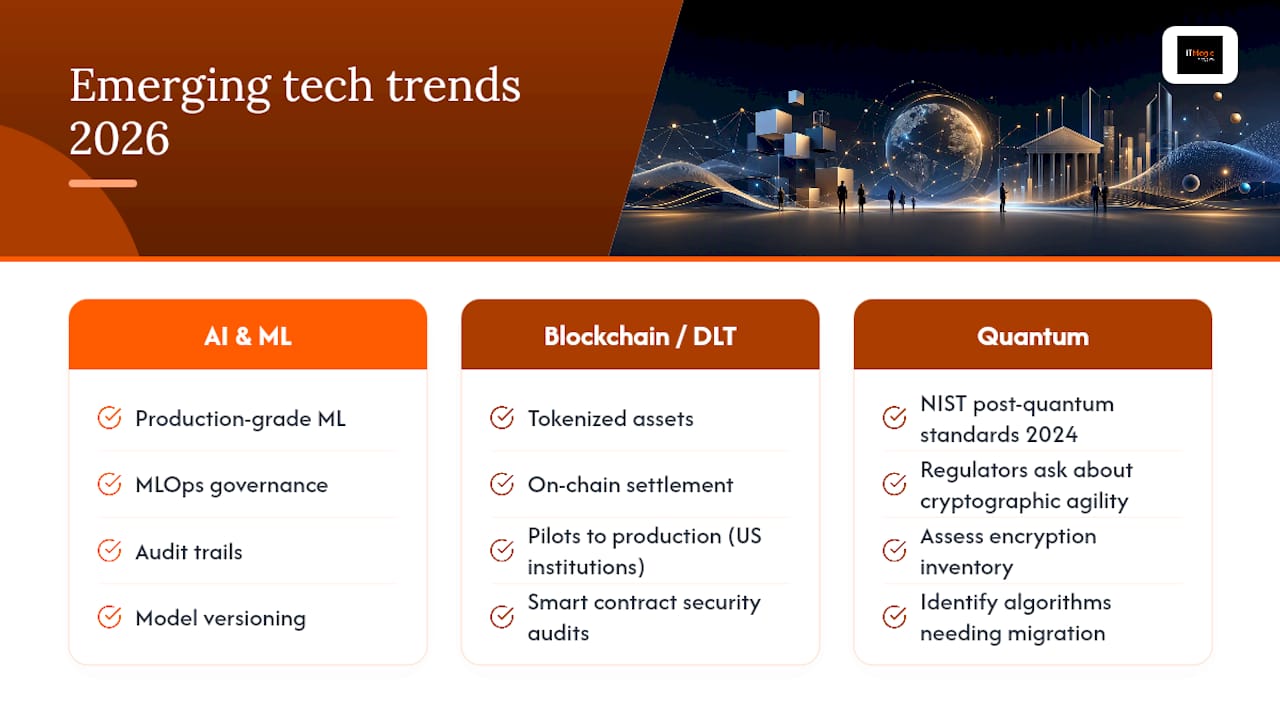
Blockchain and distributed ledger for settlement. Tokenized assets and on-chain settlement are moving from pilot to production at several large U.S. institutions. The consulting implication: smart contract security audits, key custody architecture, and integration with existing core ledgers are new service areas that require specialized expertise alongside standard cloud skills.
Quantum computing readiness. NIST finalized its post-quantum cryptography standards in 2024, and U.S. financial regulators are beginning to ask institutions about their cryptographic agility. A forward-looking consulting partner should be able to assess your current encryption inventory and identify which algorithms will need migration as quantum-capable hardware becomes commercially viable.
Why technology projects fail without change management
The architecture can be perfect and the migration can go flawlessly, and the project still fails if the people who operate the system do not understand it or trust it. This is the most consistently underestimated risk in financial services technology projects.
Effective change management in a consulting engagement has three components. First, involve operations and compliance staff in design reviews, not just at UAT. The people who will run the system daily will catch integration gaps and workflow mismatches that no architect will find from a diagram. Second, build training into the delivery timeline as a milestone, not an afterthought. Runbook handover should happen in a structured knowledge-transfer sprint, not a one-hour call at go-live. Third, measure adoption explicitly. Track how many production changes go through the new CI/CD pipeline versus manual deployments in the first 90 days after go-live. A high manual-deployment rate is an early warning that the team has not adopted the new process.
Executive sponsorship is the single biggest predictor of adoption success. When the CTO or head of engineering visibly uses the new dashboards and holds teams accountable to the new SLOs, adoption follows. When the project is handed to a mid-level manager with no authority to enforce the new process, it stalls.
How do legacy systems make integration harder, and what actually helps?
Most U.S. banks and established fintechs are running some combination of mainframe cores, on-premise databases, and point-to-point integrations built over decades. The practical problems: undocumented APIs, batch-only data exports, and no event stream to tap into for real-time processing.
The mitigation approaches that work in practice:
Anti-corruption layers. Build a translation layer between the legacy system and new microservices. This isolates the new architecture from the legacy data model and lets you evolve both sides independently.
Event sourcing from batch files. If the core only produces nightly batch files, a well-designed ingestion pipeline can convert those files into an event stream that downstream services consume in near-real-time. Not ideal, but it works while the core modernization proceeds.
Shadow mode testing. Run the new system in parallel with the legacy system, comparing outputs without routing live traffic. This is the lowest-risk way to validate that the new integration produces correct results before cutover.
Incremental domain migration. Do not try to move everything at once. Pick the domain with the lowest transaction volume and highest business value, migrate it completely, prove the pattern works, then move to the next domain. The Strangler Fig pattern, recommended by Emerline’s consulting practice, is the formalized version of this approach.
The honest reality: legacy integration always takes longer than the initial estimate. Budget contingency on integration timelines specifically, and make sure the vendor’s fixed-scope contract accounts for undocumented API behavior as a change-order trigger.
Key Takeaways
A credible financial services technology consulting partner combines AWS cloud expertise, documented PCI DSS and SOC 2 compliance, a phased delivery model, and proven core integration experience to deliver measurable outcomes for regulated U.S. institutions.
| Point | Details |
|---|---|
| Choose a phased delivery model | Discovery → Design → Build → Migrate → Operate reduces regulatory risk at every milestone. |
| Demand compliance evidence on day one | Request SOC 2 Type II, PCI DSS AOC, and penetration test results before signing any contract. |
| Embed change management early | Involve operations and compliance staff in design reviews; measure CI/CD adoption in the first 90 days post-launch. |
| Budget for legacy integration contingency | Add 30% to integration timeline estimates; undocumented API behavior is the most common schedule driver. |
| IT-Magic as your AWS partner | IT-Magic delivers PCI DSS-ready, SOC 2-aligned AWS infrastructure with 700+ fintech projects and 24/7 managed support. |
The gap between what consulting promises and what actually ships
There is a version of financial services technology consulting that sells transformation and delivers a slide deck. The tell is a proposal heavy on strategy frameworks and light on infrastructure specifics: no mention of how Terraform state will be managed, no discussion of who owns the on-call rotation at 2 AM, no answer to what happens when a compliance finding surfaces mid-sprint.
The institutions that get the most out of consulting engagements treat the vendor as an infrastructure operator, not an advisor. They ask for runbook handover as a contractual milestone. They require the vendor to participate in tabletop exercises before go-live. They measure the vendor against SLOs from month one, not month six.
The other underappreciated reality: cloud migration in a regulated environment is slower than a greenfield build, and that is correct behavior. Regulators expect evidence at each phase. A partner who promises a 60-day full migration for a complex bank is either scoping something trivially small or has not done it in a regulated environment before. Phased delivery with documented rollback criteria is not bureaucracy. It is what keeps the institution operational and the examiner satisfied.
Pro Tip: Tranche your releases by regulatory risk, not by technical complexity. Move the lowest-risk, lowest-volume workloads first, collect the compliance evidence, and use that evidence package as the template for every subsequent phase. Regulators respond well to demonstrated patterns; the second and third phases go faster because the evidence format is already accepted.
IT-Magic brings AWS expertise to regulated fintech infrastructure
Financial institutions that need cloud infrastructure built to PCI DSS and SOC 2 standards, with 24/7 operational coverage and no software-development scope creep, get a focused partner in IT-Magic. As an AWS Advanced Tier Services Partner with 700+ delivered projects since 2010, IT-Magic handles the infrastructure layer that most consulting firms treat as secondary: Kubernetes on EKS, CI/CD pipelines, network segmentation, encryption key management, and SRE on-call coverage.
An initial engagement with IT-Magic delivers three concrete outputs: a security posture review against PCI DSS and SOC 2 controls, a cloud migration roadmap with phased milestones and rollback criteria, and a 90-day MVP delivery plan scoped to your compliance requirements. These are working documents, not presentations. Visit IT-Magic’s fintech infrastructure page to start a discovery conversation, or review the AWS for Fintech executive guide to frame the engagement before the first call.
Useful sources
- Fintech Consulting & Strategy Services | BCG
- Strategic Fintech Consulting Services | D24 Fintech
- Platform | FintechOS
- Fintech Consulting Services | Bain & Company
- Fintech Consulting Services | Emerline
- Finastra | Financial Software Solutions & Systems
- Financial Services Technology, Mobile Banking, Payments | Fiserv
- Temenos Core
FAQ
What does a financial technology consultant do?
A financial technology consultant designs and implements the infrastructure, integrations, and compliance controls that allow financial institutions to ship products on modern cloud platforms while satisfying regulatory requirements such as PCI DSS, SOC 2, and FFIEC guidance.
What should you look for in a fintech consulting partner?
Look for documented regulated-client experience, current SOC 2 Type II and PCI DSS attestations, AWS or equivalent cloud certification, proven core banking integration work, and a phased delivery model with defined rollback criteria at each milestone.
How long does a cloud migration take for a regulated financial institution?
A greenfield AWS build typically takes 8 weeks; a legacy-to-cloud migration for a regulated bank with complex core integrations is more realistically a 12–24 month program, with the first 90 days focused on discovery, compliance scoping, and architecture design.
What is the difference between project-based and managed services consulting?
Project-based engagements end at go-live and suit discrete migrations or builds with a clear scope. Managed services provide ongoing 24/7 SRE coverage, compliance monitoring, and cost optimization, and typically cost less than hiring equivalent internal cloud engineering headcount.
How does IT-Magic support compliance for fintech clients?
IT-Magic delivers PCI DSS-ready and SOC 2-aligned AWS infrastructure, including network segmentation, encryption key management, immutable audit logging, and 24/7 managed support, backed by AWS Advanced Tier certification and 700+ delivered projects.
Recommended
- AWS for Fintech: The 2026 Executive Guide
- Secure AWS cloud architecture steps for fintech: A practical guide
- How Managed IT Services Transform AWS for Fintech
- AWS for Fintech | PCI DSS-Ready, Secure & Scalable Infrastructure
Alexander founded IT-Magic, an AWS Advanced Tier Services Partner delivering DevOps, cloud architecture, and managed services since 2010. He holds:
- AWS Certified Solutions Architect – Professional
- AWS Certified DevOps Engineer – Professional
- AWS Certified Security – Specialty
- AWS Certified Advanced Networking – Specialty
Talk to a certified AWS team trusted by INTERTOP, Foxtrot, Pandora, and J.Hilburn.
Get a free consultation