

Choose on-premises for fixed, highly sensitive legacy workloads where physical control is non-negotiable. Choose on-site private cloud when you need cloud-operational agility on dedicated hardware. Use hosted private cloud when you want single-tenant isolation without running a data center. Default to hybrid when workloads split across those categories, which is most enterprises.
Three reasons drive that verdict:
- Control and data residency. On-premises keeps hardware and data physically inside your facility. Private cloud, per the NIST definition of cloud computing, adds on-demand self-service and rapid elasticity to that dedicated infrastructure, but the data location depends on the deployment variant you choose.
- Operational model and time to value. On-premises demands full in-house operations: power, cooling, patching, lifecycle. Private cloud, especially hosted, shifts some of that burden to a provider and cuts provisioning time from weeks to hours.
- Predictable TCO vs. consumption pricing. On-premises is pure CapEx with high upfront cost and a predictable five-to-seven-year depreciation curve. Private cloud blends CapEx and OpEx depending on whether it is on-site or managed, while public cloud is pure consumption. Knowing which cost model your finance team can plan around often settles the debate before the technical analysis begins.
AWS hybrid cloud solutions and the NIST SP 800-145 framework are the two most widely cited authorities for grounding this decision.
Key Takeaways
The core decision rule: match the deployment model to the workload’s compliance, latency, and scalability requirements rather than applying one model across the entire estate.
| Point | Details |
|---|---|
| Check compliance requirements first | Hard data residency or audit requirements often mandate on-premises or on-site private cloud before any other factor. |
| Model TCO over three years | At medium scale, on-premises and hosted private cloud three-year totals often converge; utilization rate is the deciding variable. |
| Plan for Ukraine-specific resilience | Power grid reliability and hardware procurement lead times make hybrid or hosted private cloud more attractive than pre-2022 analysis suggested. |
| Use hybrid for mixed workload estates | Most enterprises need both fixed on-premises capacity and cloud-operational agility; a hybrid architecture serves both without forcing a compromise. |
| IT-Magic engagement model | IT-Magic runs a 4–6 week assessment, a 6–8 week pilot, then phased migration waves, covering AWS architecture, Kubernetes, and PCI DSS/HIPAA compliance. |
Table of Contents
Running this on your own AWS setup? IT-Magic is an AWS Advanced Tier Partner — we audit, fix, or fully manage it for you.
Get a free consultation- What does “on-premises” actually mean for your infrastructure?
- What is a private cloud, and which deployment variant fits you?
- Advantages and disadvantages of each model
- How do private cloud and on-premises compare across key dimensions?
- What does realistic TCO look like for each model?
- Security and compliance checklist for Ukraine
- Migration paths and hybrid architecture options
- How long does deployment actually take?
- How IT-Magic approaches private cloud and hybrid migrations
- Security threat models for on-premises and private cloud
- How does Ukraine’s geopolitical situation affect your deployment choice?
- Vendor lock-in and interoperability: what you are actually committing to
- The decision most teams get wrong
- IT-Magic helps you build the right infrastructure from the start
- Sources
- FAQ
What does “on-premises” actually mean for your infrastructure?
On-premises means the organization owns the physical hardware and it sits inside facilities the organization controls, whether that is a server room, a private data center, or a co-location cage the organization leases.

The operational consequences are significant. You carry full responsibility for every layer: power and cooling contracts, physical security, hardware procurement, firmware updates, capacity planning, and end-of-life replacement. The cost model is CapEx-dominant: you buy the servers, storage, and networking upfront and depreciate them over their useful life, typically five to seven years. Staff costs are internal, and addressing any skills gaps is the organization’s responsibility.
Common on-premises patterns include:
- A single rack or server room inside a corporate office
- A private data center owned and operated by the organization
- Co-location: the organization owns the hardware but houses it in a third-party facility
- A dedicated cage in a shared carrier-neutral facility
The line between on-premises and private cloud is not about location. Microsoft Azure’s guidance makes this precise: an on-premises data center becomes a private cloud the moment it implements virtualization, automation, and self-service provisioning. The hardware stays in the same rack. What changes is the operational model layered on top of it.
What is a private cloud, and which deployment variant fits you?
A private cloud is a single-tenant cloud environment dedicated exclusively to one organization, with the five essential characteristics NIST defines: on-demand self-service, broad network access, resource pooling, rapid elasticity, and measured service. According to the NIST SP 800-145 evaluation, private cloud resources can be owned, managed, and operated by the organization itself, a third party, or a combination, and may exist on or off premises.
That last clause is the one most teams miss. Private cloud is an operational model, not a location.
Deployment variants and what they mean in practice:
- On-site private cloud. Hardware lives in your facility. You run the cloud platform (VMware vSphere, OpenStack, or a hyperconverged stack like Nutanix). Maximum control, maximum operational burden.
- Hosted/managed private cloud. A provider runs dedicated hardware in their data center for your exclusive use. You get cloud-style provisioning without operating the physical layer.
- Co-managed private cloud. You own the hardware and the provider manages the platform layer. Common when organizations want asset ownership but lack platform expertise.
- Community cloud. Shared infrastructure among organizations with common compliance requirements, such as a group of Ukrainian banks sharing a regulated environment.
Technology choices map directly to operational tradeoffs. OpenStack gives you open-source flexibility and avoids vendor lock-in but demands deep platform expertise. VMware offers mature tooling and broad vendor support but carries significant licensing cost. Hyperconverged infrastructure (HCI) from vendors like Nutanix collapses compute, storage, and networking into a single appliance, which simplifies operations but concentrates vendor dependency.
Advantages and disadvantages of each model
On-premises
Pros:
- Maximum physical control over hardware, data, and network paths
- No dependency on a provider’s uptime or pricing changes
- Predictable cost structure once capital is deployed
- Lowest latency for workloads that communicate heavily within the data center
- No data leaves your facility without explicit action
Cons:
- High upfront CapEx: servers, storage, networking, facility buildout
- Full operational burden: patching, firmware, hardware failure response
- Scaling requires procurement lead times of weeks to months
- Stranded capacity when utilization drops
- Skills gap risk: you need specialists on staff permanently
Private cloud
Pros:
- Cloud-style provisioning speed (hours, not weeks) on dedicated infrastructure
- Easier to scale than raw on-premises, especially with hosted variants
- Shared operational responsibility with a provider reduces internal headcount needs
- Consistent SLAs and predictable performance, as Azure notes, making it well-suited for regulated industries
- Supports hybrid architectures that connect to public cloud for burst capacity
Cons:
- On-site private cloud still carries significant CapEx and operational overhead
- Hosted private cloud adds a managed services fee on top of infrastructure cost
- Platform lock-in risk if you build deeply on a proprietary stack
- Compliance evidence collection is more complex when a third party manages the platform
Workload mapping in brief: Core banking and low-latency trading typically stay on-premises or on-site private cloud. Dev/test environments and bursty web applications are natural fits for hosted private cloud or public cloud. Regulated data processing with variable load suits hosted private cloud with a public cloud burst lane.
Pro Tip: *Before committing to either model, run a 30-day utilization audit on your current infrastructure.
How do private cloud and on-premises compare across key dimensions?
| Dimension | On-Premises | Private Cloud (On-Site) | Private Cloud (Hosted) |
|---|---|---|---|
| Cost model | Pure CapEx; 5–7 yr depreciation | CapEx + platform OpEx | OpEx subscription or hybrid |
| Control and data residency | Full physical control; data never leaves your facility | Full physical control; data stays on-site | Single-tenant; data location per contract |
| Scalability | Slow; procurement-bound | Faster; software-defined | On-demand within contracted capacity |
| Ops overhead | Highest; all layers in-house | High; platform layer added | Moderate; provider handles physical and platform |
| Performance and latency | Lowest latency; no network hop | Low latency; same facility | Depends on provider location and connectivity |
| Security and compliance | You control every control | You control every control | Shared responsibility; audit access by contract |
| Deployment speed | Weeks to months | Days to weeks | Hours to days |
| Vendor lock-in | Hardware vendor only | Hardware + platform vendor | Provider + platform vendor |
| Best-fit workloads | Fixed legacy, extreme latency, air-gap | Regulated cloud-native, HPC | Variable regulated workloads, DR |
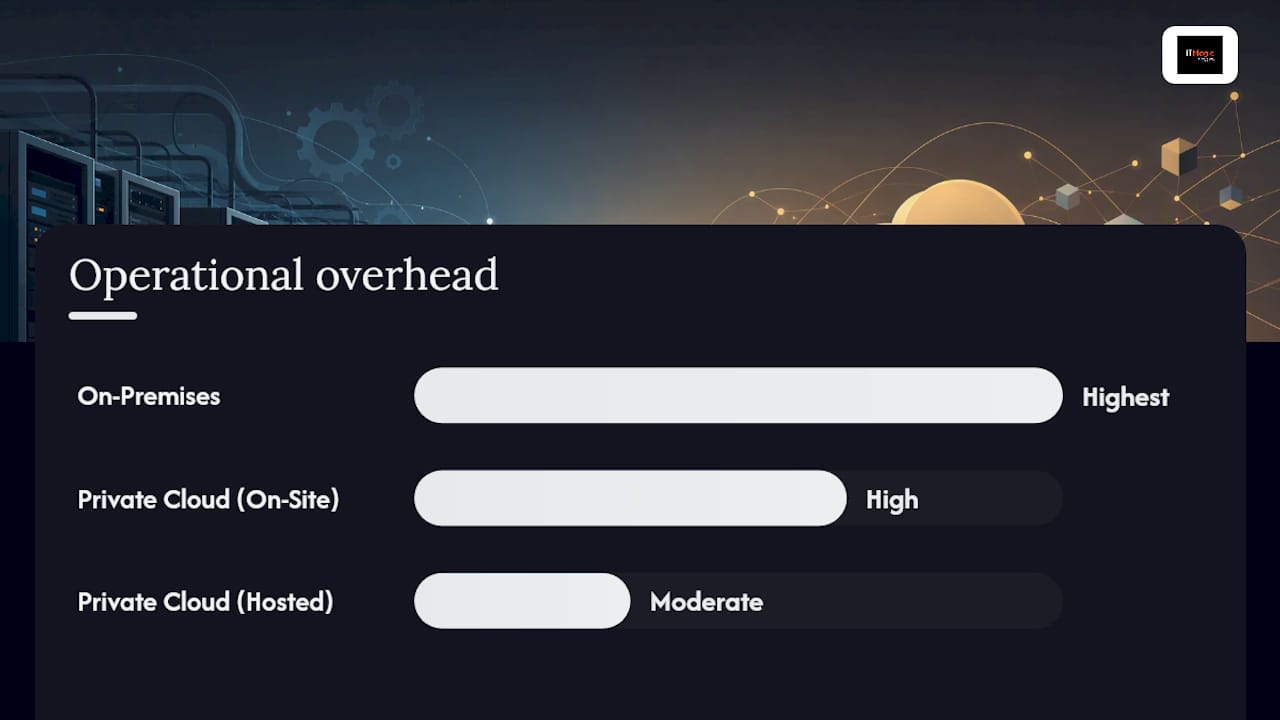
Cost model. The CapEx vs. OpEx split matters most to your CFO, but the real question is utilization. On-premises hardware bought for peak load runs at 20–30% average utilization in many organizations, which means you are paying for idle capacity constantly. Private cloud, especially hosted, lets you right-size monthly.
Control and data residency. On-premises is the only model where you can physically verify data location without relying on a contract. For Ukrainian organizations subject to data localization requirements, this distinction is not theoretical.
Scalability. On-premises scales in hardware increments. On-site private cloud scales faster through software-defined resource allocation, but you still hit a physical ceiling. Hosted private cloud can scale within the provider’s pool, though contracted capacity limits apply.
Security and compliance. Both models can be made highly secure, but the evidence collection process differs. On-premises means you own every log and every audit artifact. With hosted private cloud, NIST SP 800-145 makes clear that a third-party manager shifts some monitoring and patching responsibility to the provider, which requires explicit contractual audit-access clauses.
Pro Tip: When compliance and latency both appear as hard requirements for the same workload, on-site private cloud is almost always the answer. Trying to satisfy both with a hosted solution adds network hops and complicates evidence collection simultaneously.
What does realistic TCO look like for each model?
Cost categories differ sharply between models, and hidden costs are where most TCO estimates go wrong.
On-premises cost categories:
- Hardware: servers, storage arrays, networking switches and cabling
- Facility: power, cooling, physical security, co-location fees if applicable
- Connectivity: dedicated uplinks, redundant ISP contracts
- Staff: system administrators, network engineers, security specialists
- Licenses: OS, hypervisor, backup, monitoring software
- Lifecycle: hardware refresh every 5–7 years, spare parts, extended warranties
Private cloud (hosted) cost categories:
- Monthly managed services fee (covers hardware, facility, platform management)
- Connectivity: private link or VPN to provider
- Staff: reduced, but you still need cloud architects and security engineers
- Licenses: platform licenses often bundled, but verify per contract
- Egress fees: data transfer out of the provider environment
Illustrative TCO example (medium enterprise, 50-server equivalent, 3-year horizon):
These are illustrative ranges for planning purposes, not quoted prices. Actual costs vary by hardware vendor, provider, and local market conditions.
- On-premises: initial hardware and facility buildout UAH 8–15 million, plus annual operational costs (staff, power, maintenance) of UAH 3–5 million per year. Three-year total: approximately UAH 17–30 million.
- Hosted private cloud: no upfront hardware CapEx, monthly fee equivalent to UAH 400,000–800,000 per month depending on capacity and SLA tier. Three-year total: approximately UAH 14–29 million.
At medium scale, the three-year totals often converge, which is why the decision rarely comes down to cost alone. At smaller scale, hosted private cloud wins on TCO. At larger, stable scale with high utilization, on-premises wins.
Ukraine-specific cost factors to model:
- Electricity tariffs for commercial consumers have increased materially since 2022; power costs for a private data center are a significant and variable line item
- Hardware import and customs duties add to procurement cost and extend lead times for on-premises builds
- Connectivity costs vary significantly between Kyiv and regional locations; redundant uplinks are more expensive outside major cities
- The private cloud market is projected to grow at a strong CAGR through 2028, and many executives report that hybrid approaches are necessary to realize digital initiatives, which signals increasing provider competition, and potentially lower hosted private cloud pricing over the planning horizon
Security and compliance checklist for Ukraine
Data residency and compliance are where the private cloud vs. on-premises decision gets legally and operationally concrete for Ukrainian organizations.
Ukraine’s Law on Personal Data Protection requires that personal data of Ukrainian citizens be processed in compliance with defined rules, and cross-border transfers require specific legal grounds. While this article provides technical guidance only, not legal advice, the following checklist covers what your technical and compliance teams need to verify before choosing a deployment model.
Technical compliance checklist:
- [ ] Data location verification. Can you confirm, with physical or contractual certainty, where each data category resides? On-premises gives you physical certainty. Hosted private cloud requires a data processing agreement specifying the exact facility location.
- [ ] Encryption at rest and in transit. Verify AES-256 or equivalent at rest; TLS 1.2 minimum in transit. Confirm key management: who holds the keys, and can the provider access them?
- [ ] Access controls. Role-based access control (RBAC) with multi-factor authentication (MFA) on all administrative interfaces. Privileged access management (PAM) for infrastructure-level access.
- [ ] Audit logs. Immutable, tamper-evident logs for all administrative actions, data access events, and configuration changes. Retention period aligned to your compliance framework (PCI DSS requires 12 months minimum).
- [ ] Consent and processing records. Maintain records of processing activities (ROPA) that map data categories to systems and locations.
- [ ] Cross-border transfer controls. If any data leaves Ukraine, document the legal basis and implement technical controls (encryption, pseudonymization) appropriate to the transfer mechanism.
- [ ] Incident response. Documented and tested incident response plan with defined notification timelines.
- [ ] Vendor audit access. For hosted private cloud, the contract must explicitly grant your auditors access to relevant logs, configurations, and facility records.
When a third party manages your private cloud, NIST SP 800-145 is explicit: evidence collection responsibility shifts partially to the provider. That shift must be formalized in your service agreement before you can satisfy an external auditor.
This checklist is technical guidance only. Consult qualified legal and compliance professionals for advice specific to your organization and applicable Ukrainian law.
Migration paths and hybrid architecture options
The choice between private cloud and on-premises is rarely a single cutover. Most organizations land on a hybrid architecture that places each workload in its best environment.
Migration checklist
- Application discovery. Inventory every application: owner, dependencies, data classification, SLA requirements, and current resource consumption.
- Dependency mapping. Map inter-application communication, latency tolerances, and shared services (databases, authentication, message queues).
- Refactor vs. rehost decision. Determine per application whether you lift-and-shift (rehost), re-platform with minor changes, or refactor for cloud-native operation.
- Pilot selection. Pick one non-critical workload that represents a common pattern. Run it in the target environment for 6–8 weeks to validate ops, billing, and performance.
- Test and rollback plan. Define rollback criteria and procedures before cutover. Test the rollback, not just the migration.
- Wave planning. Group remaining workloads into migration waves by risk and dependency. Migrate in waves, validating each before proceeding.
- Cutover strategy. Plan cutover windows, communication, and go/no-go criteria for each wave.
Hybrid architecture patterns
On-site private cloud. Run a cloud platform (OpenStack, VMware) on hardware in your facility. Sensitive workloads stay local; the cloud operating model applies to everything. OpenStack is a common open-source choice for organizations that want to avoid proprietary platform lock-in while retaining full on-site control.

Hosted private cloud. Provider manages dedicated hardware in their facility. You consume it via a private network connection. Useful when you want single-tenant isolation but cannot or do not want to operate a data center.
Cloud bursting. On-premises or on-site private cloud handles baseline load. When demand spikes, overflow routes to public cloud capacity. Requires application-level awareness and a consistent identity and networking layer across environments.
Outposts-style racks. AWS hybrid services like AWS Outposts bring cloud-managed hardware into your facility, giving you AWS APIs and consistent management plane on-premises. This pattern suits organizations that want AWS operational consistency for latency-sensitive or data-residency-constrained workloads. For a deeper look at hybrid cloud architecture, the patterns and tradeoffs extend well beyond a single vendor’s implementation.
Multi-site hybrid control plane. A single management plane spans on-premises, private cloud, and public cloud. Tools like Kubernetes (EKS Anywhere, Anthos) or VMware vCenter provide this. Operationally complex but gives maximum workload portability.
AWS private cloud guidance emphasizes workload placement as the core discipline: match latency, compliance, and scalability requirements to the environment rather than picking one universal model and forcing every workload into it.
How long does deployment actually take?
Realistic timelines vary by project size and whether you are building on-premises, deploying on-site private cloud, or migrating to hosted private cloud.
Typical phases and durations
- Discovery and assessment (2–6 weeks). Application inventory, dependency mapping, compliance gap analysis, and TCO modeling. Smaller environments take two weeks; complex multi-application estates take six.
- Architecture design (2–4 weeks). Network topology, security controls, identity integration, and disaster recovery design. Can run in parallel with procurement.
- Procurement (4–12 weeks for on-premises). Hardware lead times from major vendors currently run 8–16 weeks for some configurations. Hosted private cloud skips this phase.
- Platform deployment (2–6 weeks). Rack, stack, and configure for on-premises. Provider-provisioned for hosted. Includes hypervisor, networking, storage, and baseline security controls.
- Pilot migration (6–8 weeks). One non-critical workload migrated, validated, and operated in the new environment. Validates runbooks, monitoring, and billing.
- Production migration waves (4–16 weeks per wave). Depends on workload count and complexity. Each wave includes testing and a rollback window.
- Steady-state operations and optimization (ongoing). Performance tuning, cost optimization, and compliance maintenance.
Roles required:
- CTO or enterprise architect: owns the strategy and design decisions
- Network and security engineers: design and implement the control plane and perimeter
- Procurement and legal: hardware contracts, provider agreements, data processing agreements
- Compliance officer: validates controls against applicable frameworks
- Operations team: runbooks, monitoring, and incident response
- External partner: fills skills gaps, accelerates delivery, and provides platform expertise
Parallelizing design and procurement is the single highest-leverage scheduling decision. A team that waits for hardware to arrive before starting architecture design adds 8–12 weeks to the timeline for no reason.
How IT-Magic approaches private cloud and hybrid migrations
IT-Magic has delivered 700+ infrastructure projects since 2010 as an AWS Advanced Tier Services Partner, with deep capabilities in cloud architecture, DevOps, Kubernetes (EKS, ECS), and compliance frameworks including PCI DSS, SOC2, and HIPAA.
Client capabilities:
- AWS architecture design and migration planning
- Kubernetes implementation and container orchestration (EKS, ECS)
- Infrastructure automation with Terraform and Ansible
- Security and compliance implementation (PCI DSS, SOC2, HIPAA)
- 24/7 infrastructure monitoring and support
- Cost optimization and right-sizing across hybrid environments
Engagement flow:
- Assessment (4–6 weeks). Map application dependencies, classify data, identify compliance requirements, and model TCO for each candidate deployment model.
- Design. Produce architecture blueprints, network diagrams, security control specifications, and a phased migration plan.
- Pilot (6–8 weeks). Migrate one representative non-critical workload to validate the target architecture, operations model, and cost assumptions.
- Migration waves. Execute production migration in prioritized waves with defined rollback criteria and go/no-go gates.
- Run and optimize. Ongoing managed services, cost optimization, compliance maintenance, and 24/7 support.
Pro Tip: The pilot phase is where most surprises surface: unexpected latency, missing monitoring coverage, or a compliance gap in the audit log configuration. Running it on a non-critical workload means those surprises cost you a week of remediation, not a production incident.
For cloud scalability strategies that apply across hybrid environments, the architectural principles that govern private cloud deployments are the same ones that determine whether a hybrid design holds up under real load.
Security threat models for on-premises and private cloud
The threat surface differs meaningfully between the two models, and the mitigations follow from those differences.
On-premises threat model
Physical access threats. On-premises hardware is vulnerable to insider threats, theft, and physical tampering. Mitigations: strict physical access controls (badge, biometric, CCTV), visitor logs, and locked rack enclosures.
Patch and firmware lag. Internal teams often fall behind on firmware and OS patches due to change control friction. Unpatched systems are the most common entry point for ransomware in enterprise environments. Mitigations: automated patch management, defined patch SLAs by severity, and a tested rollback process.
Network perimeter exposure. On-premises environments often have flat internal networks with excessive east-west trust. Mitigations: micro-segmentation, zero-trust network access (ZTNA), and strict firewall policy between workload tiers.
Backup and recovery gaps. Physical disasters (fire, flood, power failure) can destroy on-premises backups stored in the same facility. Mitigations: off-site or cloud-based backup with tested recovery procedures.
Private cloud threat model
Hypervisor and platform vulnerabilities. The cloud platform layer (hypervisor, orchestration API) becomes a high-value target. A compromised hypervisor can affect all tenants on that host. Mitigations: hypervisor hardening per vendor CIS benchmarks, API authentication with short-lived tokens, and regular platform patching.
Shared responsibility gaps. In hosted private cloud, the boundary between provider responsibility and customer responsibility is often misunderstood. Teams assume the provider handles security controls that are actually the customer’s responsibility. Mitigations: document the shared responsibility matrix explicitly at contract time and test it during the pilot phase.
API and management plane exposure. Cloud management APIs are internet-accessible in many hosted configurations. Mitigations: restrict management plane access to private network paths, enforce MFA on all API credentials, and audit API access logs continuously.
Data exfiltration via egress. Cloud environments make it easy to move large volumes of data quickly, which cuts both ways. Mitigations: egress monitoring, data loss prevention (DLP) controls on sensitive data categories, and network-level egress filtering.
How does Ukraine’s geopolitical situation affect your deployment choice?
Ukraine’s infrastructure environment since 2022 has introduced risk factors that most standard cloud deployment frameworks do not address. These factors materially affect the private cloud vs. on-premises decision for Ukrainian organizations.
Physical infrastructure reliability. Power grid disruptions have made on-premises deployments in Ukraine significantly more operationally complex. Running a private data center requires investment in uninterruptible power supply (UPS) systems, diesel generators, and fuel reserves. Organizations that previously relied on utility power for their on-premises infrastructure have had to retrofit these capabilities at significant cost.
Geographic distribution. Concentrating infrastructure in a single Ukrainian facility increases exposure to localized disruptions. Hybrid architectures that distribute workloads across multiple geographic locations, including hosted private cloud in a stable jurisdiction, provide resilience that a single on-premises site cannot.
Provider availability. The number of local hosted private cloud providers with carrier-grade facilities in Ukraine is smaller than in Western European markets. Organizations evaluating hosted private cloud should assess provider facility resilience, generator capacity, and connectivity redundancy explicitly, not just SLA language.
Cross-border data considerations. Some Ukrainian organizations have moved processing workloads to hosted private cloud environments in EU jurisdictions for resilience reasons, while keeping data storage on-premises in Ukraine for residency compliance. This split architecture is operationally complex but addresses both resilience and residency simultaneously.
Hardware procurement. Import logistics for server hardware have become more complex and slower since 2022. On-premises builds that depend on specific hardware configurations face longer lead times and higher procurement risk than hosted alternatives.
The practical implication: for Ukrainian organizations, the resilience argument for hybrid or hosted private cloud is stronger than it would be in a stable infrastructure environment. On-premises remains the right answer for workloads with extreme data residency or latency requirements, but it now requires a more serious investment in physical resilience than it did before 2022.
Vendor lock-in and interoperability: what you are actually committing to
Lock-in risk differs between on-premises and private cloud in ways that are not always obvious at procurement time.
On-premises lock-in. Hardware vendor lock-in is real but manageable: servers from different vendors run the same hypervisors and operating systems. The deeper lock-in risk is the hypervisor platform. Organizations that build deeply on VMware, for example, face significant migration costs if they want to move to a different platform. Proprietary storage protocols (iSCSI vs. NFS vs. FC) also create switching costs.
Private cloud platform lock-in. On-site private cloud built on OpenStack gives you open APIs and avoids proprietary platform lock-in, but OpenStack expertise is scarce and the operational complexity is high. VMware-based private cloud is operationally mature but carries licensing cost and platform dependency. Hosted private cloud adds a provider dependency on top of the platform dependency: switching providers means migrating both data and platform configuration.
Interoperability challenges. The most common interoperability problem in hybrid environments is identity: getting a consistent identity and access management (IAM) layer to span on-premises Active Directory, a private cloud platform, and a public cloud provider. Without a unified identity layer, teams end up managing multiple credential stores, which creates both operational friction and security gaps.
Portability strategies:
- Use open standards for storage (NFS, S3-compatible APIs) to avoid protocol lock-in
- Containerize workloads with Kubernetes to make them portable across environments
- Avoid proprietary managed services for core application dependencies where open alternatives exist
- Document your exit strategy at contract time, including data export formats and timelines
For organizations evaluating ecommerce cloud infrastructure, the lock-in calculus is particularly important: retail workloads that need to burst for seasonal peaks benefit from portability, since being locked into a single environment limits your ability to use the most cost-effective burst capacity at the moment you need it.
The decision most teams get wrong
Most private cloud vs. on-premises analyses I have seen get stuck on the wrong question. Teams spend weeks debating whether private cloud or on-premises is “better,” as if the answer applies to the whole organization. It does not. The right question is: which model fits this specific workload’s compliance, latency, and cost profile?
The conventional advice says to pick one model and standardize. That advice made sense when cloud was new and hybrid management tooling was immature. Today, with Kubernetes providing a consistent workload abstraction layer and tools like AWS Outposts bringing cloud APIs on-premises, the operational cost of running a hybrid estate is much lower than it was five years ago. Standardizing on a single model now often means accepting a worse fit for a significant portion of your workloads.
What I see Ukrainian organizations underestimate most is the resilience dimension. The TCO and compliance arguments are well understood. The physical infrastructure reliability argument is not. An on-premises deployment that looked like the obvious choice for a sensitive workload in 2021 now requires a serious generator, UPS, and connectivity redundancy investment to be viable. That investment changes the TCO calculation and, in many cases, tips the balance toward hosted private cloud for workloads that could tolerate it.
The practical starting point: classify your workloads into three buckets before any vendor conversation. Bucket one: workloads with hard data residency or extreme latency requirements that cannot move. Bucket two: workloads that need dedicated infrastructure but could tolerate a hosted environment. Bucket three: workloads that just need compute and storage and have no special requirements. Bucket one stays on-premises or on-site private cloud. Bucket two goes to hosted private cloud. Bucket three goes to public cloud. Most organizations find that bucket three is larger than they expected, which frees budget to do buckets one and two properly.
IT-Magic helps you build the right infrastructure from the start
Deciding between private cloud and on-premises is one thing. Executing the migration without disrupting production, satisfying a compliance audit, and keeping costs inside the model you built is another. IT-Magic has delivered 700+ infrastructure projects since 2010 as an AWS Advanced Tier Services Partner, and the engagement model is built specifically for the complexity Ukrainian technical teams face: compliance requirements, hybrid architectures, and the need for infrastructure that holds up under real operational pressure.
The assessment starts with a 4–6 week workload classification and TCO analysis that gives you a defensible recommendation for each workload class, not a generic slide deck. From there, a 6–8 week pilot validates the architecture before you commit production workloads. For organizations with compliance obligations, IT-Magic’s HIPAA-compliant AWS infrastructure and PCI DSS readiness services are built into the engagement from day one, not bolted on at audit time. Contact IT-Magic to schedule an infrastructure assessment and get a workload-placement recommendation specific to your environment.
Sources
- Evaluation of Cloud Computing Services Based on NIST 800-145 (NIST.SP.500-322)
- NIST Definition of Cloud Computing (SP 800-145)
- What are public, private, and hybrid clouds? | Microsoft Azure
FAQ
Is private cloud the same as on-premises?
No. On-premises refers to physical location and ownership: hardware inside your facility. Private cloud is an operational model, single-tenant with cloud characteristics like self-service and elasticity, that can run on-premises or in a provider’s data center.
What is the main difference between on-premises and cloud?
On-premises means you own and operate the hardware in your own facility, with full CapEx responsibility and no provider dependency. Cloud, including private cloud, adds on-demand provisioning, elasticity, and measured service on top of dedicated or shared infrastructure.
What does “private cloud” actually mean?
Per NIST SP 800-145, a private cloud is infrastructure provisioned for exclusive use by a single organization. It may be owned and operated by the organization, a third party, or a combination, and may exist on or off the organization’s premises.
Which is better for compliance: private cloud or on-premises?
On-premises gives you direct physical control over every audit artifact. Hosted private cloud can meet the same compliance standards, but requires explicit contractual audit-access clauses and a documented shared responsibility matrix. For Ukrainian organizations with strict data residency requirements, on-premises or on-site private cloud is the lower-risk starting point.
When should you choose hybrid over a single model?
When your workload estate includes both fixed, sensitive workloads with hard residency or latency requirements and variable workloads that benefit from cloud elasticity. Most enterprises with more than 20–30 distinct applications find that a hybrid architecture serves the full estate better than any single deployment model.
Recommended
- Why Choose Private Cloud: A 2026 Guide for IT Leaders
- Multi-Cloud Strategy for IT Leaders: 2026 Guide
- On-Premise to AWS Cloud Migration Step by Step | IT-Magic
- What Is Cloud Networking? A Guide for IT Pros
Alexander founded IT-Magic, an AWS Advanced Tier Services Partner delivering DevOps, cloud architecture, and managed services since 2010. He holds:
- AWS Certified Solutions Architect – Professional
- AWS Certified DevOps Engineer – Professional
- AWS Certified Security – Specialty
- AWS Certified Advanced Networking – Specialty
Talk to a certified AWS team trusted by INTERTOP, Foxtrot, Pandora, and J.Hilburn.
Get a free consultation