
TL;DR:
- Cloud governance is an internal framework of policies and controls to manage cloud resources securely and efficiently. It reduces risks by enforcing proper configurations, tracking costs, and ensuring compliance across platforms. Governance must be integrated from the start to enable automation, prevent drift, and support ongoing cloud security and operational success.
Cloud governance is the internal framework of policies, processes, and controls an organization uses to manage cloud resources securely, cost-effectively, and in compliance with regulations. Without it, teams operating on AWS, Azure, or Google Cloud face configuration drift, runaway costs, and audit failures. Cloud governance defines the rules. Cloud compliance proves those rules are being followed. Every IT leader needs to understand the difference before building a governance strategy that actually holds up under pressure.
What is cloud governance and why does it matter?
Cloud governance is the organizational rulebook for cloud use. It covers who can access what, how resources get provisioned, how costs are tracked, and which security controls apply across every environment. The cloud governance definition extends beyond a single policy document. It is a living system of technical standards, access controls, budget guardrails, and audit mechanisms that evolve as your cloud footprint grows.

The importance of cloud governance becomes clear when you look at failure patterns. 95% of cloud security failures are attributed to customer misconfiguration, not provider vulnerabilities. That number points directly at governance gaps. When teams provision resources without following defined standards, they introduce risk at scale. Governance closes that gap by making the correct configuration the default, not the exception.
Cloud governance applies across all major platforms. AWS uses tools like AWS Organizations, Service Control Policies (SCPs), and AWS Config to enforce governance rules. Azure offers Azure Policy and Microsoft Defender for Cloud. Google Cloud provides Organization Policy Service and Security Command Center. Each platform has native governance tooling, but the principles of cloud governance remain consistent regardless of provider.
What are the main components of a cloud governance framework?
Running this on your own AWS setup? IT-Magic is an AWS Advanced Tier Partner — we audit, fix, or fully manage it for you.
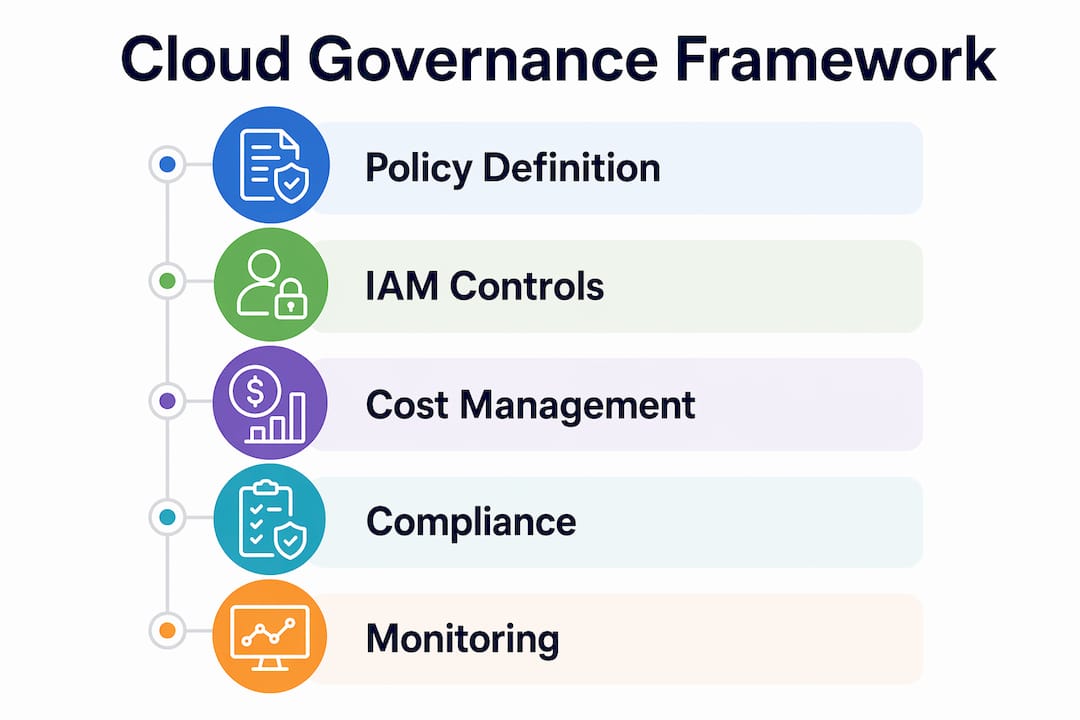
Get a free consultationA cloud governance framework structures how policies are defined, enforced, and monitored. Key components include policy definition, Identity and Access Management (IAM) governance, cost management controls, compliance rules, and continuous monitoring. Each component addresses a distinct risk area.
| Framework component | What it controls | Example tools |
|---|---|---|
| Policy definition | Technical standards and security baselines | AWS Config Rules, Azure Policy |
| IAM governance | Who accesses what and under which conditions | AWS IAM, Azure Active Directory |
| Cost management | Budget limits, tagging, and spend attribution | AWS Cost Explorer, cloud tagging policies |
| Compliance management | Regulatory adherence for PCI DSS, SOC 2, HIPAA | AWS Security Hub, Wiz |
| Continuous monitoring | Real-time detection of policy violations and drift | AWS CloudTrail, CSPM tools |
IAM governance is the highest-priority component for most organizations. Overly permissive roles are the most common source of cloud security incidents. Enforcing least-privilege access, requiring multi-factor authentication, and auditing role assignments regularly are non-negotiable starting points.
Cost management governance prevents the most common executive complaint about cloud: unpredictable bills. Mandatory resource tagging ties every dollar of spend to a team, project, or environment. Budget alerts in AWS Budgets or Azure Cost Management trigger before overruns happen, not after. Without tagging enforcement at the policy level, cost attribution becomes guesswork.
Continuous monitoring and logging close the loop. Governance policies set the rules, but drift happens. Resources change outside approved pipelines. Configuration drift, where live resources diverge from their defined state, immediately invalidates compliance posture. Tools like Cloud Security Posture Management (CSPM) platforms detect drift in real time and alert teams before a misconfiguration becomes a breach.
How does cloud governance differ from cloud compliance and cloud management?
These three concepts are related but distinct. Confusing them leads to gaps in both security and accountability.
Cloud governance is the internal rulebook. It defines what policies exist, who owns them, and how they are enforced. Cloud compliance is the proof that those policies are being followed. Compliance is a continuous state, not a quarterly checklist. Dynamic cloud resources change minute by minute, which means evidence collection and control validation must be ongoing, not periodic. Cloud management is the day-to-day operation of cloud infrastructure: patching, scaling, incident response, and performance tuning.
| Concept | Definition | Primary focus |
|---|---|---|
| Cloud governance | Policies and controls for cloud use | Setting rules and accountability |
| Cloud compliance | Proof of adherence to regulations and policies | Audits, evidence, and reporting |
| Cloud management | Daily operations and maintenance | Uptime, performance, and cost efficiency |
The shared responsibility model makes this distinction operationally critical. Cloud providers secure the underlying infrastructure. Customers are responsible for configuring services correctly. Over 90% of cloud security failures result from customer misconfiguration, which is a direct consequence of misunderstanding this boundary. Governance defines how your team fulfills its side of that responsibility. Compliance demonstrates it. Management executes it daily.
For a deeper look at what cloud compliance requires in practice, the IT-Magic guide on cloud compliance for IT teams covers the regulatory frameworks and evidence requirements in detail.
What are cloud governance best practices and common challenges?
Cloud governance best practices follow a staged approach. Trying to govern everything at once produces policies that nobody follows. Starting with high-impact, low-friction controls builds credibility and creates the foundation for broader governance maturity.
Top cloud governance best practices:
- Start with IAM, tagging, and logging. A staged governance approach establishes structure before complexity. These three areas deliver the highest return on governance investment.
- Integrate policy-as-code into CI/CD pipelines. Without CI/CD integration, governance becomes a bottleneck that engineers route around. Tools like Open Policy Agent (OPA), Checkov, and Terraform Sentinel enforce policies at the point of deployment.
- Automate exception management. Automated exception workflows reduce governance friction and prevent shadow IT. When engineers can request a policy exception through a defined process rather than working around it, compliance improves.
- Enforce resource tagging at provisioning. Untagged resources cannot be attributed to a cost center or owner. Make tagging a hard requirement in your infrastructure-as-code (IaC) templates.
- Run continuous drift detection. Scheduled compliance scans miss the window between scans. CSPM tools provide real-time visibility into configuration changes that violate policy.
- Define clear ownership for each policy domain. Governance without owners becomes shelfware. Assign a named team or role to each policy area: security, cost, compliance, and operations.
- Review and update policies on a defined cadence. Cloud services evolve rapidly. A governance policy written for 2023 may not cover new services or threat vectors in 2026.
The most common challenge is governance friction. Overly strict policies block legitimate workflows, which pushes engineers toward shadow IT. When a developer spins up an unmanaged environment to avoid a slow approval process, your security posture degrades faster than any policy can fix. The solution is not looser policies. It is smarter enforcement through automation and exception workflows.
Pro Tip: Make the secure path the easiest path. If your governance controls require more steps than bypassing them, engineers will bypass them. Design your policy-as-code so that compliant deployments are the default output of your standard IaC templates.
How do governance, automation, and orchestration work together?
Cloud orchestration, automation, and governance serve distinct but interdependent roles. Understanding how they interact prevents a common mistake: automating before governing.
Cloud orchestration sets up environments. It provisions networks, compute, storage, and services according to a defined architecture. Cloud automation executes repeatable tasks within those environments: scaling, patching, backups, and deployments. Cloud governance defines the rules and policies that both orchestration and automation must follow.
The dependency runs in one direction. Governance must come first. Without a governance strategy, orchestration and automation deploy infrastructure at scale without guardrails. A misconfigured security group replicated across 50 environments by an automation script creates 50 attack surfaces simultaneously. Governance prevents that by defining what a valid configuration looks like before automation touches it.
The practical integration looks like this:
- Governance policies define approved resource configurations and access patterns.
- IaC templates (Terraform, AWS CloudFormation) encode those policies as code.
- CI/CD pipelines run policy checks (OPA, Checkov) before any deployment reaches production.
- Orchestration tools provision environments using only approved, policy-compliant templates.
- CSPM tools monitor live environments for drift from the approved state.
This chain means governance is not a gate that slows delivery. It is the foundation that makes fast, confident delivery possible. Teams that skip governance and bolt it on later spend far more time remediating misconfigurations than teams that build governance in from the start.
Key Takeaways
Effective cloud governance requires policy definition, IAM controls, cost tagging, compliance management, and continuous monitoring working together as a single, enforced system.
| Point | Details |
|---|---|
| Governance precedes automation | Define policies before automating deployments to avoid replicating misconfigurations at scale. |
| Start with IAM, tagging, and logging | These three controls deliver the highest governance return and build the foundation for broader policies. |
| Compliance is continuous, not periodic | Cloud resources change constantly; evidence collection and drift detection must run in real time. |
| Policy-as-code prevents friction | Integrating governance into CI/CD pipelines makes compliant deployments the default, not the exception. |
| Shared responsibility requires active governance | Providers secure infrastructure; customers must govern their own configurations to avoid the most common failure mode. |
Governance is a practice, not a project
After working with cloud environments across fintech, enterprise, and startup clients, the pattern I see most often is this: organizations treat governance as a one-time setup task. They define policies, configure a few AWS Config rules, and consider the work done. Six months later, they are scrambling before an audit because drift has accumulated and nobody owns the remediation.
Governance is an operational state, not a deliverable. The organizations that get it right treat it the same way they treat monitoring: always on, always measured, always improving. They do not wait for a compliance deadline to review their IAM policies or check their tagging coverage. They build those reviews into their sprint cycles.
The tension between security and developer velocity is real, but it is not a zero-sum problem. The teams I have seen handle it best do two things consistently. First, they embed governance into the tools engineers already use, so compliance happens at the keyboard, not in a separate review process. Second, they build exception workflows that are faster than workarounds. When requesting an exception takes five minutes and bypassing policy takes ten, engineers choose the exception.
Governance maturity is incremental. Start with the controls that matter most, prove they work, and expand from there. An organization with strong IAM and tagging discipline is in a far better position than one with 200 policies that nobody enforces. Build the foundation first. The rest follows.
— Oleksandr
How IT-Magic helps you build and maintain cloud governance
Cloud governance requires more than policy documents. It requires infrastructure expertise to implement controls that hold up under real operational conditions.
IT-Magic has delivered 700+ cloud infrastructure projects since 2010, with a focus on AWS environments that meet PCI DSS, SOC 2, and HIPAA requirements. For teams running containerized workloads, IT-Magic’s Kubernetes support services provide governed, secure orchestration across EKS and ECS environments. For organizations dealing with uncontrolled cloud spend, IT-Magic’s AWS cost optimization services implement the tagging policies, budget controls, and spend attribution that governance frameworks require. Both services are built around the same principle: governance embedded in infrastructure from day one, not retrofitted after problems appear.
FAQ
What is cloud governance in simple terms?
Cloud governance is the set of policies, processes, and controls an organization uses to manage cloud resources securely and cost-effectively. It defines who can access what, how resources are provisioned, and how compliance is maintained.
What is the difference between cloud governance and cloud compliance?
Cloud governance sets the internal rules and policies for cloud use. Cloud compliance is the ongoing proof that those rules are being followed, demonstrated through audits, evidence collection, and continuous monitoring.
Why do most cloud security failures happen?
95% of cloud security failures result from customer misconfiguration, not provider vulnerabilities. Strong governance controls prevent misconfiguration by defining approved configurations and enforcing them automatically.
What should you govern first in a cloud environment?
Start with IAM controls, resource tagging, and logging. These three areas establish the foundation for cost attribution, access control, and audit readiness before expanding to more complex policy domains.
How does policy-as-code support cloud governance?
Policy-as-code integrates governance rules directly into CI/CD pipelines using tools like Open Policy Agent or Checkov. This makes compliant deployments the automatic output of standard workflows, removing the need for manual policy reviews on every release.
Recommended
- What Is Cloud Observability? A 2026 Guide for IT Teams
- What Is Cloud Provisioning? A Guide for IT Teams
- What Is Cloud Risk Management: A 2026 Guide for Leaders
- Cloud Architecture Planning Guide for IT Leaders
Alexander founded IT-Magic, an AWS Advanced Tier Services Partner delivering DevOps, cloud architecture, and managed services since 2010. He holds:
- AWS Certified Solutions Architect – Professional
- AWS Certified DevOps Engineer – Professional
- AWS Certified Security – Specialty
- AWS Certified Advanced Networking – Specialty
Talk to a certified AWS team trusted by INTERTOP, Foxtrot, Pandora, and J.Hilburn.
Get a free consultation